Problem Analysis Methods - Why, Why? and Six Serving Men.
Paul Sloane teaches two problem-analysis techniques: Why-Why, which repeatedly asks why to uncover root causes, and the Six Serving Men, which applies what, why, when, how, where, and who to map all angles. A Why-Why analysis of the Jefferson Memorial's bird-dropping problem traced it back to lighting that attracted midges, then spiders, then birds, solved by changing the lights.
Chapters
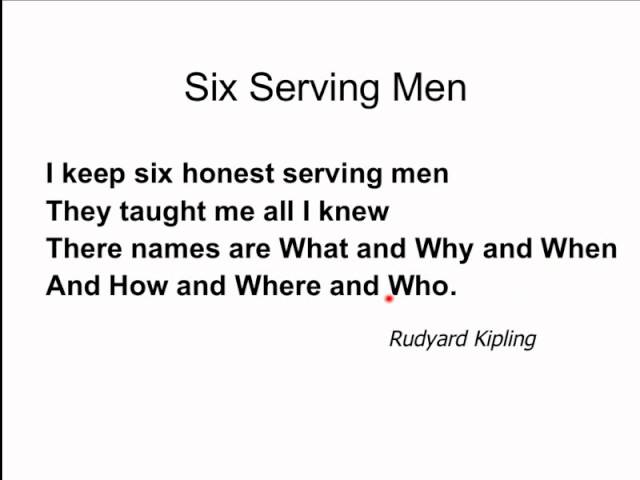
Hello, my name is Paul Sloane and I'm an expert facilitator. I lead workshops and help organizations with brainstorms and creativity sessions all around the world. And what I'd like to do with you today is show you a couple of problem analysis techniques which will help you to understand problems, unpack problems, and find a route towards a solution. And you would normally use these before you would do the idea generation, before you would do a regular brainstorm. The 2 techniques we're going to look at today are called Why Why and 6 Serving Men. And they're both powerful techniques. So why would you use them? Well, in general, the innovation cycle looks like this. You start with a problem. Typically, there's some problem you want to solve. Our sales are not high enough. We're not getting market penetration. Customer complaints are too high. It's taking too long to process orders. Whatever the issue is, there's typically a problem of some kind that you're trying to solve. And what I recommend is that you analyze the problem first and break it down into its components to thoroughly understand it before you go into the second phase, which is generating lots of ideas. And in other elements in this tutorial series, I show you powerful techniques and varied techniques to generate ideas, advanced brainstorming techniques. And I've also got some, a module which looks at how you evaluate those ideas and select the most promising ones. So you analyse the problem, you generate many ideas, you evaluate the best ideas, and then you implement. If there's no implementation, there's no innovation. So the whole thing is pointless unless you implement some of the best ideas, you try them. And then you monitor the results, you see what happens. And typically what happens is things change. And there are some beneficial results and there are some unexpected results, and that may mean a new problem, and then you analyse that problem and you generate ideas to fix it. And so it goes on forever. It doesn't just stop. So innovation is a constant process, and really innovative companies are doing this continually. So let's have a look at how we analyse a problem. We start with the Why-Why method, and if you've got young children, you'll know that Very often a young child says to you, why, Daddy? Or, why, Mummy? And you answer the question and they'll say why again. And they keep asking why. And from the parent's point of view, it can be quite tedious. What the child's really saying is, I don't understand your answer. It doesn't satisfy me. And they keep probing until they get an answer that satisfies them, that they understand. And in business, we don't do that because we think it looks rather childish and unsophisticated. But in this method you do. You keep asking why, like a child. And what you end up with is a huge mind map. You start by drawing on one side of the flip chart or the paper you're using the problem. And in this example, it was poor sales of a new product. So we had poor sales of the new product. Why did that happen? Well, initially we think it might have been poor product design. It might be inadequate promotion, ineffective distribution. The price was too high. We failed to identify the market, the proper market. So you ask why or you ask why else. So you get some of the top-level reasons and then for each of those you ask why again. Why was there poor product design? Because it was low quality. Why was it low quality? We might put over here we used the wrong materials. Why did we use the wrong materials? We had an inexperienced buyer. Why did we— and so on. You keep going down. Here we've just shown 2 levels. But you can go down as many levels as you've got time. And generally the further you go down, the more interesting insights you will reach. Some of the things become circular. You sometimes get something here that appears again somewhere else. But when that happens, you've really got to try and get underneath that issue. So here's another one, inadequate promotion. Why? Lack of advertising. Why? The budget was too small, small sales force. No buy-in from head of sales. Why didn't the head of sales buy into this idea? Well, the idea came from marketing and he hates marketing. Ah, now we're getting somewhere interesting. So as you go down, as you take the layers off the onion here, you reveal insights which will help you then solve the problem. So at this stage you're not trying to solve the problem. I can't overemphasise that too much. We don't want solutions. We don't want, well, what we should do is redesign it or change the price. That's not what you do at this stage. All you do is keep asking why. And you might do this for 20 minutes, half an hour or longer in order to really probe this situation. And then what I recommend is once you've got this down to 2 or 3 levels, a lot of detail, you prioritise which of these are the most important causes of this problem. If we were going to solve this, where would we start? Well, we'd start with the low-quality design. We'd ensure that we got buy-in from head of sales, and we'd target the right target market. So you might say those are the 3 in this order. One, redesign with higher quality, complete buy-in from sales, and attack the target market. That then gives you an approach for solving the problem. And each of those things we might then brainstorm. How could we improve the quality? How can we get buy-in from sales? How can we target the correct market for this product? So it gives us a structure then for solving the problem. So all you do is very simple. You just ask why, why, why. And I gave my course once and somebody came up to me afterwards and he said, we used a method like this when I was in sales and whenever we lost a sale, the salesman had to complete a Delilah report. And I said, a Delilah report? And he said, yes. Why, why, why, Delilah? So let's move on. That's the why, why method. It's very simple and yet very powerful. I'll show you an alternative method which I also use, and this is a very thorough method, and it's called 6 Serving Men. And it's based on a poem by Rudyard Kipling which goes like this: I keep 6 honest serving men. They taught me all I knew. Their names are what and why and when and how and where and who. And all you do in this method is you apply these 6 pronouns and you apply them in a positive sense and a negative sense about the problem, about the issue. And if you've got a team of, say, 12 people, I would divide into 6 twos. Or 4 threes and give each group 1 or 2 of these questions to look at and ask them to probe in a lot of detail. But they must use this specific approach. So when we say when, we mean time of day, day of month, month of year. When we say where, we mean physical location. When we say who, we mean real people. So I'll give you an example of how this works. The problem in this example is we've got poor customer service in our retail operations, we think. So the way we apply the 6 questions would be like this, or the 6 words. What is good customer service for us and what is poor customer service? So one group would look at that. Why do we get good service? Why do we get poor service? This is like the why, why question, but we just ask it at a top level here. When do customers get good service? When do customers get poor service? And we're looking, as I say, time of day. So they get poor service at lunchtime, or they get poor service on a Monday morning. They get really good service, you know, on bank holidays. I don't know, but you look at times then. How is good service delivered? How is poor service delivered? Are these the sorts of questions? You can choose whatever question you want. It doesn't have to be this exact format, but it must start with this word, how, and one must look at the positive and one must look at the negative. Where is good service given? Where is bad service given? And here we're looking at the physical department, the location, the whereabouts. Who gives good service? Well, our most experienced people, our most motivated people. John Jones in customer complaints, he gives— and you actually name names here. Who gives poor service? Well, the trainees, the people who aren't— managers who are stepping in. You identify as far as possible. possible, who is giving the poor service. So you go through this whole process, and for each of these questions you'll get various answers. Some of them are very obvious answers, some are very superficial. What you're looking to do is to find insights, to find deeper reasons, to find the underlying causes, to unpack the problem by using these 6 different angles of approach. And the 2 methods both have that in common. They're trying to— uncover insights which will give you a better route to solving the problem. So the benefits of using a tool like Why Why or 6 Serving Men, there are several benefits. One is it forces you to examine all the causes of the problem before you look for solutions. We tend to look straight for solutions when we're in meetings. Here's the problem, sales are down, what we should do about it is we should reduce the price, we should have a promotion. It's too early to go into the solution stage if you don't really understand the problem. And this forces you to analyse the problem. It gives you a better view of the whole problem because you keep asking the questions, you keep going down, you keep uncovering things. It helps you identify relationships. You'll see things that are linked as you go through. One thing's linked to another. And it gives you a structure for solving the problem. We'll do this item first, then we'll do this. Then we'll do that. So that's the way it works. And I would recommend that you try this next time you've got a difficult or complex problem. Don't launch straight into solutions. Don't go straight into the brainstorm. First of all, do the problem analysis. And I'll end by telling you a little story which I read on Mitch Dypkoff's blog. And it concerns the Jefferson Memorial in Washington. In America. And there was a problem there, and the problem was that the Jefferson Memorial was covered in bird droppings, and there seemed to be a great number of bird droppings all over it, and it was disfiguring the monument, and it was costly to clean. So, they did a why-why analysis on this, and they said, why have we got so many bird droppings on the Jefferson Memorial here? And somebody says, because we've got a lot of birds. Birds. Birds. Very obvious answer, but it was true. And then the question is, why does the memorial attract so many birds? And they investigated this and they found that it was because there were a lot of spiders and that the birds came because they love to eat the spiders. And they said, why are there so many spiders crawling all over this memorial? And they found the answer to that was that there were a lot of midges. The spiders ate midges, little tiny insects. And then they asked the question, why are there so many midges around this monument, and they found when they investigated that, that it was because of the lighting. The lighting in the early evening, just before sunset, was a kind of lighting that the midges found very attractive, and it attracted them from miles around. And they came, and then that brought the spiders, and that brought the birds. So they adjusted the lighting. They turned the lighting off at dusk and then only brought it on when it was— It went dark and the bird droppings were reduced. And that's an example of where the why-why leads you to a better understanding of the problem and therefore a better solution to the problem. So here are my contact details. Here's my email address if you want to drop me an email. And here is my website. So I would urge you to try one of those methods the next time you have a problem area in your department you want to discuss. Good luck with that and good luck with your brainstorming. Thank you, Paul.
More from Paul








What is different about your business? #lateralthinking #marketing #leadership

Two important questions for CEOs and Marketing Chiefs. #1 Why do people buy our products?

Questions leaders should ask to assess the level of #innovation in their business. #leadership
