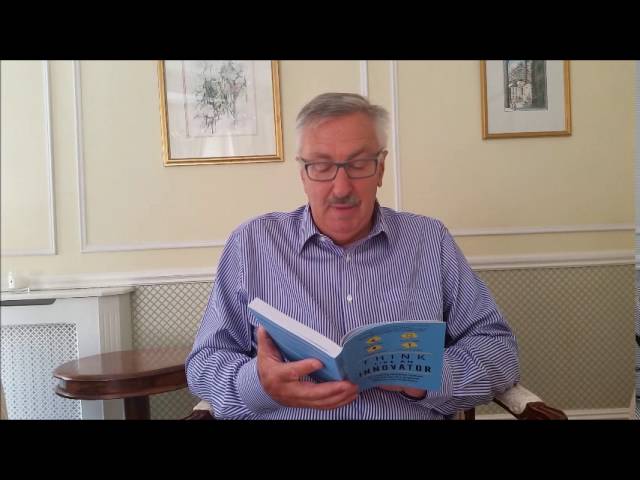
This content was created by Paul Sloane. This content was uploaded by Paul Sloane. This is a YouTube interview titled "Think Like an Innovator by Paul Sloane" (uploaded August 6, 2016). The excerpt is a short interviewer–author conversation in English where the host asks Paul about his new Pearson book Think Like an Innovator, who the book will appeal to, how the 76 innovators were chosen, and an example (Dmitri Mendeleev) illustrating a creative problem‑solving lesson. The content_type is YOUTUBE and the clip focuses on creativity, lateral thinking, and innovation for business and other fields.
Paul, you have a new book, Think Like an Innovator. Why do we need to think like an innovator?
Yes, my new book just published by Pearson is called Think Like an Innovator, and at some time or other we all need to be more creative to think of better solutions to problems in business or in any other walk of life. Whatever we're doing, there's a great premium on creativity lateral thinking and innovation today. And this book will help you to think like an innovator.
Who will this book appeal to?
It will appeal to business people, but also to people from— anyone else who wants to achieve change, progress, to be more creative. It has examples from art, from music, from sport, from warfare, from all different walks of life.
How did you choose the 76 innovators listed?
Well, they're not chosen because they are the best or the most prolific. They were chosen because of the lessons, the different lessons that we can learn from them. Some about taking risk, some about approaching problems from new directions. They're in 8 separate categories: artists, business leaders, genius, inventor, maverick, pioneer, scientist, and visionary, and each of them has a different lesson to tell.
Okay, can you give an example of how we might use one of these lessons?
Well, there are many, but just to take one example, Dmitri Mendeleev was a Russian born in 1834, one of 15 children. His parents were poverty-stricken. He studied chemistry, became very interested in chemistry and the chemical elements, but he was also fascinated by cards and card games. And he wrote each of the elements out on a card, and he laid them out on a table as though he was playing solitaire. And from that, he was able to construct the periodic table of the elements, because he saw that he could arrange the elements as though they were suits of cards with similar properties by atomic weight. And by doing that, he was able to forecast where new elements would be found, because there were gaps in the table. And the lesson for us is that if we can represent a problem as a flowchart, as a diagram, as pictures, Sometimes we get a better insight, a new approach, which helps us to come up with a more creative solution.