Copy.ai Founder Reveals His SECRETS to AI Startup Success | Founder Chat w/ Paul Yacoubian

Paul Yacoubian, co-founder of Copy.ai, built a copywriting tool on GPT-3 that reached 5 million users and $12 million in annual revenue. He validated the idea by launching multiple MVPs fast, then shifted from heavy ML engineering to low-code after GPT-3 arrived. His advice: build simple products quickly and iterate.
Chapters
This is the wave. It starts right now.
Where are the biggest opportunities right now for entrepreneurs?
If you're not building something today, just like go build something real simple. Build and launch in any— in the time frame needs to be under a week. The last time we saw this was the phone.
Hello everyone and welcome back to the channel. My name is Liam Motley, your number one source for AI entrepreneurship content. Today we're joined by a very special guest, Paul Jacobian, founder of Copy AI, one of the leading AI writing platforms in the market today. So welcome on, Paul. Thank you so much for coming on. I really appreciate your time today.
Thanks. It's great to be here.
First off, thank you for coming on. I know you have some great insights to share with the community, and we'd love to hear more about Copy AI and why it's so great. So to start off, can you tell us a little bit about your background and what led you to AI entrepreneurship as you are today?
Sure. Yeah. So my background's a little bit varied all over the place. I started out as a CPA doing accounting out of college, went into the finance industry at a hedge fund, and then learned about the finance stuff, the bookkeeping stuff. But that was really all kind of boring and wasn't quite as exciting as real entrepreneurship, really operating companies. And so I ended up moving into the startup world, helping a a family member grow one of her companies that she had started and left that for venture capital in 2016. And that's where I met my current co-founder. We were helping employees exercise their stock options at venture-backed startups, and we were really interested in the next big waves. We were trying to figure out, all right, well, what is the next thing? What is the nature of these technological changes that really spurs rapid expansion and technological progress. And we, you know, we'd seen a lot of AI companies. Unfortunately, it seemed like a lot of the technologies are pretty niche for very specific verticals. And so it wasn't like a broad-based technology that could be applied to all kinds of use cases really easily. And then in late 2019, we got to test out GPT-2, which was really the first— that was really the first generative kind of tech that I had used personally. And what was really fascinating stood out, Liam, is you would type something in there and let it autocomplete, and then it would come up— like, you could get it to come up with crazy stuff, like crazy new stuff. And then you'd Google it and you wouldn't find any search results for the thing that it created. And that was really the aha moment for me. I was like, man, if you could create anything, then the ROI from this technology is unlimited, because that means that there is no capped amount of value it could create. If you let it loose, it can go create really anything, like things you can't even imagine. And so this idea that creativity would be the first real use case of it to us was pretty clear. The whole point of it is to get it to do things that are interesting and creative and original. And even now, This is still something that we want out of these generative models. We thought it'd be about 7 years before it could be commercially viable in an enterprise context. But fast forward 6 months and they launched GPT-3 in the summer of 2020. And then immediately, because the model was about 100 times the size and they trained it with more data, it did actually hit that tipping point. And so it went from 1 in 10 kind of results being good to around 9 out of 10. And then if you created multiple examples via prompting, you could actually get it to do a task repeatedly pretty well. And so at that moment in time, co-founder and I, we just kind of said, all right, we got— this is it. Like, this is, this is the wave. It starts right now. And so we started launching MVP little side projects. We got instant access, like we got access as fast as we could to the GPT-3 API and then launched about 5 MVPs in 2 and a half months. And then each time we launched, we learned something new. We figured out a better way to replicate what we were doing on the backend from an engineering standpoint.
So this was already going into the CopyAI side of things, or you were just playing around with anything you could get your hands on and seeing what you could do with GPT-3?
Yeah, so it's just like fun projects. You don't know where, you don't know what's going to take off. So it wasn't like we quit our jobs to do a startup. It wasn't like that. But we got to do like 5 different things. We built a summarization tool that got mentioned in the Wall Street Journal. I was like, all right, that's cool. People use it. Like, let's go do something else. Let's keep going. And then we ended up building a site called taglines.ai, which was just a tagline generator. That's all it did. And so you just type in your product name or product description and it would just generate the tagline. That thing took off. We had over 2,000 people try that out and use that in like the first week or so. And we started to see people use it for all these different marketing and sales use cases, for email copy, website copy. And so it really validated that there were a lot of use cases that could use some tooling like that. And then we also found out, you know, we were thinking, oh, this is like a— it's just for marketers. And as it turns out, You had all kinds of users using the tools and finding value in them. And so that really validated. And we also set up like a little Stripe paywall. Highly recommend figuring out if anybody will pay you for the thing you built quickly. And so, yeah, so within the first week we validated one, people would know how to, how to use the interface. Two, that the use cases were varied. Like they're kind of related, but there were a lot of use cases people were using the these tools for. Uh, 3, that all kinds of users would use it, not just like the hyper-focused like copywriters. So we went back to the drawing board and said, okay, we have literally one tool, that's all this thing does, let's go build like a suite of them. We rebranded it as Copy.ai and we launched that, and that, that took off, uh, relatively quickly.
And so with, with the like tagline generator, in terms of the— a lot of these, the startups right now are front-running what the users are putting in with a sort of pre-prompt to GPT-3, correct? So a lot of the stuff on Copy.ai is like setting up a preset, uh, angle that you've gone down with GPT-3, and then users put the input on top of that, right? So is that how you do that?
That's how you get it started. Yeah, you bootstrap your dataset with prompts, but then over time you end up taking the data feedback from users and fine-tuning tools for that use case.
Yeah, that was one of my big questions for you because as I see it, there's the sort of direct usage of GPT-3 and the API, which is let's just use it for prompt and completion calls. And then we're going to be a little bit cheeky about it and we'll do a sort of pre-prompt to GPT-3 to get it to understand a certain scenario. And then we're going to let users build on top of that preset scenario. So, and then I guess there's the fine-tuning side of things, which from my own experimenting with seems quite difficult to understand at what point it eventually becomes a flexible understanding of something. So could you talk a little bit about your experience with fine-tuning and your results, and I guess experience with getting the training data fit into GPT-3?
It works, all right. You can get it to work. You need a lot of data. That tends to be a pretty safe assumption across every kind of generative AI use case. Um, so the more data you get, the more you can train it to kind of produce the results that, that your users find valuable. Um, yeah, there are all kinds of like techniques and things, but it's— that's a pretty standard process right now.
Okay. Um, and I guess for the users who aren't 100% familiar with CopyAI, I've played around with it. I love a lot of the tools, particularly the sort of startup-focused ones. They help you with ideation and, and YouTube video stuff, which is all great tools that I've been enjoying. If you could just give a quick run-through of sort of the, the core, in your mind, the core features that you provide and an example of the target users that you typically have using your platform.
Sure. So anyone writing sales or marketing copy. So if you're writing emails, you're like sales emails, if you're writing emails to your users, if you're needing to create like website content, you can describe kind of what, what kinds of content you're looking to get. You describe your product or your, or your company. And then it'll give you ideas instantly. So it's like you type that in, it'll generate, you know, multiple sets of results for you to review and find something that, that works for, for your particular copywriting use case. So we started out, you know, with these preset tools and over time, you know, we said, okay, there are infinite use cases, right, which you can't fit into tools. So what is the path forward in a world where you can do anything with this? I think you've seen this with ChatGPT work out pretty well where it's really open-ended and really flexible. So I do think that, that the chat kind of interface where you can have that feedback, user feedback experience is going to be a really interesting interface paradigm as well. And so that's something that we're going to be implementing and building into the core of our product as Well, for sure. Yeah.
Um, with, uh, GPT-4 coming, how much are you— how is that affecting your strategy going forward? And
you gotta assume it's gonna be awesome, right? I mean, um, it'll be much more powerful. And so it— these models are going to end up eating both interfaces, they're going to eat APIs, they're going to connect to the internet, they're going to eat, eat up Like, you know, uh, indexed content. I mean, it's, it's for real. It's not just like, oh, you know, let's carve this little niche out here. It's not like that at all. It's, it's a, um, it's a very large ship sailing increase— increasingly fast, right? And you really want to get on board that ship. You want to look out as far into the distance as you can. And even Even now, people online are like, oh, you know, AGI is so far away. I'm like, no, no, it's 2023.
Give it a couple months.
That's what I said. I'm like, 2023, all this stuff's accelerating. We already know Google has, uh, better models than what's publicly available now. And, you know, Larry and Sergey just came back. They came back to Google to do this. So
coming back,
you're telling me that we're not going to see massive exponential progress in an arms race, and now in a competitive environment at the base layer. It's— that's crazy. That's crazy.
Enough for those guys out of like essential retirement and be like, I'm back in the game, I'm ready to, ready to make another shift. Um, I fully agree with you on that. This is, um, sort of a new era of, of tech, and it's a different, different breed. And like you said earlier, that it's when you noticed that it was a— it's going to affect a lot of areas. And I think for me, I remember growing up sort of the past 8 years as a high school kid and stuff, I was looking around like, yeah, we've got smartphones, we've got this and we've got that. But like, I knew that these things weren't going to be as— I was like, we've had this big smartphone wave, what's this next big thing? And in my head, I couldn't figure out what this thing was. And as soon as I had my first go with ChatGPT, I was like, this is—
yeah,
this is the big one.
How old are you?
I'm only 22.
22. All right, I'm 35. When you don't— you don't maybe remember when, like, phones first came out or the internet came out. I mean, dude, imagine the internet coming out, you know? Like, that—
Was it one of those moments for you?
The internet? Yeah, the internet was for sure. The internet was. And then Napster, when you could get any song, you download any song on the planet for free.
And I was using LimeWire. That was LimeWire. LimeWire era.
I mean, you downloaded— I downloaded every song. Every song. It's on, like, an external hard drive. So those are paradigm shifts and your mind is exploding. And then relatively quickly, people just adapt to it and you're like, oh, yeah, we have Spotify. And it's like they just don't compute together.
You have access to every song.
Yeah, sure.
Of course we do. Right. But
it makes sense that we would. And that's how technology works. And technology is a force for making things cheaper. That's how you know you have technology. If things get more expensive, you don't have technology. When we talk about AI products being free or whatnot, yeah, of course they'll be free. You look at Google is free and it's incredibly valuable, right? They don't try to charge you for that. Somebody has to figure out the business model.
Mm-hmm. Say if ChatGPT is going to sort of play a role like a revolution of search, how would these, uh, ChatGPT tools like that be, um, monetized? And the current strategy that they've just put out, it's this new thing that you see with these AI tools like Midjourney and stuff that you're paying for premium access to servers and first, first results and stuff. But if it was—
Yeah, it's hard to imagine that that's
gonna be— If Google made their search platform paid and charged per search initially, right, it'd kill the business overnight. So it's been interesting seeing how they're gonna get to that paid situation. I think what they have is not a bad, not a bad medium where you can pay if you're using it for commercial purposes or using it as a, as a serious, uh, works person. Then you can get these faster access to the results. I don't
know. I mean, these models are going to be embedded into your iPhone, like on, on the hardware. So hard to imagine those business models last, being very durable. Right.
With my business partner, we're talking a lot about where's the— like you said, it's going to replace the APIs and like personal assistants and stuff, and it's basically just going to connect to everything. We were thinking it needs to be ChatGPT, but you can ask it things, or you make a personal assistant and then you, uh, develop a program that will allow it to interact with Google Sheets or your calendar or this and this and this. That's very basic stuff, and like you said, I think that's going to become Mainstreaming.
Yeah, I mean, we have some of that, some of that already exists, and you can get those different connectors set up. Google Sheets is going to get a massive improvement, like just the way that data gets organized is going to be incredibly— it's going to be an incredibly powerful product once they embed that in, probably this year.
Um, just for the, the viewers who aren't familiar with the history of CopyAI, could you give us a A quick rundown of funding, employees, your users, and all of that good stuff that I'm sure you're very proud of.
Yeah, I think we've, you know, we've done well. We've gone the venture-backed route. It was a decision that we had to figure out. Like, my partner and I, we had got it up to like $50,000 a month in recurring revenue before we hired our first employee. And then we ended up raising a total of $14 million for like seed round and Series A. And then we've grown the team to like 34 people and past $12 million now in revenue run rate.
Awesome.
And from a user standpoint, we really, we very much believe in free products, freemium. So we've had, I think we just passed 5 million users sign up for this product this past week. So we're trying to really build very long-term distribution around the product and the platform. And we want to, you know, we want to make, you know, make something that people want. That's really critical to who we are as a company. I think you're going to really like when you're at It's not like 35 people is not a huge company, right? Google has, I think, 120,000 or something people. It's a lot of people and they have a lot of funding. So if you're going to be nimble as a startup and lean, you have to really play into your strengths. And so when you're a lean team, that means that we can be scrappy, we can build things quickly, we can pivot engineering teams to you know, building what, what, you know, anything that gets released that's a game changer, you want to integrate that really fast. And all of that really accelerates your growth engine as well because users continue to find increasing amounts of value in the platform. What's going to be interesting is, and still I think a little bit early to see where the how to translate distribution and growth and usage into like really powerful business models that win. And again, I don't— I'm not sure that charging for ChatGPT, you know, $40-whatever a month is going to really be that competitive if, if Google just integrates that into— they just integrate it into the search engine and then they're in every interface.
They're not going to need to be charging for it either. Yeah,
no. And they happen to own Chrome, YouTube, Gmail, G Suite, pretty big search, Android. I mean, they have sewn up so much distribution. And then if it does end up at the hardware layer and the OS layer, they own that. They own a lot of that too. And Apple's already, you know, thrown themselves in the mix as Well, so I think you're looking at hyper— you're gonna look at a hyper-competitive environment. All eyes are on AI for big tech, and so I am anticipating, you know, very, very fast improvement here.
And what's your experience been like with VCs? I've, I've spoken to my business partner about getting funding for different ideas, and he's always been very, uh, sort of against going that route because he feels like as soon as we take the money, then there's going to be people over our shoulder. So what's your experience been like, and, uh, what's your relationship like with your, your VCs?
Our relationship's great because— but we also were very fortunate to have the best VCs invest in our company. Um, venture cap— there's nothing magical about venture capital. It's just an investor, right? Somebody investing money. Um, as that industry has grown, it's harder to bring in founders to become investors. And so if you haven't started things, you know, companies before, or been very, very early, and you really see the process of company formation and making, it's very hard, um, outside of a very, like, your core expertise area to provide advice. So the things that you tend to get are like introductions, which are really helpful. The capital itself Obviously very helpful. Um, you know, you hear horror stories though. Some people have really bad, bad experiences, and then the more investors you invite into your company, the higher the odds that you're going to hit one of those really bad investors. So I always recommend doing back, you know, reference checks with founders that have worked with that investor over a long period of time. So yeah, I'd say do your diligence. Don't think like, oh, I'm tricking this person into investing, you know, that you're just— it's not going to work. It's really not going to work and you're going to end up in a bad position. So play it like a long-term game and do not lie ever in fundraising process.
Yeah.
Life is too short for that shit. Then people will figure you out.
We'll find out.
Yeah.
Yeah. A lot of it's reputation-based. So
it's all reputation-based because you have— that's how the startup world works. There's an insane amount of trust that you give to someone else without doing reference checks. Like, that's how things are so efficient and move so quickly. You don't need to, like, get a warm intro. Like, you— I think you just cold messaged me and like, Sure, I'll do a podcast. So that's how the world should work. We should all trust each other. And you hear these horror stories, you hear about these startups blowing up and just total outright fraud. I do not want people to think that that's how it is done or should be done and that you should expect that or you should behave that way. Um, so if you're— if you're, um, this is your business partner, your business— like, if you're— if you think that venture capitalists are going to ruin your company, you should not raise money because, because you will not give them the benefit of the doubt. You won't trust them, and that's really critical that you do that.
Awesome. Um, what do you look for in core team members and co-founders? I think this is a very big topic and important for, for people who are watching to, to get some advice from you and your experience of how did you know that the person that you co-founded CopyAI with was someone you could trust long term and that they had the qualities that you were ready to move forward with and trust in a business relationship? Because business is one thing, uh, friendships are another, and they're often a bit of a gray mix when, when they come together.
Uh, yeah, I mean, I'm just Insanely lucky. My, my co— it was my colleague, and then he and I became friends instantly when we met and started working together. So we'd already worked together for 4 years, and, uh, I trust, you know, trust him with my life. He's, he's incredible, and he's, you know, extremely talented, um, engineer and an insanely, like, highly futuristic thinker. So it's just— Beautiful match. I would not recommend— I know people ask like, oh, I need a co-founder for my company. I would not recommend bringing on a co-founder you don't know or you met in the past 2 months. The trust— don't—
you got to trust them 100%.
Very, very deeply. Very, very deep trust. And so again, would not recommend.
And in hiring your sort of key positions, what have you found as a co-founder? What was your process of learning how to hire well? And I'm sure you've run into that a lot. What are your things that you could recommend to people who are in the position of having to hire some really crucial staff? What are the things that you look for, or what are the red flags that would turn you off someone who was looking to join your company?
Yeah, for like, we're a software company, so, you know, finding great engineers is, is like a key thing. And, um, one of our friends was a like contract CTO, so he had been CTO. He helped do the initial interview screens, really helped guide us through that process, um, and then helped us find a really great head of engineering. And that, that's been amazing. Like our engineering staff is top, top, top tier. And then across the rest of the organization, it is a little bit harder. Like it's somewhat narrow to define, you know, kind of the engineering skills you're looking for. And it's pretty easy to do the— to get a sense of culture. On the other side, like, you know, product design, marketing, We're looking for people that, because we want to maintain a lean focus, they, they have had experience doing like lots of different types of things and have a really good sense of where to focus time and how to prioritize what's important. So that's worked, that's worked well for us. Uncovering that would just go really, you know, go as deep as you can into the resume, the projects they've worked on, understand how their brain works.
References.
References and all that. So those are really key. I can't, I can't stress references enough. Um, and then we've also been fortunate because we, we have like so, so much of our companies out in the public, you know, online, that we have a lot of applications when we post jobs, job openings. And so it's a, it's a very big pipeline, and that actually to find people that fit what you're looking for and match, like, culturally. Like, for us, optimism's huge, right? We're a remote company. That means every time I get on a Zoom call with someone else, we have to feed each other energy, right? And so that's really, really critical in this remote world. So do you know, does the team have that chemistry? Because that's how you open up communication. Yeah.
Online chemistry must be even, even harder to find. It's not easy.
That's a tough job.
I didn't realize you were fully remote. That's—
it's tough. Yeah, my co-founder is not even in the same city as I am, but we had worked remotely before, so we were working remotely.
Yeah. Um, in terms of, uh, as a startup founder, if you're looking to step into the, the AI space and, and start a business, how important do you think technical ability is in a startup founder? And is it 100% necessary? Do you need sort of a rough understanding? Because I know there's a lot of people looking to get into it and seeing that, yes, this is the future, I wanna try and build something here and build some value, but they're so clueless when it comes to anything ML or machine learning or anything, you know, that they're just so blind on that side of things that maybe marketers coming in and they just, they can't even grasp a lot of the stuff. So what are your thoughts on technical ability for startup founders?
Well, you've got kind of 2 periods. One is before transformer models like GPT-3, and then the second period's after that. So before, yeah, you needed like someone with data science skills, machine learning skills, because you had to go find models, build the right models, test them in production. Like that's a whole, at least a person that's just doing that. After GPT-3, it's literally low code. So it's like you just describe what you need in this and you can implement into an application. So the technical requirement for building a company that uses AI to do something is much lower now than it used to be. So I would encourage people, you do need to know what's possible. very important to understand technologically what is possible. The hardest part is understanding it at a deep enough level to engineer your architecture in a way that makes it really flexible and modular. So that, that would be the thing that you'd want. And then if you're a founder and you're not technical, you need to be really good at business and really understanding the business use cases and applications. Awesome.
But in terms of, say, building on top of GPT-3, would you say directly building on top of it and just allowing people a nicer way to interact with it for some certain use case, that's the sort of model people should be looking at? Or are there other areas that are also just exciting that people may not be aware of?
Well, these models are going to do work. They're actually going to do work. They're not just going to— it's a total transformation of software. Software used to be just, here are the rails. Like, we set this up so that you can do this task pretty easily. You just go through a workflow or these steps. These models are gonna do all that work. So we're, we are in a total transformation. Everything has to get rebuilt and redone, and it's gonna be in the next kind of 2-year timeframe when that needs to happen. So if you're looking out and you're like, I don't know what to build. You are not like— you need to get in deep in, in some kind of use case and get and start just building stuff and understanding how the, the technology works. So I would, I would not recommend like, hey, we're gonna start a business. I'd much recommend, you know, recommend, yeah, build some side projects and launch them and see what happens.
Awesome. So would you say find someone who's— if you're not necessarily technically capable, find someone who is and And then sort of just get deep and start bouncing ideas off each other would be a good place to start.
Yeah, and it probably wouldn't be a bad idea for you, even if you're not technical, to figure it out. It's not a 2-year thing to build something anymore. And if you don't know what the stack is, you need to go figure that out first.
I'm about to post just a basic fine-tuning guide for people to just get ChatGPT to help them make a fine-tuning script and then just put it through, get a bunch of example data off Kaggle that I grabbed and put it through and did a fine-tuning process. So I'm trying to educate people on the channel a little bit as well who may be blind. Um, just be able to— I say in the video just that you need to know that at least the starting bit of information, how people are doing this, and then you're going to be light years ahead of people who are, um, completely blind and don't know how a lot of this stuff works.
Yeah. Company— any company is going to need people that understand how it works, even at a base level. There, you're going to be really, really valuable.
Can you discuss any exciting developments or plans for the future for CopyAI?
I expect that the— like, we're approaching a singularity from a technology standpoint, and a singularity means that you suck in everything, right? Everything collapses. into one really tight mass of value. The last time we saw this was the phone, the iPhone, right? Before the iPhone, you had a digital camera. You remember those? Did they have those when you were a kid?
Yes.
Do you remember the old camcorders? Right. And do you remember what flashlights look like? Do you remember flashlights? Do you remember what watches look like? They tell you the time.
Yeah. So what happened? I want Apple Watch too.
So the hardware ate everything up, just ate all of it up, like the old telly, you know, like all of it is— literally everything is now on a phone. Same thing's gonna happen in software where everything gets eaten by the model, all the interfaces, the front end, the works. The problem's gonna be when you— if you're a big tech company And you have a certain business model that's dependent on certain types of activities happening. If there's a disruption in the way that activities happen, which is what we think, then the value shifts. Like, the value that you can capture and monetize shifts elsewhere, and then you gotta, you got a whole new problem on your hands.
Okay, well, uh, one last question. Um, what is your life outside work like? What are your hobbies? How do you stay sane as a founder with a lot of pressure on your shoulders?
I've got 2 kids. 2
kids? They keep you pretty busy.
They're great. Yeah, I'm huge on family. Married, happy.
Awesome. That's a great role model for some of the younger viewers.
Grilling. I don't know why, but every algorithm on my phone is just now showing me videos of somebody cooking a steak. Everything is just constant steak cooking on my phone. Like, what are they doing this? Like, can I turn this off? And it's like, no, you have to watch it.
They're listening to you, of course.
Yeah.
And I suppose one last thing, any general advice for, for an aspiring entrepreneur like yourself?
Oh yeah, you gotta be optimistic, one, because no pessimists don't do shit. Nothing. They don't do anything. Nobody cares, and they just depress everybody. So I don't want to hear it. Nobody wants to hear it. 2, if you're not building something today, just like go build something real simple and just build and launch. And any— and the time frame needs to be under a week. So anything you're doing needs to be under a week. And if you can't commit to doing something for a week, shrink the time frame to like 2 days. And if you can't do that, then just like set a timer. for like an hour, build something and launch it.
Awesome. Well, Paul, thank you so much for your time. I appreciate it immensely, and I'm sure the viewers do too. Um, everyone watching, be sure to go check out CopyAI if you haven't already. Uh, excellent tool. Um, say the best writing platform you could possibly find at the moment.
Oh my God, it's gonna get so much better.
It's gonna get so much better. Um, and of course, head over to Twitter and follow, uh, follow Paul. I'm going to drop his, uh, Twitter down below so you can go show some love there and also keep up to date with what he's doing and what CopyAI is doing as well. So
thanks.
Thank you so much, Paul. Have an awesome day. I don't want to keep you around for too much longer, but I appreciate your time and all the best.
Thanks.
More from Paul
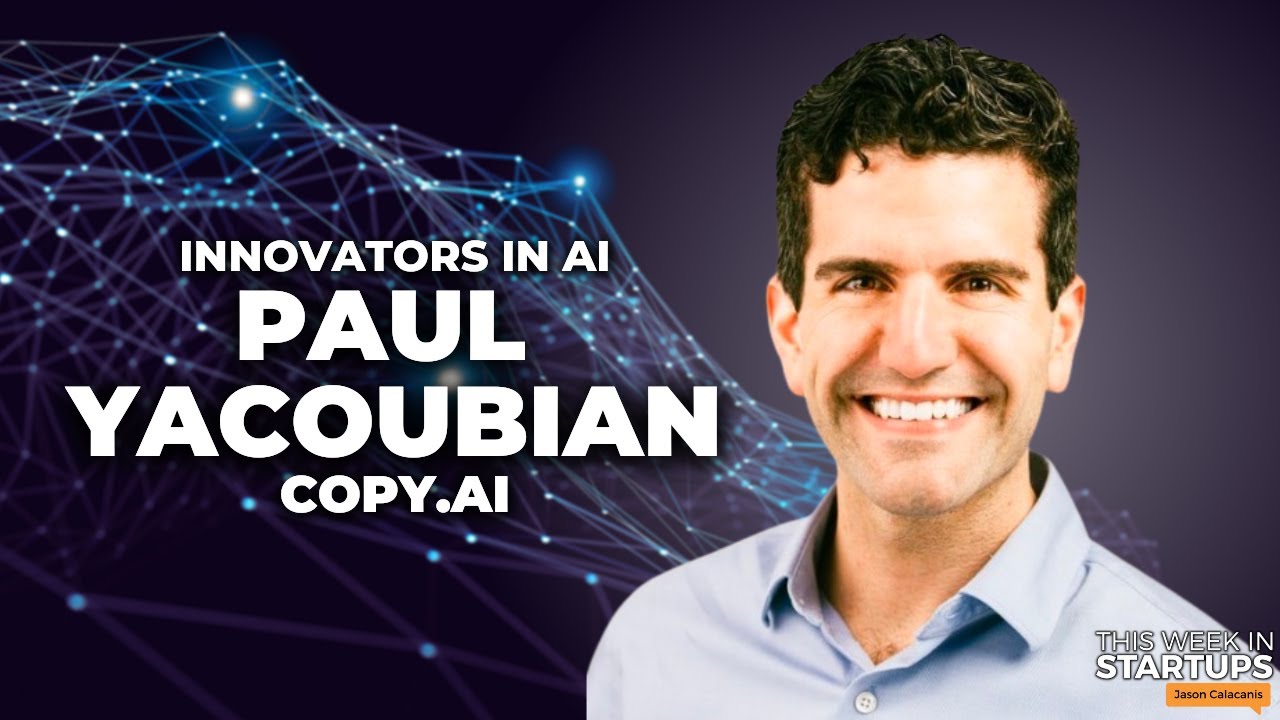
Copy.ai CEO Paul Yacoubian on keeping up with GPT’s rapid evolution & AI’s potential impact | E1719

AI and the next gen of businesses w/ Paul Yacoubian & Chris Lu @ Copy.ai - - Out of the Woods Ep 10