
🎙️ From Broke Single Dad to Multi-Million Dollar Referral Empire | Brandon Barnum
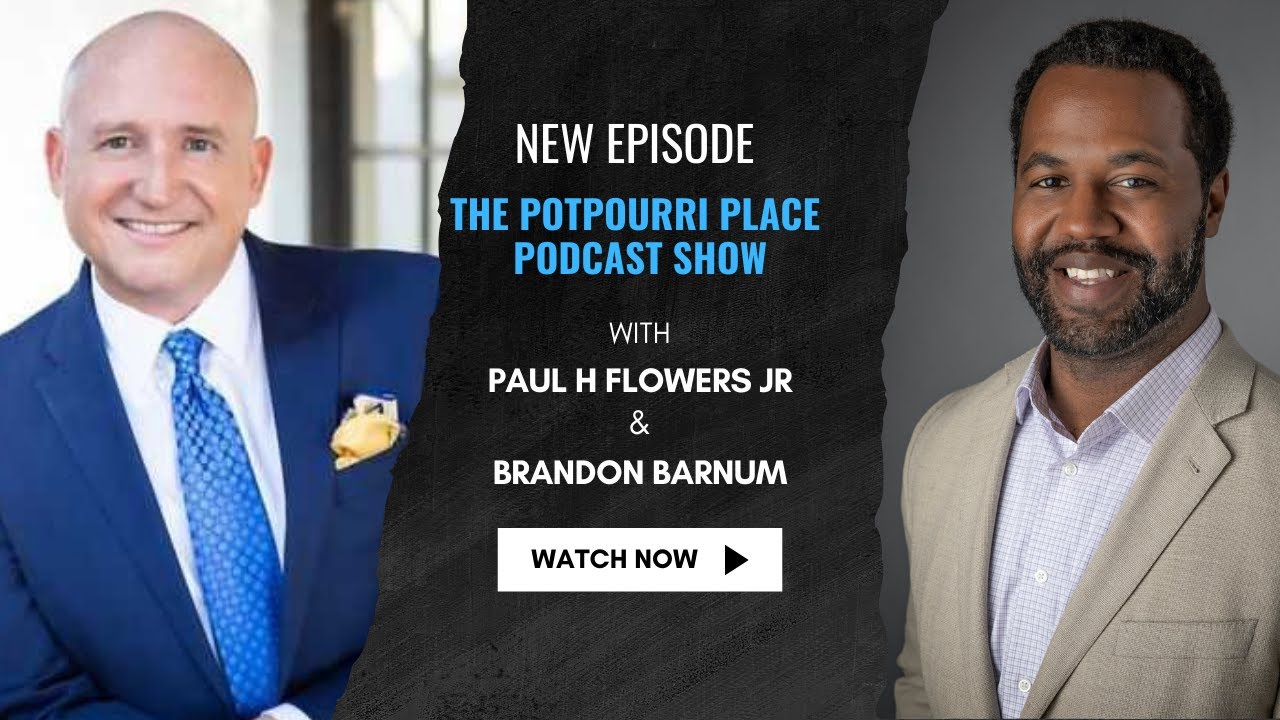
Brandon Lee Barnum, CEO of HOA.com, went from broke single dad to building a multi-million dollar referral business. He talks about his path through mentorship and faith, the cash-flow struggles that nearly killed his first company, and how HOA.com uses AI to match neighbors and position community as a service.
Chapters
Welcome everybody, Paul H. Flowers Jr. here, host of this podcast, The Pope Will Replace. And today we're bringing all the way from one of the warmest climates that you could possibly imagine, the CEO of HOA.com. Mr. Brandon Barnum. This is where I'm going to insert all of the lovely little applause. But for right now, I'm going to give you a round of applause, Brandon, and say thank you so very much for joining us today. Brandon, if you would just come on and share a little bit about, again, where you've come from, where you're going, and we'll ask some questions along the way. So, Brandon, I want to turn it over to you.
Awesome, Paul. Thank you so much for having me. I really appreciate that. Yeah. As far as where I came from, if I think about my origin story, I found out back in college that you don't have to be married to have a kid. And at 22, I had a son, and at 24, I was a single dad. At that point, I was making $20,000 a year and I just, you know, couldn't afford life. So I had to make a change. I ended up getting into the mortgage business, had somebody kind of take me under their wing, mentor me, teach me the art and science of what I now call raving referrals. And that changed my life. Within 18 months, I had 10x'd my income from $20,000 a year to $200,000 a year.. And I've been on a mission ever since to help as many people as possible do the same.
Excellent. Excellent. Now, Brandon, we're going to be talking to both a visual audience and an audible audience. So for those that can't actually see us right now, Brandon has this amazing background with a slogan above him that says Unity Through Community. Brandon, if you would, I want to come there for just a moment and figure out what, what is it, what does it mean, where did it come from?
Oh man, I love it. I love that we're starting there. So for me, Unity Through Community is the mission that we're on at hoa.com. If you look at the word community, the word unity is part of it. You can't have community without unity, and community really means come together as one. I wear this bracelet that's a Do Ubuntu bracelet, and Ubuntu is a South African term that means I am because we are. And it's really the oneness that the world works by. And so we're on a mission to create unity through community and help neighbors get to know each other. As HOA.com, 53% of all homeowners in the US live in an HOA. Most don't love their HOA. So we're on a mission to change that. And part of what we do is help communities connect. And we do different events that bring the neighbors together, whether it's a barbecue or an ice cream social or a great egg hunt. Just fun, family-forward, festive events that bring everyone together. So you actually do life with the people that you live nearby.
Hmm. Now you bring up something interesting when it comes to actually bringing people together. I'm going to talk about HOA for a minute. I'm going to ask about HOA for a minute, I should say. Sure. With that, this isn't just any regular software. You'd given me a phrase right before we hopped on the recording. And I want you to explain a little bit about what you meant when you said community as a service.
Yeah, you bet. So we started off, as most software companies do, as a software as a service business. That was our intention. That was our model— provide software that empowers and impacts people's lives. And what I realized, and actually I had this epiphany, I was at the RE/MAX Global Sales Convention a few months ago, and the CEO was talking about introducing marketing as a service for RE/MAX. The real estate company. And I went, you know what? We're doing something different here. We're doing community as a service because we're actually manufacturing connection within the community. One of the things that we're doing is we're using AI to revolutionize the homeowner association space. And part of what we're going to do is actually connect neighbors with each other. Imagine, you know, most people feel more disconnected than ever. So imagine if you had recommendations like Match.com, but for a friend match. Service where you connected with other people that share your same values, interests, and hobbies. And now you're getting connected to neighbors that you can actually spend time with and do life with.
Now, that's pretty interesting. And, and forgive me for if it sounds like playing the devil's advocate a little bit, kind of bringing up the, the competition. I know that's a dirty word in business, right? The C word. Now, When I heard that initially, I'd been introduced previously to something called Nextdoor, I believe. Oh yeah, yeah, yeah. And if you would help me to differentiate HOA.com from Nextdoor.
Yeah, so I think Nextdoor does a lot of things well. They get you connected so you know what's going on in the neighborhood. But a lot of times when I talk about Nextdoor, what I hear is people complain about the complaints. What they say is that they enjoy Nextdoor because it gives them access to information about their local community. What they dislike is the dislikes that get complained about on the platform. And I said, what if you had Nextdoor, but there was only positivity, you only had positive comments, or if there's what we call suggestions for improvement about how we can make things better in our community, Those go to our AI called Karen, you know, because Karen's responsible for improving things, right? And so that's what we've named our AI is Karen. And so anyway, that's how we frame it. But I think Nextdoor does a lot of things really well. If you think about homeowner associations though, there's no brand leader. I ask people all the time, when it comes to HOAs, what's the number one brand that you think of when it comes to HOAs? And I only get one answer. Any guesses, Paul?
I can't even think of a brand when it comes to HOAs.
You nailed it.
That's it.
That's the only answer that I ever get, which is I don't know, right? So that's what we're creating is HOA.com. We've got the ultimate domain when it comes to homeowner associations, and, and we've got the right mission and message because it really is about unity through community and helping improve people's lives, which I know from our pre-conversation, something you're passionate about.
Absolutely, absolutely. Very much so. Now, you brought that phrase up again, unity through community. Again, for my Audible listeners, it's a beautiful sign that he's got behind him. It glows very well, much like his personality that I'm certain is shining through into y'all's listening space right now. Now, with that particular phrase, how do you actually interpret that in the context of your personal life?
Oh, great question. You know, I think once you take a stand for something, it really shows up in all aspects of your life. And for me personally, since 2004, I've been on a mission to inspire, empower, and uplift every person on the planet. Okay, so that's my scoreboard that I think that I live life by. And sometimes God brings me people that are interesting, that really kind of test that and challenge it. And I'm like, okay, that means them too. And so it creates a response of compassion in some challenging conversations because I recognize and realize that, you know, God loves all his children. And so I— that's my responsibility, too. So I am all about uniting, not dividing. A lot of people are very critical about everything in the world, quite frankly. And I only speak positivity because that's what I'm committed to creating. Sometimes people get challenged by that because I had this conversation with a counselor recently and he said, have you ever heard of toxic positivity? And I'm like, I've never heard that term in my life. But if I'm guilty of toxic positivity, then that's a sentence that I'll live with.
Well, having an optimistic outlook is one thing, like being delusional is an entirely different story. But having an optimistic outlook, quite frankly, I join you in that category, right? I think all the toxic positivity, because there's clearly always a silver lining in some way, shape, or form. So with that, I want to go back a little bit in terms of your story. You mentioned starting off as a young father, and clearly you were well past that point today. But let's talk about some of that transition into the drive, because again, with this segment Every Day Entrepreneur, we want to talk about some of those characteristics that you don't really see, right? We can't see your drive on your website. We can't see your motivation, right, through the words on screen. But if you could share with us what it was like coming out, and I know this is going to impact somebody, so I really want you to, to be vulnerable if you can. You bet. As a, as a young father, as a single father, And then what, what drove you to, to success? Like, what were some of the things you were thinking along that path?
Yeah, well, great question. You know, at 24 years old, you're pretty self-absorbed. I was. And so all of a sudden I'm responsible for somebody else. And, and I think God gave me that opportunity and experience to really mature me at a young age because I didn't have a choice, right? My son's mother was strung out on meth and she was in a position where she couldn't take care of him. So I stepped up and stepped in, as I think any, any responsible person would. And it definitely changed things. It was tough. It was rough. It was a long time, man. I mean, I, I have so much respect for entrepreneurs because unless you are one, you don't appreciate what an entrepreneur goes through, right? We as entrepreneurs face adversity and challenge, and we got to get up every day. And that's why I'm so positive, because I have shaped my mind to stay positive. Regardless of the obstacles and the objections that you face, you got to believe in your dream and your vision. And I love— Les Brown is one of my mentors. I've met him a couple of times. He says, "It's not over until I win." "Until I win." That's it. "Until I win." And Miss Mamie Brown's baby boy. And so, you know, he really preaches that. And I love that phrase. And I've had to hang on to that over the years in lean times when, you know, there wasn't a lot of hope left. I wasn't sure how things are going to work out, but you have You have to just keep believing and grinding and keep moving forward. And if you've got a dream and it feels like it's been given to you, it's a calling, it's a passion, stay on focus, stay committed. But, you know, as far as the personal journey, man, there's been a lot of times where my wife didn't see the vision and it caused challenges in our marriage. And, you know, cash flow is king. And one of the things that I would have told my previous self is focus on the cash flow. Make sure that although you're building your vision and the dream in the future, you got to pay your rent today.
This is true. This is true. You touched on so many things, and I want to hit on both the business piece and the personal piece at the same time, but I've got to pick one. So, all right, we mirror each other, and you didn't know this prior to us having this conversation, but it sounds like to me that you had a child and then got married after the fact to a different spouse. Is that right?
Correct. Yeah, yeah.
If you could, and again, because I think this is going to help someone in the audience, talk about that dynamic of bringing your additional self, so to speak, into your new relationship and how you were able to navigate those challenges along the way to building success.
Yeah, well, so fortunately my wife and I have been together since my son was 1. So, uh, we've been married now 27 years, dating 31 years. My son's 32. So we've been together a long time. Before I got custody, we were dating and it was about a year in when I got custody. And that was really hard for, you know, our relationship. And her mom was telling her to go run for the hills because her mother had sort of inherited and ended up adopting 2 kids because she met a man that had 2 kids where the mother and the wife had abandoned the family. And all of a sudden, my wife's mother stepped up, married that man, and had 2 stepkids that she raised. And so my wife's mom, who's landing right about now here in Phoenix, did not want that for her daughter. And so she said, you know, get out of here, don't do it. I've been down that road and it's too hard. But thank God my wife said yes. And, and we've been together ever since. But it brought challenges, right? We ended up having 2 children of our own. My older son at times felt like he was the outcast a little bit because it wasn't his mom. Right. And now, while he was the only child for the first 8 years of his life, suddenly there's these 2 younger kids that are getting all the attention. You can probably relate to what that's like. And then on top of that, I'm building a business, right? So I'm not only married with kids, but I'm married to this vision, this dream, this mission that I'm on. And it's challenging. Now, one thing that I knew at a young age was that family comes first. And so what I chose to do is I worked pretty much till 6:00 every day, and then from 6:00 to 9:00 PM was family time. And, you know, we figured out early on to make sure that the phones were away at dinnertime and then when the kids went to bed. So, we didn't have that distraction. But because I'm an entrepreneur, I had the pleasure of being able to be out on the sports fields with my kids and got to coach 20 seasons of football and baseball and basketball and all the fun stuff. And that's the one thing that I would urge anybody listening right now is put your family first. You only get one shot with your kids and then they're going to grow and be gone and it's going to be over in the blink of an eye before you know it. So make sure you spend that time dedicated to raising your kids, your family. You'll never regret it.
Excellent. That is an amazing, amazing nugget. I want to blend a piece of that conversation and relate it to mentorship when it comes to listening to the right people, right? Having the right influences in your life. You mentioned that though your wife's mother had actually gone through having stepchildren of her own, and I'll say it didn't sound like it was a terrible thing. Obviously she chose it, she did it, and there might have been some challenges, but then she advised her daughter not to. And luckily, like you said, your wife said, I'm gonna do this anyway, right? So you also mentioned, of course, one of my favorites, Miss Mamie Brown's Baby Boy. Last round.
Yeah.
So in the spirit of mentorship, share with us any mentors that have helped and shaped you along the way and, and any mentors that you've needed to stay away from and not take their advice.
Oh, okay. I've never heard that question. I love it. Yeah. So for me, I was blessed and highly favored to have a mentor by the name of Mark Victor Hansen come into my life. He wrote all those Chicken Soup for the Soul books. I hired him to speak at a charity fundraising event that we were doing for a Christian charity back in Portland, Oregon, back in 2004. So I met him on May 18th, 2004, and this man changed my life because I hired him to come speak at these events. We raised $1.2 million of medical aid that day, which was fantastic. But more importantly, he challenged me to write 101 goals, and I'd never really written goals before. But he challenged everybody in the audience. It wasn't just me, but I took the challenge personally. And the following week, my wife and I went to Hawaii. Hawaii, and I sat there at night under the stars with my laptop and my praise music, and I wrote 338 goals.
Wow.
And what that did is that set the course the rest of my life. I really spent time with God saying, okay, Lord, what do you have me here for? What's the mission? What's my purpose in life? That's where I got that download of uplifting, inspiring, and empowering every person on the planet. That's where that came from.. But since then, that time, Mark's been an amazing mentor to me. I just talked to him the other day. Here we are almost 21 years later, and the man has made a massive impact in my life. As far as mentors to stay away from, you know, I've definitely had some advice that didn't feel right to me. But so I listen to advisors, but then you always, you always have to make your own decisions. Don't blindly follow other people's counsel. But listen for the wisdom and then make your own decision. And I think mentorship is so important. I think not only do we need mentors to teach us and guide us, but we have a responsibility to mentor the younger generation. So I'm a big brother. I'm also an ambassador for Big Brothers. And I was just with my, my 17-year-old little brother called me the other day and, or texted me actually, and he said, hey, I've got prom coming up and I don't know what to do. Can we get together? And so it was so cool, man. I got to take this kid out on his first date and drive him around on his first date. I got to teach him how to drive and then teach him how to drive a stick shift. And now I got to mentor him the other day on the promposal and the whole bit. So it's just so fun and rewarding. So I say have a mentor and be a mentor and it'll enrich your life.
Excellent. Excellent. And I just want to give kudos to you and highlight your character. Because clearly you could have said exactly the person that gave you that terrible advice. And it speaks to the character of a person to, again, and I've heard this several times already from you, speak highly of individuals. It might go into that overly optimistic place, the, the person that shared with you toxic positivity, right? And, and that's a great outlook to have. Now, you've mentioned several times, so I want to slightly turn the page, if you will, over to faith. It sounds like you're a believer, right? A fellow believer. So I'm really glad to hear that. And there's going to be an audience for that, folks. If you're, if you're anti-beliefs in higher powers, we love you too. And I'd like for you, if you would, Brandon, to highlight how important is faith in what you do.
Yeah, I think you either choose faith or fear, right? You cannot choose both. So in every moment of your life, You can either choose that this is happening for you or happening to you. I choose faith over fear. And as an entrepreneur, I can't imagine any other way. It would be a really tough road to hoe if you didn't have faith or if I didn't have faith. So to me, and if there's nonbelievers, I think the reality is everybody pretty much believes that there's a creator, right? Because this world is just too magnificent and incredible for it to just be circumstance. I think the probability of that is so infinitesimally low, I don't think most people believe it. I think where people get stuck is not at the Creator or God, what we call God, right? But it's the next level down. For me, I teach people to love like Jesus, lead like Jesus. And whether you believe that Jesus died for your sins or not and is the Savior you have to respect his— the man's game, right? You have to respect the message that he lived by. And, and if you really study his word, it's really incredible. So I stay in faith. For me, that's part of the power of my positivity, is I listen to worship music every day. I go to church on Sundays. I used to sing in the choir, not so much anymore, but faith is super important. In fact, that's one of my missions, is I have a side passion project called the Christian Business Alliance, because what I see in the church is a couple of gaps. Number one, they don't talk about business from the pulpit. Number two, there's no fellowship of believers in business. And number three, people don't buy Christian. In other religions, those religions are intentional about helping to buy from other believers of their same faith. And as Christians, We just don't think about it. So with the Christian Business Alliance, we started it a little over a year and a half ago. We have 137 chapters now in 24 countries, and it's really just about small groups of believers in business choosing to do life with each other and connecting on a consistent basis so they don't feel so alone.
I'm, I'm floored for just a moment. So again, for our Audible listeners, he mentioned it as a pet project and I was going to inquire about the CBA thermos that's in his background, right? You all can't see it. He's got a beautiful plant, family photos, and then a CBA thermos. And that is— okay, he was putting it up to the screen here. It says Christian Business Alliance. Beautiful. Now again, for my audible listeners, you couldn't see my facial expression, but would you say one more time how many chapters and how many countries And how much time did that take?
Yeah, so in 18 months, we now have 137 chapters in 24 countries, and we're believing that we'll have over 1,000 chapters by the end of this year. In fact, I just met one of the members of the National Christian Foundation. We're having lunch in a couple of weeks because when he heard about what we were doing, that we're going to have a conversation about taking this throughout, throughout their organization. And then also, I just met with the dean of the Grand Canyon University. School of Business, and they're a Christian university here in Phoenix. And so we're having lunch in a couple of weeks as well. So we're believing that God is going to continue to grow it. I believe that he'll grow it over 1,000 chapters this year, 10,000 chapters in 2026, and over 100,000 chapters by the end of 2027.
Amazing. Amazing to take something. And let's talk about the, the faith of a mustard seed, right? Or for this to be a pet project. And in just 18 months, Listeners, if you can understand what it takes to grow something, 137 chapters in 24 countries, again, as a side project, there's definitely a higher power that is on this man's side. So please, we're going to get to his links and socials again towards the end of our conversation here. But you definitely want to check out what he's doing, make sure that you're following him, that you're connected to him, because it definitely takes connection to the best to continue your blessing. Now, again, you brought up faith, and there was a scripture that came up in my household a little bit earlier, and if you don't mind, I'll share it here. It was Matthew chapter 6, verse 25, right? And it's a few of the verses, we'll just go through a couple of them. Yeah. Therefore I tell you, do not worry about your life, what you will eat or drink, or about your body. What you will wear. It is not— excuse me— is not life more than food and the body more than clothes? Look at the birds of the air. They do not sow or reap or store away in barns, and yet your heavenly Father feeds them. Are you not much more valuable than they? Can any one of you by worrying add a single hour to your life? Now I want to pause there and kind of reflect on that piece for a moment. Because again, throughout this journey in building HOA.com over the last 6+ years, I'm certain there's been some worry. And again, we always like to talk about the times where things are up and growing and glowing. A lot of entrepreneurs need to know about those times when that faith is tested. So if you could tell us about a time, maybe in the beginnings of HOA.com, again, majorly successful now, but in those early stages, when once the idea began as the faith of a mustard seed that you had, what were those crows coming to peck at you? Where were those naysayers? And again, how did you get through that stage of worry?
Well, I love that you brought that up, Paul, because we're recording this on Good Friday, so people won't be able to experience it on Good Friday, but that's what it is. And, uh, I love the fact that in the Bible, 365 times God says, do not fear. So again, choose faith, choose faith, choose faith. And there were so many times growing this business where I had to choose faith. Our team had to choose faith. We started off as the homeowner alliance. We didn't have hoa.com. We had thehomeowneralliance.com. And one day I was with my partner and I said, you know, this domain is too long to fit on the side of a bus. It's so long. I said, okay, if we could wave our magic wand and have any domain on the planet, what would it be? Homeowner Alliance. I went, okay, there's got to be an hoa.com. And so I typed it in, reached out to the owner. It took about 2 months to do a deal, but here we are, and that's changed everything. Now, just because we had the domain didn't mean we knew what to do with it. There was a long time where we started this company as a referral network. We started out with a mission of creating a referral network for professionals who serve homeowners. My last platform was called Refer.com. We built that up to 5 million members in 190 countries, but we wanted to create something specifically for all those professionals and business owners who served homeowners. So that was our mission. And now we own HOA.com. We're like, okay, we've gotta go revolutionize the homeowner association space. And so there were a lot of pivots, a lot of lessons. And I think the biggest thing as an entrepreneur, is again cash flow, right? Right. We didn't have millions of dollars in funding. We've raised $1.75 million over the last 5 years to fund this company and get it where it needs to be. So as a, as a founder, you not only have to have a vision, you got to communicate that vision, and you got to enroll other people into it. Now, these days it's easier than ever to start up a company with AI and all the tools, but Back then, we didn't have that, right? So you just get in the game and you start going, and cash flow is usually one of the biggest challenges for people. And that was certainly true for us. There were a lot of times where I wasn't sure how I was going to take care and pay my team, right? And when you're a leader, you're responsible for feeding not just your own family, but other people's families as well. And so we had over a dozen people. Whose families were dependent on me finding the cash to stay in the game. And there were times where we didn't know if this was going to make it. We weren't sure if we were going to survive and succeed. But again, you got to keep that faith. You got to stay focused and just continue to refine and learn and pivot along the way. But you got to believe in yourself, because if you don't believe in you, who else will?
Who else will? That reminds me of a phrase a gentleman told to me when I was about 9 or 10 years old, and I had no clue what it meant until I was in my late 20s, really early 30s. He said to me, "Young man, it's a sad dog that doesn't wag its own tail." And a sad dog that doesn't wag its own tail. And I didn't quite understand what that meant until years later. So in your instances of, again, having mentors, having naysayers, and having to choose faith along the way. Share with me, we're 6 years in for HOA.com. What's coming up soon, and what's coming up in the next, let's say, year to 3 years, as far as the vision that you have for HOA.com?
Yeah, well, we're creating the future of community. And if you go to HOA.com at least at this point in time, you'll see our white paper called The Future of Community. If you're listening to this 2 years from now, it may not be there. But what we're doing next week, actually, we're launching the world's only certification program for real estate agents to become experts in HOAs. When you think about real estate agents, over half of their listings are in HOAs, but nobody's taught them how to specialize in HOA transactions, how to partner with HOA boards, and how to really serve communities within an HOA structure and ecosystem. So that's what we're launching, and we're super excited about that. Part of the reason that we're doing it is strategic. Not only do we want to partner with real estate agents and empower them so that they win more listings and serve more families and make more money, we're also enrolling them as our sales force. When you think about it, as we help them claim those communities, they're going to be taking our brand out to the market. And so it's a really synergistic play. I think one of the things that I often will coach and advise business owners on is being super strategic about identifying exactly who is your perfect prospect. And, you know, I teach Raving Referrals, right? So I teach people how to build their business through referral. And if you engineer your company so that your clients become your ambassadors and advocates, life gets super fun, super fast.
I love that. And again, for our listening audience, you didn't see the beautiful cover of the book that he posted up to the screen with the title again, Raving Referrals. Again, Brandon is an author and I think we're absolutely going to have him back for the launch of our Authors Alley portion of the Potpourri Place. Now, really quickly, when it comes to Raving Referrals, and again, we're going to save some of the, the meat and potatoes of it for our next podcast conversation because again, we're going to do this again. What was the inspiration there, right? What was the inspiration for Raving Referrals?
Well, again, as I said, you know, when I 10x my income from $20,000 to $200,000 a year, it changed my life, right? I suddenly had more financial freedom. I, I was in 20s. And so, it opened up a whole world of possibilities for me. And I just want to empower other people with that same understanding. I went to business school, right? I got a bachelor's degree with a focus on marketing. I never once heard the word referral in 4 years of college.
Wow.
Which is actually why I'm meeting with the Dean of the School of Business from Grand Canyon University, because I said, look, Doc, this should be taught on every college campus in America.. So, that's what we're talking about doing. But I just, I want to empower people with this understanding that if they partner with other people and professionals that are serving their perfect prospects every day, they can really expand their business. So, a client for one becomes a client for everyone. And when you do that and you've got a loyal, what we call a trusted team of people that you're referring your clients to and they're referring clients to you, everyone wins.
Absolutely, absolutely. Kind of like one hand feeding the other. Reminds me of the parable of the long wooden spoon, right, where you've got a— they're trying to feed themselves and they don't realize that if they just feed the next person, and so on and so forth, that they will absolutely be fed. Really, again, speaks to your character in terms of putting together not just this community, but also putting together a resource for people to take this out into their own communities and learn from it and teach from it. And again, expand and grow together. I want to touch on one thing quickly for our educational crowd. You'd mentioned that in 4 years, 4 years of— correct me if I'm wrong— you got a bachelor's in business administration. Is that right?
It is a Bachelor of Science.
But yeah, that's Bachelor of Science in Business and If I heard you correctly, you told me that you didn't— you told our audience that you didn't hear the word referral one time in 4 years.
Now, correct, Paul? And I, I keep asking people that I know have business degrees if they have ever heard the word referral. So far, I have not one person that heard the word referral during their bachelor or their, their business degree.
All right, now this is going to be a slightly loaded and maybe even a little controversial question. Okay. You'd obviously gone to school.
Yeah.
Knowing that you're an entrepreneur today and having gone through several trials and tribulations along the way, how necessary or not do you believe it is to receive a quote-unquote formal education? And by formal education, I'm specifically referring to post-secondary or after high school, meaning college and beyond?
I think it depends, Paul. Like, I have a daughter. She just graduated with a degree in neuroscience. Her, her goal is to be a neurosurgeon. She just took her medical entrance— medical school entrance exams a week ago. To be a doctor, you got to go to school, right? I have a 24-year-old son and he graduated with a degree in business. I don't think he'll ever use it at all. Right. So there really wasn't much that I learned in business school that I, that I didn't learn in the real world. So how valuable was that experience for me? The education wasn't that valuable. That's the truth. The relationships that I, that I built, I mean, that's where I met my wife was in business school. Would I go back and not go to school? No way. Absolutely. The, the connections, the community that you create and who you become. In those formative years after high school. That's the value of college these days. But if you can know, if you're clear on where you want to go and you get somebody that mentors you and you get into your industry, depending on what profession you choose to pursue, I think college is less important now for most than it used to be.
Excellent. Excellent. Now we're coming upon the end of the hour here.. And I want to ask just a couple of pointed questions for— and I'll give the context for this next question. When it comes to community, there's a certain closeness that I believe we all have within our immediate networks, or our nuclear families, if you will, that allows us to understand one very specific thing about that person. I'm going to ask you this question, Brandon, and please don't take offense. Again, this is not a rehearsed— and Brandon didn't know I was going to ask this. So my audience out there.
But Brandon, I can hardly wait.
What's your middle name?
My middle name is Lee. Brandon Lee, just like Brandon Lee from Bruce Lee, son.
Beautiful, beautiful. Now, quick follow-up on that one. Where did the Lee come from?
Uh, my father's middle name was Lee, so I think I got named after him.
Excellent. And are you a junior, or is that just the same middle name?
Same middle name.
Perfect. Perfect. Now, I'll share why I share the context. The— where I was going with the context for that question is that when it comes to community, and typically in our nuclear family and our closest relationships, we typically only know the middle names of about 5, maybe 10 people, maybe 10 people. And it's typically, again, your nuclear family, mother, brother, sister, etc., father. And maybe your best friends and some really close cousins. So I asked that question so that, hey, our audience— so that I— well, let's start with me, so that I can get closer to you, and that so that our audience would also learn something about you that they wouldn't necessarily pick up again on hoa.com or your LinkedIn or your social medias. I do believe in connection. I do believe in closeness. And I think you were the perfect, perfect person to headline our Everyday Entrepreneur episode. So what I'd like, Brandon, is if you wouldn't mind sharing, how can listeners find you?
Yeah, best way to find me is at brandonbarnum.com. You'll find all kinds of info about me. It's a page on ravingreferrals.com. So you'll be able to see that there as well.
Excellent.. You use your own name as the domain. So shout out for personal branding, obviously. And if there are, let's say, 1 or 2 things that you would like to leave the audience with as far as key takeaways, what would those be?
The biggest thing that made a difference in my life is to get clear on what you want. What are your goals? For me, I have all my goals written out. In fact, I have them right here, right? I have goals for the next 50 years.
Wow.
And I know exactly what I want to accomplish, achieve, people I want to meet, places I want to go. And so I've got crystal clarity on what my life looks like. I call it life by design, where I think a lot of people live life by default. And if you take time to really get clear on what do you want to accomplish, achieve, attract, manifest, write it down, have a date by which you want to accomplish those things, you'll be amazed how many things come true. Sitting on that beach, I wrote several goals that I thought were outlandish at the time. Like, I wanted to meet Bono, the lead singer of U2, in the next year. I ended up meeting him in 6 months afterwards. Would that have happened had I not wrote the goal down? Maybe, but I don't think so, because I started sharing my goals with other people. I started speaking them, right? The most powerful words in the Bible are "I am.". And when we declare who I am, who you are, and you declare that out to the universe, to God, however it works, because quite frankly, it's beyond my understanding. But what I do know is that when we claim that, things come to pass for your benefit. So, get clear on who it is that you are, what you want to accomplish and achieve, and the difference that you want to make in the world, right? We talked about unity through community. Well, that's about we, not me. It has nothing to do with me. I get to live as this conduit and have this amazing life experience, but it's because I focus on we more than me.
Excellent. And for our visual listeners, you all saw the pages there. For our audible listeners, you didn't see— he has pages and pages of written goals that are articulate. And if you don't mind me asking, How many pages are there?
6, I believe. Yeah.
Ladies and gentlemen, these are pages from top to bottom. These aren't big block paragraphs. These are line by line by line. And are those dates all the way to the right of them?
Yeah, they're dates all the way through the year 2050. The last one is, uh, Inspire, Empower, Impact over 8 billion people by December 31st, 2050.
I love it. Putting an absolute timeline to the things that are important, being clear in what it is that you want to do. Brandon Lee Barnum, you have been a phenomenal guest, an amazing, amazing conversationalist, and hopefully for at least one person out there, they've been able to receive the impact and the inspiration that you've brought to this community. Any last words before we wrap up?
You know, Paul, I just want to give you a shout out. I'm so impressed by you. Thank you for being on this mission, right? Because when we talk about inspiring, empowering, and impacting people, you're doing it. So thank you for your leadership. Thank you for stepping up and answering the call. And I can't wait to see how far you go in your career as a result of your leadership.
I appreciate you. Thank you so much, Brandon. And listeners, this has been another episode of The Everyday Entrepreneur with again CEO Brandon Lee Barnum, CEO of HOA.com, Mr. Brandon Lee Barnum. There we go. You all have a great rest of your day. Bye for now.
More from Paul




Term vs Whole Life Insurance, Explained Plain — Which One Your Family Actually Needs


The Cheapest Claim Is the One That Never Happens | Claims Deflection Explained




