What CEOs in SaaS need to know - how the Marketing function changes as you scale toward $100M in ARR

This content was created by Pete Crosby. This content was uploaded by Pete Crosby. This is a YouTube interview titled "What CEOs in SaaS need to know - how the Marketing function changes as you scale toward $100M in ARR" (published/recorded 2026-10-22). Emily (co-founder of Revelesco) interviews Andrew Davies (Chief Innovation Officer at Paddle). The discussion is a practical, stage‑focused conversation for B2B SaaS leaders about how the CMO role and marketing function evolve at different revenue stages (finding product‑market fit, managing complexity, shaping category/monetization at scale), stage‑fit when hiring CMOs, demand vs. bottom‑of‑funnel priorities, alignment across functions (run‑the‑business vs change‑the‑business), decision‑making and enablement, and the accelerating impact of AI on product‑market fit, tooling and go‑to‑market speed.
Chapters
Hi, I'm Emily, the co-founder of Revelesco. We are the creators of Whole Revenue Strategy, a methodology for CEOs in B2B SaaS who want to scale to $100 million in ARR. And today I'm joined by Andrew Davies, who is the Chief Innovation Officer at Paddle. Paddle is the leading merchant of record platform, helping more than 10,000 app, SaaS, and AI-native companies sell and grow globally. Prior to Chief Innovation Officer, Andrew was Chief Marketing Officer at Paddle, taking the business past $100 million in ARR in that role. And in my opinion, Andrew's superpower is being able to help SaaS and AI-native startups looking to scale by solving problems which help them break through to much bigger levels of revenue. We've seen you do this again and again. And what we're going to be talking about today is how the marketing function changes at each different level of scale and how do they find the right fit CMO that fits their stage of the journey. So, Andrew, to kick us off, can you give us a short version of how you got to where you are on your journey so far?
Yeah, absolutely. It started accidentally. I'm an accidental CMO. So I started a couple of businesses at university that went nowhere and then eventually had a business by the time we graduated that formed into a B2B personalization engine called Ideo. I ended up falling into that CMO role and doing a lot of the go-to-market work and the company that acquired us that became Optimizely, I ended up running brand demand and digital, so global marketing for Optimizely. So suddenly from a company that was doing sub-$10 million ARR, we jumped into a business that was doing, you know, a couple of hundred million ARR and was formed by acquisitions and did several more acquisitions. I really enjoyed that journey, but very different to the early stage, multi-territory, multi-product, very complicated. And then I did fractional work for a whole bunch of B2B SaaS companies in UK trying to grow, particularly in America. And, um, and then I started the role at Paddle as CMO. I think we were probably about 35, um, maybe 40 million ARR at that point. And I was CMO through, um, 100 million ARR when I transitioned into this new role. So I've seen a few bits of the journey from zero up to where we are now.
So if you could separate the stages, because then you went back to Paddle, which you said was around 35 million in ARR, going back to that level of ARR. Could you give us an idea of how you would separate the role of the CMO and how it really changes as it scales?
Yeah. So I think at the very early stage, single digit million ARR, your job is really to find what works, find something that works. And you have to be extremely scrappy. You've got to have a test and learn type mindset. You've probably got to lean into a whole bunch of areas that feel uncomfortable. And the role probably depends quite a lot on who else is in the team. if you've got a CEO that's very out there and, you know, leading the story, or whether you have a CEO that's very internal or perhaps technically focused. So I think you have to pivot based on that. But, you know, the journey is just finding something that works. When you get to the kind of the mid-stage, $10, $20, $30, $40, $50 million ARR, complexity starts to increase. You've got multiple products, multiple segments, geographies, channels, sales motions, partners, customer types, budgets start increasing. And so now you've You've got to start grappling with those elements of complexity I spoke about. And when you get into those later stages, $100 million and beyond, then the job is all about, you know, category and share and corporate narrative and pricing and monetization and product portfolio and international expansion and, you know, partnerships. Maybe it's about, you know, M&A, maybe it's about company reputation. And so the portfolio of things you've got to think about changes dramatically, and you've got a lot more to lose, whereas in the early days, you don't have a lot to lose. is you can try a lot of stuff and just cycle through it. So those are a few of the differences, but broadly, it's about finding something that works in the early stage, starting to manage complexity and build a system to make it repeatable. And then at the end stage, it's much more about shaping the overall market and the future of the business. What I have observed is that every company I look at thinks they're focused, and yet, their level of focus leaves a huge amount to be desired. And they have chosen a market size that feels meaningful to their business and their future, rather than a market size that is genuinely ownable and influenceable. Because in those early days, you just want to make 1, and then 10, and then 50 raving fans, because you deeply understand them and solve their problem, rather than really have a bunch of people who are generally interested in what you do, even though there might be many thousands of them.
And I was speaking with a business recently, they're on around £10 million in ARR, and when I asked, what do you think your biggest problem is right now, their response was, we need to double our top of funnel. Do you think that's the right way to think about it? Is there another way that they could be thinking about how to solve a problem? And if they, if that is the right thing, what should they be doing?
So firstly, I'm seeing 2 very different business types in the market right now. There are businesses who are broadly in AI-native categories where they are being pulled forwards by massive global demand. And in their world, it is all about a monetization usage conversion type problem because they're, you know, we're all trying these tools every day. You might have signed up for 5 over the last month. The acquisition isn't the problem. The top of funnel isn't necessarily the problem. It's can I get these people I've acquired to actually use it, get value from it, and pay for it and then stick around? So there's that category of business and, you know, So if you're working in one of those businesses, the challenges are just very, very different. In many of the companies that both of us know and love, there'll be a different type of problem where there's an understanding of what the market we've gotta serve is. And we've got some data on how many customers we convert once we get into a conversation with them. We've got some understanding of what that funnel is. And therefore, it's really easy to say the problem is just go get more top of funnel. And often that's actually the right answer, but it's not the right first thing to go and do. Whenever you go and try and boost your top of funnel, try and double your top of funnel, you almost always have to be using tactics that are additive or different to the things that have got you that existing funnel. So if you've got a top of funnel that's largely come from, you know, word of mouth and search, i.e., intent, you know, they've got intent as they come to your funnel, and then you go and double that by dumping a bunch on paid ads, You're never gonna have the same conversion rate from them, but you've done the job, which was going double the top of funnel. And so firstly, I think it's really critical you think about the entire revenue operation, the entire revenue strategy. What are we trying to get this to do through the funnel? And yes, we wanna maybe double the top of funnel, but actually what we wanna do is double what's coming out the bottom rather than just what's going in the top. Right. I think it's always easiest to think about the top of funnel as the problem, whereas certainly the experience I've had in multiple organizations now, starting fixing things from the bottom of the funnel up actually can be much more impactful. So thinking about go-live and making sure there's no churn problem, thinking about that sales conversion. You know, I sometimes talk to businesses and they're demanding a 5x or a 6x pipeline coverage. And it's 'cause they just don't have that message that matters and a really tightly defined ideal customer and sales rigor that's around it. And therefore the top of funnel has to be absolutely huge. Right. In order to serve this, very leaky, inefficient funnel. Maybe it's a case that your product just hasn't built out the capabilities yet for you to be able to close at a high enough clip rate. And so thinking about those things in sequence is actually really critical, rather than just putting loads more in the top of funnel. And if it is a leaky funnel, or the product doesn't have the PMF that it needs to, that can be an extremely inefficient use of resources.
And we talk about the funnel, and it's useful for us internally to have a way to think about the stages and moving customers through those. But do you think that the funnel is almost irrelevant these days because the buyer journey, people are landing on so many different things and different and finding you in, in, in, it's almost quite a chaotic way they're finding you. So it's not like they're going on a specific journey. But do you think that the funnel, the way we're thinking about that funnel and the customer journey has changed over the last 12 months or so? And if so, What has changed?
So I think it's changed much before that, and I think the funnel has always been a very inadequate framework or model to put on the buyer journey. Even if we roll back 30 years, I don't think people went through a set of stage gates. But yes, there's much more perhaps now that's in digital but hidden, and there's much more that's happening that we think we can track but we can't. So I think probably the disparity is what we think we can structure as a funnel versus what's happening, rather than it actually being that buyer behavior is just necessarily way, way more complicated. And so, yes, I do think it's inadequate. And I think that's just part of the process of building a system, is understanding kind of what bits of it are true metaphors for real life, and what bits aren't. And so if you think about that funnel, I think it is extremely helpful to think about it for especially the middle and lower phase stage, where you've got very controllable interactions, particularly in a kind of an upmarket B2B-type motion. You've got very controllable interactions that you wanna measure. I also think it's really helpful to think about general rule of thumb of what you need to do in terms of volumes and budgets you've gotta deploy up the funnel. Because it can help you think through that if I close 1 in 3, and every one of them, therefore, based on my deal value, is worth $10,000 at that stage, and I wanna go and get another 100, then you can start doing that maths up the funnel to understand the kind of budget you've gotta deploy to get there. So no, it's not the finish line, and it's absolutely not a perfect reflection of reality. It's just something that's helpful sometimes as a mental model. I think other mental models, I like the bow tie. Certainly at Paddle, we've used that a lot. And it's a much more holistic way of looking at it because if you only get them to the point of yes, actually that's not doing anything for your bottom line, your gross margin, it's not doing anything for your ARR growth. Actually, what you need to do is make sure they're active using the product, happy, expanding, referring other people, maybe adding extra product lines through cross-sell and upsell. And so it's a bit more of a holistic way of looking at it.
And how do you, as a leading a marketing function, how do you make sure that everybody is aligned within that function?
So, I think company alignment or cross-functional alignment is a super interesting topic, because it's something we've worked extremely hard on at Paddle. When myself and a few of the other key execs joined, we were a very interesting high-growth business that, not by design, but by default, had ended up becoming reasonably misaligned across functions as the company has scaled dramatically. scaled very fast through COVID. And so product was doing one thing for one reason, and sales was doing another thing, and marketing was doing another thing, and CS was doing a slightly different thing. And actually, we used the paddling metaphor, the rowing boat metaphor. We said that actually, you know, we've got some great rowers who are rowing in slightly different directions at different speeds, and that's a real problem. So I think that's where it all comes down to the foundational elements that marketing can help steward, but are a cross-functional agreement across the leadership team in terms of your purpose and, you know, your operating model and the things you're gonna prioritized to go and do, whether it's OKRs or other forms of initiatives, utterly critical. And if you can do those things well, then, you know, certainly our experience at Paddle has been a massive speeding up of the boat, not by lots of new effort going in, but just aligning the rhythm of how everyone is rowing and the direction people are rowing in.
It's, yeah, it's really interesting. What we've seen is a number of businesses now, are believing that they are now doing better enablement because they are using Claude, for example, to put enablement docs together and then share those documents, but potentially not necessarily really going through them and thinking, how is this valuable? What's your, what's your opinion on that? And if you have advice to SaaS businesses and CEOs thinking about this, what would you advise them to do?
So at Paddle, we have a very kind of well-built muscle around this now, and it's been lots of hard yards over the last couple of years where we have a change the business and a run the business program. Our run the business program is, you know, sales and pipeline and product roadmap, the things that have to happen every single day, every single month, every single quarter. And then we have a change the business set of initiatives, which are cross-functional by nature. And they are the top initiatives across our key pillars in our strategy that we have prioritized for that quarter to go and get a job done that we believe has a chance of changing our business. So there might be a market focus, or a new product innovation, or a new tweak we're doing to our back office, or our compliance stance. All of those things might sound like they're led by one function, but they have to be cross-functional if we're gonna make them change the business. We have a rhythm about that. Every Monday, we spend 2 hours on a call going through every change the business initiative one by one in 15-minute chunks to check that it's on pace and we're unblocking it.
And if, for example, a business wanted to do it in the way that Paddle does it, so you'd You talk about running the business and change the business. What is the ratio that you would put? Is it 80% run the business or 50% run the business?
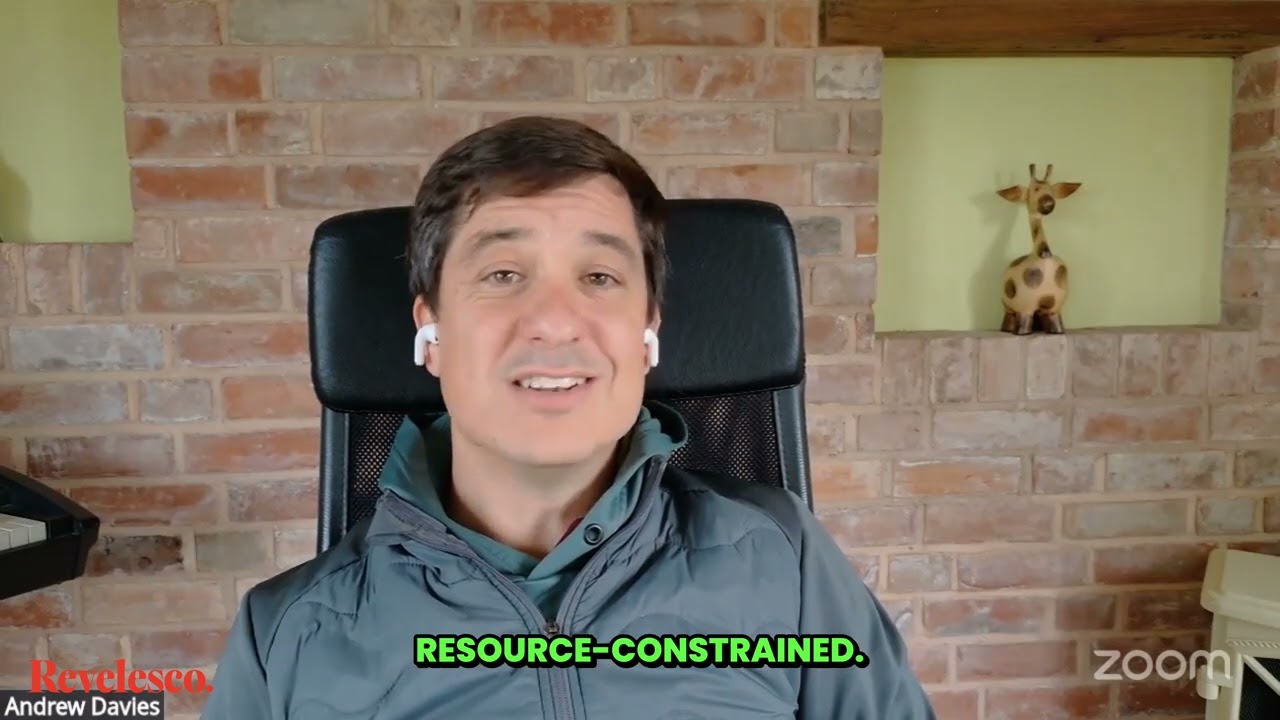
I don't think we've thought about it in that way because it probably changes. If I was, if I was going to judge it by a unit of paddlers, the number of people waking up and working on those things, then it probably is a 70/30, with 70% being run the business. Um, but, but yeah, I think it's definitely a key priority of ours. But there's a whole structure around this, and, you know, I think of it aligns very closely to Revalisco's whole revenue strategy. You know, we've— I'll send it across. We've got a whole book here where it's defined in terms of our purpose, our vision, and also the values we operate, and then our 5 enduring kind of pillars of our strategy that are the same every quarter for 2, 3, 4 years. And then our initiatives sit underneath those. And then we've also gone one stage further, which I think is interesting, which is we've developed our own decision-making framework. Because in a world where you can move very fast and build anything fast, I think many organizations are decision-constrained, not resource-constrained. What should we build and why? What decision should we make? And so we, going back to your cross-functional point, our decision-making process is, by its very nature, cross-functional. You have to get inputs from multiple people on a decision. You've gotta lay out multiple possibilities. You've gotta force-rank them and come up with a way of visualizing what the options are. So it can't be a, oh, Emily, you think your idea is great, and Andrew thinks his idea is great, so whoever the best arguer will win. win, um, has to be a much more pragmatic process.
One of our objectives at Revalisco is that we understand that normally founders and CEOs of a SaaS business can normally get their business to, let's say, $10 million in ARR. And at that point, often they reach a block. And then there's like another stage, it might be $20 million, $30 million, $50 million. And it's normally just down to a really simple thing, which is leaders don't know what they don't know. And one of our objectives at Revalisco is to help shine a light on what is coming next around the corner at each new level of scale. So can we go through from an actual, from the role of a CMO, you spoke about those different stages, can we just talk about how you would, even if it's just 4 different levels of CMO, what should that CMO be expected to contribute to the business at that point? And how does that change?
So of course, there's a whole bunch of things that just change based on market and sector, but let's talk about some generalizations that I think can be useful. Firstly, let's talk about stage fit and the fit of the CMO to the stage, to your question. Then let's also talk about the different, the span of a CMO and where they spike and when that might be needed for different businesses in different stages. And then maybe we can talk about a couple of other things that are changing as we're all adopting AI. So firstly, stage fit. I think it is really critical that as you choose a CMO for your next stage, that they have the experience, not of the place you want to be in several years' time, but they have experience of the stage you're going through right now. I think it's really hard to thrive in an environment where you don't know what good looks like. And so, yes, you can find some fantastic, perhaps one level down leaders that now are ready to shine. And they've been through the experience of that stage, but perhaps not as the kind of number one role. And maybe you've got other people who've been part of a team, who've been on part of that journey. So, I think there are ways of thinking about this other than just, has this person been CMO at this specific revenue journey before. But I think stage fit is really important. I also think, however, that the velocity expectations of the business are important. So if you've been a CMO at $10 million, but the previous business you were working in was bootstrapped and was growing at 10% a year versus now going into an AI-native business at $10 million, but they expect to be $50 million next year, that's just a radically different job to be done. And so yes, do they have the experience crossover of a bit of where you are or where you will be next year? through the next couple of years? Do they have that velocity experience or alignment over velocity? I also think that one of the questions I like to ask of CMOs that have been at multiple stages is, what made you come alive? Like, where did you get most joy? Because that's got to be important here too. You do your best work where you experience most joy. And I really think that many of the startups that I've ended up, particularly before I joined Paddle, when I was doing a bunch of fractional roles, a lot of those situations were people who had overhired and got a big hitter from a big brand who hadn't been at this earlier stage for quite a long time, but was looking to try and be really kind of scrappy. And it just didn't work because the company didn't have all the support structures and the documents and artifacts and resources that they were used to. Or was businesses that had perennially underhired and churned through marketers that the CEO was not happy with because they weren't able to move the needle often because they weren't able to market as well as the CEO is, which is a kind of a key challenge in this early days when your CEO is kind of outward facing and perhaps the best marketer in the business by default. And so, yeah, I think stage is one way of looking at it. The other thing is the fit against the other people in the executive team, because if you've got a founder who is leading the company strategy, leading the company story, speaking at all the conferences, the role of the CMO, particularly in those early days, is radically different than if you've got perhaps a CTO turned CEO who's built the product, who deeply understands the problem space and how you— and the engineering solution. but doesn't gravitate to building that market message. And so you've got to think about how your fit is against that CEO and perhaps also the head of sales and maybe some other people on the exec team, which then comes on to kind of the third way of evaluating a CMO against the opportunity, which is, I think that, you know, we can talk about different areas, but let's break it down into 4 common ones. I think the role of a marketing leader spikes across 4 different ways. It's product marketing. So can I accurately, compellingly describe the product and the market it serves and message that in a way and launch. Secondly, branded communications. Can I build that narrative that guides the whole business as well as informs and influences the customer and the market? Thirdly, demand generation. You know, can I build that model, that system of how we go and repeatedly acquire via different channels? And then fourthly, and this perhaps was less prevalent in the past for marketing leaders, but an operational background. So really come, you know, in detail understanding the stack and the toolkit and how it all works together and the numbers that kind of RevOps perspective. And I think as a marketing leader, you are doing yourself and the company a disservice if you pretend to be good at all 4 of those. I think most marketing leaders spike in 1, maybe 2 of those 4. And so then it's about evaluating for the company you are serving and for the stage they are in and what needs to be done. Are you spiking in the areas that are right? And that's just a really helpful process to go through. I think there's different— Mm-hmm. People think about this different ways. Often I ask a candidate and then also the person who's trying to hire to, you know, assemble perhaps 20 points along those 4 categories, uh, and try not to make them an even 5 on every one of them so that they can explain where they fit and the CEO can explain what their company needs. So you can start evaluating whether there's a good match or not.
What are some of the other things that are changing in the market at the moment?
I think one of the hardest things right now when it comes to, when it comes to hiring marketing leaders, 2 of the hardest things right now. Firstly, the marketing leadership role has always been very broad. It's always covered things all the way, often from internal communications, you know, leading company all-hands and that kind of thing, all the way through to reputation and brand, all the way through to, do we have enough pipeline this week, this month, this quarter, all the way through to sometimes managing BDRs, to definitely managing tech stack, to thinking about quite large budgets across multiple, you know, there's just all this range of surface areas, a more diverse surface area than most of the other executive executives sit in. And also, a lot of that surface area is easy for others on the executive team to think they have domain knowledge and certainly have a loud opinion on, right? And so I think it's a really hard role. And so, you know, that aspect, I think, is only getting more complicated now as we're diving into a world where you now have to be agent-first, and you have to operate at the speed of light. And suddenly monetization becomes more important because you're not running an 80% SaaS margin. And so you've gotta be the pricing owner and the margin owner as well. And there's all kinds of things. And product-market fit is becoming a treadmill you have to go through every week rather than something that you achieve and then pass through. There's all these things that make it more complicated and faster moving. I think the second piece, though, is perhaps the more interesting one and the more definite one. I think in a world gone by, you went from being a specialist in an area, and then you got promoted into management, and management had to become your specialism. And then as you became more senior, kind of, your unit of delivery went from, you know, a campaign or a blog post to perhaps a strategy for a channel, to perhaps a multichannel strategy, to perhaps running a team who run a multichannel strategy, to influencing the executive team around resourcing allocation across this system you've built. And now I don't know anyone who's trying to hire a CMO who's not also a doer and doesn't know their way around Claude and doesn't understand how agents can work work in, you know, in a very distributed way. And so they're doing the work rather than the team, and that isn't having to answer questions around why they're hiring new people rather than just giving the work to robots. And so you've suddenly got a world where not only do you have to be experts in the surface area you're operating on, you've gotta be a doer on a whole bunch of areas where perhaps, if you've been in the market for 10, 15 years, you've lost context on, 'cause you've not done that job for 5, 10 years, or perhaps never before. And I think that is a real opportunity for generalists who have got deep experience in a, in a certain market or a certain process or area. And now they can use this horizontal context. And it's a real opportunity for people who love to get their hands dirty.
And one of the things you said, you said it as a kind of a throwaway comment, but I want to come back to it. You said, um, product market fit is something that you need to assess each week, uh, as a joke, I think you said, but what, what, but really what?
Not a joke.
How often should SaaS businesses be assessing this, and how do they monitor and assess this if it has to happen so frequently?
Yeah, so let's look at the drivers as to why, and then we can think about the frequency. Products used to be hard to build. It would take— there would be a cycle of months, if not years, to build a quality software product that served a market need that was known and identified. Therefore, Product-market fit, i.e., where you got a product to the point where the market was certainly valuing it, would not want it if you took it away, there was an ability to repeatedly go and get the next customer and deliver the same type of value delivered to the last one. That was something that you kind of achieved. And once you'd achieved it, there was some semblance of stability that you could go then and scale a system around that process for the next couple of years. Right now, you not just compete with those who've spent the last year or 2 or 5 or 10 building something in your space, you're also competing with a whole bunch of other upstart competitors that have come from nowhere and who are, you know, seeing a similar problem set and building on top of frontier models to get much faster. You're competing with people who are not just building perhaps a SaaS business that might be a system of record, but they're building the system of action, the actual ability to do the work, and perhaps replace the humans that your system was operating around. You're also competing with not just competitors, you're probably competing with customers who now think they can build the thing themselves anyway, and are just trying to vibe code their way to the thing you've spent many years lovingly built. You're then also competing perhaps with, you know, people who are doing this as their university experiment and building something all the way through to people who've raised huge amounts of money to build something. You know, so the fragmentation of the software market is incredible right now. You're facing threat from every angle. And so there's lots of change on the supply of how software is built. On the demand side as well, though, there are just radically changing customer expectations. We used to, you know, if we just take a generic vanilla B2B SaaS business, say it's an HR tech platform, we used to buy it, license it, and expect to have to do a whole bunch of customization work for it to fit what we had as a business. Our default expectation now is it will customize itself to my context. We used to buy it knowing that it would probably help us measure and manage and be a bit more efficient about the work we do, whereas we now expect it to do a whole bunch of the work itself and report back when it's done it. We used to, you know, be willing to spend 3 to 6 months to deploy and enable our entire team to start using it. And now, if the first person who uses it hasn't become addicted to it in the next few days, we'll throw it out and try something new, because the integration and reintegration costs in many areas of our business have dropped down. So, you know, there's lots of ways we can think about how expectations are changing, but that creates a radically different environment because it's not just the product, it's the market. Product is changing and is very vibrant and flexible, and you can experience threats from lots of areas. And the market expectations are changing dramatically. So that's what I mean by we've got to keep assessing it. And honestly, those who are building in areas that are being disrupted by AI-first competitors, They are probably the most stressed founder cohort I've ever met in my life, because every day you wake up and there's been a model change. Your fundamental infrastructure might have gone up 3x or gone down 3x in terms of how much it costs. A new model might have come along that means that someone else can do it faster. I think it's— I was thinking about this last week. I'm not sure I've ever felt an environment where it might actually be better to launch a company tomorrow than today. day, because the infrastructure you're building on will be better. And so you won't have any kind of costs to think about future-proofing. So that's just a radically different world to the one we were building in 5 years ago.
And I mean, are you suggesting then that founders and CEOs these days should have a specific role that continuously monitors the Yeah.
Yeah, I think often it does come down to marketing, but it'll often sit between marketing and sales and product. But what's really important here is to steward that customer voice. And if customer voice in the organization used to be a survey once every year, or a set of customer interviews, or a customer advisory board once every 6 months, it's just not good enough anymore. You've gotta find a way to bring that, bring your team and the people making product decisions and go-to-market decisions into immediate proximity with what what is, you know, quite rapidly changing customer expectations.
More from Pete
How Paddle, valued at $1.4bn, decision making framework is much like Whole Revenue Strategy

Misalignment across your leadership team is NORMAL! But you need to fix it fast...

Why leadership offsites fail - how to turn them into your competitive advantage
Why culture will be the biggest strategic driver for B2B SaaS and AI-native businesses in 2027.

How to Make Your SaaS Indispensable: Criticality & Rarity Talk with Pete Crosby, CEO at Revelesco


Whole Revenue Strategy: Why Revenue Isn't a Sales Problem | Pete Crosby, CEO at Revelesco


Revelesco helped me sleep better at night. The reassurance every scaling SaaS CEO actually wants