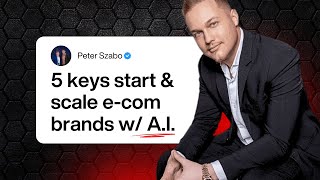
$40M/yr Ecom Client Rob Rammuny Interview | Peter Szabo's Aicommerce System

Interview between Peter Szabo and Rob Rammuny about their 10+ year relationship and a past client engagement. They met ~10 years earlier at a mastermind in Dallas; Rob is 31. Rob hired Peter to help launch a supplement e‑commerce brand (morning energy / nighttime sleep). The business went from zero to about $4 million per month in roughly six months after finding winning ads; early months required planned losses for testing («buying data») and training ad platform pixels. Discussion covers team specialization, the hockey-stick scaling effect of ads, modern advantages (pay-as-you-profit financing and AI lowering costs), and caution that Rob’s result is exceptional — a client survey of ~312 respondents showed an average outcome of $29,000 for those who took action. Peter also notes he has ~16 years in the industry (started at age 11).
Questions this video answers
31
Zero to $4,000,000 per month in about six months.
Approximately 312 respondents.
$29,000 (average).
About 16 years (started at age 11; turning 17 next year).
Chapters
Now let's take this back to day one, right. I flew out, Rob here to Dubai. We have this beautiful sea view. But we met like what, 10 years ago.
10 years ago, wow. In Dallas actually. Dallas, Texas.
Yeah. One of these masterminds. We had a, same mentor there back in the day.
Yeah.
How do you, how do you remember that day?
Well, I remember you stood out the most because you were the talk of the Mastermind because you, you flew in from, you were in Slovakia, I think, still Italian. You were 17, so you couldn't get in the country by yourself. So you fly your parents in with you. And I just remember everybody bragging about this 17 year old wonder kid who's right, who's running this big advertising agency at the Mastermind. And I remember like a couple hours later we had an opportunity to meet.
Yeah, I think you were the second youngest there, like maybe. How old are you right now?
I'm 31.
31, okay. So like four or five years older than me. Right. So I could connect you with the most and immediately like you were kind of helpful as well. I looked at you as a older brother, almost like a mentor of mine as well. And yeah, can we fast forward a couple years? So we met there, we hung out, became friends, and then when did we start working together? First time?
One or two years later.
One or two years later. Right. And that was the supplement company for morning energy, nighttime sleep.
Yeah.
Right, right, right. So tell me about that. Like why did you decide to bring me on?
So one of the things that I've, I've learned is that you can have the best product in the world, but if nobody knows about it, it's not going to sell. But the alternative is also true in the world. You can have the worst product in the world. Everybody knows about it and it will. So think about McDonald's, right? I mean nobody, nobody really likes a McDonald's hamburger, but yet it's one of the most biggest selling or one of the highest selling burgers in the world. Why? Because they're everywhere. They have great marketing. Right. So when, you know, I wanted to start going into E commerce, I didn't have a background in E commerce. My background was in real estate. My background was in consulting. My background was in other things, but was not in E commerce. And one of the, my mindset has always been if I want to do something, find the best person in the room and learn from them to avoid failure. So obviously I'd known about you from the Mastermind. I knew you were literally the best at what you did, you at that time, I think you already built it for like 200 e commerce brands, some in the supplement space as well. So I said it makes sense to have a conversation with you and have your team and yourself help you build a brand.
Makes sense. And so walk me through it, like what was the experience like? Right. How was it working with myself, my team, the onboarding, the day to day.
I mean professionalism, right. Obviously we have more of a friendship now, but I, I got to see you on the professional side more so than the personal side. When we first started working together and just through our times together, you know, professional turn, personal. But on the professional side of things, it was great. Like communication was, was instant. You always gave me an update. You set really good expectations. You said, listen, like in the beginning, initial amount of money you're going to spend on ads, it's just for testing and buying data. So I really appreciated that you set clear expectations and honest expectations from the get go. You didn't say, look, you're going to become a millionaire overnight or you're going to make tens of thousands of dollars overnight or anything like that. You said, you literally said to me, expect to fail, expect to lose money in the beginning, but if you trust the process, it will work out. And you did work out. So I really appreciate that, I really appreciate that. You have a diverse team.
Right?
Right. So from web developers to graphic designers to copywriters, you really had everybody who was in their areas of expertise. One of the biggest mistakes that I've seen with working with smaller individuals is they try to be a jack of all trades. And sure, maybe in 2010, 2005 that would work, but in 2025 you really going to work with a team who has specialized information, who has specialized product knowledge in their realm and you got that.
Appreciate that. And can we talk about a little bit, the numbers and timeline, if you don't mind sharing? Like what was the business doing when you first started, what was it doing by the end of it and what, what was the timeline in between those two points?
Yeah, so I mean when I came to you was just literally an idea in my head. I'm like, I wanna, I wanna, I wanna do supplements and I want to do it in this particular niche. So you helped me do like the product research, you really helped me dial in the niche, you know, the marketing plan, you set, the advertising. So when I started it was that it was at zero, right? It was, it was at zero and then we went from zero to 4 million a month. In six months, I think. And people hear that number and they're like, wow, that. That's so fast. But again, it goes back to what you talked about, where, like, the first couple of months were just dry, right? It was not a lot of momentum. But what. What really you did is you stayed true to the process. And what I did is I just trusted the process. I didn't really understand what was going on. But because you set the expectation from the beginning, I said, this guy has done it before. He's done multiple times. He's doing it right now. He's. He set the expectations in the beginning. So even though I don't understand, I'm going to trust the process. And then, like, you talk about your concept on return on ad spend. Like you said to me, you know, we'll test with smaller budgets until we find an ad where you can put a dollar in, you can get two, three, four, five dollars out. And that's what happened. We eventually found an ad that, you know, you put a dollar in, you're getting two, three, four, five dollars out. And at that point, it's just like, the more money you put in, the more money you get out. And at that point in the business, I was just like, all right, well, let's just double down. Let's grow aggressively and soft the races.
Yeah. And that's very typical, by the way, in the sense of the hockey stick effect. Right? Like, you start very slow, and eventually it explodes. Right? I've seen that with most of my clients. It's very rare to launch the first ad and make a 10x return overnight. Right. Like, typically, you start very slow. And that's what I recommend anyway, because in the beginning, you don't necessarily want to risk a huge amount of capital just to figure out it didn't work. Right? So we started slow on purpose. Right. Eventually we started finding some winners. And we were discussing this earlier that the beauty of E. Com is you can scale very fast, right. It's not a typical traditional business model where you have a local business, etc. And you want to double, triple, quadruple the size of it, you need to get all this, you know, extra staff, extra, you know, land or extra property with ecom, if your numbers make sense. And eventually, when we start to crack that 3, 4x, right? Like, we could literally just click one button, takes two seconds to do, and we could start doubling, tripling 10x in your ad spend. And that's how you got to those big numbers. Even though initially we started with, like, a couple Hundred bucks a day.
I'll add on something that, that you said people see the fast growth and they focus on the fast growth, but what they don't see is what's behind the curtain.
Exactly. Right.
Like, what they didn't see is we went, you know, one, two, three months with just like someone's in the. In the red.
Yeah, right.
In the red. Losing. Losing money. But you set the expectation very clearly.
That.
And you really frame it to me really well. You said we're not losing money, we're buying data, and we're using that data to see what works and what doesn't. And through finding out what works and what doesn't, that'll get us to that winner.
Exactly.
I think the big problem that is in the market today is people see. Grow your E commerce business to 10, 20, 30, 50,000 per month, which is. Which is possible, Right. If you're willing to trust the process, if you're willing to go through a little bit of pain, and if you're willing to go through a little bit of loss. Like, again, I love. I love gym analogies a lot, right. If you think about. If you think about whether it's muscle growth or fat loss, either one of those outcomes require pain. Resistance in the muscles is how muscles grow, Right?
Exactly.
It's not fun being on the cardio machine 45, 60 minutes, dual resistance training, right? But it's. It's that work that makes it work.
There's really two parts to that. Right. When I said you're buying data, you're not just wasting money is a. You're learning what works and what doesn't work. Right? Because even each campaign that you figure out or each audience created, that didn't work is a stepping stone closer to what will work. Right? You're gathering this data and it's giving us that acuity that, that pattern recognition that, okay, this message, this audience doesn't seem to resonate. Maybe there's a little bit better results here. So let's double down in that direction so it helps you move forward. And then buying data also means that you train in the pixel, right? So without getting too technical, Facebook, Google, etc. They have this AI and the more data you, you know, send it, the more you spend on ads, the more accurately they can target people. If I want to keep it simple, just think of it as like, they have a list, right? And on that list, each time you get a customer, it gets added to that list. And they have, like, millions of data points per each person, so they understand like, okay, this is their typical age, where, where they reside, what pages they follow, what content they interact with. So they start creating this perfect avatar of your ideal customer. And the more data you've acquired, the more you train the pixel, we call it the essentially the more you spend on ads, it's going to be able to target those people, bring your costs down. So in 99% of cases, that's how it works. And I think that applies to any business, especially E Comm. Is you start with a little dip, but then eventually you get your numbers, you optimize your numbers, right? Because we spend some time making sure the storefront looks optimal, the brand, all these conversion elements. You get the right metrics, then you can scale really fast. And that's what unlocks this exponential growth.
Exactly.
So last question I'd ask you is if somebody's on the fence, considering working with myself, my agency, what would you tell them?
I mean the obvious answer is do it right? But the, the, the, the not so, the not so obvious answer is it's like we were talking about in, in a different video, which is, which is the dream typically stops at the door, right? Which means everybody has a dream, everybody has aspirations, but the moment they get to the door and they see what's on the other side of that door, which is work, they just, they just turn back around, right? So I would say in this example that when they get to the door, it's fear, right? And fear of being burned again, fear of losing money, fear of what if it doesn't work out. Some people have fear of once it does work out. You know, being in business now, for, for, for 22 years, I've, I've seen a lot, right? And the, the biggest thing, knowing what I know now, if I were to meet you today, pretending I never knew you before, right. The, the one thing that I would look at that stands out to me about you is that you have a 15 plus year track record in a very, very good reputation. There's a lot of things people can fake online, but one thing you can't fake is a 15 year reputation. There's a lot of people that are here today, gone tomorrow, here for one year, gone the next year, right? But the fact that you've maintained a 15 plus year track record and you've done it in the E commerce industry, like, I mean we're in person development as well, when you also taught E commerce there as well, but you sustain a 15 year track record specifically in E commerce and now AI and like your reputation is very, very strong. And to me, that's not something that could be fake. Because if you weren't, if you weren't who you said you were, you change your name, you want to be around for 15 years, someone would be complaining, right?
And we've seen those people around, right? Like we've been doing this for a minute. It's actually 16 now, going to be 17 next year because I started when I was 11, which is a whole crazy story on its own. But there's another important point I wanted to make, which I just remembered is when we started working together, right? Like back then there was no such thing as pay as you profit financing, right? So Rob had to invest at least a few thousand a month just for management fees, right? And then plus ad spend, things like that. So nowadays it's a little bit easier, right? Like when you have these pay as you profit options, you can only start with a couple hundred bucks a month or maybe 500amonth. So that way some people have an advantage these days. Also with the advent of AI, a lot of the things can be done with AI, so we also have lower cost. It's still overseen by humans, right? So I think that gives people an advantage now versus back in the day, you had to have some money, right, to like get started. At least a couple thousand a month. I also want to put this out there as maybe one of the final comments is Rob's result is pretty extraordinary. Like he's a great entrepreneur, he put in the work time, etc. So I don't want to claim that you'll be also making 4 million a month. That is why we've done the surveys. I think around 312 clients responded to it. And the ones that took action like Rob did made $29,000 on average. So with that being said, if you're interested, you can check out the stuff below. Anything else you want to add?
No. Appreciate you having me on. Appreciate you bringing me to Dubai, man.
Love it. All right, thanks for watching.
More from Peter

278 Profitable Campaigns Documented Over A Year – Peter Szabo's Aicommerce Results
AI Commerce Client Feedback From Weekly Calls (for Peter Szabo's Aicommerce.co)



"I Felt Torn In The Beginning" | Wife & Husband Review of Aicommerce by Peter Szabo