How to Build Systems (so your property management company runs without you)
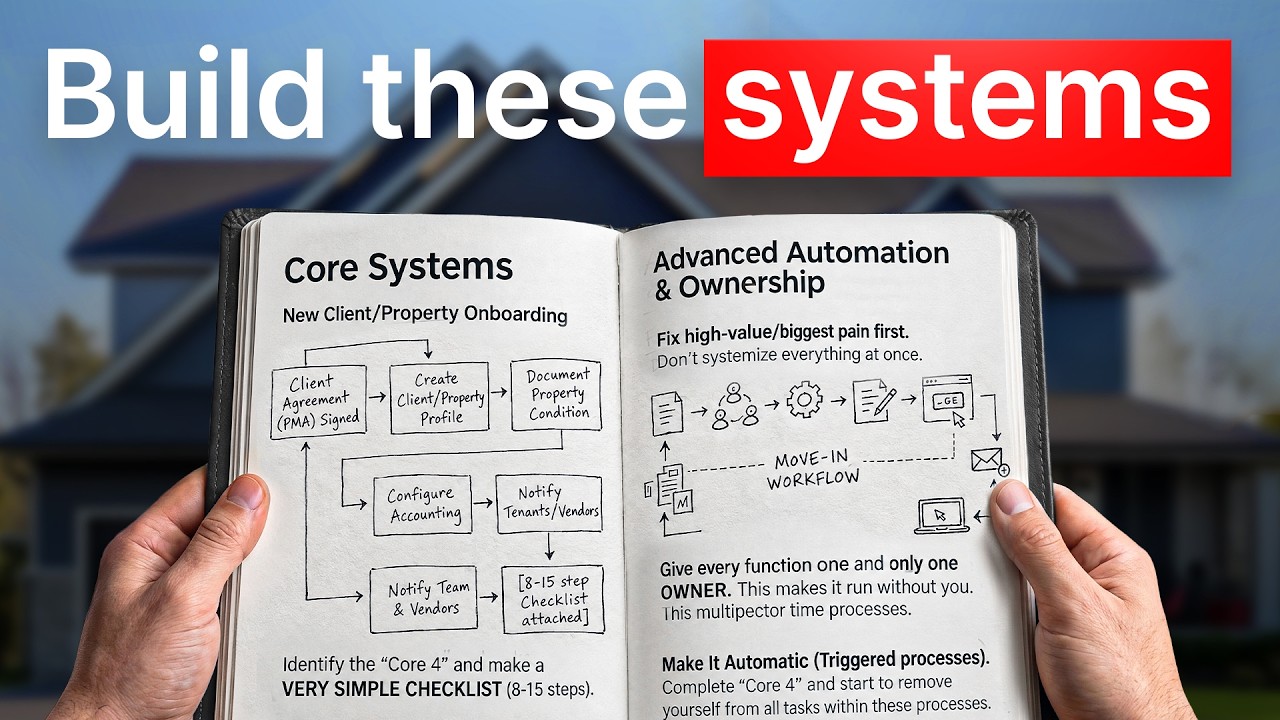
Peter Lohmann, who manages 700 rental doors, shows how to stop being the bottleneck in your property management business. Start by mapping four core processes (onboarding, move-in, renewal, move-out) into simple checklists, digitize them in workflow software, assign owners to each, then gradually remove yourself from every task. The goal: a month off each year while the business runs itself.
Chapters
This video is sponsored by LeadSimple. More on them later. I run a property management company with more than 700 doors. Every June, I take the whole month off. I don't check email, I don't take calls, and when I come back, nothing's broken. In fact, the business is running better than ever. It's worked that way for 4 years straight, and it isn't because I got lucky with great hires. I'm an engineer by training, so I built the machine to run the business instead of trying to run the business myself. And in this video, I'm going to show you how to build your own machine. So most property management business owners don't actually own a business. They own a job. That's the unfortunate reality. Maybe you feel that way if you own a property management business yourself. I know I did when I first got started. When you have a job instead of a business, everything runs through you. Every decision, every exception, every problem, it all lands on your proverbial plate. That is not fun. I've been there. I lived that existence for many years. Your team, you hire great people, train everybody, you tell them what they should do, and still for some reason it feels like you're the one always running around putting out fires, dealing with problems, getting on the phone with the toughest customers and the vendor who didn't show up and the tenant who says their neighbor's cat attacked their daughter, blah, blah, blah. Everything comes to you and it's crazy making. You're just like, I got into this whole thing to own a business. I feel like I'm babysitting. It's the worst feeling in the world. After a couple years in the business, I started to think about my background as an engineer. How can I take an engineering approach to property management and turn this into something that's more of a system, more of a machine that's going to free me up using principles of engineering? And so I was able to do that. And in fact, I was so successful at it that I take a month off every year now. What I'm going to do in this video is break down exactly the systems that you can follow to free yourself from your property management business. We're going to start really simple, and I'm going to walk you through the exact steps that you can go through in order to get your business feeling more like a business and less like a job. We're going to use principles of systems engineering, and we're going to build a series of processes that are going to free you up from the business. They're going to free up your brain, they're going to free up your time, and they're going to make your business actually fun to own again. I'm really excited to share this because this is What got me able to take that month off every year. And when you're able to take a month off every year, amazing things start to happen for you. You have better quality of life. Your business runs better even when you are there, let alone when you're not. Your business can continue to grow and hire people and fire people and fix systems and deal with problems without you having to be personally involved every step of the way. Let's get into it. So how do you actually do this? What are the first steps? Well, we're not gonna try and boil the ocean and do everything at once. What I want you to do is think about the core processes that your property management business executes over and over again every month. Every property management company has 5 or 6 of these absolute core functions or core processes that they execute repeatedly. And I like to start with the core 4. So let me just list them out here. You've got your new property slash owner onboarding process, your new tenant process. I like to call that my move-in process, your lease renewal process, And your move-out process. So those are your core 4 that every property management company in the United States is running every single month, whether they know it or not. And what we're not going to do is try and tackle all those at once. So what I want you to do is pick one of those and we're going to walk you through the steps of how to actually document and systematize that process. That's going to be the building block or the foundation for the rest of this video. Most of these processes at your business are either undocumented, poorly defined, inconsistently executed, or all of I know that's how it was at my business when I first got started. That's leading to errors and mistakes. That's burning up tons of your team's time and probably your time as well. And that's what's keeping you chained to the business in firefighting mode. So what I want you to do is pick one of these 4 processes, get with the person who's actually doing it, and write down every step in the process. Basically, we're gonna make a checklist. So whether that's you or you, if you're the person doing, say, the move-in process, Or if it's somebody on your team who's doing it, sit down next to them, grab a piece of paper. It doesn't have to be fancy software. In fact, it's better if it's not to start and just say, okay, when someone signs a lease, what's the first thing that you need to do in the move-in process? First, we need to upload a tap folio, blah, blah. Okay, great. Write that down. What's the next thing you need to do? Well, we need to accept the security deposit and record in the system. Okay, great. Write that down and go through that whole process with them and get it all written out. Not in detail, just In a checklist format. And when you're done, review it with that same person and get clarity on like, okay, is it— you're actually doing this, not before this? There may be a little bit of like reordering and rewording. That's fine. Get it how you both like it. And this is going to be the cornerstone of the improvements that we're going to make. And I'm going to walk you through for the bulk of the rest of this video. Okay. So once you have that where you like it, and by the way, I encourage you to keep this simple. Do not use fancy workflow software. Don't try and automate this. Don't try and create detailed step-by-step instructions yet. I want you to keep it Really simple, and I want you to take that, make it digital. It can be as simple as a Google Doc with checklists, or you can get some basic workflow software. And I want you to get your team using this. The key to this whole thing is every time you sign a new lease, or every time you a tenant moves out, you execute a new version of the checklist. As you've been using the system for a few weeks, you want to get to the point where you have five or six or ten copies of the same checklist—one for each property or client or tenant or lease. That applies to it. For example, if we're doing the move-in process and you signed 8 leases over the last month, you should have 8 copies of that checklist. And the checklists, of course, are— some of them are going to be fully completed and some of them are going to be partially completed and some of them may not have even been started yet. And that's all totally fine and normal. The key is you're going to have in your software 8 copies of that checklist that you can reference and that are labeled with the specific tenant or lease or property owner or whatever it is. And it lets you see what's going on with each one. That's awesome. If you can get to that point, now we're ready to move on to the next step. Real quick, this video is sponsored by LeadSimple, the software we use to run process automation at my property management company. We use it for the core processes including onboarding, property maintenance, lease renewals, move-outs. It keeps my team from having to manually chase down every step. LeadSimple integrates with all the major property management softwares including AppFolio, Buildium, Rentvine, PropertyWare, and more. It streamlines our phone system by automatically handling calls, Or routing them to the right person. It knows who's calling, whether it's a tenant, an owner, or a vendor, because it integrates with our system and it gets the caller to the right person immediately without using a phone tree. If you wanna see more and watch me build a full lease renewal process in LeadSimple from scratch, click the link in the description and you can follow along. Thanks again to LeadSimple for sponsoring this video. Your next step is to move this into some type of real workflow software. In terms of workflow software, you can use the built-in tool to your property management software. Whatever it is, you just wanna make sure that It's capable of having different types of process templates and the ability to create a new instance of that process for every new tenant or every new owner or whatever the process is. And it should have the ability to have multiple people able to view that checklist and check off different parts of it. And you should have the ability to have an overview so you can see what is the actual status of all of these checklists or processes for each individual property. So you should be able to go to some type of overview for the move-in process and see, oh, 123 Main Street is halfway done with the move-in process. 456 Main Street, they haven't started it yet. 789 Main Street, oh, everything's done. Great. I see it's been fully completed. And this is going to power up your business and your life in several really important ways. The first thing is you're going to be able to see the status of every process. You know, is it done? Is it not started? Is it completed? Is it partially completed? The ability to just see where everything's at in your business for each of these processes is huge. The second thing is you're going to have a written record of completion for every step of every process. So if ever some kind of discrepancy, someone accuses you or saying, oh, you never did this, or a team member saying, no, I actually did do that, you can go back and say, you know what, we have a written record. I can go and see exactly who checked off which step in which process on exactly a specific date and time. That's the power of this type of software. There's, there's no more finger-pointing. You know exactly who did it, when, and whether it was done or not. Number 3 is it gives you the power to easily update and improve these processes as you go. Part of the problem with written records or written processes, they become instantly outdated because we all know business is changing constantly. So as these things change, the power of these systems is all you have to do is go into the base template, make your change, whether that's something simple like a typo or you want to reorder the steps in a process or you need to add a new step to the process. You do that in the template once and now every new version or every new move-in, every new move-out, whatever it is, is going to use your new version. And you're completely confident that any change that happens in your business, you just update the process once and everyone who runs a future version of that process is guaranteed to be using the The fourth thing that this is gonna do for you is it allows you to add instructions to each step. Once you have your basic checklist in the software, the ability to add instructions on how to do that specific step is a superpower because for one, it makes sure that everyone is doing it the same way every time because the written instructions on how to do it is right there. For two, it makes it really quick and easy to hand off parts of the process to different people on your team. So let's say for example that you're the one who's been doing everything on the move-out process because you wanna make sure the security deposit is handled correctly and everything else. Once you've got this documented and in some workflow software, you can reassign parts of the process to different people on your team. So you can say, well, uploading the move-out inspection to Dropbox, we can have Jeff do that, right? So you just reassign it in the software to Jeff. Now every future version of that process that you run, Jeff is going to automatically be assigned to do that step. And you can keep the important parts of that process if you want to and leave those assigned to yourself. So this is incredibly powerful, and it's the first step in getting you out of the day-to-day of your business. And the fifth thing that this is going to do for you is having the processes at your business consistently executed correctly is going to free you up in an unbelievable way. Just getting these core 4 property management processes documented and into workflow software. And once you've got this system going, we're going to go into more about exactly what you need to do. You wouldn't believe how much your brain and your time is going to be freed up to work on more important things. Here's a mistake that some people make when they get going on this. They see the power of what's possible and they start trying to do everything at once. I know I'm guilty here, but what you need to do is make sure that you're just doing most important parts of your business in kind of a slow and methodical way as you roll it out to your business. So pick the key functions at your business, your key processes, start with those core 4 I mentioned, do those, get comfortable with the software, get your team onboarded and go from there. Don't try and boil the ocean here. A couple tips on building your checklist. You do not want to build for the exception. You want to build your checklist, your process for the common case. The most common mistake I see people make when they're building a process is they try and cover every possible scenario, every edge case, every exception. They want to get fancy with conditional logic and every single thing is in their checklist. That's too much. Your team is going to hate you. You got to keep it simple. Exceptions are where someone with a brain raises their hand and says, all right, let me go ask somebody about this rather than just blindly following the checklist. The more you try and encode those exceptions or edge cases into your checklist, the less powerful it's going to be ironically. It's gonna be clunky, unwieldy. It's gonna get mistakes. It's gonna become outdated because no one wants to go in and fix and update it because it's so complicated. Leave all that aside, build it for the common case. As you start to build it out and get to the point where everything is documented in the process, Here's the test to know if you're done or if you've succeeded with that process. Could somebody with no training sit down in front of a computer and run through that whole process without you? If so, congratulations, that process is now done. And yes, it is possible to get to that point. If somebody has to raise their hand and come ask you, or, oh, where's this document? I didn't see a link. Go back to the process and add more instructions step by step. And I think it's really important that the instructions of how to do the process are where the checklist actually is. Put how to do it where you do it. You don't want to have like some separate notion explaining how to do the move-in process. You want to have your move-in process, which lives in LeadSimple or whatever, and how to do that move-in process should be built into that same piece of software right where they're doing it. That's the best case scenario. So as you get going here, there's something else I want to make really clear. Every process needs to have one owner and only one owner. So your move-in process needs an owner, your move-out process needs an owner, etc. Now maybe that's you and that's That's okay. But as your business grows, you should delegate these processes to other people. Now, there are going to be different parts of the process that other people do. That's fine. I talked earlier about how this step and that step may be Cindy. These other 4 steps are Jeffrey. And then you as the owner have a couple steps you want to take care of. That's fine. That's great. But there should still be one owner of that process. And that person is accountable for making sure that all of these processes are getting done right and getting done on time. So they're the one who goes and follows up with Jeffrey, follows up with Susie and say, hey, your stuff's not done yet. What's going on? Do you have a problem? Do you have a question? Let's get it done right. And they follow up and make sure it's done and it's done right. There's an old saying, the fastest way to starve a dog is to make 2 people responsible for feeding it. That's why you can only have one person accountable for each process. If there's 2 people, you're back to the starving dog situation. So everything I've just described sounds simple, but I guarantee when you go to start implementing this in your property management business, you're going to run into roadblocks. And you're going to be like, where's the map? This wasn't talked about in the video. That's why I started my newsletter. I write a weekly newsletter for 20,000 property management operators telling stories, solving problems, and sharing benchmarks and numbers from my own property management company here in Columbus, Ohio. I'm sitting in the office right here. So if you want to learn what other property managers are doing, best practices, software they're using, solving problems, what conferences are coming up, and way more, subscribe to my newsletter. It's free and the link is in the description. Now let's make it automatic. So if you've built your core 4 processes, it's time to take things to the next level. Step 1, make sure your team is using the new system and make sure they're really using it. Go around to everyone who's involved and ask them, hey, are you using XYZ, the new process software? How do you like it? What are the problems? Where are the errors here? And actually, I really encourage you to empower your team. Go into the software and give them the ability to edit the checklists. Give them, empower them and say, hey, if you see a typo, if you see a broken link, if you see a description that's missing, If you need to add a step or reorder it, go do it. Make the change and let me know so I can take a look at it. But I want you to feel like you really own this. You'd be amazed at how they latch onto this and really they're gonna take it to levels you never thought imaginable. You're gonna come back in a few months and they're gonna have built it to the nines and you're gonna be amazed at how streamlined and effective these processes now are. That's the next step is you gotta get your team on board, make sure they're using it and really empower them to make it their own. Finish out the remainder of your processes. So we talked about the core four, but most property management companies have a few other core processes they're regularly doing. Think about maybe like a collections or evictions process, a de-management process, even something like a new employee process or checklist. So go ahead and build out the rest of those, and now we're ready to move on. Step three: Start removing yourself from these checklists. This is the best part. But now that you've got these all of your core processes that your business are documented. And they have written procedures and processes. Go into the software and start removing your name and your little profile photo from all of these processes step by step. Don't do it all at once and let your team know what's going on. Obviously, whoever you're just replacing your name on each task, let them know about that and give them some training if needed. But this is the step that people, they get to this point and then they become scared and they're worried, well, only I can do the security deposits or only I can sign the PMAs. That's not true. I promise you, that's how I take a month away from my business every year. Get to the point where you have competent people on your team that you can reassign to these things and empower them. They're gonna be thrilled that you're giving them an opportunity to level up in their career. They're gonna be challenged, they're gonna learn new skills, and they're gonna feel a new level of accountability and responsibility that actually feels good because they know that they have your support. And if there's a big problem, you can always step back in, but you never know until you try. So I really encourage you, start getting your name off of these processes. And the last step is let's automate. The more advanced Advanced workflow software is going to let you kick off these processes automatically. So rather than relying on somebody's memory to say, "Oh yeah, we got to go do the move-in process." So and so just signed their lease. You can set it up so that other processes or changes in your property management software or dates or form fills can trigger new processes to start. So dig into your software and figure out how all that works, and ideally get to the point where all of the processes in your system are triggered automatically. You're not relying on somebody's memory. You can get creative here. I really like. Like form fills. So for example, if a tenant submits a move-out notice, which should be like a Jotform or something on your website, that should automatically trigger the move-out process for that tenant. And it will assign the first person the first step on that task, which is probably something like contact the tenant and confirm you have all the details needed for their move-out and confirm their move-out date. It's a beautiful thing. So once you get to the point where all of your processes are automated in this way and they're kicking each other off and they're like, you don't have to remember to go in and do Oh, it's a beautiful moment. Now you've really built a machine. So let's bring it back to June. The reason your company can run without you isn't luck or smarts. It's taking a systems approach to reorganizing your property management company around a series of core processes. You can do this and it can lead to time freedom. That's something I'm very passionate about. You're going to notice I haven't talked about door count. If you've ever been to a property management conference, you know that everyone's obsessed with how many doors do you manage? What's your door count? That's great. And I love growth. That's important to me too. But what's even more important than growth is the ability to have time freedom and actually get away from your business and feel like you don't have a job. You actually own a business. That's what this video is about. It's about documenting and systematizing your core processes so that you can step away from the business. And by the way, it's easier to grow your business and add doors when you're not chained to it and being run ragged by every little task and problem and decision. You can do that with using the steps in this video. You map the core processes, you give each one an owner, you keep door count out of it, and now you've got a well-oiled machine that runs without you. What's your reward? Time freedom. That's how I get back an entire month every year. If you want the open book teardowns and all the numbers from my newsletter, you can subscribe for free. The link is in the description. I'll see you there.










