Video (media leverage) for business owners: Early Lessons Learned
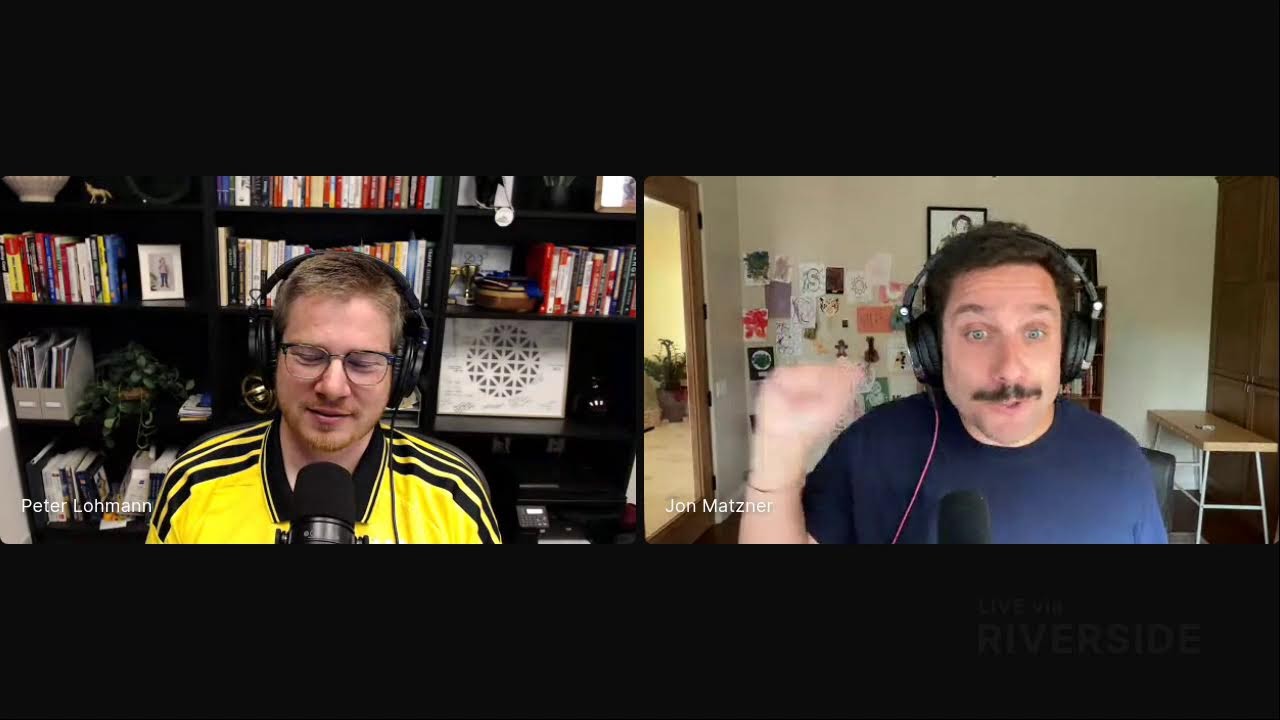
John and Peter S. Lohmann discuss how video proves you're human in an AI-saturated world. They share their shift from DSLR rigs to iPhone bullet points, the "smile with your voice" technique for better delivery, and why business owners should build personal content libraries before AI makes agencies obsolete.
Chapters
Welcome back to another episode of Lazy Leverage, the internet's number one small business operations podcast, downloaded 4.836 billion times in the last 48 hours. I'm joined here by my Eagle Scout ribbon-wearing, property-managing, window-building heterosexual life partner, Peter S. Lohmann. How are you today?
I'm doing well, John. How are you? I like that you added like in 48 hours.
That's a new addition to our Well, you know, because if you can't have a bigger number, you need to do shorter time or else you just won't sell those sweet info products. So I like to really just A/B test, you know, A/B test various bullshit claims.
They say you need a good hook.
Oh, good hook. Basically, like everybody on the internet, I just make things up for attention. So, you know, this is just keeping with that trend. Today we are talking about something that you and I have informally talked about for years that we are formally involved in at various stages in various categories, both in our direct businesses as well as in our media business, for lack of a better word. We are talking about video today for business owners. How would you— there's about 50 different directions. I have a million thoughts. I've seen it. I'm good at some video. I'm horrible at other video, you know, yada, yada, yada. How do you want to approach this topic, Peter?
Well, I think it's really important. So being on video as a business owner is a superpower if you can figure it out. And we're going to talk about long-form video, we're going to talk about short-form video, we're going to talk about video podcast, uh, which is something you and I have a lot of experience with. If you can figure this out, especially in the age of AI and AI slop content, you have an unbelievable advantage over your competitors. Because video, even in the day, even in the modern day and age of very advanced AI models, they haven't quite mastered consistent video look and feel content. And so if you can speak to an audience in a way that's comfortable for you and in a way that makes the audience feel comfortable about something you're good at, your area of expertise, your domain, your, your domain of authority. There's just like the sky is the limit in terms of what you can do with that. So I think what we're going to do today is talk about a couple of things you and I have learned. I would say we're early in our journey here. We're obviously not like YouTube stars.
In some categories we're early, in other categories I feel late.
You know what I mean?
In some, like YouTube, I'm very early. In async videos to train my team, I feel very good about when and how to use it. You know, so like I'm, I'm, I'm spotty. Yeah.
So we're going to share some of our early learnings and talk about what were sort of video projects that we both have going that we haven't really talked about actually before, some, some sort of new stuff. And I'm going to talk about some of the different formats I've experimented with for short-form video.
Cool.
Uh, we can talk about monetization of video content, but, um, where do you want to go? Because there's a lot to unpack here, and I'm excited to talk about like what I've Some early stuff I figured out. Yeah.
I want to put one benefit up front to somebody listening here, which I've talked to my team about, that I think is going to be remarkably important, and you hinted at it, which is I wrote a memo to our team the other day. It'll be a newsletter at some point, and I'm calling it Proof of Human. If I send Peter one page of written text, more and more, depending on who you serve and how you serve them, There is going to be the accusation of AI, whether or not it was written. You could have taken 10 years to write it, and unless you're Ray Bradbury, somebody will still say you sent me AI. But if you turn your camera on and you use AI to write bullet points saying, how should I apologize to this customer? And you get your face on camera. And you say, hi Peter, I just wanted to personally apologize for that maintenance snafu. We've went ahead and reversed the charge. As always, I want to thank you for being a customer of RL Management. As always, I'm putting my cell phone number in this email. Thank you so much. You could have said the exact same thing as the block of text, and the reaction you're going to get in the age of AI writing is night and day, and I've already seen it in my own life. Yeah, that is another benefit. Proof of human.
The underlying theme is authenticity. And, and that's, it's always been true that authenticity is a superpower. In fact, my newsletter, I would credit like the fact that I was willing to be transparent about my business and show up authentically about like what I was good at, what I was not good at, success, setbacks, failures. I think that is why I had the success I did with that platform, with the newsletter, is because I was willing to be authentic.
Here's the issue though, which— and it's, it's, it's a cousin to authenticity, which is even today, if you are authentic, I do not react to authenticity in anything but top 10— sorry, top 1% of the written word, because everything else below that, I immediately Discount it because I'm like, well, this could have just been like one prompt and no slop AI skill. Whereas the authenticity of video on camera or audio, I'm like, ain't no way. Yeah, AI ain't sending Loom videos.
This livestream is, you know, we're a ways away from being able to reproduce that.
Nobody is doubting that you and I are having this conversation. But if I say get my free email course that is 5 tips to building leverage in your life, everybody's going to be like, brah, Again, depending on what sector you're in, but more and more, it's going to become a thing. So people are not going— people are going to immediately associate the written word with a lack of authenticity, in my opinion.
Yeah, exactly. I think that's exactly what I'm saying is like video is a way to come across authentically in a world that's increasingly driven by AI slop. And so what I think business owners have that the average person does not have is If you go on TikTok, YouTube Shorts, Instagram, whatever, you're gonna see a bunch of people trying to make a living on the internet. Okay. And they're going to be watching a bunch of videos about how to make content and they're going to try to become influencers and try to sell you stuff and try to resell and try to like do TikTok shop and try to like become a travel influencer or make videos about the new iPhone and stuff like that. Um, you don't have to do any of that as a business owner because you already, you already have a built-in domain of expertise, which is the business that you're currently running, which is an unlimited source of content.
It's vertical integration. It's, you know, people say in the future every company will be a media company. Like, why would I try to sell a $19 property management guide when I could just sell property management coaching? Or what, you know, or maybe that's not the best example, but like, Because coaching has a negative connotation these days.
But I know what you mean.
But like, like, like, you don't have to make money in the media business. The media business can fuel a wealth of other ways.
Exactly. Which is, you already have a way to monetize your audience, which is the business you're already running. So you really have 2 things going for you. One, you have an unlimited source of content and instant authority because you can say, hey, I'm the owner of Point the camera at the sign on the door. This business, we're a bakery. You know, we, you know, we produce 10,000 loaves of bread a month or whatever. Yeah. I'm going to tell you about something that happened the other day when our oven broke and how we figured it out. Right. You're already interested, right? This guy's a baker, his oven broke. What the fuck would you even do? Like, how do you solve that? So that's the first thing.
You're also not like, oh, we got demonetized. Like, who cares? I don't use ad rolls.
Yeah, exactly. You don't have to worry about that.
That's the other thing that's nice.
Yeah. So the other thing you have going for you is the way is your built-in monetization is your business that you're already running. So you don't need to like get people to go download your ebook that you're selling for $19.99. Like your example, you can just say, hey, and if you like what we're up to, come on by the bakery and I'll give you a free sample or whatever. So now it's a little different because like for, for my example, like my property management business, I've never gotten a customer from media who, who hired us to manage their property. So I ended up having to create a kind of a different way to monetize my audience, which is Crane. And sponsorships in the newsletter and the podcast. But that was all made 1,000 times easier by the fact that I had a built-in— but by the fact that I was already a business owner is what I'm trying to say.
So I will mention an aside, and I will not be specific because I don't want to throw anybody under the bus. But there is somebody who a few years ago was very active in the internet worlds where I circulate in a particular home improvement category, which is a very difficult category. And They they were trying, you know, talking on podcasts about all this growth and sales and all this stuff. And I spoke with them recently, and now they are full time in content creation. And it is a hundred. Now they're using the fact that they used to be in that industry, and it's a hundred times easier. Like it's just you know how hard it's not a plumbing company, but you know how hard how much easier it is. to run a plumbing YouTube channel than it is to actually run a plumbing company.
Totally.
And it's actually, frankly, a little bit of a rarer skill in my opinion. Meaning if you have the gift of gab and you like, and you have taste, and I would actually argue that the reason why it's easier is because there's less people who can make good plumbing content on Instagram than there are plumbers who can replace a water heater.
That's right.
I actually think it's a little bit of like the market rewarding what's more rare.
It is more rare right now. And that's why I want to talk to our audience about it. Because I think there's just like, so my experience with video, which we're gonna get into is like, there's only like a couple things you have to figure out, and then it becomes 100 times easier. But it is very difficult if you don't kind of figure out some of these basics. So To get a little more into it. So you and I have both separately hired different YouTube agencies or YouTube people to help us with YouTube content. So if you go to my YouTube channel right now, you'll see there is one fairly new long-form YouTube-first video. It's not a podcast. How's it doing? It's not doing very good. And I'm going to tell you why. Uh, it's not a podcast. It's not a, uh, recording of me giving a talk on stage. It was literally a video made specifically for YouTube. Which is its own flavor and its own type of thing. And you've also been messing with this as well. And the process of making that video was really hard, even with like a total done-for-you agency who prepared the script, interviewed me. They do the editing, they do the uploading, they do the thumbnail, they do the title, they do the tags and the description and all that. So all I had to do was like, here's the script. Turn on your camera and go. That is really hard. I don't know if you've done this yet, John, or if anyone listening has done this. If you turn on a camera without anyone else and, and, and like the expectation in your mind is I need to make a 15-minute YouTube video, it's me and the camera. There's no one to talk to. There's no one to ask you questions. There's no one to like make little funny comments in the chat. It is very hard. It's very hard. It's a completely different skill. I could talk for hours on, on podcasts and have done so. I probably have like many, many, many hundreds, maybe over 500 hours of speaking on a podcast on video and knowing that it was being recorded and knowing that people were watching live or watching the recording. Something about someone else being in the room and having a conversation, which is something all humans have practice with.
Yeah.
Is so different than like you're looking at a camera and it's like a dead room. There's nobody there. It's so hard. So, but I'm going to talk a little bit about some ways I got better at it. You, you actually had some really good like feedback for me with my early videos. Um, so yeah, but hopefully, hopefully what we share is going to help other people shortcut some of the learnings that I had.
It Yeah. I mean, it's— I think an important thing to say here that has helped both of us, and it's why I'm kind of begrudging and I'm getting— not getting in a pissing fight, but arguing with the YouTube folks, which is I'm like— and we've talked about this before, about how I'm very much allergic to certain types of stuff that, oh, the algorithm wants you to do that, that kind of stuff. And, and I, I've realized a huge part of this for me is creating a form that plays well in the medium, but that I enjoy. Because if I don't enjoy it, what's kept me on Twitter is that I have fun. And you and I've talked about this for 50 episodes. And what I realized that I'm now landing on, and I'm maybe it's just an insight that I have as I'm walking down this path, is I saw a first set of videos that were proposed posed to me. And it was like, oh, you know, there's this one called 10 Boring Businesses I'd Love to Buy. And you know, the boring business category on YouTube. And I was like, if you send me another video like this, I'm going to quit. Like, I'm just going to quit. But then I talked to him because this is where you need an expert. And it was like, what about 10 boring businesses you'd have to pay me to own? And I'd say, I love that video and I can't wait to make it. And so you can still, and you can still play to the algorithm because the term boring businesses does well on YouTube because it's a category, whatever, but you can make it your own. And so for me, that is, as I'm entering potentially this medium, like if you don't like talking to a camera by yourself, there are ways to play nice to the YouTube gods that aren't like pulling your hair out because you're going to do this for a month. And then you're gonna say, I don't want to do this anymore. So you might need to—
Have you made— have you done this though yet? Have you recorded a video yet?
I've done it before. Yeah, yeah, yeah. I've done— not, not in the current form that it's going to take, but I have opened up a camera and shot VSLs and walk and talks and over the shoulder stuff.
I can't wait to hear like your, your current present day experience with it.
The difference is, is that you have to remember though, I'm a sales guy and you're an engineer by training. So you have to like, as much as you and I have a ton in common, I love the sound of my own voice.
I, so I get into it. Like, the hardest part is starting. Like, after I get kind of get warmed up and get, get a little bit of the jitters out, and I get in a rhythm, I can get going. Because you've heard me go on rants. Like, I can go on a rant. And like, if I can get into that mindset and go on a rant to the camera, it works. But it's like, the beginning is so hard, because you're so conscious that people are going to be watching it. It's very— you're in your own head about it. It's very difficult.
I struggle with— the place where I struggle is I struggle with short form. Because I dislike it so much because it feels so—
I'm gonna give you a tip for this.
It feels trivializing to me.
I'm gonna give you a real hack for this. Okay.
But I struggle with— it's not talking to a camera. It's short. Hey, I'm John and I've done 3,000 hires in the last 3 years. And if you want my top 3 tips for hiring your first global talent—
No, no, no.
I just can't do that. I can't fucking do it.
Well, I want to talk for a second about why we're leaning into video. So I can speak for myself, see what you think. So I don't— I'm not interested in becoming a YouTube, like a YouTube star at all. Like, I have no interest in mastering video. I've never been like interested in video cameras or YouTube or anything as far as the creator side of it. So it's not because I'm like, oh, I'm really into video. Like, no, I'm not.
Maker. Yeah.
I'm not at all. But the reason I'm doing it is because YouTube and short-form video is one of the Is one of, is one of a very small number of algorithmically driven platforms. So the 2 platforms that I'm kind of quote big on, not big, but like in our space of property management is emails and podcasts. That's like my 2 kind of cornerstone media.
Horrible discoverability.
Zero discoverability. There is no algorithmic discovery whatsoever. The only way to read an email is to be on the sender list, and the only way to get a podcast is to subscribe to the feed. So it is very, very hard to grow a platform, grow an audience on those 2 platforms. Someone has to literally manually subscribe in order for you to gain. Whereas with short-form video and YouTube, as you know, anyone who's used a phone in the last 10 years, when you pull up any of those platforms, you are not getting videos from your, from the people you subscribe to. You're getting random videos that the algorithm thinks you're going to be interested in. So if you flip that around for the other side, what that means for the creators is if they make good content that's interesting for property managers, the algorithm will serve it to property managers. They don't need to know those people ahead of time. They don't need to get them to click subscribe. Now later after the fact, they might subscribe and that's valuable. So that's why I'm interested in figuring out video is because it's an algorithmically powerful platform.
It's the only one left.
It's the only one left. So I'm running out of people to subscribe to my email newsletter that I know how to reach. I need a new, a totally new set of potential subscribers to the newsletter and to the podcast.
Right now you've got fantastic mid-funnel.
Yeah.
Once somebody is in the Peter Lohmann ecosystem, there's a lot of ways to get to know you, but learning who Peter Lohmann is, you have to go—
Exactly.
Choose a class. So, okay, so we've talked about this before. Um, talk to— it's gonna be very hard, but I have yet, other than chopping up long clips, which is like rule number one of what you don't do in short form, how have you been able to think that, like, is it you don't make them 15 seconds, you make them 3 minutes, and that still counts as short form? Like, I, I— How are you getting excited about opening up your camera And being arrogant enough that you can explain something in 60 seconds, that is an enormously— like, I, I haven't tricked myself into that yet.
Okay. So yeah, a couple thoughts on that. One, yeah, it doesn't need to be 15 seconds. Like, my videos are mostly 2 to 3 minutes.
So that makes it feel a little better to me.
Yeah. And the— what I'm doing, and you got to figure out what works for you, is, is I'm doing the news. So each of my short-form videos is about a news item from that week in the world of property management, because I have this theory that not everyone's gonna read a newsletter and more and more people are consuming their news content by video. Literally, like, when was the last time you watched the news on TV or read a newspaper? Yeah. You get news from TikTok, you get news from, from Instagram. That's how you are learning about world events. And property managers are no different. So if I can be providing a steady stream of weekly 2 to 3 minute news clips of like, hey, Here's what happened with Rentvine this week. Let me tell you why it's important. Let me give you my perspective. Um, that I have this theory that that's going to do well in terms of content. And that's just my first foot in the water step toward making the short-form content. And so when I flip my camera open, I'm not like trying to demonstrate my authority or hook somebody with it. I'm just like, hey, uh, Rentvine hired a new CEO today. Let me tell you about why.
It's immediately topical.
Yeah, I'm just, I'm just like, I'm not trying to like position myself as like an expert. I'm just like, hey, here's something interesting that I found. Let me tell you about why I think it's interesting. You may or may not agree.
Yeah.
The way to position this in your head is you're, it's like a behind the scenes. So like the newsletter is like the, is like the stage. It's like the newsletter is highly produced. It's edited. It looks the same every week. It's gotta be right. No typos. Links are right. Sponsors, everything. And then I go over here. I literally like slide over to a different part of my desk and I'm like, All right, now let me tell you guys what's going on with this. So I saw this RentFi thing you might see in the newsletter. Let me kind of like tell you what I really think about it. And I think of it as like a behind the scenes of the media of like me just talking to somebody about like, here is kind of what I really think is going on. And that helps me get in the right—
it gets me in the right headspace.
Yeah, the right headspace.
I'm not in the right headspace. And the other answer that you— and you choosing news is also a great way to do this, which is Short form could be, and it doesn't even have to be me because I don't really do, I don't really look at resumes. But if I did look at resumes, it could literally, the short form top of funnel strategy could be called, hi, my name's John and I've done over 3,000 global hires. Let's look at a resume of an account executive from South Africa and I'll tell you the red flags and the green flags. Let's dive in.
Yeah, totally.
Like, it doesn't have to be, it doesn't have to be, like, there's format functions that I think could probably help me get my head around short form that Right now, I just can't. I just can't get around in my brain what short form is, because I just— it's uninteresting to me in the, in the modes that are in my head right now.
You know, also, like, it's important if you're trying to break into a medium, whether that's email, whether that's podcasts, whether that's short form video, long form video, you have to be a consumer of that type of content to get a flavor. First of all, you have to develop your taste. But you also have to get a sense of what's out there, like what's possible. Like I got the idea for doing short-form news videos by seeing a bunch of other frickin dudes talking about the news on TikTok, right? I'm like, oh yeah, that looks pretty easy. I think I could do that talking about property management. And it legitimately gives me a way to talk about things that wouldn't be appropriate to put in the newsletter. Like the newsletter is supposed to be kind of formal, objective, just reporting the facts. Yeah. Especially when it comes to news stories. I inject my own opinion in stories about RL Property Management, but I still want to talk about the news. Yeah. And so it's a way that I get to do that. Now you helped me with originally the way I was doing these news videos is I had this fancy DSLR video camera and I bought a teleprompter and I and I had Andrew prepare scripts.
Yeah.
For these news videos, and then I would look. I would look at the camera and I would read and I would be reading the script and I'd be looking at the. teleprompter. And you gave me a lot of feedback about like, dude, it's flat. It's dull. Like, it's obvious you're reading. It's not working. And so I would try, tried lowering it.
Your better ones are way better. And what'd you do? Use an iPhone?
So here's what I did. Yeah, I switched to an iPhone. And I moved over to a different part of my office where I can sort of like, lean forward on my desk and just kind of like, as if I was talking to someone on the other side of the table. As if you—
as if— no, it works.
Yeah. And here's the other thing I did. I got rid of the teleprompter and I have on my desk just bullet points. And so I have like some pieces of paper in my hand. And I also learned this trick of when you're recording video content, you don't actually want to look at the lens. You want to look through it.
Oh, interesting.
You want to sort of like look past the lens because then when the person, when it's actually being recorded and you play it back the other way, You're, you're actually looking more— because like, if you're looking at the lens, it looks like you're looking at the screen between you and the— I don't know if this is making sense at all, but if you look through the lens, then you're hitting them in the eye. So anyway, I tried that and those videos have done way better and I've gotten great feedback from you. So that's what I've learned about short-form video. By the way, I've made like 12 short-form videos ever, so do not consider me an expert, but I'm trying to figure this out.
The, the other thing I was going to say to you was, oh, the other trick that's just for everybody that I know, just in general with everything. It's like Sales 101 is your first videos. The thing you didn't do that you do in your new ones is the phrase smile with your voice.
Yeah.
Hey, I'm Peter Lohmann, and today we're going to talk about AppFolio. Hey, I'm Peter Lohmann, and today we're going to talk about AppFolio's recent news. That's called smile. It's when you cold call, you smile with your voice. It's like tonality.
Oh, totally.
I was, I was taught to smile with, you know, when you're making cold calls, stand up, dress nice, and smile with your voice. And it's the same thing with short form, which is If you're flat, it just comes right through.
So, and I figured that out a couple years ago recording, um, recording ads for my podcast, because I would get a script from the sponsor of the episode and I would, and I would read the scripts and send them the recording. And I got several people coming back saying, this is really flat. Can you like redo this with more interest? Because it sounds like you're bored. Uh, so then I figured out like, yes, you gotta smile and you gotta be really engaged and you gotta like overemphasize to the point that it sounds ridiculous to you. Yeah, the camera flattens everything. Well, I realized— watch it back.
When I, when I work remotely, I realized I'm a more expressive version of myself because I have to have more energy. I've about— I have to be about 20% higher than I am in person because I'm a flat— I'm— and it's this— it's on Zoom. And it's the same thing with short form.
Or it's like they say, the camera adds 10 pounds. The camera flattens everything by 20%. And so you have to like overdo more than if you're a systems engineer.
You're basically in the negative.
You're already at a deficit.
You're already— you're negative 10, and then the camera puts you to negative 20.
That's correct. You gotta go. That's correct.
So I have 2 other completely out of left field video things I want to talk about.
Mm-hmm.
Um, I'll tell a short story, but it'll tie in, which is, um, we used to do something where our crews, uh, They would get a bonus if they did a door hanger that generated a lead for our home improvement business, and we'd give them basically attributable door hangers. And we'd say, after your installation, 3 to the left, 3 to the right, 3 across the street. And one of our guys eventually was like, I make more money doing this. Can I just do this? And the answer is yes, because being an apprentice installation guy Versus somebody who can generate top of funnel, which one do I need more help on? I can always backfill. And what I realized is we have somebody on our team right now who's been doing a bunch of different stuff for us, but this guy likes making video content and he's good at it.
Nice.
And I'm like, you're now in front of the camera full-time. I need you way more than I need like a shitty go-to-market guy.
Yeah.
Like, I can hire a go-to-market guy who's like a mouth breather who barely speaks English, who's like a savant with Yeah. You know, but I was like, so one of the things that— the lesson I want to say is if you have somebody in your company who shows an inclination to go to your installation sites and start shooting Instagram videos, and like, please, for the love of God, encourage that. Make it easy on them. Give them a bonus. Say, I'll give you extra money if you want to stay late to— and then if they're really good at it or it really starts to work, Have them do it full-time. Do you know how much harder it is to get a guy who's got an eye for Instagram Reels than it is to get a commission-only sales rep?
Yep.
Or whatever. So like, if you have somebody who's got that content energy and fire and eye, do not let it go to waste. That would be the other— that was just like an observation that I've seen, and we're trying to do it now in a couple different categories. Sorry, I did have two others. Any thoughts on that?
No, keep going. Okay.
I had one thing, and then I want to maybe if we have time, the last thing, which is I think as with everything, I think in barbells, and I'm going to give away a little bit of. I'll give away some sauce here, right?
Oh, you got to say. You got to say give away some alpha.
Oh, give away.
Isn't that what the cool?
I'm going to give away some guys. I'm going to give away some alpha here.
Yeah. Okay.
And you are a perfect example of it. There, I believe, should be 2 types of videos that RL Property Management makes. There should be ones that are done with Remotion, which is an AI-based editor that literally it's one prompt and it can make you an HTML video with royalty-free music. You should be making 10 of those a month. To do what? Advertise rental listings, which is the easy part of your business. Because now you don't have to post on Zillow and you'll get better applicants and you'll get more applicants. And that is done. And if you, if they make 10, you say, how do we make 20? And if they take 4 hours, you say, how do we do it in 3 hours? And because rental listings in a premier building in Columbus are like honey and bears.
Mm-hmm.
And so you have some, pictures and you use a little AI tool that automatically creates carousels and off you go. That's video type A. Video type B is you hire a videographer and you do owner-investor testimonials and you do a drone video going through your new whatever and it's about owner-investor recruitment that is produced and it takes longer and it's got— and you cut it up into short forms and you turn a lead magnet on and What I see a lot of people doing is they do the shitty middle, which is they use a bad AI B-roll to try to go after owner-investors whose LTV is $40 grand. And then they don't post enough to get a lot of rentals, but then they don't make it good enough to get owner-investors. That's what you're saying. And so you're like, if you're going to do it, you either go like headless YouTube Shorts channel that shows off rental listings, whatever that is for your business. Or, yo, I need to put GoPros on our installation crew and we're going to hire a short-form video editor from Sagan and we're going to post before and afters at the end of every day that our crew does.
Yeah.
Because that'll get us owner investors. Or, you know what I mean? Like so I think you got to, what everybody's doing right now is the shitty middle. That's what I see is the shitty middle.
A couple more thoughts here is You gotta find what works for you. Like, and you were saying that the YouTube guy sent you this video idea and you hated it. You have to respect your instincts around this type of thing. Like, the reason the newsletter worked for me is because I love writing it.
Correct. Correct.
Right. And so podcast, it comes through, it comes through like crystal clear. In the media, whatever the format is, whether that's video, whether that's audio, whether that's written. And so you have to find something that you like to do, at least somewhat, and you, you enjoy either the end product or the process or whatever it is. The next thing I want to say is like, as with everything else, it's reps. And you figure it out as you go. I've already course corrected in a pretty serious way from starting with video not even 60 days ago. Yeah. And but I would have never known that until I started and got some reps in. So you just have to like, do stuff for a while. And like, I didn't figure that out. I had to do like 12 of those news videos before I figured out what I was doing wrong and course corrected, right? So you just got to get the reps in.
So smart.
My last tip is, and this, this was like such a hack for me with the newsletter. The problem with writing a newsletter, and you know this as a reader of newsletters, is it's easy to write the first 3 and then it stops. And like most newsletters never make it past 6 issues because the person who starts it has these big ideas and big intentions, and this is going to be my next big thing. And then they just get busy and they, they just kind of stop writing it or they write to it when they get to it. And so it goes out once a month. The hack is you sell sponsorships, you sell ahead your sponsorships. I don't care if it's $100 an issue or whatever, anything you can get to start. Once you've sold that sponsorship for a specific date, you will write that newsletter. I can guarantee it because you've made a promise to somebody and you're getting paid. So that was like the best thing I ever did for my newsletter was to start selling sponsorships because it's like hiring a trainer.
It's like hiring a personal trainer.
That's exactly what I do in my per— as well. I've been working with the same personal trainer for 5 years for the exact same reason. I will not go to the gym unless there's some dude there looking at the— his watch expecting me, right? It's not— do you think I don't know how to do the exercises? 5 years working with the same guy? Of course I do. He's given me written workout plans.
And I think that's the difference between you and I, which is it's like that old joke about like, are you serious or committed?
Yeah.
Which is like, I basically only want to do stuff that I enjoy right now, and that's why I write on Twitter, and that's why I do this podcast. Because if literally my mom just watched this, I'd still be like, Peter, you want to do a pod? And it shows through in what we talk about, my enthusiasm for our debates and whatever. Whereas I'm not serious enough to do something like commit to YouTube and take a sponsor. And like, I'm just like, that doesn't bring me joy, even though I know it's both sides of my mouth a little bit with it.
Because I said you got to enjoy it. But then I also said sell the sponsorships. For me, even when I enjoy something, like, I'm like, I'm kind of lazy, right? Lazy Leverage is the name of the show. And so even though, even though I enjoy writing the newsletter, if I hadn't sold the sponsorships, I would have stopped. Yeah. So you do, it's kind of both, you got to find something you at least somewhat enjoy doing, but then to make sure you do it—
Diagram.
Yeah.
Yeah. It's that old diagram of like, what should you do with your life? It's like something the world wants, something you enjoy, something that you like. And it's like, you have to find the middle one.
Right.
I mean, it's, it's, that's my biggest struggle right now. Okay. Last, anything more on that? I have one last little nugget that, um, that I think for somebody who's listened for this, to this whole episode, I will give them Some alpha. I'm joking now, but of course, that I'm seeing coming across the board. And I think I'm just like the vanguard, let's say. I'm the early advanced party of this, which is if you're in a sector where people are using a lot of AI, like themselves, I'm not talking about medical record digitization. I just mean like you're on Twitter talking to small business owners. Nobody's going to be impressed if you cut and paste something from Claude. If you're in that type of environment, I think that these done-for-you agencies in many different categories are going to start to get pressured because I'm already seeing it in the very few services that I've engaged with. I'm now saying you need Peter. If you're— let's say you're my scriptwriter and I say, Peter, you need to— and let's say you charge $5,000 a month to write me scripts for LinkedIn. And I say, okay, Peter, here's what you're competing against as my done-for-you LinkedIn agency. I'm going to upload 35,000 tweets, 250 newsletters that I personally wrote, And 400 hours of podcast transcripts. And then I'm gonna go on YouTube.
It's like a tactical nuke of content right there.
It's unbelievable. And then I'm gonna create another database of the top 10 best guys in the world at LinkedIn content and meta. And then I'm gonna upload 5,000 hooks that I bought for $3 as a swipe file. From David Ogilvy's education firm. And then I'm going to point Fable at it and say, write me 50 LinkedIn posts. And you, Mr. Done-for-you $5,000-a-month guy, needs to not only beat that, but noticeably beat that, because that cost me $3.
Yeah.
And you cost me $5,000 a month and are slower.
Well, I think the difference though, John, is that that tactical nuclear weapons worth of content that you started your rant by articulating, most people don't have that. Right. Most business owners, most people do not have 100 newsletters, 20,000 tweets, 10 hours of—
Yeah. I'm not representative. I agree with that. Yeah, you're right.
So you do have, but, but that is yet another reason to, to Start with media, right? You know, just like Benjamin Franklin said, the best time to start a media business was 100 years ago, and the second best time is now. Like the sooner you start putting out—
that was like a John, that was great.
I liked that.
That was good. A little like esoteric historical reference.
And the sooner you can start producing content that's original that you wrote or you thought of or said or whatever, and start putting that out soon, you have a year's worth of that, that you can do exactly what John just articulated. And then That helps you crush the next platform that you want to go after. So it's a big advantage.
Because it's, it's, it's accessible. It's accessible though to imagine the same thing, but instead, again, I'm a LinkedIn writer and I say, yo, Grokbot, look at my email, look at my Slack and send me 5 questions that I can send you in voice note to help punch these up. Every business owner has Slack, has email to learn their voice.
Correct.
Say, look for some interesting stories that we might develop into full LinkedIn posts. Just look at my sent email and look at my Slack with my direct reports. And that is content. It's the, oh, you know, you, you coached somebody in Slack. Here are 4 questions about your coaching style. And if you answer these via voice note, I can give you a banger LinkedIn post. And you have to get— so I think that these done-for-you agencies, they're going to get really profitable while the market's ignorant because they now no longer need 15 copywriters. And then they're going to get fucking smoked unless they increase their service quality. Meaning I don't want a done-for-you agency unless you send a videographer to my house.
Sure.
I don't need you to build me a Notion page with some shitty YouTube thumbnails. I don't need it.
Sure.
And so I think, and that's going to apply to fractional CFOs and EOS coaches, bro. I'm just going to upload a PDF about EOS and then put our transcript in it. And I'm going to say, give us feedback on our offsite and our L10 this week. And you need to beat that.
Brutal.
You need to beat that, Mr. EOS coach, significantly, because I know your day rate. So if all you're doing is saying, Use the five W's on your rocks.
Mm-hmm.
I can just turn ChatGPT voice mode on and say you're an EOS coach. What? Give real-time feedback as people list out.
You're in it. You're in our quarterly offsite. You know, listen and engage and guide the meeting. Yeah, crazy.
And so, or or somebody who's just sitting there and they're just recording it, and during break time they're giving feedback as if you were Gino Wickman and saying, "Hey guys, quick EOS hygiene break." It seems like, Peter, you're really dominating the conversation, and you need to be able to beat that in your value, which might be a relationship, might be other things, but you cannot just be like a, I put things into Fable and then hit cut and paste, 'cause smart buyers are gonna get smart.
I think you're right.
Yeah, so that's, in closing, I only say that because if you're like a done-for-you video agency, I think you're gonna start to come under a lot of pressure, because what was really good 5 years ago, like being able to create a bunch of thumbnails, Is like 4 prompts in Astra. Yeah.
Okay. That's all I got, John.
Cool, man. Best of luck. And as always, Peter, park your tasks downhill.
I don't know. I just kind of like that. Park on the downhill. Park on the downhill. Yeah. So, like, if your day comes to a close, rather than waiting until you finish a task to stop for the day, Stop like halfway through a task you know how to do, and then you can pick back up in the morning with that same thing and really, you know, build momentum early.
Love it. And that ties into what we talked about today with, with creation and all that fun stuff.
Yeah.
As always, follow Peter, subscribe to his newsletter.
Crane applications reopen in about 2 weeks. And so in the spring, we added over 100 new Crane members. We're only accepting 60 in the fall. So there is going to be a little bit of a first come, first serve, because we're starting to kind of close those gates a little bit. So just wanted to throw that out there.
Love to hear it.










