
Path to Executive with Philippe Masritz | Growth Support Ep. 43
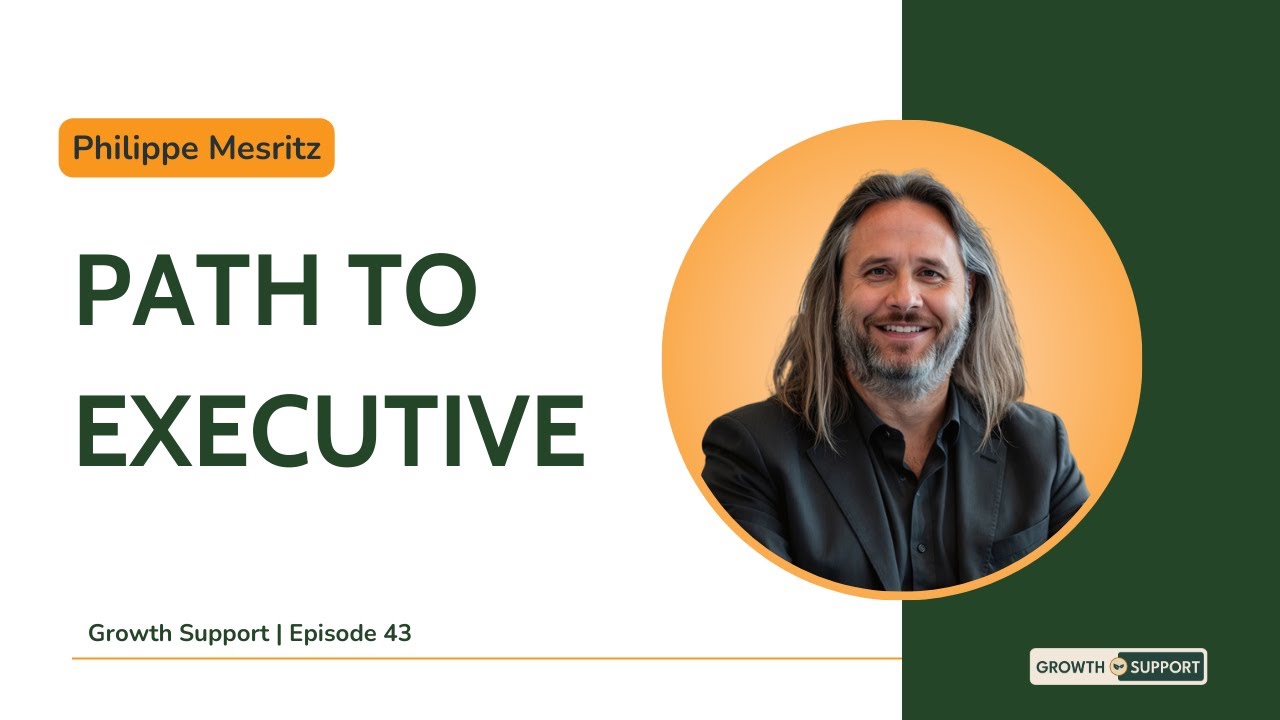
Philippe Mesritz breaks down the path from individual contributor to executive, showing how each level requires different time horizons and skills. He introduces MAPS, a framework for building influence through measuring, aligning, presenting, and supporting. The biggest shift: realizing control doesn't scale, so leaders must learn to influence instead.
Chapters
Hello, welcome back to another Grow Support conversation. My name is Neil, and today I'm joined by Philippe Mesritz to talk about leadership development, going from an individual contributor to a manager to a director to VP and beyond, which I think is something that is universally a struggle for a lot of people developing in their careers. So I'm super excited to, to dive in and to talk about it. So without further ado, Philippe, you wanna introduce yourself, where you're coming from, a little bit about yourself?
Sure, Neil. So I'm based in Austin, Texas, in the US. I've been part of this growth myself for about 20 years. My first manager role, I got thrown into and had no training, grew my team from 0 to 135 within a span of 2 years, but never got any training and didn't understand like, how do you do these things? Effectively. So I've spent a lot of time over the last couple of years really thinking about what that means. And at this point, I've been VP of success, support, professional services, operations. I'm doing fractional consulting as Chief Customer Officer at this point. So I think that that perspective— one of the things I love doing is mentoring people. So this is a perfect conversation to have. I love it.
I think it's trial by fire when you jump in like that.
Absolutely.
So I know for me, like, a lot of people think that the growth and development track within support and customer-facing roles is oftentimes only vertical in that sense, which is not always the case. But I think that's exactly what we're here to talk about today in terms of that development. I would be curious what your— I mean, for me, it's going through that as being a team lead, being a manager, being a head of— it's slightly the difference in the farness of purview that you have when it comes to being able to plan and see kind of what's coming down the pipeline and what you're accounting for. Because team leads will see kind of some things that are midterm and a little bit coming up, and there's just a little bit further and a little bit further. I'm curious from your perspective, what is the difference at each kind of level that makes them different levels?
Yeah, no, I think that's great. I think the frontline managers have one perspective, right there, day to day, they're tactical, they're operational. And then as you go up that the ranks, as it were, you go and you're driving and changing that towards the strategic long term. And the way that I look at it from a very simplistic standpoint, if you kind of bucket and you go manager, director, VP, and then anything beyond that, managers look at the day and the week, directors look at the week and the month, VPs look at the quarter and the years, And then beyond looks at the 3 to 5 to 10 year strategy, right? So it is incrementally a larger span that you are starting to look at. And it does depend on the size of the company and the scale and the growth and all of those things, because there's times where, to your point, your career changes. And I've had VPs where I'm like, I just got to fix today's problem. So it does change, but. When you look at it from a macro lens, kind of looking at it from that perspective tells you the time span of what you're, or how you need to think about your execution.
Yeah, I definitely feel you when you say like there depends on the size of your company. I see people with like a size of 3 people at the company, but they're VP of something and you're like, are you really working that kind of span? Like, yes, of course your skillset and your knowledge and everything accounts for that in terms of what you're looking at. But I think it's different company sizes and different levels mean different things. I know this for me, I'm in an organization around 100 people or so. VPs are still super involved, heads are still super involved in the, in the nitty-gritty and in the weeds, uh, while it's not normally the, or should be the case all the time.
Absolutely. Yeah, I mean, my last role I was the GM, um, and I had VPs and directors that reported to me and they were doing the job. Like, that was part of it because we were a 135-person whole organization. And so my support lead had 10, my support director had 10 people, my VP of services had 50. Before that, I was a VP of services myself and my team was 200. Different spans of— and so you're thinking of things in a different way, what I would consider a VP or a director. And so I think there are ways to define that. And every company has different titles and names and all that kind of thing.
Yeah, I think the baseline of it is really being able to have that core competency of, you know, what is the kind of scope and accountability and focus that you can deliver regardless of that and kind of make this universal level a little bit regardless of company size or things like if I can deliver on an org-wide impact, then I can deliver on an org-wide impact regardless if the company is a certain size or not.
Exactly. And that's why I try to think about in those time frames, right? Because then you can standardize your time frames, and that's how you start to think about it. Some days you might be, for example, in your case, you might be needed to act at a VP level and think about the next year. And then there's other times where you're thinking about something at a day level and really acting as a manager for that particular point in time. So you have to change everything. You have to change your language, you have to change your influence, you have to change what you talk about. It's, it's you have to shift accordingly.
This is extremely timely for me, so I'm going to jump on it. I'm going to dig into that. I, right now, we are just coming out of year planning. We're focusing on all of the strategy for the year. We have like all of this really full look and view with the leadership team, with the directors and heads up, for example, where we've just come out of this really long viewpoint and things. And so I'm seeing things quite far down the road of what we need to kind of account for and plan for. At the same time, I have all direct reports, so they're all kind of skip level down and they're just the ones who are on the front lines in that sense. And it's— that switch is really important, being able to understand, okay, I'm thinking about these things and I'm speaking this language and someone comes in with a question of, hey, I need to get unstuck on this really day-to-day thing. And kind of get, okay, I need to view it at their, you know, what is important and relevant for their day-to-day. I had a conversation with one of my team members the other day, which was like, are you asking it because of this particular thing from your perspective? And they were like, yes. I was like, that's the problem. It's like we're speaking two different languages. But how do you think, what, how do you go around that kind of like finding the balance of context switching in the language?
I mean, it's hard because language itself is, is key, right? At each level you have different perspectives and different things. And I literally was writing a chapter about this in a book, and I'm going to quote it. A Harvard Business Review analyzed communication patterns of 1,000 leaders. Executives at higher levels spend 62% more time discussing strategy and financial matters compared to frontline managers. And so it's a very different language that you're talking, and you're talking different time spans, you're talking different contexts. That context switching is important because your frontline employees, they don't care in the same way about the long term that you do as an executive, because they're dealing with their day-to-day responsibilities, which are now important operational metrics. And so you have to be able to shift your language and whether you're going to talk about the financials and the bookings and sales and the revenue and keeping customers and your earnings before taxes and depreciation or your EBITDA, that changes versus I'm going to talk about call handle time or my day-to-day margin or my on time, on budget. Like those are much more operational metrics. And so you have to be able to do that shifting. And it is more difficult, I would say, in smaller organizations where you're playing multiple roles. Um, but it's, I think the, the way that I've done it before is you carve out time and you go, this is my strategy time and this is my operational time so that you're not context switching in, in between two meetings right after another. You break that out. Otherwise your brain can't keep up.
Super important, like that frame of mind itself. It's very different thinking. Uh, you do have to kind of shut stuff off, go look, focus, and be stuck in it for a little bit so that you can then have the proper mindset. Or else, yeah, what you mentioned, your brain can't keep up, you're gonna fry yourself out really quick.
Yeah, and it's, it's not like multitasking, right? For— so since y'all are in the support side of things, if you think about switching from one case to another, that's hard enough, but it's still the same product, it's still the similar problem set. So you're not— you're context switching, but you're not changing languages, right? You're based in, uh, in the Netherlands, for example, so it's not going from like English to Dutch and switching your physical language, which is what happens, and that automatically slows you down. It's very difficult to think in one language and then speak another language, or and then bounce back and forth. It's just not natural for most people. And I don't think that people forget that the language of leadership is that same scenario. It's different.
I think that's a really powerful thing to keep in mind because when you're talking with one person, they're like, I don't care about that. That's interesting, but not relevant. If you're talking to somebody who is only stuck in that particular type of language versus another. When it comes to one of the things that you mentioned is that it does kind of slow you down and you get kind of stuck in those operational metrics if you're coming from, hey, it's a day-to-day, this is what we're looking at, and then you need to go into this kind of strategy conversation and speak a different language. Do you find that a lot of— I mean, you're coming from the support and customer space as well— that that is one of the things that people struggle with a lot of, and that's maybe why we're thinking so much of operational day-to-day metrics versus kind of being able to branch out and become a better strategic business partner?
Um, I think a lot of it has to do with education, to be honest. Um, so I started my career in tech support, and I— no one ever told me that what the business cares about are financial metrics, right? So, um, I have this kind of concept, there's— it's keep it simple, executive. It's the keep it simple stupid methodology. And so how do you keep it really straightforward, really simple for your executives? Or as an executive, that's where you're living. And what matters at an executive level is bookings and sales, revenue and keeping your customers, and the financials, and then EBITDA, um, to as a proxy for how much profitability you have as a company. Those are the core 3 metrics that executives care about at any point in time. And so transitioning from support or CS or wherever, you don't get taught that. And so now you're trying to speak in a language that you don't understand. It'd be like me stepping in and being expected to speak Arabic and it's like, I don't know, I've never spoken it before. And so you have to learn it and you have to be taught it. Or go and take a class, read a book, whatever that might take to be able to translate your operational metrics into the financial language of an executive. And I think that's the key is how do you take it from, well, support, for example, is operationally driven. They think about, we talked about call handle time or ticket closure rates, none of which matters to business at a macro level, but how those impact my revenue and my customers staying with us, that's what matters. So as you're growing in your career, you have to learn how am I going to tell that story in a different way, because a manager telling a director— the director is fine with hands-on and understands the metrics, knows what they mean. They start to do that translation. But once you're a director, you now need to be more financially savvy, focused, and be able to communicate differently to your VPs. Your VPs haven't been hands-on for a while, traditionally, and so they don't remember what it means to do certain things. And then when you get to C-suite, it's really far off because now they're running professional services and support and CS, for example, who have each have 50 metrics and you can't remember all of that and you can't know which numbers may matter the most to the business. So you need that translation.
I think you bring up an interesting point. I mean, we talked about the, the view of length of time that you can really think about how far in the future are you thinking and what matters the most. And now we're kind of talking a little bit about distance from the front line when it comes to leadership, uh, that those people have like a ton of metrics across multiple teams that they're looking at. They don't have the capacity to be able to dive into really every single one of them.. But as we talk about the distance of the front line, I think one of the big differences between managers and directors and VPs is also how you manage people and the types of people that you manage as well. Whereas if you're a manager, you have direct reports. If you're, you know, a head of or a director, you're starting to manage managers and starting to kind of manage other managers who are then managing managers. It goes down the line and down the road. And one of the things that I think about there is That in itself is also a very different style of leadership and, and competency to be able to develop over time as well. How do you think that this evolves rather than just the language itself, but this comes from, hey, I'm actually gonna coach this person, I'm gonna tell this person what to do. So now I'm managing a manager and even though I might want to jump in and kind of tell this person, it's, their responsibility and helping them to, to take that responsibility and teach as well?
Yeah, no, it's a great question. I think so. I call it the fallacy of control, and basically it's that concept where as a manager you typically have the ability to control exactly what's happening. Your team is 8 people large, you can talk to them 3 times a day and it's fine, right? All of those things. And it is very difficult to transition from that doing part to leading. So a lot of times they focus on how do you drive it by controlling what's going on, and it is a total illusion because no one can actually control it. But the higher you go, the less control, like actual control, you have. So you have to influence that, and it is a illogical change, I guess, right? You think about it and you go, well, I have 100 people instead of 8. I can control 100 people now. Well, the fact of the matter is, if you were running 100 people, you have no idea what that person is actually doing every day. And so you have no control. You have to be able to influence and train them and teach them and coach them and coach their managers to help coach them, right? To be able to think of it in that way. And then not only that, As you go up the levels, your role also shifts simultaneously to less getting your teams to do what's necessary because your job is now, I television, I drive a change, and my directors and managers go and execute. And now it's, how do I help everybody at the business be successful by removing roadblocks? And now you're trying to, if you're a support VP, for example, You are trying to influence the product roadmap. Well, there's zero control there. The product leader is the one that makes those decisions, so you have to influence. And so I think it's a very big question of mindset shift, and I think it's probably the hardest one because I think human nature is, I can control what's going on. And I just don't believe in it. And so I think, I mean, it was my first time I ever let anybody was like, all right, here, I'm going to sit next to you physically and make sure that the 5 people in this cube set do what I tell them to do. And it works when you have 5 people that you can physically sit next to every day. It doesn't work in any other situation.
Yeah, I think when you Is one of the ones that we struggle with the most in that sense. I mean, this is where micromanagement stems from, right? People trying to be still too involved and in everything in that sense. How do you think— I have two, two skills that I want to dive into and see if we can develop a little bit. How do you go about building influence in that way when you're starting out? You don't necessarily have kind of the opportunities in that sense, but how would you say you get started to change that mindset? Sure.
So, um, I've had this process for a number of years that I believe is quite successful. And what I recently— I termed it MAPS. It's Measure, Align, Present, and Support. So you measure where everybody is in this journey. Like, you're trying to influence people, so you have to know where they are in the journey, right? You have to understand where they are. Then you sit there and you align with them and you have to think about how to get everybody on that same page. And it might mean you have to have multiple one-on-one conversations with the people that you're trying to have a conversation with. It might be you do it in a group to gain consensus to, to do things. You then kind of present your thoughts and I believe, um, where it's possible, you pre-align before you go do that. And so you've had quick conversations to make sure that there's no major blockers so that you're going in kind of expecting that things will go the direction you're trying to go. And then after that, it's you support what happens because your influence isn't you. It's what's in it for them, what's in it for the company. How do you get to the goals you're trying to accomplish? And you have to remember that a company's success isn't your success, and those two things sometimes conflict. So you want to influence but adapt to whatever is necessary.
I like that framework that you go through and be able to actually have a very clear and practical way to go about some of these things as well. And what you mentioned, laying that groundwork and having those conversations, is really important to make sure that Yeah, there's no, nothing's gonna blindside you in that process as you're going along.
Yeah, the worst thing is you walk into a meeting and you present something and then you have like, everybody goes, no, that's the dumbest idea possible. And if you had spent 2 minutes with me, I could have told you this is what the blocker is. So having a quick conversation, and it can be asynchronous by Slack, sending an email, whatever, but I think it's that conversation that matters a lot.
I remember years ago I had this, uh, there was like this initiative we were gonna start doing with one of the teams, and we were gonna, you know, start this— just let's start outbound calling, for example. Let's do an outbound experiment. Great. Uh, and I was like, sweet, this is what the project is, I'm gonna build on it, and this is what it's gonna mean. And then I had this entire, like, next thing you know, this giant strategy deck. This is a whole plan for like 6 months, uh, thing. And then I got the, like, this feedback from our, from our VP at the time, it was like, this is really great stuff, uh, but a little too early. We're not, we're not, we're not there yet. I was like, if I would have probably just done more groundwork at that time and actually, you know, gone through the, the reliable process, probably wouldn't have gone, uh, too far off, uh, in that sense, or too deep too early.
Yeah, and I think it does change a little as you go up the chain, right? When you get to VP or C-suite you don't pre-align as often because you want that open conversation happening because now you're talking business strategy with long-term implications. And so you don't want to be known as the person that backchannels everything, right? But at a manager or director level, you don't have as much long-term insight and you don't know what's happening in the other departments. So it's always good to find out and make sure that there's no major changes and no blockers or it's too early or there's a technical reason it's not possible or a resource reason where it's like, hey, this can be done in 6 months and in your deck you've got it for 2 weeks. That just doesn't work. So that way you have an opportunity to adjust your expectations and your presentation pitch to, to doing that. So at manager and director level, I am very much into this MAPS process. I think as you get to VP, and it's still beneficial, but once you get to C-suite, you have to really rethink again Do you do that? How do you think about it more strategically?
Hmm. I think the second one— so I said I had two kind of skills to go into. One of them I think is building influence. And I think one of the other skills that we talked about is, as you go, you start managing different levels of people and that framework kind of changes and the mindset changes quite often. What I found at the early stages, at least of my own journey, is, hey, I want, I want to grow, I want to go up the levels, but I don't necessarily have an opportunity to get some of these skills that are required in the next level. For example, this is one of the biggest differences for me going from manager to head of was, hey, you need to be able to manage managers or like manage through others. I don't have any team leads. I have a small team. I don't have the opportunity to build and showcase that skill per se. I have a way that I did it, but I'm curious to hear if you have any strategies or ways for people to go about kind of getting exposure to that experience.
I think that's a hard one, to be honest, because you can, you can go get it through volunteering, right? You can go get it through, through communities and being part of a leadership team on a community. There are ways to ancillary at least get some of that experience. But a company will look at that and go, maybe, right? So it applies when you're growing within your company. It applies better than trying to jump to another company. It's a little bit more difficult. I think the way that you have the best success is to get a mentor that can help with you and role play with you and work with you to coach you in a safe space. And when I say mentor, I typically don't mean your boss. It is going to be someone outside of your sphere, someone outside of the company, someone that you know that has been there, done that, that can help you and give you suggestions and thoughts and be like, okay, well, pretend I'm a manager of managers and here's my problem. What are you going to do? How are you going to attack this scenario? Because it is difficult to get the experience without having done it before. I mean, that's, that is traditionally the hardest reason why it's difficult to shift companies and get a bump in a role is, oh, well, you haven't done that before. I need someone that has done it before. I'm like, well, how do I learn to do it if you don't give me a— if no one gives me the shot, right? So it's, it's definitely a challenge. But I'm curious, how did you do it?
The tip that I got, so I'm lucky in the fact that I do have internal mentors as well within my company. So I get a lot of advice and I'm also just naturally, this is the whole reason I have these conversations as well. The piece of advice that I got when I was having this conversation on, hey, how can I actually get this experience? It's okay, well, try to find a way that you can manage through other, it doesn't need to be that you're managing a manager,, but just a way that you can manage, maybe even how can you influence somebody on another team through another person and kind of be able to have that jump a little bit in terms of I'm working with, yeah, maybe another manager to help support another one of their team members cross-functionally, for example. So are there ways throughout the organization that you can showcase somewhat of the skill and be able to develop it and build it to where you get maybe 80% of the way there, But then I do think it's really important that you have that relationship with your organization to say, hey, I've showcased 80% there, can you meet me in the middle a little bit and then we can gain that experience hands-on? I've been lucky enough to be in that situation, but I think, yeah, finding alternative ways to show the business that you're in visibly that you can do that.
What's funny to me is I'm gonna disagree for just one second on that.
Yeah, yeah, yeah, 100%, I love it.
That's not managing managers at all, but it is being director-level influence. So it's two different skill sets that a director needs. You need to be able to manage managers. But for me, the managing managers is how do you grow your managers? How do you coach them? How do you do things to make them more effective as a manager? What you're talking about is actually getting other departments to think about what you're needing in a way that helps the business move forward, which is another critical skill as you go up. So I totally think there's value in what they told you. I just don't think it's the same skill set because that influence is— to the conversation of control earlier— the higher you go, the more your job is influencing. At frontline manager, maybe 10% is influencing. At VP, maybe 10% is not influencing. So I think it's the right skill set that is necessary to be head of, director, VP, and so forth, but it's a different skill set.
Maybe this person just had different plans for me than I thought.
Yes, they're both beneficial, and you need to be able to grow them both. Um, but I do believe that a strong— so it's interesting is when you promote it a lot of times from IC to manager, it's because you did really well as an IC But that doesn't mean you make a good manager. But being promoted from manager to director, if you're a good manager, you can usually coach good managers because you know what's good. So the managing managers is the easier part because you've shown that you're a good manager, therefore you should be able to help people manage. And so I think that's an easier skill that's naturally falling into, whereas the influence or the ability to allow control to be free is much more difficult.
I look through my mind throughout this conversation, there's been a couple of times that have come up that it's easier— I don't mean easier, but sometimes one transition is softer than another, that there might be higher barriers at certain levels that, uh, to break through. I'm curious what those barriers are kind of at each level, maybe what are easier transitions than others.
Sure. Um, typically the easiest to get is IC to manager, but it's one of the harder transitions to make because you're used to doing everything on your own, you're used to running everything, and you have your own individual metrics. Now suddenly you're responsible for a team and your individual metrics are not relevant. So that's a mental shift that's very difficult, but it's usually easier because a lot of companies turn over managers And so your opportunities are greater. The other two that are very difficult is director to VP and VP to C-suite. So manager to director is not as difficult because you're still one foot in the operational and you're one foot in the strategic. So you have an opportunity to play with your skills and grow them both. And that allows you to shift. But once you're director going to VP, you no longer should ever be like hands-on unless you've got a gap or something you're stepping in. But you, your focus isn't the operational, it's how do we strategically drive the business forward in my organizational function, my team, my organization, my business, like that kind of thing. And so that, that's a big mental shift. It's a difficult one for people to make. And then VP to C-suite is another one. And that one is, I think, a little bit less around skill necessary than it is about opportunity. There's very few and far between C-suite opportunities. So it's very difficult to do that. And this is where a board who typically does the C-suite hiring wants people who have been there, done that, proven. And so becoming a first-time C-suite is difficult as well. Even if you've got the backing of lots of people who are like, yep, you can do that, no problem, you've got the skills, the attitude, the knowledge, all the things, um, bitch, making that shift is difficult. So each level is a little different for different reasons.
I really like that. It's a super clear breakdown, I think, is the way that you go about it, which I think is amazing. So thank you so much for sharing that. For— I'm personally going through now the director to VP challenge and change. That's my next goal and step. Like, this mental shift is— has, has been and is, uh, one that takes a long time, I think, as well. When you talk about, you know, maybe it's easy to get but hard to transition through, I think there's also that time frame of the higher you go through some of these skill sets or frameworks, the longer it will take to build some of these skills because it also is more complex at each level when you start to go through these as well. So there will be a transition in time frame throughout that. So that's a super clear breakdown and I really appreciate you sharing that.
No, absolutely. And I think part of it is finding the right leaders that you're working for that give you the space to learn or teach, to grow. One of my old companies, they wouldn't promote people until they said you can do the job. And you've been doing it for 6 months before you got the promotion. Now, this was a multi-billion dollar company, 88,000 employees. So they wanted a very structured methodology. But it's an example of they don't put people into positions before they're ready. Startups go the other way. They're like, you need somebody, go Neil, you're doing it tomorrow. And then you have to have the space and the grace from your bosses to learn on the job. And so it's a different scenario. And so you have to find those bosses and the leaders that are willing to work with you and kind of teach you or give you a class or sign you up for a community that can help or whatever that might be, right? So something that helps you. Develop the necessary skills to be successful. Hmm.
I saw this breakdown of what is kind of moving to the next level made up of in terms of this kind of, you know, how does the company see you? Are you ready for it? Have you been doing the job? And I thought it was interesting. I'm wondering, I'm curious to get your take on it. Breaking into the next level. And they say it consists of this. It's 10% performance, your day-to-day work and the quality at which you deliver it. It's 30% your image, your personal brand and how others perceive you. And it's 60% exposure, your visibility and ability to be noticed by the right stakeholders. I'm curious to get your take on that kind of breakdown.
I agree that it's very low on your actual performance. Like what you look at traditionally when I'm, when you're promoting, or if I'm promoting a director to a VP or whatever, your performance matters, but it's very binary. You're either good enough or you're not, and there's not a lot in between. So that's why it's such a small percentage. I think the image and the, um, kind of exposure side is probably a little bit more balanced than 30-60%, but I, I can understand where they're coming from, because if you're exposed to enough people and you have the right image then it makes life easy. But that's why that image part is so critical. And without that, I would call that the foundational piece. But your image consists on your performance, it consists on your like presentation gravitas, your ability to stand on stage, as it were, whether it's a virtual or in-person stage, whatever that might be, which then allows you to get that exposure side of things. And but it is very true. One of the companies I worked for, there, to become a VP, you had to have 60% or 70% of the ELT, which was the C-suite, agree that you could get that promotion.
Hmm.
So it was people outside of your purview, like to become a VP of support, you had to get the CMO on the board. And So you have to have that exposure. And part of that is your presentations, your board. How often is your leader helping elevate you? So in that particular case, is your Chief Customer Officer, your Chief Operating Officer bringing you to executive meetings and allowing you time to present so that you're exposed? And so I think that's an important— that is absolutely a critical component to success. Because most companies won't promote a VP without some level of agreement because VPs, when it's done right, those VPs will make or break your company.
It's a, it's a different kind of influence, right? We, at the beginning, we talked about building influence and being able to have these conversations. And I think when you talk about influence one direction towards the rest of the organization down, You also need to build influence upwards and how you actually manage up through these levels.
Absolutely. Absolutely. I think managing up becomes an important skill to be able to do, and it's managing up and diagonally, right? It's that whole, how do you manage up to groups that have nothing to do with you and how do you help them? I mean, the fact of the matter is most people that get promoted have helped someone else succeed in their role. And so how can you as a support leader or a CS leader or whatever help the CMO or the CPO get their goals? Head of product, head of marketing, how do they succeed? Because you help them, then you have that exposure. They have goodwill towards you. They help you. I hate to say it, but it is the political nature of getting promoted. Maybe less in small startups, much more in bigger companies, because there is so much competition. And then you're competing against other people at the company, external hires. You have to have that backing of people that are willing to go to bat for you to say, no, Neil's the right person for this role. If you don't have that and someone else does, hmm, you immediately lose.
It could make or break that decision.
Yep.
Thank you so much. I know we're kind of— we could talk— I think I would talk about this all day, probably. Uh, I really appreciate you. You break it down very, very clearly. It's like you're writing a book about it or something.
Um, yeah, no, I, I am in the process of writing a book. Um, it'll be out sometime in 2025. I haven't decided when yet. It really depends on Timing and structure. I'm about a third of the way through it. Um, I have the outline concepts, which is one of the reasons why I've thought about these things on an ongoing basis. Um, but you can follow me on LinkedIn. I'll be posting about it, um, every so often. And then we've got a signup sheet there too.
Nice. Thank you so much for that. And I do have one last question for you. Sure. Um, just to round things off, I'm really curious over the course of your experience, if there's still one thing that you've stuck with today. Doesn't need to be professional, it doesn't need to be in one particular area, but, um, my willingness to learn.
I'm always trying to learn something, right? So for example, last weekend I spent time on Lovable, the one of the new AI coding platforms, and created my first app. I'm rebuilding our kitchen at the moment. I'm teaching myself how to do woodworking and, um, building like end panels for our cabinets and the island and all that kind of stuff. So it's this passion to learn and grow myself on an ongoing basis. And I think that's, for me, been very, very beneficial because it's allowed me in my kind of career path to be given opportunities that I don't think I would have otherwise, where it was like, hey, you've never done X, but I know you can do it because you're gonna go learn it, study it, figure it out, and come back with a plan in 2 weeks. So here you go, run this department that you've never run before, right? So I think it's that willingness to learn that I have had forever.
Oh, thank you. I, yeah, I think, uh, being able to learn, unlearn, and learn again is always a really interesting way to be able to develop it. And yeah, you can go very, very far with that.
Yep, absolutely. I like the statement of adding the unlearned part because you have to realize that what maybe worked 10 years ago isn't working, therefore stop with that and learn something new.
Yeah, yeah, indeed. Well, Philippe, thank you so much for joining me. I think it's been an absolute amazing conversation, especially for my own needs and learning as well. Uh, so thank you for joining me for it, and I really appreciate it.
Of course, thank you, Neil, for having me on. I appreciate it.
More from Philippe

Ep #13 - The Capacity Gap: Unlocking Human Potential in the Age of AI w/ Philippe Mesritz