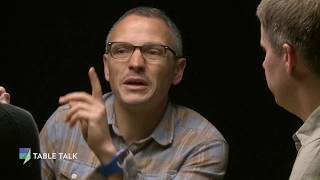
If God is in Control, Are We Really Free? | Table Talk S03 E04

Ty Gibson, Jeffrey Rosario, James Rafferty, and David Asscherick debate whether God's control leaves room for human freedom. They trace determinism through Augustine and Calvin, argue God honors human choice, and say we're responsible for opposing evil and pursuing justice.
Chapters
In this conversation we're going to tackle a pretty complex question and it's related to our previous conversation. Where we came from was with the question, if God is love, why is there so much suffering in the world? And there's going to be some overlap here, but this is a necessary subject. The question now is if God is in control, are we really free? And this is a question we have to ask because there is. In the world of philosophy, in naturalism or materialism, there's a materialistic determinism that says that every single thing that happens couldn't happen otherwise than it did happen because of the Big Bang. Everything traces back to that one event that created the causal chain that produced all outcomes. And that's materialistic or atheistic determinism. But there's also atheistic determinism. There's the view that the sovereignty of God dictates every single event that ever occurs, so that omnipotence is viewed as omni control. In other words, if God is all powerful, therefore nothing ever occurs that God himself did not choreograph, determine or make happen.
He's like the cosmic micromanager.
Yeah, the big control frequency.
Some people may or have referred to that as the blueprint.
Augustinian blueprint.
Yeah, it's like the blueprint worldview, where there's a blueprint for every single thing that's been predetermined and planned out.
So how do we approach this subject? Well, first of all, do you resonate with it at all? Do you resonate with a worldview or a theological orientation that says God is in control of everything that happens?
Well, one of the things I think it's important for us to say from the onset is this because so many people have used this in a positive way to, you know, don't excuse me for using this phrase, but to find a purpose driven life or a purpose in life. And therefore when they've dealt with bad situations, they've tried to say, well, no, God is behind this and therefore there must be some purpose in this.
It's a way of coping.
It's a way of coping. And it's a. It's a religious idea, a religious way of coping. And what I try to say right from the onset is this because I had this experience when I was in Africa. I was counseling this young lady and she was suicidal. She was suicidal, having migraine headaches. And when we got into this counseling session, she told me her life story, her experience. When she was a young lady, she had been sexually abused by her uncle and the issue was, in her life was that she had never talked to anyone about this. And so when we were counseling, this was. So I said, you know, have you talked to your parents?
No.
Have you talked to a pastor?
No.
I said, well, have you prayed about it? Have you talked to God about it? And why would I talk to him about it? He's the one that made it happen.
She said it like that.
She said it like that.
And it was.
And by the way, wow, got some work to do. I had to say to her, I know that's what you just heard in that last sermon that we listened to. That's what I had to say to her. But I said, I would like to.
Share with you a sermon that you had preached.
No.
Okay.
So it was preached at the place where I was preaching also. And I said, but I would like to share with you a different option. And basically the option I shared with her without going into detail, was Romans 8:28. All things work together for good to them that love God and are called according to his purpose. Not all things that happen are God's will. There's a lot of evil that happens on this world, but God can overrule the evil that is taking place on planet Earth, and he can bring good out of it. And I said, that's one step away from what you're talking about. And as I explained this to her, tears began developing in her eyes. She was sobbing. And I just want to tell you, it was just a powerful, powerful experience. That girl completely was completely transformed by the gospel, by the good news.
It's liberating.
Ended up going to college.
We sent her a Bible. She ended up just falling in love with Jesus Christ, and her life just went in a completely different direction.
Well, you say. You say it's liberating, but. But I've had conversations with people who, the moment you say that, no, God is not in control of every single thing that happens. It's not liberating for them. It's threatening. And they feel like, well, then there's no reason for my pain. There's no. What's behind this? How come? I was quite satisfied believing that God had some plan or purpose or blueprint or something he was up to in making this happen to me. And now you're telling me that there's no such thing, that God isn't in control of everything.
Do we need to just say in a blanket manner, God is not in control? Or is that overshooting the mark in another direction? That's overshooting the Mark, does God control anything? He overrules everything.
I believe he overrules everything. So in a sense, we are understanding and recognizing that God is alive and well and he is in control of planet Earth. But in another sense, we're recognizing. And that is that there are things happening on planet Earth that are distinctly unrelated to God and not part of God's will.
I think that there's a real trickiness, even in the way that we've worded the question. And this has come up several times in the way that we've worded other questions. And that's what I like about these questions, because they're thorny. They're thorny. They're difficult. Even the questions themselves are problematic. So this is a case in point. If God is in control, then are we really free? Well, there is a sense in which you could describe God's being in control that I would totally disagree with Biblically. And then there's a sense in which you could describe God's being in control with God's being in control, with which I would totally agree. So maybe we should sort of define our terms there a little bit. In what sense is God in control? Like, for example, if I decide to pick this up right now and then I decide to set it down, okay, that was an action that just took place. It took place in time, it took place in space. It has, in some, you know, miniscule way, altered the person that I am. In other words, that is something that's happened now. It's a part of human history.
Okay.
Okay. Was God in control of that? So is that something God did, or is that something that David did? Because I'm operating under the decided impression that that was a choice that I made when we were just here in the back trying to decide what, you know, shirts we wear. Because if we all wear dark or we all wear light or whatever. And on this beautiful shirt, you notice how beautiful it is. I'm under the impression that this was a choice that I made.
Yeah, but the deterministic worldview.
That was a good choice, wasn't it?
Yeah, the deterministic worldview says that you're under the illusion.
Exactly.
That you made a free choice. The fact is. I'm not saying. The fact is. I'm saying that in the deterministic worldview, they would say. The fact is that your apparent choice was just that. It was apparent you didn't make the choice because God is sovereign, God is in control, God is omnipotent. And that equates to. God has predetermined, every single micro detail that ever occurs, it's all choreographed ahead of time. And you didn't really make that decision at all.
What would you.
Is there anything to John 3:16 on this question.
For whosoever believes in him? That sounds to me huge. That sounds to me to contradict the notion that everything is controlled by God and that we're under the delusion. Right. God so loved the world that he gave that whosoever believes in him should not perish but have everlasting life. So to me that sounds a lot like what you were just saying. You have the real, very real capacity to make an exercise of your will to make a decision that's not pre. Manipulated by God. Agree.
I agree with that. I'm just going to say that for me, John 3:16, a great text, needs to be brought to the table, literally. But I feel like it's down the pike. I feel like it's like three turns down the road. I want to ask you the question, Ty, I want to put you right on the spot here because you know more about this than I do. Just straight up, is the way that you articulated the theistic determinism or that last time that you just were speaking about determinism, were you speaking primarily about like materialistic determinism or theistic determinism?
Well, I was.
Every event being choreographed, you were referring.
To theistic, I was referring to theistic.
Okay, so here's my question. Do you feel like that's a. Is that accurate? Is that an accurate way of characterizing, I don't want to say, caricaturing the way that a determinist would. In other words, like a calico?
I think it's bigger than that for them. I think it's more salvific.
I think that's the question I'm asking.
Well, the way I understand it, just for some philosophical and historical background, first of all, the idea of determinism is not a Christian idea in its origins, and it's not a biblical idea. This heels back to Greek philosophy and you have a succession of ideas that were passed down. And the basic lineage of the idea is you begin with Plato. And Plato conceives of God as absolute being. And by that he means that God is really all there is. There is no such thing as an autonomous creature or being that exists adjacent to God as a free will being. Anybody that looks like they're existing adjacent to God is an extension of God projecting out into the world what he's conceived in himself. So for example, in Greek philosophy. If the Greeks would win a war, they would attribute it to the will of the gods. If they lost a war, they would attribute it to the will of the gods. And the secret, the psychological background of this is it abdicates the individual of responsibility. If a man is married to a woman, it's destiny that he be with her until he doesn't want to be with her anymore. And the moment he doesn't want to be with her anymore, and then he enters into a relationship with another woman, he attributes it to destiny or fate. I was supposed to be with you, but not anymore. Now I'm supposed to be with you. And you see how nicely that abdicates the man of any shame or guilt. He doesn't have to deal with himself on the matter because he conceives of himself as being acted upon by an external force that is bigger than himself. Okay, so that's the Greek philosophical base. And then Aristotle, who was a student of Plato, came along and said, well, if that's true, then God is conceived as what Plato called the unmoved man. God is forever himself unmoved. Nothing external to God acts upon God to produce response in God. But while God is unmoved, he never experiences emotion or response. He's constantly the mover. So if anything happens, whether you decide to have Shredded Wheat or Cheerios for breakfast tomorrow morning, God predetermined that you're going to have shredded wheat. That's what you're going to have. Okay, so that comes to Aristotle, but here's where it gets into Christianity. A lot of people aren't aware of this history, but Augustine, arguably the most influential theologian in Christian history. Augustine was not raised a Christian. He was a student of Greek philosophy and then converted in adulthood to Christianity. And he brought his Greek philosophy into his Christianity. And he was the one, Augustine was the one who then wrapped biblical Christian language around the Greek ideas and said, okay, Paul speaks of predestination here. That must be the same thing that Plato and Aristotle were talking about. So then you have this idea that God predetermines from eternity past who's going to be saved and who's going to be lost. And then hundreds of years later, sorry, this is taking so long, but this is the background. Hundreds of years later you have John Calvin of Reformation fame. And John Calvin is a student of the writings of Augustine and he's the one that most fine tunes the idea of, of theistic determinism or predestination.
And he goes so far, but Augustine did this too and this is getting to what your real question was. They went so far as to not only say that God predetermines who's saved and lost, but God predetermines everything. If a little girl is raped, this is a part of God's sovereign plan. If a car accident occurs, if somebody's diagnosed with a disease, whatever happens, it's all happening within the parameters of the sovereign will of God. The moment something is allowed to happen outside of the will of God, the assumption is, well, God's not powerful, then God's not all powerful. So yes, in that view, God controls literally.
Everything that happens. There's some kind of divine reason behind everything, the good, the bad, the ugly, the otherwise, anything that happens. And it's a very dark idea. It's difficult to conceive of any more dehumanizing idea than for me to look across the table at Jeffrey and to conceive of Jeffrey as basically a non entity, a shell of an apparent autonomous being who makes choices. But to, in my philosophical and theological outlook, to basically say, no, you don't actually exist adjacent to me, adjacent to God in relation to anybody. You're an extension of the will of God. You make no choices. Everything that happens to you, everything that ultimately happens in your destiny, God predetermined.
In a sense, it sounds like an attempt to simplify the chaos of the world, because that's a simple answer, that's a very clear cut one liner. But I think we would all affirm at this table that.
The world is complex and it's not that simple. It's not that cut and dry, that there's a war, that we're in the midst of a war. I think you said something about we're in enemy occupied territory and that it doesn't work that way. That there are clearly things as revealed in scripture, that take place on a daily basis that are not part of God's. In fact, God has to enter and intervene. Why would God have to intervene in anything if everything was an extension of his plan?
I think we could accurately say that God has macro control, but not micro control. That ultimately God's principles will trump the principles of evil, that good will ultimately overcome evil, that love trumps hate. So God has an overall plan and he's finessing and navigating through the evil, bringing good out of this bad thing. He's navigating forward through the evil to an ultimate end of victory. But he's not micromanaging every detail along the way so that every bit of pain and Suffering that goes on in the world is traceable to God. Predetermining that that happened to you right then and right there for some reason. So macro control, but not micro control. Another way of saying that would simply be to say the fact that God controls some things doesn't mean that God controls all things. So we're not saying that God's not involved, right?
We're not implying that God is not involved.
God is involved.
He's fully involved.
We're not even saying he's not sovereign.
He's fully sovereign. Yeah, but he's sovereign in love. In other words, God is all powerful.
But his almighty omnipotent power coexists with his love. He has a particular will. And that will is God chooses sovereignly for you and me to be free. That's God's sovereign will. And that has all the possible upsides and downsides that come with that actual freedom.
So I think a good illustration, I think of a good illustration of this in relation to us is parents and children. I think it's a great illustration because we want to control their lives. We want to, you know, we want to live in a certain place. We want them to go to a certain school.
We want them to.
Yeah, you're going through that, learning certain things. And we want them to make certain decisions. And while we have the power to do that, we don't.
We better not.
If we do do that, we're going to ruin them. We're going to take away their individuality and we're going to make them who we are.
That's a good term.
We're going to make them susceptible to be controlled by somebody else once they come out from under our roof.
Yeah. In other words, we could control, but we shouldn't.
Man, this is good. And after the break, we'll just keep unpacking this subject.
The Bible is a big book. It's composed of 66 smaller books written by more than 40 different authors. It's easy to get bogged down in all the genealogies, ancient history and intersecting characters with unpronounceable names. And yet the Bible is full of rich and powerful truths that all of us need to understand. Wouldn't you love to have an experienced tour guide take you on a step by step journey through some of the most vital and beautiful truths contained in the Bible. Well, now it's here. It's called Truth Link. Truth Link is a groundbreaking new series of easy to understand Bible study guides that thousands of people around the world are raving about. Why all the excitement because Truth Link systematically unfolds 27 life transforming biblical topics. But not as a list of dry theological facts. Rather, Truth Link takes you on an engaging biblical expedition, demonstrating how every truth of scripture reveals some facet of God's beautiful character. Truth Link isn't just information. It's a spiritual journey that will radically impact your life. We would really love for you to have these Bible study guides because we know they will be a blessing to you. You can get them by visiting truthlink.org or by calling 541-988-3333.
In reflecting on the first segment of this conversation, I think we were all sort of saying in the break, and I was thinking that there is a sense in which this conversation. You started by saying, you're exactly correct. This is a complex question. If God is in control, how do we say it? If God is in control, If God.
Is in control, are we really free?
Are we really free? And in the course of that first segment, we need to let the viewers know, those that are listening into this conversation, that we recognize that there is a complexity, theological, philosophical, even historical to the things that we're talking about. But what we're trying to do in an hour long program is to set a tone, to talk about something. And this is, I think, the key. That is a hugely influential philosophical idea that many people might not even be familiar with as a hugely influential philosophical idea, namely determinism. In other words, there are people that are walking these streets right now that have either watched a movie or seen a sitcom, or read a book or a magazine article or heard a story, and it's been, well, God or where was God or God? And it just becomes a part of our modern psyche to some degree that we are being acted upon by the gods. Not in this case Zeus or Poseidon or Mercury or whatever, but God.
Like the insurance clause.
Like the insurance clause. Okay, exactly. And yet many people outside of this conversation would be hugely influenced by this, but not even aware of the language, the history and things that we were just quickly sort of putting. But I think we should summarize by saying.
We'Re really dealing with a picture of God that is one in which he is in absolute control. Micromanaging control was the language that we used, or he has relinquished to some degree control. To a greater end.
Yeah, to a greater end.
And then for me, the questions would be, first of all, is this true? Is it true that God is in absolute control? And we kind of address that. And then the second question is, if God has to Some degree relinquished control.
Why? And in what sense has he relinquished control? And I know that what you said, James, is so true, that when people are going through the vicissitudes of lives, the ups, the downs, the difficulties, the trials, the cancers, the diseases, deaths, we want to console ourself by finding some purpose, some meaning, some intentionality in it. And we feel consoled by it. But the question is, is everything that happens. You quoted Romans 8, 28. Does that mean that God is in control of every circumstance? We're saying no.
No.
Okay, so then when is he in control? When is he not in control? And is it even possible to tell the difference?
And you also asked earlier, you said, what is that greater end that he's aiming for? I think Jesus, if we accept the premise, without going into the details to demonstrate why we believe this is so, that Jesus was God in the flesh. Okay, here's a picture of God in the flesh in Matthew, chapter 23. Jesus sitting on a hillside overlooking Jerusalem. O Jerusalem, Jerusalem, the one who kills the prophets and stones those who are sent to her. How often I wanted to gather your children together as a hen gathers her chicks under her wings. And you were not willing. So in this scripture is a picture of God. This is God looking at a human situation, the city of Jerusalem, namely. And God is saying, I wanted X, but you didn't want X. You weren't willing to go where I wanted to take you. This is almighty God. This is omnipotent God. This is sovereign God. And the answer to your question, what's the greater end? What's the ultimate end? I think one way we could say it, and there are lots of ways to say it, one way we could say it is that God wants me to want him. God wants me to want what he wants. He doesn't want to be the one who wants a situation and then shove me into it, force me into it, manipulate me into it. So what's the greater end? To which God, in holding his power in reserve, what's he up to? He's up to this. He wants me to want what he wants. Yeah. Not because. And we need to clarify. He doesn't want me to want what he wants because he's stubborn, opinionated and dictatorial. He wants me to want what he wants because what he wants is in your best interest. Is in my best interest. You know, it's like somebody has said that God can't. God can't give me happiness apart from him, because no such thing exists. There is no happiness to be had apart from God because in God is the recipe, the principles for happiness. So he doesn't want me.
That's why in the Bible God is described as a jealous God. And we look at jealousy in a very self centered way. I'm jealous because that person is flirting with my wife. I'm jealous really for my feelings. But God is jealous for us because of us. He's jealous because he sees things that are happening to us that he doesn't want to happen to us. And so his jealousy is in.
It's not self centered, it's other centered.
No, it's other centered. I'm jealous over you with Godly jealousy because I want you to have those things I've always wanted you to have and experience those things I've always wanted you to experience. And you are not willing to go in that direction.
You were going to say something?
Well, yeah, just as you guys were talking, I was reading from Genesis chapter two. And I was just thinking, you're in Jesus, right? You're in Matthew. And I was thinking, well, what was the deal from day one, like at the gate with the kind of world that God designed and created in regard to his control or his sovereignty over it and our involvement in it? And I just read this quote, not to make some big point, but just this really cool verse here. I never noticed this one detail. It says, when in the garden of Eden and God's creating, it says, and out of the ground the Lord God formed every beast of the field and every bird of the air and brought them to Adam to see what he would call them.
That's beautiful.
And whatever Adam called each living creature, that's what it was called, that was his name. So I just, I think that's pretty cool. Is that God, this may be a trivial example of this, but God creates this beautiful world, this beautiful realm in which we exist. And the representative of the human race, right, Adam, he puts Adam there and he says, Adam, and he brings all these animals. He says, so Adam, what do you think we should call these? So he's right there. He's bringing Adam into the decision making processes. And I wonder if.
When God created this world, it brought him pleasure because he exercised his will as God brought something into existence and it brought him happiness and pleasure.
If God controls everything and we're not allowed to make any decisions, he would be stripping us from that happiness and pleasure because we would have no potential for that because there'd be no effect from our actions. You know what I'm saying?
Absolutely.
Whereas here Adam is invited to experience the pleasure of exercising his will and just in something so simple, so trivial as naming the animals. Anyway, I just thought that was kind of cool. It's right there in the garden I encounter the fact that the universe is not. Which God controls everything?
Well, just a few verses before that in Genesis 2:16. One of my favorite verses in Genesis that's along those same lines is where God says to the early couple, Adam and Eve, he says, of every tree of the garden, you may freely eat. Freely. To me, the insertion of that word freely there is huge, because God is saying, you're free, you're free. Here's all of these trees. We don't know how many there were, but let's say there were 5,000 fruit trees, various varieties from which to choose. And God says to every one of those trees, the answer is yes. It's a yes, a yes, a yes. A yes. A yes, a yes, a yes. He says, but of this one tree, verse 17, just don't eat of this one. So the ratio of yeses to nos in God's governance is 5,000 to one or whatever, 2,000 to one or however many there are, a million to one. God's freedom, as we've talked about in the past, and we're gonna come back to this over and over again in the hard question series, is that freedom is absolutely fundamental to God's governance of the universe because it's fundamental to his own character.
Yes, that's the key.
It's fundamental to who he is. And if that's true, then this micromanaged, dictatorial, Augustinian, Hellenistic view of God, it's gone. The insurance clause, God who's causing and that and this and that. And you're going to put on that shirt, that's gone.
But there's still that overruling.
God still saw that.
Let me just read these verses to you. This is really powerful to me in this context. Daniel, chapter 10. Daniel's been praying for three weeks. He's been fasting and afflicting himself and praying for an answer to an understanding of prophecy that he got in previous chapters. He wants to know more. And he's praying for three weeks, and there's no answer, no answer, no answer, no answer, no answer. And then finally, in verse 12, Gabriel comes to him. And Gabriel says to him, do not fear, Daniel, for from the first day that you set your heart to understand and humble yourself before God, your words were heard. So as soon as he prayed, the very first day he prayed, his words were heard. So what Gabriel is saying To Daniel is listen, God hears and God answers your prayers. But notice what he goes on to say. He says, but the prince. And he goes on to say, and I've come for your word. So God answers him, but the prince of the kingdom of persia withstood me 21 days. That's three weeks. That's the whole time. Withstood me 21 days. And behold, Michael, one of the chief princes, came to help me, for I had been left alone with these kings there, with these kings of Persia. Basically, what he's saying is God heard your prayer and God answered your prayer the day that you prayed. But there's this other force, the powers of the prince of Persia, the prince of Persia. These guys were the kings of this earth.
The power.
The prince of the prince is Satan. He's the prince of this world. So he's withstanding. And what's really interesting about this is the thing that Daniel wants to understand. The prophecies that Daniel was given, these prophecies are God's will, God's purpose. God is going to carry out, in a sovereign sense, he's going to carry out these prophecies. But Satan is withstanding him. Satan is trying to stop. The prince of this world is trying to stop these prophecies from being fulfilled. So the point I'm trying to make is this.
There are even things that God is in control of in the sense that he's carrying out his will in these prophecies, that Satan is still withstanding him, that God is coming in with reinforcements to make sure that these things happen, that they are done in a way that is in harmony with his will and his purposes. And Satan is still trying to come in there. We're seeing this conflict taking place between these powers of good and powers of evil. So in the context of Bible prophecy, you have this incredible picture of this conflict taking place between what God wants and the opposition, the rebellion.
We ended our whole last conversation about if God is so good, why is there so much suffering? On that note, we ended it on the note of the scriptural motif is one of conflict. To me, the way I'm compartmentalizing the four conversations that we've had up to this point, I see two major themes emerging, freedom and conflict. That these are macro themes for understanding what's taking place not just in scripture but in the world.
That's a great summary.
We have freedom. God has given freedom. He's granted freedom. He loves freedom, he values freedom. His nature is that to grant freedom. But there's conflict. And here's the interesting thing, we can talk about Satan. And some people say, well, where's Satan? I've never seen Satan, demons, angels, never seen any of that. But let me say this. I don't know if you guys can relate, but I have a suspicion that not only the three of you around this table can relate, but all the cameramen in this room and everybody outside of this room to the conflict that I feel in my own self to do right, to do wrong, to do this, to do that, to go this way, to go that way. The selfish thing, the just thing, or the selfish thing.
You know, that's proverbial, isn't it?
The demon and the little angel.
That's proverbial. But isn't that emblematic of something that we all know intuitively that there is a moral struggle in our souls to make the choice or the choice?
Can I just comment further on that, David? That increasingly there are people in educated western culture who find the existence of Satan and demons completely ridiculous, absurd. They just write it off. Are you kidding me? Really?
We're going back thousands of years now.
But here's the thing. I don't know if you've looked at it from this standpoint. We all know that evil is moral. It's immoral, but it has a moral quality to it. And therefore we know that it is personal, that it has its origin in persons. Take the devil, take demons out of the picture, and evil as it occurs, as we witness, arises out of a free moral agent making bad decisions, to rape, to pillage, to murder, to control.
In other words, it's not a tree seeing in a middle of a field.
It's not abstract, it's personal. So the way I've thought about it in the past is that the most logical thing in the world would be that if evil exists, and we all believe that it does, the most logical thing in the world is to believe that it's traceable to personal, to an agent, to a personal agent.
I get that.
It's not like the law of gravity.
It's not physics. Evil is the personal exercise of wills to do perverted, bad, ugly, horrible things. So when people ask me, do you actually believe that the devil exists? I say, look at the world around you. The only way to make sense out of superhuman evil that is just beyond anything that we can calculate in this world is to think that there must be some superhuman evil personal agent ultimately behind it.
I love that time. With your permission, I'm just going to simplify it, not only for the viewer's sake, but for my own sake, let me see if I can do this. You're saying that when we.
It needs to be simplified, by the way, because it's only the second time I've ever said it.
Okay, so you're saying that when we see evil acts done on earth on the news in your local neighborhood, somebody was shot, somebody was. Whatever. We trace that not to a tree, not to a rock, not to a.
Car, not to an inanimate, not to.
A glass of water. We trace it to a person, an agent who has misused or perverted his or her freedom.
That's right.
And you're saying, well, hey, if that's the case here and what we see, then why wouldn't it also be the case that the sum total of evil in the world, which is far beyond our comprehension, would also be traceable to an agent?
That's what I'm saying.
I love it. Yeah, yeah, I see that. And then now let's further corroborate that. Not only is that what our experience is telling us Scripture says, oh, and by the way, evil, evil is traceable to an angelic rebellion against the governments of God until the day that iniquity was found in you. So this is going back to. We asked the question, a few conversations. Bible is God's word that the Bible is inspired. And we said, well, there's this internal and this external thing, there's this external reality. But then this internal corroboration, for me, this is an example of that. That's a very good description of the world I see around me. Then I go to the text and I'm not asked to believe that yin and yang, evil can be good and good can be evil and they exist in a dualistic counterbalance. I can't accept that. I can't accept when a little girl is kidnapped from her parents home and was taken and abused and raped and killed and dumped somewhere in a river. That's wrong.
That in no sense is good.
It's in no sense good and it in no sense is necessary. And don't tell me that I couldn't understand goodness and kindness and magnanimity and grace. And without that, some people say, oh no, you'd never know what good was if there hadn't been evil. Oh no, au contraire. I don't need that to see. So I hate that. That's an enemy to me and it's an enemy to God.
God hates that. He hates that abuse, he hates that perversion. He hates iniquity. He hates the perversion of the gift that he has entrusted to us.
And there's a lot of intellectual, rational resolve and satisfaction in knowing that ultimately the universe and the world is governed by a God who himself stands against all evil that is going on in this world.
He's not complacent.
No. No.
He is not indifferent. Some people get uncomfortable with a God who's upset, who's angry.
You wouldn't want it any other way.
How could you handle a God who couldn't get angry?
Yeah, you don't want an indifferent God.
I don't even want a friend who can't get angry at the stuff going on in this world.
Well, Job got angry, and God said, that's my man. Now. Job got angry at God, and God said, hey, I'm not worried about him.
Getting angry at me. The anger was correct, but it was. The direction was wrong.
And when Job got angry, God said, that's my man. He's angry at the same things. I'm angry at your friends, Job. Those three guys totally misrepresented me. They think this is okay. It's not okay. I'm glad you're angry.
Pray for them. Yeah. If you were able, as someone I know, to witness the horrific things going on in this world and for it not to upset you, I would think you need professional help. Somehow you're not firing in on all cylinders to witness evil and not be angry about it. How could we conceive of a God who is good, who can look down upon our world and not be in a holy sense, in a righteous sense, just livid about the kinds of dastardly deeds that.
I think the thing that makes us human, the things that makes us human, is the fact that we are repulsed from these things. We do react. We're not in the animal kingdom where things are just accepted. Because, I mean, we assume we haven't psychoanalyzed a lion or a tiger or whatever, but we, by observation of nature, we assume, hey, that's the way it is. But the thing that makes us human is the fact that we react to these things and we get angry.
I know we've got to take a break here. Ty asked the question. How could we not respond? How could we not be happy with a God like that? And the answer is this whole other view that we talked about. If you think that God is. That is his will, and that's his will, and that's his will, it's a numbing.
It's a numbing of the sensibilities of the image of God in us. The love of God in us. And it's not just done in that way. It's done in a number of different ways. Maybe in our next section we can touch on that.
Yeah, we have to take a break, but these are serious things and we just need to understand it the best we can as we continue the conversation.
Truth is not merely a list of theological facts, but rather the revelation of God's beautiful love in Jesus Christ. Truth Link is a series of Bible study guides that magnify God's love as the center of every Bible doctrine. To receive your free copy of lesson one, call 877-585-1111, or write to Lightbearers 37457 Jasper Lowell Road, Jasper, OR 97438. Once again, to receive your free copy of Truth link, lesson one, call 877-585-1111 or write to Lightbearers 37457 Jasper Lowell Road, Jasper, OR 9.
Simply Ask for Truth link lesson one.
So I think we need to get practical, you guys. We're dealing with this subject on a philosophical level. We're talking about the complexity of the intersection between God's sovereignty and his power and his will intersecting with the fact that we're free and we have free wills and there's Satan and he intersects. And we explained all of that. But I think there's a very practical question that we need to address. Okay, so we're free and God isn't micromanaging the world. He's not in a kind of control freak mode where he's determining everything that happens. So what? So where do we go from there? I have a friend, a couple, a husband and wife, for example, just to drive this in a very practical direction. He's preparing for local meetings that are going to take place where people are invited to come and hear the gospel preached. He pulls his car over, he grabs the sign that he's gonna nail into the power pole there, the wooden pole. He opens his truck door, he steps out, shuts the door, and boom, he's killed on impact. The car that is coming by doesn't see him getting out of his vehicle and kills him on impact. He leaves a wife and children behind. Okay, now she's faced with having to sort through.
Not just a philosophical subject. She's left to sort through the visceral pain of that loss. But then you can take it to another level. You've got people doing horrible things in the world all the time. All you have to do is look at the evening news, and it's almost more than you can bear.
That's true.
So God's not in control in a micromanaging sense. What then? Do we just give up and say things are going to happen? Or does Scripture give us guidance as to how God would have us relate to the evil that's in our world?
Yeah, I think going back to the text we looked at earlier in Genesis chapter two, before there was evil, before there was sin, before there was suffering, pain, cancer, what have you, how God brought Adam and Eve in to decision making processes on earth in the garden, he says, hey, what would you name these animals? So in the same way that they had a contribution to make before sin and pain came into existence, that it would make sense. Now that you're asking now what? We know that God isn't like this, yet this craziness happens. What do we do now? Well, it seems to me like the answer would be the same as it was prior to sin and evil. Just like human beings were expected to contribute, to take, maybe. What do you think of this term? To take ownership. Take ownership of the stuff that happens on this planet after sin. Now we're in this crazy world. We know God is a God of love. We know what his character is like. What do we do now? Well, God would be inviting us, just like he did in Genesis, to get involved, to get involved, to take ownership, to contribute, to join him in merging our heart with his heart. And at least to me, that's at least the beginning of.
I have scripture for Isaiah, chapter one. You have all these horrible things that are being delineated, terrible things that are taking place, oppression and injustice of every kind of. And then rather than God just kind of breaking in and saying, here comes God with his almighty power to the rescue. I'll sort this out. This is interesting. God turns the tables and he says to those perpetrating the evil, he says to human beings, he says to his own people, wash yourselves and make yourselves clean. In verse 16, put away evil from your.
Do you get that? Put away evil from your doings. He says, from before my eyes. From before my eyes. God's depicting himself as beholding the evil. And he's saying, you stop doing it. I saw a caption one time in a magazine that was depicting a conversation between human beings and God. And the human beings were saying, God, why don't you do something? And the caption above was God saying, that's my question precisely to you, why don't you do something? And that's what's happening here. God is saying, you stop doing and watch this. He goes on and he says, learn to do good, cease to do evil. Seek justice. These are all imperatives. These are all God saying, seek justice. David. He says, rebuke the oppressor. Jeffrey, you witness oppression, you rebuke the oppressor. Tell the oppressor. Don't do that to other human beings. Plead for the widow, James. God is saying to James, get involved with the widow.
Plead for the widow.
Yeah. Come now, let us reason together, says the Lord. Though your sins are like scarlet, they shall be as white as snow. Though they are red like crimson, they shall be as wool. If you, if you, if you, if you are willing and obedient. This is a powerful passage.
It is. It's not just this one, though. There's tons of passages like this that basically suggest that we are free moral agents that have the choice that God is sovereign. God has given us a choice that we are to make, and that choice has impact on other human beings. Not that we have the power to cleanse ourselves, not that we have the power to do these things in and of ourselves, but we have the power to choose.
Yeah. Yeah.
It shows what we see as a metanarrative in scripture, as an overarching theme in scripture, and that is that God takes human beings seriously.
He says, hey, like the caption you saw in the magazine, well, what are you doing? Too often we want God to come in and do for us what he would say. Hey, well, you can handle that situation now. There are things that we can't do, but there. I think God has put the church. I just tweeted this the other day. The church is one of God's gifts to the world. The church is a body of people, should be a body of people, a body of believers that are bringing about the kingdom of God on earth as it is in heaven. It should be in terms of teaching to read and undoing injustice and undoing oppression and rescuing from, in a variety of social venues, familial venues, addiction venues, all of that, the church is supposed to be doing good, extending the kingdom of God and bringing truth about the character of God to earth. If we sit around twiddling our thumbs, sitting on our hands, as it were.
On padded pews and saying air conditioned, God is sovereign. God is in control of all these things.
All doesn't really matter.
Everything's going to be okay. Everything has a purpose. So, you know, we just kind of.
That view breeds inactivity, I think, so.
It breeds listlessness, apathy, indifference. And yet in scripture, you Read that. It's funny because the text you were written there in Isaiah 1 resonates very similarly to what is in Isaiah. Chapter 6. I love this Isaiah chapter or excuse me, Micah, chapter 6, verse 6. With what shall I come before the Lord and bow myself before the high God? Shall I come before him with burnt offerings, with calves a year old? Will the Lord be pleased with thousands of rams, 10,000 rivers of oil? Shall I give the firstborn for my transgression, the fruit of body, for the sin of my soul? Now I'm going to make a modern application here. Should I just become super religious? Right. In other words, this is a. Should I just do really religious things? Things that are in house, that are understood by religious peoples in a religious context? Is that what God's advocating?
Shut myself away and pray and read and meditate?
Exactly. Is he after hyper religiosity? Well, he is, but not misunderstood. He says. Okay, here it is, verse 8. He has shown you, O man, what is good. Colon, what does the Lord require of you? And he gives three things to do justly, to love mercy and to walk humbly with your God. That's what God is after. God is. We're asking the question, if God is in control, are we free? One of the ways that God is exerting his will and extending his kingdom on earth is not through the mysterious interposition of his hand into human events. It's through the church, it's through the tithes and the James people.
It's through us, through human beings.
He does the other. But it's not in the sense that.
Go ahead, you keep going.
Well, it's not in the sense that we have been trying to explain is over the top micromanagement. And I like this because that verse eight begins with he has shown the old man what is good. It is the goodness of God that motivates and leads us to walk humbly and to show mercy and to love justice. It's the goodness of God that motivates us to do it. And if we see God as a micromanaging control God. Okay, I don't want to use that word. But if we see him that way, it's not going to lead us to do anything because there's no reason for us to do anything. But if we see God as a God of love who honors free will and free choice, a God who has micromanagement but not micromanagement, a God who's enlisting and looking at us and what did you say? What was the phrase you used earlier when he Looks at human beings.
He takes it seriously.
He takes it seriously. You have a part to play. You have something that I need.
You have a contribution.
Then there's a complete, completely different picture here.
The thing that came to my mind is John the Baptist was one of those people. John the Baptist was one of those people that was one of God's hands, mouths, feet on earth. He was making a difference. He's out, he's preaching, he's announcing, you know, may every valley be made, you know, fill the valleys and bring the mountains down. Jesus is coming. And check this out. Jesus is speaking about this experience. And it says, and when all the tax collectors. I mean, Luke 7:29, when all the texts, when all the people heard him, John the Baptist, or excuse me, Jesus, even the tax collectors justified God having been baptized with the baptism of John. So he's talking about John. Now watch this. Luke says, but the Pharisees and lawyers rejected the will of God for themselves. Not having been baptized by John.
They rejected the will of God.
That's exactly right. So God has a will. His will is for people to be baptized. God enlists John to help him carry out his will. So here's God's will. Here's John's will coalescing with God's will. And yet even the force of John's oration, the power of his ministry, the strength of his consistent witness, coupled with God's will on earth. And some people said, no thanks. No thanks.
You know what?
This is interesting too, because in 1 Thessalonians, chapter 2, Paul is writing to the believers there. He just established a church there and he left them. And this is what he says. He says, but we brethren, having been taken away from you for a short in presence, not in heart, endeavored more eagerly to see your face with great desire. Therefore, we wanted to come to you. Even I, Paul, time and again. But Satan hindered us.
We wanted to come, but Satan hindered us.
And you know how Satan hindered them. You know, the reason why Paul had to leave and the reason why he couldn't go back was because of the Jews. The Jews stirred up the people in Thessalonica after Paul was preaching there. And there was such a raucous that they. They had to get Paul out and he couldn't go back. But it's saying Satan hindered him. So we have this choice that individuals are making. And when they make that choice, they're making that choice to side with the ruler of this world. They're making that choice that is stopping God's purposes and God's desire to reach them and share with them the gospel. And they're making decisions that are in opposition.
That's very Isaiah 1, isn't it? Here's all this negative that's happening, here's all this evil. And God says, okay, there's really two great principles here at work. And we're either aligning ourself with this principle, and if we are, then we're furthering the kingdom of God and his work on Earth, or we're aligning ourself with this principle, in which case we are aligning ourselves with it.
Satan hindered us, and Paul is an example of that because he's persecuting the church of God at one point. Then he turns around and he's preaching the gospel.
Oh, man.
His will was changed.
His will was changed. And when he describes by the goodness of God, when he describes his will being changed. Listen to the Acts, chapter 26. This is Jesus speaking to Saul, saying, hey, this is what your life is going to be going forward. I will deliver you from the Jewish people as well as from the Gentiles to whom I now send you for this purpose. To open their eyes in order to turn them from darkness to light and from the power of Satan to God, that they may receive forgiveness of sins and an inheritance among those that are sanctified by faith in me. I got a plan for your life, Paul. I got a plan for your lifestyle. And the plan is to turn. For you to turn people. Not just for you to be turned, but for you to turn people from darkness to light, from the power of Satan to God.
Go.
I just really wanted to read this powerful passage. I don't think we appreciate in general how strongly God feels about what we're saying in regard to our involvement. You mentioned I love what you said. Should I just seek hyper religiosity?
Right.
There's this passage in Amos, chapter five where God says God uses language that is just shocking. He says he's speaking to the church. He's speaking to believers that are aware of the condition of the earth. He says, I hate. I despise your feast days. I do not savor your sacred assemblies, your church services. Even though you offer me burnt offerings and your grain offerings, I will not accept them, nor will I regard your peace offerings. Take away from me the noise of your songs, for I will not hear the melody from your string instruments. And then verse 24 is the point. But let justice run down like water.
Come on now, start preaching and righteousness.
Like a Mighty stream. God is in essence.
That's what he's after.
He's saying, look, stop your prayers, close.
Your Bibles, put the tambourines down.
Stop the song, stop the prayer. Stop the plastic Christianity. Pick up the shovels, go do something in this world. Alleviate the pain and the suffering.
Get your hands dirty.
And that's, in essence, how you would worship me and serve me.
I have to say this. When the chips are down, when the whole thing's done, when Jesus returns, he says he uses this parable. Then the king will say to those on his right hand, come, ye, blessed of my father, inherit the kingdom prepared for you from the foundation of the world. For I was hungry.
That's it.
You didn't pray for me. I was hungry. You gave me. Now, that doesn't mean they didn't pray, but after they prayed, they gave food and I was thirsty and you gave me drink. I was a stranger and you took me in. I was naked and you clothed me. I was sick and you visited me. I was in prison and you came to me. Clearly, God here is taking the decisions of people seriously.
Seriously.
Let me close this out just with this one thought. Do I have enough time?
Go for it. If you hurry.
This is a tweet, and it's powerful. This universe was created by a God of love to operate in ways of love. So no lie can last forever, and all injustice will cease to exist.
Oh, I love that. Who is that? Did you write that?
No, that's Vance Razee. Friend of ours.
Oh, yeah.
Oh, and that is a great place to land because we're basically summarizing in answer to the question, if God is in control, are we really free? The fact is that God exercises control to the degree that our intersecting free will with his is made valid. Seriously. He takes into account what we do, and collectively, we bring evil to an end. In harmony, working in concert with God rather than at cross purposes with him.
Amen.
More from Pocket




Why Is There so Much Killing in the Old Testament? Part 2 | Table Talk S03 E10

Why Is There so Much Killing in the Old Testament? Part 1 | Table Talk S03 E09