How I Got Here, episode 58 - Rami Zeidan of Life House
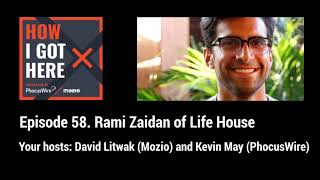
Podcast interview (How I Got Here, ep.58) with Rami Zeidan, founder of Life House. Zeidan recounts his upbringing, education, finance and hotel-industry background, and the personal motivations (including family loss) that led him to start Life House. He explains Life House's thesis: focus on under-served small hotels, apply software to automate non–guest-value tasks, and offer both branded hotels and white-label management powered by proprietary SaaS. He cites traction: ~25 hotels managed, ~8 branded properties, raised seed quickly (seed closed ≈7 months after start), ~$35M OpCo capital and ~$350M real estate capital, eight in-house software products, largest hotel 135 rooms, luxury property charging ~$1,700/night. He stresses mission (belonging through travel), design/creative involvement, and balancing mission with financial viability.
Questions this video answers
2017 (as stated in the interview).
About 25 hotels (manages total of 25).
Eight properties under its own brand name (per interview).
About $35 million for OpCo.
About $350 million of real estate capital on the side.
Chapters
Welcome to How I Got Here, the inside stories of startups and innovation in travel and transportation with your hosts, Focus Wire's Kevin May at mozio's David Litwack.
Hello there and welcome to another episode of How I got here. That's Mozio and FocusWire's weekly podcast where we interview the entrepreneurs and innovators in travel, tourism, hospitality and transportation. This week, we warmly welcome Rami Zaydan. He's the founder at lifehouse. Many of you will know lifehouse already, but for those of you that don't, the company was created in 2017 and has eight properties under its own brand name and manages a total of 25. He was previously vice president at TPG Capital and worked at the StarWorld Capital Group in the role of acquisitions. Rami, thank you so much for joining us on How I Got Here.
It's a pleasure. Thanks for having me.
Okay, those of you that have been tuning into many of these will realize the very first question that we always ask all of our guests is to tell us how you got here.
Yeah. Yeah. So thanks for. Thanks for having me. There's a few other resume tidbits that I'll probably get into with the story, but in short, lifehouse was the genesis of a collection of personal and professional experiences. And to kind of start from the beginning, I grew up in Minnesota to two Lebanese immigrant parents. My mother passed when I was young and I effectively saw there was an opportunity to find my nourishment or my nurturing without my mother by just focusing on school or soccer and being good at certain things as it was quite challenging to be somewhat of a minority in a pretty homogenous place. And as I kind of evolved, I saw that to be develop confidence in who I was, it was highly correlated to being good at certain things as opposed to just feeling a sense of belonging in the universe. And this will kind of segue into the brand of lifehouse and less so about the business. Nevertheless, I left Minnesota, went to Johns Hopkins University to start, studied economics and chemical engineering, got injured playing soccer, transferred out to London School of Economics, and throughout all those experiences saw that, wow, there are much more diverse populations outside of the state of Minnesota, and felt really connected in many other ways. So I took a job initially in the finance sector, partially because I didn't come from money and I didn't know exactly what I wanted to do. I was a creative at my core, but saw being creative and, you know, struggling with fitting in in Minnesota wasn't a really great formula for success. So focused on kind of figuring out a more pragmatic approach to a career path and finding my personal fulfillment. Took a job with Deutsche bank in the last recession in their special situations group. And we were buying portfolios of loans that were distressed and Excel was our baby. And so I became quite good in Excel, modeling basically building templates for how to. How to quickly underwrite $100 million portfolios of thousands of different distressed pieces of real estate. And saw that building these robust templates was enough to automate some people's jobs because the templates and the formulas, etc. Did all the work for, for people. And I actually was more productive and saw that building models was actually a creative outlet for me being creative person. And then we also financed hotels at that time. We ended up financing the Nomad hotel in New York. And I saw there was not avenue for me to kind of pursue a creative passion in design, operation, operational complexity and still make a decent living. And so I went on to Starwood and at Starwood wore a few different hats. But the latter part of my time there helped build a management company and learned a lot. So I kind of jumped from place to place to learn, which is really great for me and not maybe the best for my employers, but appreciative of all the mentorship that I got and quickly jumping into the hotel space there in the management side, saw that again, Excel could automate people's jobs away. And there was a dearth of sophistication. You know, whether it's building OS and E templates or budget templates, there was a lot of people spending their time in Excel and documents that didn't add value to a guest and didn't add value to the real estate owners underlying in 2014. And so I kind of developed this, hey, I want to be a hotelier and have my own brand because I have my own ideas. And somewhat of a naive, ego driven approach. This was 2014 and not something I'm proud about. But then in 2014, my brother passed away in a tragic accident. He was a doctor and humanitarian and the opposite of me. Very focused on how do I be a better person? And not necessarily that focused on economics. And I remember feeling if I made a billion dollars immediately, it wouldn't even change my mood. And I saw I needed to do something that was a little bit more or quite a bit more meaningful to me personally. So I tried to figure out, okay, where can I add value to the universe and do something fulfilling and make a living? And so I saw there was an opportunity to. So I immediately went to Lebanon, where my family's roots were, where my brother used to go, and try to connect with my roots. And in doing so, I kind of saw there was a huge opportunity to use the travel ecosystem to help bring the world together. And I felt it was more powerful to work on solving that big problem than to work on even bigger policy, as that doesn't change people's behaviors or perceptions. So I saw there's an opportunity to kind of marry all my skill sets. And so I took a job with Seidel to figure out how to build lifestyle real estate brands, hotel brands, and then they were really good at that and the genus that they were good at building brands. And I saw there was still an opportunity to use Excel and software is far more powerful than Excel, obviously, and solve the problems that exist throughout that entire ecosystem, which are complex because you have real estate owners, real estate lenders, travelers, et cetera, tech operations, brand. And so it's not a trivial problem to solve. I saw at the time, this was 2016, 2017, that there were companies like Airbnb, sprouting, Uber, et cetera, which where there was capital available to solving complex problems and the capital that had funded most hotel companies prior was real estate, private equity, which wasn't suited to solve complex problems in an aggressive way. And at that time wework was a thing and everyone was looking at are you classifying yourself as a real estate company or a tech company? And I don't like those classifications, I think they're too broad. But fundamentally I saw there was an opportunity to look at a hotel company AS an enterprise SaaS business where you sign really long term contracts, you have really sticky revenue and you have a sales team that goes out and acquires contracts and the margin on those contracts is close to 100%. So in many ways it looks like a very scalable enterprise SaaS business with really high barriers to entry. And to solve the problem, we needed capital. So I went out to the venture capital world and I think I missed the TPG stint. But largely speaking, I went to TPG just to get a bonus and save up to be an entrepreneur. Yeah. So I hope they're listening. Yeah, yeah, yeah. So that worked out well. And then I was able to get some really great investors to believe in the idea and solving the problem. And it's a complex problem because you have to basically sell a vision to real estate owners who are putting investments into things well before you have a product, which is no easy task. So we were pretty successful in the early days and allowed us to raise a lot more capital. And now Today, we have 25 hotels, we've raised about 35 million for Opco, 350 million of real estate capital on the side. We've got great partnerships with some public companies, and we've built eight proprietary software products in our own tech stack. And fundamentally, our mission here is to make travel more meaningful and more accessible and make owning a hotel more profitable and more seamless for hotel owners. And I think we're decently well on our way.
Okay, thank you very much. I mean, you're the first person, and David might correct me if I'm wrong on this, that we've interviewed. Out of the dozens and dozens that's mentioned mentors. Very, very few entrepreneurs that we've interviewed have ever mentioned mentors, which I think is quite surprising because I think mentorship is a terrific program if it's formulaic like a corporate program, or if it's just something that you go out and do individually. So is there a mentor that you're happy to name now or just can describe what you learned from one of your mentors that has put you in the right, both kind of emotional frame of mind and kind of corporate frame of mind to be doing what you're doing now?
Yeah, I think it's a generous description, maybe using that word in my earlier statements. But I guess what I would say is I try to learn from every experience, whether they are intentionally trying to help or not. I think there have been some folks who haven't necessarily tried to help, but I learned a lot from that. For example, I wasn't the most diplomatic person when I was this, you know, kind of, you know, jumping from job to job trying to extract as much information and knowledge as I could, and, you know, learning from those experiences and having people, you know, conduct themselves in their job, that still still taught me. I think there have been some mentors that have taught me different things along the way and I think collected those different tools, whether it's the. On the business side or the personal side or the business ethics side that have kind of evolved me into who I am. But I wouldn't say today I have a singular mentor that I continually keep in touch with.
Yeah, yeah, for sure. And you're one of also very few people that we've interviewed that is a sole founder. Many, many CEOs and founders that we have been part of a partnership. Is there. Did you have a co founder at one point for this Lifehouse or why did you go down the Sole founder route.
I did, I did, I did have a co founder who went to the same university as me at Johns Hopkins and was the tech side of the business early on, who's gone on to be a successful entrepreneur himself and he was very helpful to the launch of this business. And we were, we were a good partnership because we were very different in our skill sets and very complementary in our work ethic and drive and you know, and candidly it was a great, great, great partnership to launch lifehouse. And I, having not been a tech entrepreneur, had got really great, you know, I think perspective from him and now I would say I'm a sole founder. You know, we don't necessarily keep in touch but you know, there are definitely things about having a partner at my level that I miss and there are some benefits to being, to not, to not having friction as well.
Last, last one for me if I can. I mean it's. You've got all this experience, as you say, you almost like a sponge going through all these different organizations and absorbing of much experience and knowledge and process and all those kind of things. It's still quite a considerable leap to do all of that which you could have seemingly carried on doing and earning some very, very good money in the VC world and all those kind of things to suddenly go from there, go, okay, right, I'm ready. So what was the moment where you thought, okay, I'm ready?
Yeah, so I was risk averse by nature in some degrees. And so part of what I saw was I was, no matter how much money I was making in the private equity world, I was unfulfilled and I was really stifling my what made me get up in the morning. And so that was so to your point. Yeah, it was still quite a leap. And actually I think you don't see too many people leave the private equity or VC world where they're making a bunch of current income, cash income because the opportunity cost is so high. And so I think I left at a good place where, you know, I wasn't a managing director and you know, had a family or anything. I was, I was kind of on my own and so, you know, I didn't have a huge opportunity cost. And also I was pulled in through having some. I was an advisor to a company and I basically saw there was an opportunity to, to raise capital and pay myself a salary in short order, so to speak. So I knew that I was going to give myself about a year to figure it out. And we closed our seed round seven months after kind of starting. So yes, it was a leap and I'm really, really grateful to the investors that that believed me in the beginning.
So I want to delve a little bit into the how of how you went from property number one to scaling because I think there's a lot of interesting things in your business. One, you guys manage some hotels yourself, but you don't manage all of them. Your SaaS, product powers, some other ones or they're not all under your brand. Let me restate that. I'd like to like for you to actually clarify a little bit of that for us. But the I can you. I got a couple of follow up questions but let's start with how did you go from one property to multiple? I feel like there are a lot of private equity real estate guys that I know Blue Flag is helping you guys expand right now that never get involved at the first concept, but they'll love to help you scale from number three to 50. So often that first one is the hardest. So how did you start there?
Yeah, so I actually again credit to my prior experiences but I kind of wrote this thesis when I was at TPG about there was a mispricing in small hotels that were underserved by sophisticated capital, sophisticated operators and any sort of legitimate brand. And so basically you have a bunch of hotels that were small, that were underserved by sophistication and you could basically find real estate investors to buy mispriced hotels if you gave them sophisticated attention. And so the belief from owners didn't have to be hey, this startup is going to change the world. The belief needed to be hey, this is a good real estate deal based on the price I'm paying for the, for the real estate. And so we. So in that in order to do that I had to kind of have the general knowledge of how to buy real estate at decent prices because to your point, it's hard to convince a Blue Flag or any real estate group that's risk averse bet on an operator that doesn't even exist yet. So my prior job was finding good real estate deals in my prior companies and I saw there were particularly mispriced space with small hotels where the big institutional groups weren't looking to buy them because it was too much effort for such as little check. And so we started in the small hotel space and proved out a model with small hotels. I'll ramble for just one minute here. Small hotels have a different problem than big hotels. But salaried staff really burden a P and L in a small hotel because there's lower revenues. So it really forces you to figure out a staffing model and build software and operating model that is a staff light and then that those, those constraints help evolve that model to larger hotels. So we were, I'm really pleased that we started with small hotels because it forced us to think about every dollar that was going into the operation and every touch point of the guest. And now luckily those learnings apply perfectly and scale perfectly to larger hotels. Our largest hotel today is 135 rooms. And now the software doesn't just power automation. We have a hyper luxury hotel in the Berkshires that's $1,700 a night and the software powers hospitality. I think that's something maybe we don't get enough credit for in the press, but we. I'll use this analogy because I think your listeners will appreciate it, but it's somewhat cliche. Uber didn't just build software to automate the dispatcher, they built software that made it very easy to become a really good driver and so lowers the amount of training required to be a driver and increases the reliability of it. And we thought about the same way for on site staff. So we basically tried to automate and I'll get back to your question. Automate jobs that don't add value to the guest experience. So that's everything from finance, accounting, revenue management, performance marketing, all those things, HR and automating. A cost in a P and L is a risk free cost savings. So as a real estate investor you don't have to believe much on all you have to know is that there's going to be zero finance dollars in your P and L. And so it was about finding a really compelling risk adjusted pitch to real estate investors, or hotel owners, if you will, on why we can create value for their property. And it became, you know, as you build trust in the ecosystem, it becomes easier to grow. So that was a whirlwind and no.
So it's what you said about Uber, actually it's. I've said this before, I mean obviously Mozu is a ground transportation company. So I use Uber vs taxi magic slash curb analogies on a very regular basis for a lot of different things actually to the annoyance of people for my new company. But I've said the same thing about how Uber's biggest insight innovation was actually being able to boot bad drivers off the platform and enforce quality among service and hospitality. Because like driving is kind of like, you know, driving but like if you end up with someone who doesn't pick you up and. But they happen to be the cousin or the owner of the taxi company. It's kind of like you're, you're out of luck. So I totally get where you're coming from there. I want to, you know, ask you a little bit about how, why you have something called Lifehouse Connect. Actually, let me, let's start there. You know what is Lifehouse Connect? Is that what you're referring to in that you are also managing everything or is it just the platform and someone else can manage it? It's just the tech and all the automating, the cost and the P and L portion of it.
Yeah. So Lifehouse. I'm not sure where lifehouse Connect came from, but it's not a term we use anymore, candidly. So we have. Why don't I just quickly explain the product lines? So at our core we're a hotel branded management company. Think a tech enabled Marriott. There has been a shift in that space to focus on brand and stop focusing on management and Marriott's become largely a franchise business. We believe these things work closely together and so we do both of them. And basically having been in the lifestyle brand space for quite some time, I saw that there's going to be a, there's a proliferation of lifestyle brands and a faster way to grow and to monetize our software faster is we should manage other people's brands as well. And so that is what we would call our white label power by lifehouse Management Company. And while it's powered by our software owners still want a management company at the wheel. And so we monetize our software via a management contract. And I think that's an important note. I always, you know, everyone that goes back to that real estate company versus tech company question is, you know, I always said well sure, I can be a tech company, but then my customer changes from an owner to an operator and the economics changed pretty dramatically. And there's not a lot of hotel SaaS companies that have done so well long term because you get such little economics out of each hotel. You need a million hotels to be a billion dollar company, you know, thereabouts. And so our view was let's solve the whole problem. Software is a huge differentiator, but it's not the only thing we do. And we can, you know, have a very lucrative business model in that way. Although, you know, struggling to communicate that it's not just SaaS, it's a management company.
Interesting. And so you guys, so then the next question I guess then is how are you Guys thinking about expansion, right? So you can facilitate things under the lifehouse brand or you can manage other brands. And I feel like I have experienced VCs or product people saying, run in this one direction, this is the one that's appealing for. Why are you doing both? And I imagine you might have gotten similar questions. How do you think about saying, hey, we're going to coordinate with Blue Flag and we're going to be launching a lot of lifehouse branded stuff versus someone else dealt with all that. We don't even have to like think about choosing a property. We found them, they want us to do it and we can kind of get a come at the end and monetize it. And have you decided to choose ATT and CK or is there a reason to maintain both?
So it's great question because it gets asked often. And to your point, a lot of people want, what I've heard is venture investors want to bet on something and a very specific thing and having multiple things convolutes that betting decision, so to speak. And so my belief is that we should do things that make good business sense. And so we've built, let's say we've built the architecture for a lifehouse and the tech is kind of a white labeled product. And so if we can quickly layer it into other hotels and brands and the margin on that revenue stream is really high, then we should do it. And it's actually really high margin revenue and it's a really big problem. And I'd also say, you know, we started from, okay, what is the problem that we're solving in the real estate community? And there's a lot of real estate out there that's fine, that just needs a better operator and it basically increases our tam, so to speak. And in that there's hotels that may not be a good fit for the lifehouse brand because, you know this, we have the Chateau in the Berkshires and it's like we shouldn't convert that to a lifehouse. But it definitely needs an operator and you know, a tech enabled one that can drive more profitability out of this asset. So we found a way to not be, you know, ego oriented about our brand per se and just focused on solving the problem. And it's really scalable to be a white label management company. And there's not a lot of people doing it because it's not necessarily that sexy. But to us it's really sexy because it solves the problem pretty elegantly. We can plug in our, you know, our systems and increase revenue in the first month by 30% and you know, let go of all back of house labor and then the front of house people instead of being in spreadsheets and reports are focused on the guest. So we like to say we reduce the headcount in the hotel and increase guest reviews. So it's a problem that we're all, it's still part of our DNA to solve that problem and we're not interested in necessarily picking a singular path. And last thing I'll say is we're going to launch new brands as well. So we'll have a budget motel brand and a luxury brand probably later this year.
Very cool. Well, so let me just ask you then because for the sake of our listeners who are a lot of startup founders who I won't go into, but I've gotten a lot of that exact same pushback that you have about choose a path from venture capitalists. What was your response in that then? Right. Like why when they go to you, why are you still launching new brands? Why don't you just find more chateaus in the Berkshires to fund? Sorry. To operate instead of funding other things? What is your response?
Yeah, so I think why you don't see a lot of real estate operator startups of any real estate asset class is because you need to understand the customer. And the customer as a real estate owner, it's a B2B product. So one customer as a real estate owner and the real estate owner problem is fundamentally, you know, nuanced because it's constrained by what the physical real estate is. And so we try to design solutions for real estate. And real estate is the limiting factor because we're asset light. And to stay asset light, we have to be malleable to real estate, otherwise we have to go buy our own assets. And in that light, as supply is the challenging thing to get in our business, it's always focused on what does a real estate owner need and how can we create value for them. And so long as we don't have two separate business lines and departments focusing on the white label and the branded, then it makes a lot of business sense as well. And you know, it takes some massaging, but a lot of people love it. And frankly, it's really fast growing. 60% of our portfolio is the white label thing now. It's grown 150% during COVID because there's a lack of a real estate capital availability in this environment right now. And so seeing the agility that we've had has really excited investors because it's Somewhat recession proof. And so in short, I think if there's a compelling business argument, our investors thankfully are willing to listen.
You said a few moments ago, Rami, that you know, the white label parts of the business is not very sexy, which is why a lot of people don't do it and why you like it. It's only a question of time before everyone kind of catches up and hang on a second, the folk at Lifehouse, they're onto something here or do you just think it's just not something that presumably you hope or that they're interested in doing?
So you probably wouldn't have heard of these names, but the biggest management companies out there are Aimbridge and Highgate. Have you heard of those groups? Yeah. And so I think why it's not sexy. I think that's a nuanced thing to say. But what I meant by that is brands oftentimes get premium valuations for 1 and 2. Management companies typically get valued on the NPV of their contracts, which is not a very sexy thing to sell VC investors. So I don't think that alone is sexy enough to sell VC investors. And I also would say that it's a complex problem to solve still. So, you know, good luck to anybody that wants to start a company in that space. You've got to build a lot of software and as a practical matter, I think what we're trying to do is powered. Hotels that are powered by Lighthouse will eventually feel very much like a B2B brand. Much like Slack and Asana and the other enterprise software products feel like a consumer product. And why that does end up translating to a powerful brand is our users, our employees in these hotels are, you know, love the software. They walk around with an iPad or housekeepers walk around with an ipod touch. Their training is so minimal and they feel really good about the work that they're doing and versus you know, using Opera or some PMS software out there. So long story short, and our owners get, you know, great, great reporting. So I. Sexy is maybe not the right word.
Okay, well so actually I want to kind of restate something you said there, just see if I'm interpreting correctly. It's almost kind of like you're putting a brand around the non sexy part of the industry of management of competence. And previously the brand was all around, you know, just lifestyle like Marriott like you said. But they opted out of the operational component. You're almost putting a brand around the operational component saying okay VCs, you don't normally, you know, like value us like the Brand but we have the cash flow of the management company. Is that a correct interpretation?
I want to adjust it slightly because I don't think brand is purely an optics thing. The way I think it sometimes gets portrayed, having our entire team, for example, aligned on an ethos and having the people at the end of the day we're, we deliver hospitality as a service. So the people on the ground need to feel connected to a greater mission than just a pragmatic job scope. And candidly, it's a very complex system. So hotel owners don't understand hotels often definitely not the tech underlying barely OTAs. And so to have a simplified digestible story is valuable. And I think there's so much noise out there, everybody wants to say they're doing something with tech in the hotel world. And so I do think it's important to be able to have a digestible product in a way that's communicated to owners.
We interviewed a little while back, Avi from the Pali Society, you know, another entrepreneur has created this brand of lifestyle hotels. I think what's quite interesting is that our conversation with you this first, you know, 25, 30 minutes has been a lot around the numbers and the tech and you know, all those kind of things where I think it would be fair to say a large part of a similar time that we spent talking to him was about the details around design and things like that. He's really into the design and the look and feel of his hotels. Do you get involved? Are you interested in that type of detail within the properties?
Yes, immensely. I do think the hotelier of the past, whether it's Ian Schrager or, excuse me, Andre Balage or whomever, you know, built their brands around themselves and they weren't, you know, highly scalable venture backed businesses. And fundamentally I'm excited about the responsibility that I have and to our investors and to our customers. So I'm trying to think about ways to scale myself. But fundamentally the brand was the brand Lifehouse was built on the storyline that I communicated earlier, which is like, how do we help people belong to the universe and feel that sense of belonging? Because that sense of belonging doesn't just make them feel better, but it gives them a sense of other people's belonging in the universe as well and makes their life feel more fulfilled and meaningful. So I'm deeply connected to the brand. I finally just hired our first creative director who starts next month. So I've been owning the creative. I picked the linens, the scents. I've got our own candle line. We've launched. I'm highly integrated into that. But as we think about scale, I'm also thinking about things from a first principle standpoint. And I think there's a. Creativity is actually a really complex formula and if we can break down that formula granularly enough, we can scale creative things. And so I've internalized all interior design and all creative into our company so that we can constantly own the creative. And that's everything from renderings to graphic design to architectural design and procurement. And yeah, you get my creative team and my design team probably say I get overly involved. So I'm trying to get out of it because, you know, as we scale, people need to feel empowered and I don't think I have all of the answers and it's definitely not an ego trip for me.
So I wanted to rewind to one of the very first things you said. You actually touched on the immigrant experience a little bit there. And I had to smile because my mother was an Estonian immigrant to Minnesota actually to prioritize Prior Lake actually is where she grew up. I'm not sure if you know that area, but I do. Yeah. So I spent my summers going there. And so I know what you're talking about when you say kind of like the world is bigger than Minnesota. I think she very positive things to say about Minnesota in general. But yeah, it can be a little insular. I think you also, I think you touched on this idea of belonging a lot and I. And it linked to your immigrant experience and I think you alluded to several things that I don't want to put words in your mouth. So I'd like you just explore that a little bit more. Is it. Is this search for belonging maybe because you felt like, you know, this immigrant experience and that you were a little bit of fish out of water or. Yeah. Maybe delve into that a bit.
Yeah. So in short, I would say I don't necessarily want to say that I had a experience that was, was, you know, unsavory because of my race or anything of that sort, because people had a lot worse than me. I want to just be very clear about that. My mom had died when I was six and so. And my dad wasn't like a strong communicator. So instead of having someone at home say, hey, it's okay to be who you are, I didn't have that. So my goal was how do I fit in? And you know, it's a very Christian dominated society where every Sunday you don't fit in and every Christmas you don't fit in and et cetera, et cetera. And so for me, it was a hyper aware challenge to sort out. And I don't think I'm alone. And I don't think it's always related to ethnicity or race. I think sometimes you don't fit in if you don't have a certain knowledge or skill set or. And so what I fundamentally believe is that, you know, we're all just a node in a really big network and helping people realize that their nodes belonging and everyone else's nodes belonging can help us work all together to work through this thing we call life. And I think travel is a really great tool for that. And I don't mean it in the cliche sense, but I think just even getting exposure, we have a hotel in Little Havana. If you don't speak Spanish, you're gonna have a tough time out there. And it's in the US So I don't even necessarily mean you need to travel and camp and meet these different tribes. I think I read 60% of urban population growth is through minority communities. And you know, you can just go into urban locations and get exposure. And so I'm interested in helping people appreciate diverse experiences. And I think people get a lot out of stepping into unknown territory that does a lot of good for them and then that kind of carries themselves out into the world. And I think, last thing I'll say on that is if you feel more like a greater sense of belonging. So when you walk into our hotels, we try to make tell an authentic design story and narrative because if you feel that sense of truth that this story is real, that gives you a slight edge maybe of confidence that allows you to say, hey, I feel confident enough to say hi to a stranger in a way that if this was like wrong or tacky or didn't ring true, I would probably stay in my little comfort zone. And then those experiences help evolve and permeate the universe. And that's, you know, probably more than you wanted to hear, but how I think about it.
Not at all. No, that's, that's, that's perfect. So would you, I guess, last question on this subject. And how do you, how do you think about Lifehouse then as like a mission driven company versus profit? I guess, I think, right. Like we're at a time here where, you know, Nike is talking a lot about social justice and good for them, but on the other side of the equation, you've got the wing that just basically spontaneously combusted because they hugged feminism too closely. Right. Like, and I think they're, you know, people are trying to figure out how to be a company with a cause in this day and age without having it, you know, backfire. How do you, how do you weigh that?
It kind of goes back to us in the beginning, which is you kind of have to marry a mission with a financial viable business if you want to do things. I believe obviously, there's obviously success stories in either case. At the end of the day, our culture at lifehouse is predicated on the idea that it's more meaningful to be engaged in solving a complex problem than not to have a problem at all. And so I don't think there's an easy answer. So we get excited about nuanced, complex problem solving. And solving that problem for one is like, you know, during the George Floyd protest and when the sky turned orange this summer, you know, we were all having conversations about, well, what should we as a company be doing about this? And obviously there are people at some of the end of the spectrum that said, oh well, we should go get in the streets and we should go donate to climate related causes. And I kind of think back and on climate I have maybe an obtuse perspective, but I like Bjorn Lomborg, who's done a lot of work on the topic. And I think that solving complex problems requires a nuanced, complex solution and people that are well suited to solve them should have a responsibility to them. And I think in terms of focus to your question earlier, we're focused on solving a singular problem that's related to kind of connecting the universe. And I don't think we should be spending a lot of time in other areas at this stage of our company. And I think our company is pretty bought into. Hey, the work we're doing has a longer term mission. In our hotels we practice, you know, sustainable practices, whether that's plant based orientation menus and F and B or, you know, no red list fish on any of our menus because I think the oceans are overfished. And more than that, I think we believe in education. So we'll do a lot of sustainability talks instead of, you know, music performances. You'll see more, you know, educational programming pre Covid at least. So long story short, we try to use the space we have to do what we can, but at the end of the day, we need to also survive financially.
Okay, so last question from us then and take you right back to something that you said at the beginning, which is when you were talking about when you worked in the, in the finance world. And you said, you know, you could make. And I'm paraphrasing, he said, you make a billion dollars and it would never change your mood. So just tell us then, what does change your mood for good and bad? Very quickly.
I try to be as stable as I can so the mood doesn't change too dramatically. I think it came clear at the holidays. I got a few notes from employees saying that how. How grateful they are to be part of this mission. We start our Monday calls with zoom meditation. I think that my team works far more than 40 hours a week. And seeing people working relentlessly and working hard towards something that I started and they're very much a part of is like a really emotionally powerful thing for me and really rewarding, independent of the stresses. What sends me downwards, I don't understand when people will go out of their way to cause harm. Whether that's, you know, there's a real estate negotiation practice which is, you know, hold out and, you know, cause fatigue in the other person or use the legal system to create havoc. I just don't understand that. And I try to. I try to trust that there's something good that can come out of that, but it's. It's hard.
Okay, that's great, Rami, thank you so much for joining us. We really appreciate your time.
Likewise. Thanks so much for having me. This is a pleasure.
Okay, you've been listening to another episode of How I Got Here. That's Mozeo and Focus Wise weekly podcast where we interview the entrepreneurs and innovators in travel, tourism and hospitality. If you're not a subscriber to our podcast, you can do so all the usual places, including Spotify, itunes, Google Podcasts, Amazon, tune in all those kind of places, as I say. So go on there, subscribe, give us a nice review. We always like to read those, but otherwise, thank you very much for tuning in. On behalf of Dave Deny, thanks ever again, Rami, for joining us and we'll see you all next time.
Thanks for listening to the How I Got Here podcast. We'll be back next week with more insight stories behind startups and innovation in travel and transportation. Check moo.commove for a complete write up of the highlights of every podcast with translations into five languages. And get your daily dose of news on the digital travel economy by subscribing to the newsletter@focuswire.com See you next week.
I.
More from Rami
The Hospitality Hub - IMI Podcast Ep.3: A conversation with Life House Co-founder Rami Zeidan