#60 Diversifying Traffic Sources and Revenue Streams for Creators | Tye DeGrange and Reagan Fry
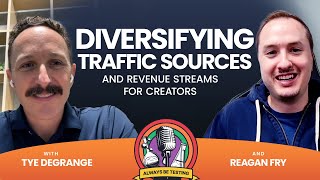
Reagan Fry, who led product at Google, Amazon, and TikTok, shares how small changes drive big results: changing a button from 'Buy' to 'Start trial' lifted conversions 12%, and TikTok's interest selector shaped creator success. He explains why automating back-office work matters more for creators than AI hype.
Questions this video answers
Approximately 12% increase in conversion (estimated ~$70M annual impact at Google scale).
Chapters
Sam, welcome to another episode of the Always Be Testing podcast. I'm your host, Ty degrange and I'm really excited to talk to Reagan Fry today. Reagan, what's going on, man?
Hey, it's great to be here. Thank you so much for inviting me. I'm excited to chat.
Absolutely, man. It's been awesome to get to know you, stay in touch over the years and see you now here and catch up. It's going to be a really fun one. Yeah. For those of you who don't know, Reagan Fry is the director of product at Kajabi. He is ex Google, Amazon and TikTok. He knows growth, he knows performance marketing, he knows products. So it's going to be a fun one. I'm excited to get into it today.
He as well. It's always fun to talk about this stuff.
Heck yeah. Heck yeah. We've had some great conversations over the years. We met through Reforged through the Seattle growth community. We were both at Amazon for a hot second and you've had some very impressive roles over the years. Maybe to kick it off for the audience. How did you break into product and growth?
Yeah, so I broke into product and growth when I was at Amazon. I originally started as a marketing manager and ultimately it really was Reforge. Both, you know, on my own initiative, taking that course, the course material being great, helping me understand how to look at things in a different way. And ultimately that led to a former colleague who went into product taking a chance on me. And so I joined the Amazon prime team as a product manager. But ultimately I think it all goes back to what I was able to learn and how I was able to parlay that those learnings into getting a product role. So I have a lot to thank Reforge for.
Yeah, that's awesome. We obviously share an appreciation. I think I've described it as some of the best frameworks and training around product growth marketing. And I think it sounds like you would agree. It obviously applied and helped support your career progression and I think many others, as I'm sure you've seen and observed.
Definitely I am a big proponent of Reforge. I can't recommend it enough, especially if you're looking to break into product, break into growth. They have a ton of other classes now. The material is great, the instructors are great, so it's a great program.
Yeah, that's awesome. Lots to. Lots to talk about there and certainly can can share more. We should link to them in the show notes. What, what would you say? You know, you've seen a lot of things in marketing and product and growth. How, how would you maybe kicking off? Like what, what are some like the hard lessons that you've had to learn as you kind of learn what is product and growth and kind of how you perform within those teams and within those functions?
Yeah. So I'll maybe separate them out a little bit. Product. I think the hardest thing to learn is the intangible, the soft skills about being a product manager. You can have the best ideas in the world, but if you can't convince an organization to work on those ideas, if people don't like working with you, if you can't understand the motivations of other teams, whether they're product teams, design teams, data teams, engineering teams, whatever, bringing all of these disparate groups together and aligned on marching towards a singular goal by building a particular feature or product, that's incredibly hard to do. And so building the business case, you have to be very good at that, but you also have to be very good at understanding how to bring people together and excited about the direction and the things that they're working on. That's why oftentimes a lot of product experience just comes from being in the role for a long time. Because those soft skills are not really necessarily things that you teach. You fail several times and learn a lot over time. The I think for growth the hardest thing is to understand. Like a lot of times you want to balance between quick wins and step change wins and try and balance your roadmap with a bit of each. So if one thing doesn't work out, you do have some successes to lie on. I think the other part of that that's challenging to sometimes understand and balance is what stage of the organization you are in. Do you need quick wins? Are incremental wins going to be enough or does it require step rate step change wins? And so balancing your roadmap between those two things as well as oscillating in one way or another towards quick wins or step change wins, depending on what the organization needs, where the organization is at a particular time. So if you're working at a very, very large organization, Amazon or Google, I think you're going, you're kind of moving dials and because of their scale, there's a lot of impact there. If you're working at an earlier stage company, oftentimes you need step change wins and incremental wins are not going to move the needle because you're running out of Runway or because in the grand scheme of things it doesn't matter. And Time matters, speed matters in business. So learning how to balance all of those things together and recognizing where you are and how you can promote the success of your team and ensure that you're not putting all your eggs in one basket, it's actually kind of challenging to do because you're not just balancing your team. You're balancing the needs of the organization and kind of understanding where you're at and what's.
Really well said. There's a lot in there. Very powerful stuff. You said something really interesting that I jumped out at me with regard to the product challenges and the notion of the skill of being able to bring people together. Can you maybe share some examples of where you've observed that, where product leaders or product folks that are doing it right or have done that really well or maybe modeled that effectively?
Yeah, I'll start with where I see product leaders actually doing it wrong.
Yeah.
And the reality of being a product. Everyone says you're the CEO of X as a product manager or a product leader, whatever your area of ownership is.
Yep.
The reality is, is that no one has to do anything that you say. They have other priorities, they have other concerns. And so product managers that act kind of like dictators, like, you are doing this because I said so, and they don't take the time to try and understand what are those ancillary, those other motivations that people have. How can I explain this in a way that is meaningful to this individual? They have their own career goals. They want to work on impactful things. So no one has to do what you say. You have to understand those motivations. You have to understand how to explain things in a way that different parts of the organization will understand. You have to anticipate what the pushback might be and make sure that you're addressing it so that the individual is like, oh, they're not. They're thinking about the things that I care about. That's good. Right. So I think it's about understanding the needs of different individuals and teams within an organization, anticipating what they care about and making sure that you address those things and frame what you're doing in a way that is important to them.
That's awesome. I think that's such a. Such a great practice of effective leadership, effective teamwork, effective persuasion, for lack of a better term, and leading with empathy. You have to have that discussion and have that negotiation and have that person raise their hand and opt in to be part of something as opposed to dictating it from above.
Please and thank you. It sounds simple, but it Goes a long way.
Yeah, well said. That human touch of care, that does really matter in a significant way. It's amazing. It's nice to see it kind of being drawn out of product and engineering in the growth worlds and the more technology roles. I've had so many interesting roles over the years and some of those times when you were able to interact with the technical teams is. It can be invigorating because you know how much the levers they can pull can be very quite powerful. They, they obviously communicate differently and think differently, but I always enjoyed it and found it refreshing to kind of work with, work alongside and collaborate and understand their position and then try to seek to find common ground. And I think that that's a. You've called out a really good, important piece of the puzzle for a lot of people.
Yeah. The other thing that I would say is that other teams and functions exist because they specialize in that function. Right. So I think oftentimes if you are too, if you dictate specifically how this needs to be designed or how this should be built, you are not an expert. Right. You, you need to explain the end goal and work with these teams about what are the options for us to get there, listen to their recommendations and ultimately make a decision based on the information that, that they put forward. If you start for this is exactly what we're going to do. You take a little bit of their craft and their joy out of being able to create something. And at least for me, and you know, for a lot of engineers, a lot of design folks, that's the magic of, you know, and the passion of what we're doing is being able to build something. And if they don't feel like they can have a meaningful part of that, that's. That's not a good place for them to be.
Yeah, no, well said. You're dealing with. It's so funny because I see it in our world quite often too, in different ways, as you, I'm sure, understand and can appreciate. Sometimes a client will say, I want this prescription for this illness and this dose. And when in fact is like, all you need to do is give me the illness. We take pride in being able to tell you the prescription and the dose and the training to get you back to healthy and growing, you know, and it really resonates with me that unfortunately people have a tendency to, you know, kind of fall into that. You know, here's the gum. Let me show you how to chew it.
Right. It's rely on others to do their best work. Doesn't mean you're. It's an excuse not to be involved. Right. If it is like I know what will convert in a design, like in a user flow, I know that this will convert, but I don't know how to make it look beautiful from a design perspective and understanding those things about where you're really strong and where you're not as an individual or as an organization, even as a client, that is how you get the best kinds of outputs.
You're not hands off the wheel. And that's so funny because I wasn't necessarily the best at managing agencies or external resources or internal teams, but I always felt like I really enjoyed giving them an opportunity to thrive and have enough rein and leeway to feel like they could have some agency over their growth and charting their. How do we get to this aggressive, exciting goal together?
And I think that's about doing it together. Yeah, I think is the main thing. If you're prescriptive, you're not really doing it together and then ultimately someone else is just executing.
Yeah, yeah. Easier said than done, but I think it's a really great, really great call out. So kind of an epic run. You're still on it. Let's hit Amazon first. What's the big learning test from your Amazon experience? If you could kind of give us the reader's digestion as best you can?
Yeah, I think one of the things that one of the best learnings that I took away from Amazon is it is frequency matters more than like one big purchase. You want to develop a habit because over the long term that's a lot stickier than one big thing. Like I can spend a thousand dollars in one week, but if I spend $200 each week for three weeks, even though it's less money, I'm going to be a happy, healthier customer because I've developed that habit. And how this manifests is in a specific example is how you do promotions. So I can give you a $15 gift card for doing some high value action, or I can give you $5 each week for three weeks to develop that habit. $5 each week for three weeks is in the long term more impactful. So for example, in a while ago in prime now it's $15 for shopping. In prime now for your first shopping experience, that's not, that was not successful if you just give them $15 after they make their first purchase, but $5 each week if you make a purchase during that week. Using prime now was much more effective. And then in the world of promotions, yeah, in the world of promotions, you can take that one step further. If I just give you $15, that's not as impactful as if I give you $15 to shop. In other words, electronics. Because if you shop in electronics, you are much, much more likely to make follow up purchases. Oh, I bought a computer. I need a microphone as an example. It's what we call kind of the, the back of the store milk. When you go to a grocery store, you have to walk to the back of the store to get milk. That's why you're there. But as you're walking through the aisles you're like, oh yeah, I need some cereal, I need some water, I need some of this. And so all of a, all of a sudden you went in for milk and you're coming out with much more. And it's because you're having to go to the back of the store and front and you're seeing all these items. It's similar in promotions. You want, ultimately the promotion is cheaper. If the promotion gives you money or whatever kind of incentive it is to take an action that typically results in more action. It's all about creating that habitual sticky behavior because that's where it is much more likely that a user, regardless of the product, gets to that value moment.
I love that such a, such a good trade off and such a clear takeaway. Obviously a ton of learnings. But to be able to manufacture and support and nurture that habit moment we talk about is so critical. It sounds like, and I love the difference. And the grocery store analogy is a great one. How shifting gears a little. Let's talk Google. What was the big takeaway? Learning with that experience.
Yeah. So I think if you take a step back and look at, you know, and we can get into this a little bit later. But I think the being the individuals that are the best at growth really understand customers. And that means underhand understanding, behavioral economics, behavioral psychology, because it is not always rational or obvious why a user chooses to do the things that they do. And so at Google I had the pretty rare and unique opportunity to work with a team of PhD behavioral economists and behavioral science folks. So my job was to understand like where's the drop off happening? And they help us understand why is it happening. And here's something that you can do, an experiment that you can design.
To.
Address that gap, to address problem. So one of the more interesting experiments that we did, and there was a ton, but I have to be choosy and this was run by my colleague Jiang, there was A program in India for Google Pay, where they were essentially just giving out using like, kind of scratch cards to win money as an acquisition lever. That is really not a good idea for acquisition because in the long term, you get. People expect that money, and if you take it away, then all of a sudden, like, everything stops, right? All the behaviors stop because it's always tied to that monetary value and it gets really, really expensive. And what we found was that.
You.
Know, we need to reduce the cost of the program. And what we found is that if we increase the frequency of you doing that scratch off and winning like a dollar versus the dollar amount that you would actually win, we could lower the cost of the program and not have any downstream, downstream negative side effects in terms of business metrics, et cetera. And so what we found was that people kind of enjoyed the thrill of winning regardless of the amount, more than the amount itself. It's the anticipation of winning and the thrill of winning that was more important than the amount. So if, you know it went from $10 to $5, you would think, rationally, I care more about winning $10. The reality is I care more about winning $5 slightly more often or $2, $3 slightly more often. In that kind of scenario, you lower the cost of the program. And I always thought that was super interesting. And a very clever test that the.
Team was able to run in your experience was, isn't. Is there variable rewards? Is that the terminology used? It's like you're.
Exactly.
We've talked about this concept before, but is that kind of what you're tapping into there?
Yes, exactly. It's the anticipation of the reward is more powerful than the reward itself. So variable rewards in a lot of different scenarios is a very powerful concept. And I appreciate you bringing that out because that's the. The actual term for it that I neglected to mention.
No, it's all good. I. It's fascinating and it makes some sense. It kind of has some slight correlation to your first learning, in my view. And it's really powerful stuff and it's very interesting.
I'll give you one more from Google, and I think this one's important because it's relatively simple. Also probably the most impactful test that we ran. So when you're signing up for YouTube Premium, you can get a free trial, right? The flow is fairly simple. It's a couple of steps. And before you start your free trial, there's kind of a buy box. This is free trial, $0. What we noticed is that a lot of people were dropping off at that buy box step and, or the checkout step rather. And we noticed that the reason was even though it's free trial, it says $0. The CTA, because of how the system kind of worked, said buy. And that creates a lot of cognitive like dissonance and apprehension. How do you buy a free trial? Am I buying something? I'm going to leave, I don't want to do this. Right. And so a lot of people that I talked to was like, oh, it's not that big of a deal. It says free trial at $0. Like we don't want to do the work to fix it. But the reality is it does matter. And so when we change that from buy to start trial, you had, I think it was around 12% increase in conversion, which at the scale of Google is like $70 million a year. And in ARR or MRR, however we were calculating it, I don't remember. But those simple things really matter. They really do and they can have a huge impact. And so I guess the lesson there is you can have big impact from small changes if you figure out the right small change to make. And of course, amazing, as we all know, CTAs are super important.
Yeah, absolutely. What a great call out. Like there's expectation that's that comes with that by word. Less expectation comes with that start trial word. Such a fascinating area. I enjoy it greatly and love talking to you about it. It's fantastic stuff. Moving on to the trifecta. Really cool learning and experience many at TikTok. What's one one of the bangers that you want to share with the crew.
I have a couple here that I'd like to share because I think they're just so interesting. If you'll indulge me. The first is when you are onboarding to TikTok, you sign up and historically you just got dropped directly into the feed. A lot of people abandon because it's hard to get those first like two, three, four videos right? You'll land in the feed and like, ah, these are for kids. This is not for me. So what we did was we had an interest selector. So you sign up, select your interests, get dropped into the feed. The interesting part here is when we actually tried to use those interests to influence the algorithm and what you saw in those first like nine videos had zero impact, had negative impact in fact. But we also had a variant where it had no impact on the algorithm. You just select interest and we do nothing with that information. That performed better when we removed the interest selector. We had more people drop off. And so the learning there was that it's kind of like an IKEA effect mixed with algorithm aversion. IKEA effect is the more you effort.
Or.
The more effort that you put into, like building something, the more invested in that thing that you are. Algorithm aversion is the more, the less, I guess, control that you believe that, that you have over how the algorithm works, the less you trust it. So you have a scenario where you're dropped into the. The algorithm. They're like, this algorithm doesn't work for me versus I select my interests and I get dropped in.
I was part of building this feed.
For me, I was part of building this feed, so I'll give this a.
Little bit more time.
And that even though it wasn't, I'm.
As critical part of it.
Because in TikTok they load like nine videos. And after that, nine videos, it's incredibly good at kind of being like, all right, this is. It'll starts getting better and really starts to know you. But without getting to those nine videos, people would drop off and not give it a chance to actually work. But if I feel like I had a hand in building and kind of dictating what the algorithm was supposed to show me, I'm more likely to give it longer and get through those nine videos. So the algorithm says, okay, this is what you actually want. And then it starts to get better. So I always found that extremely fascinating.
That is. That is awesome. It's like they. They got your vote and you felt like you were part of it and it was like, I voted, so this, this must be represented representative of my vote.
Exactly. It's. Well, this is not. I select my interests, so it must be my fault that this video is not very good. Let me go to the next one and see how that works. Right. It's a very interesting psychological blend of psychological concepts working there.
Very cool.
The other two that I want to talk about are the creator fund in a feature called Non Life Gifts. So creator fund, for lack of a better way to explain it, was kind of a simple way to do ad revenue sharing with creators. Since TikTok did not have that YouTube did. All creators on TikTok want ad revenue share. And we're like, well, we're going to test it. Doing it this way first. The mistake that we made was allowing too many creators to be part of the fun and having the payouts from the fund be too small. And the principle here is intrinsic versus extrinsic motivation. When you add money into the Equation you go from, I'm creating videos because I enjoy doing it. I enjoy people reacting to them, liking them, whatever it is, to is the amount of money that I got from this video worth all the time that I put into it. And people were getting like less than a dollar, maybe a dollar per video. And you change that mental model from that intrinsic motivation. I'm doing it because I like to do it to that extrinsic motivation. And the mental model becomes this is this money that I'm getting is not worth my time. And so that. And there are several other things about Crater Fund for kind of why it was not successful. But I thought that was the core of why it was not successful. And so understanding intrinsic motivation and extrinsic motivation, especially when you bring money into the equation, is incredibly important. The other thing that I'll say is that non live gifts. So I watch a video I can buy like a little exploding star and give it to the creator. The creator gets some money. That's very common in live streams. But we were doing it in the video setting. Even though creators were earning much less money. The impact that that had on core metrics in terms of the frequency of creation and things like that was more than creator fun, even though the dollar amounts were the same. And that's because the same or even potentially less. And that's because the feeling that a creator gets from, oh, this person enjoyed my content so much that they were willing to give me this paid kind of emoji that let me know how much they enjoyed it or how they felt about it. That rather than the money influenced their motivation in a positive way. And therefore we saw better impact relative to creator fund. Now there's a lot of other metrics and different things going on between those two things. I don't want to, they're not apples to apples, but I think from a principle standpoint and a psychology standpoint, that's the learning.
That is amazing. That is amazing. Can you, before we move on, it's fascinating to me for tons of reasons, but without giving away the secret sauce, can you maybe give a quick hit of like what, what it was that cracked the code for the creator. And if you can't share, that's fine. But like, just from the high level, like this is what we was changed after I left or during this period of learnings where they realized they needed to and maybe, you know, gifting perhaps a small piece of that, of that evolutionary learning of how to create a proper creator ecosystem on TikTok and that maybe is part of a larger conversation for later. But I have, I'm compelled to ask, what was it that kind of turned the tide for creator monetization and creator fund like activity at TikTok?
Yeah, I would say that, you know, first of all, for non life gifting, this is another like product lesson. It was in a pretty prominent part of the app within the comment section. And so even though it was successful on the terms of like what it was supposed to do, what we thought it would do, we removed it from that. It's still there, but it's less prominent. And so even though it was successful, the reason we had to remove it was because there was something else that we could put there that was much more successful because it's valuable real estate. And so you can be successful, but also the product can still, I don't want to say fail, because it's still there, but it can still not working the way that you intended because there could be a bigger fish and a more impactful way to use that real estate. And so I think that was a learning for me what I'll say about, you know, cracking the creator code at TikTok. I do not think that creator monetization at TikTok really, like in a direct way really influences creators at TikTok. I think the value at TikTok is that because of the algorithm, you can gain a large following or a lot of views very quickly at any time. And at the time, and still somewhat true today, that was not true on other platforms. On YouTube, you have to have a bunch of subscribers. It takes a long, long, long, long time. Same for Instagram. Now there's like reels and shorts that are still going off this. But the biggest motivator is that you can very quickly get a lot of views and build a large audience in a very short amount of time. And I think that more so than anything else was the biggest kind of way that TikTok kind of cracked the creator code. And with that comes forms of monetization. Like you have a big audience, you can start to get brand deals. They don't really do ad revenue sharing. And yet a lot of creators, millions around the world, still use TikTok. Because what I think creators are finding is you are renting your audience on these social platforms. The way to really build a sustainable business and to make money in the long term, if you want to do this full time, is you have to figure out a way to migrate your most engaged audience from those platforms to something that you own and you control and in that way you diversify both your traffic sources. You need to be multi platform, YouTube, TikTok et cetera. You need to kind of funnel all of that to one place that you are able to own and control and leverage a more diverse array of monetization or revenue streams to be successful. And so I think creators are really starting to learn that over time you need to be multi platform and you need to not be reliant on those platforms because they can change the algorithm.
Yep.
All of a sudden your views go from hundreds of thousands to zero overnight and then your business is put.
It's, it's kind of a fascinating learning because it, the unlock wasn't in the payment. The unlock was in the nature of the variable rewards. The ability to go 0 to 60 quickly to get those followers to get the crazy high engagement where with similar outputs it would have taken much longer to do that on YouTube, ig other platforms.
Right, exactly. For creators. TikTok. TikTok is the ultimate variable reward engine. And I love the way, I love that you brought that up because that is a perfect way to describe it in the context of creators.
It's so cool. Those learnings are honestly Reagan, just stepping back like these are some, we've had some good ones on this, on this show. We've had some amazing guests but those are really powerful, really like well articulated. Some, some great historical examples almost and like in the world of product and growth and so I think just tip the cap like those are, those are phenomenal.
Thank you so much.
Yeah, yeah, man. Always, always, always dropping heat, always dropping knowledge. Let's, let's bring it down the home stretch. I'm gonna wrap, wrap them up because I feel like that was, that was just so much like we could make like multiple, multiple shorts out of that and fun, fun more can offshoot multiple more topics. But you know, zooming into now like with, with all the cool stuff that's going on with you and leading product at Kajabi. Just, just generally speaking, what are you most excited about now?
Oh man, I'd say there's two things. One is there's a real problem in the creator economy that we need to solve. I kind of alluded to it earlier, but there are three legs to the stool in the creator economy. There are the platforms that distribute content, so your TikToks and your YouTubes et cetera. There are the folks that consume content. So you, me, everyone listening to this, everyone in the world consumes content on these platforms. And then there are the creators of this content. So the platforms get a lot of value because they can sell ads off of the viewers that consume the content and they make money. The viewers get a lot of value because they're getting all of this wonderful content, all, all of this knowledge, the Library of Alexandria at their fingertips, essentially for free. The creators in this three legged value exchange get the short end of the stick and arguably they're doing the most work because they're producing all this content and they aren't getting reciprocal value and return. And so I'm excited.
It's hard out here for us, Reagan. It's really hard.
I'm excited about solving this problem and creating a more equitable value exchange between these three pillars in the creator economy. The other part that I'm incredibly excited about is AI. Everyone's excited about AI. I know it's a big topic, but I want to emphasize this is not like a flash in the pan. This is not a bitcoin where the value is actually not super clear. How is this bringing value to people? How is it used? AI is incredibly valuable. And I think there's a lot of apprehension, especially from creators about AI and it's going to create content that's going to compete with me, but I actually think that is the wrong way to look at it. We know that being creator is incredibly hard. It takes a lot to email Reagan, get them on, you know, have some notes, get them on your podcast, record the podcast, edit the podcast, distribute that podcast. Same thing. For TikTok creators, it's takes a lot, it's hours to create a 15, 20, 30 second video. There's a lot that goes into it. It's not easy, it's even harder to build a business off of that. And I think what AI does all of those things kind of behind the scenes, all the back office stuff, taking the transcription of this podcast and summarizing it, for example, AI has the potential and it's not even the potential, it's already doing this to essentially automate or make all those back of office processes that goes into being a creator. You're essentially running a business. It makes it incredibly a lot, a lot, a lot easier so you as a creator can focus more on creating that original, authentic content.
Where do I sign?
The other thing that I'll say is creators thinking about like AI is going to create this content that's going to compete with email. They're not necessarily 100% wrong. That's not a unfair concern to have. And so where I think this kind of creator world is going is that Authenticity and things that can't be created by AI. Your particular, very deep knowledge in a particular space or your ability to connect with people and engage with people, whether it's live stream comments, a community, whatever, that authentic engagement is going to become much more important. So the creators that are able to use AI to save more of their time so that they can connect with their audience in a more engaging and authentic way and spend more time there and on creating the content that they love and leveraging their deep expertise are going to be very successful. So I think creators should look at it as an opportunity rather than an existential threat.
I love that. I couldn't agree more. It's like you guys are solving a big problem. I couldn't agree more about the three legs of the stool. You know, we're going through that ourselves. I feel it. And it's a big opportunity. You bring a lot of ideal experience to it. And I think we could have an entire new episode just about that topic as well as many others. Turning around the home stretch as I promised, making it go into the fun and personal questions. What's a fun product that you bought recently that you're obsessed with, that you want to share with the audience?
Good question. Fun product that I've bought recently. It's mostly baby stuff for the last.
Six months, probably kid related. Congrats on becoming a new dad.
Thank you. Thank you. I would say I love my Roomba. Any product that saves me any amount of time, being a busy professional and a dad, new dad. Anything that saves me time to spend more time with my family or spend more time with myself, I obsess over. I think there's two things. One's a little bit more fun, but I discovered There are these CO2 wine openers. This is the best small product I've bought in the last year. But basically you just kind of stab it, push a button, and it pops open. Instead of doing the whole like, I got to do the corkscrew, try and pull it out. I was like, this is such a simple and amazing product. When I saw someone do it, I was like, it was an aha moment. My mind was literally blown. And I immediately bought one.
Nice. Nice. And you have some really phenomenal wines up in Washington, by the way. Just for the audience Needs to know this. Same latitude as France.
Yeah. Wonderful wines. I love, you know, kind of collecting wines. It's a. It's a fun little hobby. But the most annoying thing is doing the corks.
Growth into that. So we're in good company. Yeah.
Just don't ask me to, like, taste and rate wines because I'm terrible.
Hey, man, I miss. That's all that. That's all that matters. That's what it's all about. All right, well, what's a fun, interesting thing that maybe folks don't know about Reagan?
So usually my go to for this one is the first job I had coming out of college. I was actually a production assistant on the TV show the Office. So I got to take shots with the cast and crew at like a wrap party, you know, it was a very, very, very fun experience.
Wow.
And so did not know that. You know, I've always been passionate about creation and media and all that kind of stuff. And I think throughout my career, I've always been on the periphery of kind of the broader media ecosystem. And I think it's always something, whether it's, you know, creators or movies and television or video games. It's a space that I really enjoy. And I really have a passion for enabling the people that are super creative and super good at that stuff, even if I'm not necessarily great at it myself. I enjoy it so much that I want to be a part of it. And the best way that I'm a part of it is being good at what I do. And what I'm hopefully good at is enabling creatives to do more of their best work easier.
Amazing.
And it's something that we can all consume and enjoy.
What a killer one liner. What a mic drop. What a great episode. You hit everything. Did you get to take a shot with Dwight Schrute? That's the question for everyone.
I did not. But what I will say is Daryl, the character Daryl, I can't remember. Craig Robinson. He's exactly the same in real life as he is on the show. He's an awesome person. I'm not going to say that we're best buddies. I was a peon, but that's how he acted towards everyone.
Wonderful. The other thing, he gives off the best vibes ever. He's so funny.
He's exactly how you would think. He.
Yeah.
The other person that I found very surprising, probably the nicest person in terms of actors on the set. Everyone was wonderful. But the guy that plays Stanley, he's kind of a curmudgeon on the show. In real life, he is the nicest, happiest dude you will ever meet. And so I found that interesting and funny, and he's a wonderful person. So I was very fortunate to have that. It was a lot of fun.
Heck, yeah, man. Reagan, this was an epic episode. Just a ton of like fun personal chock full learnings, great growth and product learnings. We always go deep and have great conversation. This was no exception. I think people are going to have some really good nuggets to pull out and hopefully we can get those surfaced and shared properly. For those that want to look you up and learn more and ask you questions and connect, where can they. What's the best place to do that?
The best place to do it is on my LinkedIn. At some point I should probably have a website and maybe a blog or something like that to actually be a creator myself. But unfortunately haven't got quite there yet.
Too busy. Too busy growing these great companies. Reagan, you're the man. Thank you so much for joining. Have an amazing weekend and we'll talk to you soon.
Thank you so much. Ty, it was wonderful being on the show and also wonderful talking to you again. I love talking to you because we are just so passionate and we can go deep into all these things that, you know, we both find super interesting. So thanks again and always have a great day.
You too, man. Take care, Sam.
More from Reagan
“The Creator Doing the Most Work Gets the Least Value and That Needs to Be Changed”, with Reagan Fry
Uncovering the Creator Economy: Insights from a Social Media Insider with Reagan Fry #110