“The Creator Doing the Most Work Gets the Least Value and That Needs to Be Changed”, with Reagan Fry
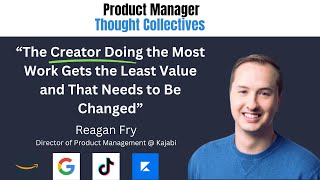
Reagan Fry, director of product at Kajabi, explains why creators do the most work but capture the least value. Platforms and app stores take huge cuts while creators struggle to monetize. He argues PMs should focus on defensible AI capabilities, not viral tricks, and shares how his path through Amazon, Google, and TikTok shaped his mission to fix the creator economy.
Questions this video answers
Director of Product at Kajabi
Amazon, Google, TikTok
October 15, 2024
Seattle
He had his first child.
Chapters
Hello, welcome to the product Manager Thought Collective's video podcast. Today we are joined by Regan Fry, who is currently director of product at Kajabi. If you are a creator, you've probably heard of Kajabi before. It is a platform for creators and entrepreneurs to create, market and sell digital content. I personally have bought Ethan Evans class from Kajapi before and it's really good. With experiences at tech giants like TikTok, Google and Amazon, Regen brings a wealth of knowledge to the creator economy. So today we'll explore his journey into product management, the transition between large and smaller corporations, and dive into the world of AI. Hello, Regan.
Hey, Yang. Thank you so much for having me. I'm excited to be here.
Absolutely. So the first question I usually ask the guests is like, how would you introduce yourself as if you were catching up with an old friend. What are some updates you have? Maybe over the last six months or over the last year?
Yeah. So big life changes over the last six months. I had my first child six months ago, so that is definitely a new life change. Moved up to Seattle.
Yes.
Switched jobs from TikTok to Kajabi where I focus on helping creators monetize and build a business through their creativity.
Yeah, absolutely. That's amazing. I feel like that's like the. One of the biggest promotion you can get is from a no kid to a parent. That that's one of the biggest life change for sure. And then I would love to hear more about your origin story into product management. And I know there are many different paths. Right. I started as a software engineer and then somehow found my way into pm. How did you find your track?
Yeah, so it's really interesting. I think if you asked me 10 years ago, there's no way I would have predicted that I would be where I am now. After college, university, my first jobs were actually in entertainment production. So I was a production Assistant on Entertainment NBCUniversal's TV show called The Office. Some of you that you know are a little bit older might, might remember that show is a lot of fun. Spent some time interning at talent agencies, movie and TV marketing agencies, et cetera. But then one I decided, you know, this is a lot of fun. But where my talents truly lie is in the business side of creativity. That and being a production assistant. Frankly, it's hard to live off that salary. They don't pay super well. It's a lot of fun, but they don't pay super well. So then I got into kind of digital marketing, focusing more on like, how do we Distribute, how do we get the word out about these films and TV shows that are being made? And then kind of through that I got really interested in just testing different things. A B, testing, understanding data, looking at the difference in outcomes if I try this versus that. And I thought that was really cool. That led me into like, okay, I'm building these experiences and I actually really enjoy building these experiences. I enjoy understanding how to improve experiences for users. And at that point I was in marketing at Amazon. I joined a program called Reforge specifically around growth, which is kind of an intersection in between, somewhat in between marketing and product. And that really gave me a lot of the tools that I needed to make the transition. So at Amazon I switched teams internally from a marketing manager in retail video games to a product manager on the prime team. And I think, you know, there are two like key things that I see. I think there's three paths into product management. The first is going to business school. Companies will hire PMs right outside of business school. I think Amazon's kind of one of them. The more common one that I see is you are in a non product role, but you are working directly with product managers and you are doing product managery things, taking things off their plate, building a relationship and ultimately building trust to when a role opens up or pm, they know you, they are willing to take a chance on you, you have experience in what the role requires and that is the most common path that I've seen into product management. And ultimately that's what I did.
That's really cool because you started in the entertainment industry, right? Kind of almost like the OG creators. You work with celebrities and then you find your way into digital marketing. And then in Amazon kind of you set up credibility of yourself, right? You prove yourself, hey, you can do product management work and that's how you transition within Amazon to pm. And then after that I think you joined Google, right? And then after that, like TikTok and Kajabi.
Exactly. The reason that I joined Google was a team reached out to me asking if I wanted to work on Google's growth team, specifically within a new unit called the behavioral economics or behavioral sciences unit. That's basically where you're teamed up with by practice people with doctorates in behavioral psychology to really understand user motivations, user psychology, user behavior. And then my role is, you know, working with them to understand that behavior and building product experiences that improve a product or help people get, you know, take the actions that they want to take or get the value that they want to take. Based off some of those interesting psychological principles or just really understanding the way that people are thinking when they're going through products and using them online. And I thought it was a really unique role, a really unique opportunity. Yeah. The woman that led the team was actually started the behavioral economics unit at the, at the White House under the Obama administration.
Oh, wow.
So ultimately I thought it was a really interesting role and a really interesting opportunity to learn from some really, really smart people and dive really deep into something that I've always been interested in, which is user behavior, user psychology.
That is amazing because there are different phases of product management. Right. So you're more of in the understanding why people do this way and then the deep dive into understanding their behaviors and then that, that I think that makes you a more empathetic leader. Right. You have more of a behavior scientist kind of a PM type of role. I see.
Yeah, it's, it's always interesting because as a product manager you will have focused groups, you have user interviews, you're talking to customers all the time. But oftentimes the way that customers will articulate the reasons that they are, that they did or are doing a thing in person are slightly different than the actual psychological motivations when they're going through an experience. They're not always the same thing. And if you think about your day to day, you're do you're just going xyz, click, click, click when you're going through a site. So you're using a lot of mental shortcuts and understanding kind of the psychology behind why you're taking those mental shortcuts, why you might get stuck at different points in the experience. If I asked you to articulate that, tell me why you respond because you're answering a question.
Right.
But that you're not always consciously thinking of the things that you're doing on like from minute to minute in an experience. Right. So it's very, very. I thought it was a very, very interesting role.
Yeah, absolutely. So we both work at TikTok, even though we didn't work alongside with each other, we don't have overlap. And then now we're both into like a smaller set of companies. Right. So you used to work at Amazon, Google, and now you're at Kajabi. So how did you decide the transition that, hey, I want to go from bigger phone level companies to maybe smaller startups. Technically TikTok is no longer a startup because I was so surprised when I found out they have 100,000 employees. Right. But I guess Kajabi is Considered still a startup. Right. So how did they decide, oh, I want to try something new. I want to go from a company with 100,000, you know, six figure employees to Kajabi. I don't know how large Kajabi is. Maybe a few hundred, a few thousand. So what triggered that decision? And then what do you find that things you kind of enjoy. Right. Your day to day as like director, product.
Yeah. So when I was at TikTok, that's really when I entered specifically working into. Entered specifically into the creator economy. Working in the creator economy. And ultimately my objective as a product manager is how do I create solutions and solve problems or creators. Now when you work at a major platform like TikTok or YouTube or Instagram, whatever, creators are a big part of your business. But ultimately you are selling ads and that will take precedence over everything else. That's how your business makes money.
Right.
And so at times the interests of creators and the interests of the platform are not always in sync, they're not always aligned.
Yeah, yeah.
However, I did fall in love with the creator economy because ultimately everyone can be a creator. Anytime you go Google something and get an answer, someone has created something that give it, that gave you the answer. It's not just short form TikTok videos. I think everyone can be a creator.
Yep.
These individuals that do this full time, that are creating videos full time, writing content full time, whatever, they are creating so much value that all of us consume every day in the world.
Yeah, that's true.
Ton of value. Right. Ton of knowledge that they're sharing that is drastically expanded like the way that we're able to live our daily lives and for the better. I would argue, however, if you think about the three pillars, which are the distribution platforms where you consume the content, the viewers of that content, so that's you and I looking at a YouTube video, for example, and the creator of that content, the person that is doing arguably the most work is getting the least amount of value in that three legged exchange.
Yeah.
The platform makes a lot of money from ad revenue. You get value just being able to consume for the most part free content and the creator is kind of gets the leftovers if there are any. And that is a huge problem in the creator economy and something that I really, really wanted to make my mission that we need to solve this problem. And I felt like it's not a problem that I could necessarily solve working at TikTok or working at YouTube or working at one of these major distribution platforms for a variety of reasons. And so that's why I joined Kajabi, because Kajabi's mission is essentially to solve that problem. How can we help creators that spend a lot of time and effort creating this content that we all consume and find value in? How do we help them receive more value in return and ultimately create sustainable businesses around the knowledge that they share and create?
I love that. I think you touched on a few really good points. It's a misalignment of values. Right. Creators, if you think about it's not just a third sentence video they have to put into scripting. You have to think about how to edit the videos. And then in this chain, they might not have a lot of values out of it because platform will take the big chunk of it. And then how do you almost democratize this? Assets of knowledge will provide sustainability to creators so they don't burn out. Right. I think I've seen the average creators in the U.S. they, I don't remember. It's like $15,000 a year or something. It's not that much money. Right. It's not. It's below poverty line. So they have to have a different job. So the being a creator is their side hustle. I think. Two weeks ago, I've seen on my LinkedIn feed, the white House had the first creator economy conference. So I could see that from the government level. They see, hey, this is a big opportunity. They want to see how they can help. Right. I think that's definitely a big trend. And I'm glad that you joined a company that has a good mission that really aligns with the values you have.
Well, yeah, I think here's the way that I think about the lack of parity and the value exchange. For every dollar that I want to spend on a creator, let's say I'm tipping them or let's say I'm buying a course or a coaching session. If I'm doing that on YouTube's platform and I'm doing it on an Apple device, Apple takes 30% because it's a digital product right off the top. So for $1, you. You're left with 70 cents.
Yeah.
Then the platform takes anywhere from 30 to 50%, depending on the platform, sometimes a little bit less. So then you're left with somewhere around, you know, 40, 40 to 45 cents for the dollar that I've tried to give to the creator. Then the creator has all the expenses that come with running a business. They have to buy cameras, they sometimes need support, they have to pay taxes. Ultimately, for every dollar that you want to Spend for a creator that's given you value.
Yeah.
They're getting maybe 30 cents, a little bit more, a little bit less in return. Yeah, I think that's a. If, if it's like if Microsoft said, hey, we're going to take 35% of all E commerce businesses like Amazon would not exist today, E commerce would not exist in the way that it does today if they had chosen to take that stance a while ago. And yet that is kind of the stance that both platforms and device manufacturers, the companies that own the operating systems, have taken when it comes to digital products, which are for the most part one of the largest chunks of potential revenue streams for creators. So when you make those revenue streams financially kind of not workable or creators, it limits like this whole section of the economy. And it's not just creators. Right. It is the companies that support creators, that build things for creators. How do they make money? You're, you're, you're a creator and you have 35 cents. And then I as a platform need to make something for my operations.
Yeah.
So I'm taking, you know, 5 cents from that 35 and then, then you're down to 30 cents or 25 cents or whatever it is for every dollar. And so not only does it not really allow creators to receive fair value, it suppresses innovation for creator centric companies because they have to find value somewhere in that exchange that is fair for both creators and the services that they provide as well. So I think it is a, it is a real problem and I'm glad that the White House is taking this segment of the economy seriously.
Yeah, it kind of reminds me, I don't know if it's a good analogy. It's like if you go to a nice restaurant, right. And then you say, hey, the waiter has been great to your family, who maybe the kid is being noisy or making a mess and the waiter is being patient, you know, get everybody sorted out. Well, and then when you're about to tip them a dollar and the restaurant takes 30% because it's a platform, and then there's a bunch of other fees being taken away and then the waiter eventually gets like 20 cents. Right. Even though they have put in all the hard work, but that the platform that's been providing them, I guess the job for the service has a lot of expense taken out. That, that doesn't seem sustainable for the waiter. Right. That makes sense.
Right. It's not, for lack of a better description, it's not fair and it's not equitable. And we Wouldn't allow this in other sectors of the economy. You know, like caveats withstanding.
Yeah.
So I think we need to take the creator economy and the people that are attempting to build businesses within this segment of the economy seriously and treat them like actual viable businesses because that's what they are. There are other things, like they don't have access to the same financial tools and financial like loan opportunities that other businesses might have. Right. So the more seriously that established institutions take the creator economy, the better it is for creators first and foremost and then the products and services that support creators.
I like that. I think that makes a lot of sense. You're giving them the right space to thrive and grow. Right. Instead of trying to extract values that they put so much hard work on the platform. That's a good point. Yeah, I like that. That's a really good discussion. The next question of switching gear a little bit. As a director product, how do you keep yourself updated with all the AI stuff? Right. There are so many AI newsletters I subscribe to. Then my feed, LinkedIn feed. There's a lot of AI creators or influencers on LinkedIn and then I personally I subscribe to cloud and then I know people use ChatGPT or Google Gemini and then you see all these mobile new phones. They have the fanciest new AI tools. I heard Apple Intelligence is made a big wait in September. So as a PM leader, how do you manage the overwhelmingness of this AI landscape that's changing every single day?
It's very, very difficult as you pointed out. For a variety of reasons. For, for a variety of reasons. One, there is just information overload. How do you sift through what's actually important versus what? Oh, I learned how to write a prompt in a different way that's not like groundbreaking.
Yeah.
So the industry is moving so quickly in a way that I haven't seen in a long time that they are constantly releasing new capabilities.
Yep.
That can transform and are transforming a lot of industries, a lot of jobs and job functions and stuff like that. So I do think it is very difficult. I have kind of three ways that I try to stay up to date. The first is I create like within my own company. I create a group of people that are interested in this space and we share different things that we think are really, really interesting or cool or hey, wouldn't it be awesome if we were able to do this for our customers, etc. Right. So crowdsourcing amongst like minded individuals as a group within your company or a group outside of your Company, maybe the Product Management Collective. That's number one. Number two, I try to follow the actual thought leaders in the industry rather than people that aggregate certain information or people that are sharing tips and tricks and stuff like that. Yep. Yeah. And then lastly, I try to find ways to. What's the best way to describe it? To filter my news feed.
Figure out the noise, learn.
Yeah. To throw out the noise and really focus on groundbreaking researcher capabilities that are truly new and not just a derivation of something that exists. So an example of something that's truly new is. And this is already old, by the way, but AI Video creation.
Yep. Yeah.
Right. So for a lot of YouTube creators that use animation and they're. It's. Maybe it's a history video and it's a voiceover and they use animations to kind of make it a little bit more entertaining, you could just create video using AI instead of those animations. As an example. I'm not saying that it's going to replace animators or whatever. As an example.
That's one option that they now have. Right, okay.
Exactly. That's groundbreaking. What's not groundbreaking is. Is here is how I manipulated like this series of prompts to do X. Yeah, yeah. Because everyone's doing that. Right. So I. I tend. Unless it's very explicitly solved a problem that I have. Yeah, I tend not to focus too much on that stuff because as a product director or product manager, I want to see what the capabilities are and think about future applications building true products off of these capabilities rather than here's a hacky way to do X, Y and Z. You cannot build sustainable products with exceptions by just kind of hacking different things together. How do you create true new capability and new product. Product that is defensible, that is valuable, that solves a problem and that you can do really, really well that others can't do very, very well. That's. That's actually the challenging part.
Yeah.
So it's more about figuring out what the capabilities are and spending more of your time thinking about their potential applications and how you could do it well and how it could have some competitive moat rather than trying to stay up to date with every little thing. Every little. Like this is how you can create different prompts, et cetera. I'm less interested in what everyone else is doing. I'm more interested in how can we build this capability for a use case that solves a problem for our customers in the future.
I really agree with that. I think when ChatGPT first came out, I saved a bunch of Prompt libraries for Product manager. Here's template. Here's 100 prompts you can use now. I never use it. It's a tool. If I just try to fit my use cases into whatever they provide, it's not going to work. Right. And the real way to learn is thinking about take a step back holistically. How does this apply to your customers, to your industry? Instead of oh hey, here are 50 prompts and then let me save that on LinkedIn or Notion. I've done a lot of those and I realized it makes me feel good, feel productive. But it's not really productive to learn about AI. Do you have any kind of a favorite AI creators or thought leaders on top of your mind that you really like to follow them or Recommend to other PMs?
That's a good question. Let me follow up with that. I can't remember them off the top of my head. I think one of them's name is Merrily, but I don't want to butcher it. But I do have my list. I'll share that with you afterwards and you can put it in the notes.
Yep, sounds good. Sounds good. The last PM focused question is do you have any advice for people who want to get into the product management in the creator space? Right. You and I, we kind of stumbled upon into the creator space. I would say you had that transition, the leap of faith from kind of the behavior learning at Google to being the creator economy leader at TikTok. I think I also had my accidental found my way into creator monetization of Pinterest. But what of, let's say, a new grad? Right. If they want to work for a top creator company like Kajabi or Patreon or other companies, what are some advice you have?
Yeah, it's a really good question. And I think the advice that I give for creator economy is going to be similar to the advice that I give for breaking into really any industry. And is the job that you're taking if you think about the job that comes afterwards. So the job that I'm I would theoretically be accepting today, what job do I want next? Does it get me closer to that next job that I want? So you always need to be thinking two, three steps ahead. That's one, two. Realistically, can you parlay this experience into something that matters for a job in the creator economy or whatever industry that you're trying to break into? Right. Like I said, everyone is a creator. Everyone works with creators. We think of creators like generally, oh, someone that creates videos on YouTube and TikTok or whatever. The reality is that if you work at GitHub, for example, a lot of that content comes from creators. Just because they're not making TikTok videos doesn't mean they're not creating content. And so can you form a coherent and realistic narrative about how you have been helping creators, about how your experience in a creator adjacent role or company makes sense and how you bring valuable experience to a specifically creator economy or creator focused role. And I think that works for breaking into any industry. But you really have to think about your narrative, you really have to think about that, your next two steps after your immediate job. And then if you're at a job where you're like, well, I'm not looking for a job right now, I'm not working really in a something that I can kind of parlay into a creator experience. Start actively within your company or organization, going and seeking those opportunities out within your own organization. And if you can't, and that's something an industry that you really want to break into, maybe it's time for you to switch roles within your organization or switch organizations entirely so that you can get to your next step. Because it's not just going to fall in your lap, you have to work for it.
Yeah, I love that advice because it's all about what value you can provide. Right. I think, you know, you found your way to switch within Amazon because you have done the work, you know how it works and then you can prove yourself that you can provide additional values. So similar in the creator space, maybe you could have volunteered for open source project, you were somehow maybe pro bono work or maybe help kind of do some marketing for small creators. But you have to prove that you have the passion and you have the skills and you have done the work. Not just taught the talk, but also walk the watch. So then you know, okay, I'm aligning, whatever I'm working on, aligning with my goals, where I want to be. That makes sense that that's a really good advice. Right.
I give you an example from early in my career. So as I said, I started out in movies and tv. I've always enjoyed working in the creative space, whether it's with YouTube and TikTok creators or people that are making like Netflix shows. Yeah. Et cetera. Right. That space generally appeals to me. So when I was deciding to move into product at Amazon, the reason, one of the reasons that I chose the prime team, knowing that I'm really interested in movies and TV and creativity and stuff like that, thinking about my Next step, if I join the Prime Team, there is Prime Video.
Yeah.
And if I join the Prime Team, I'm going to be working with people that are on Prime Video, and I'll be well positioned to potentially make relationships with folks on that team and join that team. And then within the Prime Video organization, depending on what it is I want to do, I can attack it as step number two or three. So it's an example. Like, obviously, things changed for me, but that was the plan. And you kind of have to think multiple steps ahead.
Yeah.
To try and get where it is that you want to be. Because if you're accepting a job that doesn't get you to that second step that you actually want, you are wasting your time.
Right? Yeah, that's very true. You have a personal North Star. Right. You know, maybe it takes weeks, months, years to get to that North Star. You can fit that. Some people might have a step back, but eventually you have to move towards the right direction. Right. You. You kind of lose focus, but as long as you're moving towards that goal, eventually you'll get there.
Exactly. Just think two steps ahead.
Yep.
And you have to work at it. Have grit, have determination, and you can do it.
Yeah, absolutely. Right. One bonus question. Since I work at Stitch Fits, I actually got this dress from my Fitz. So what is your favorite clothing brand? I think this will be incorporated into all my future podcast questions. Just like, you know, as a product leader, what's your favorite clothing brand?
So I actually think this is a really fun question. I know when people look at me, they say style, they think style. Right. I'm just kidding. I have no style. And because of that, I do have a favorite clothing brand. It's Bonobos.
Oh, okay. Okay.
I go there, they give me some measurements, whatever. I get a plain, solid color T shirt.
Yep.
Solid color, like jeans or pants or whatever. They fit great. No fluff. I can just order more. Again. When my baby ruins, spits up and ruins one of them in the mail, it fits perfectly. Again, I don't have to think about anything. I just have a row of different colored T shirts in my. In my drawer. Fit great, easy. That's why I like it.
That's brilliant. Because you know, it fits. Right. First of all, you got that it's not like product market fit, but product body fit. Right. And then let's say maybe your style is minimalist. Right. You want to have a good sense of taste, but you don't want to do like extra fluffy fluff. Right. Because everybody's busy and then that's a really good business model they have. And then you can just change colors, different locations there. I have to check that out for my husband because he's been wearing a lot of company shirts, so. That's a good point. Thank you for the tip.
I'm a simple man. I'm easy. Easy to clean.
Thank you so much, Regan, for your time. Sam.
More from Reagan
#60 Diversifying Traffic Sources and Revenue Streams for Creators | Tye DeGrange and Reagan Fry
Uncovering the Creator Economy: Insights from a Social Media Insider with Reagan Fry #110