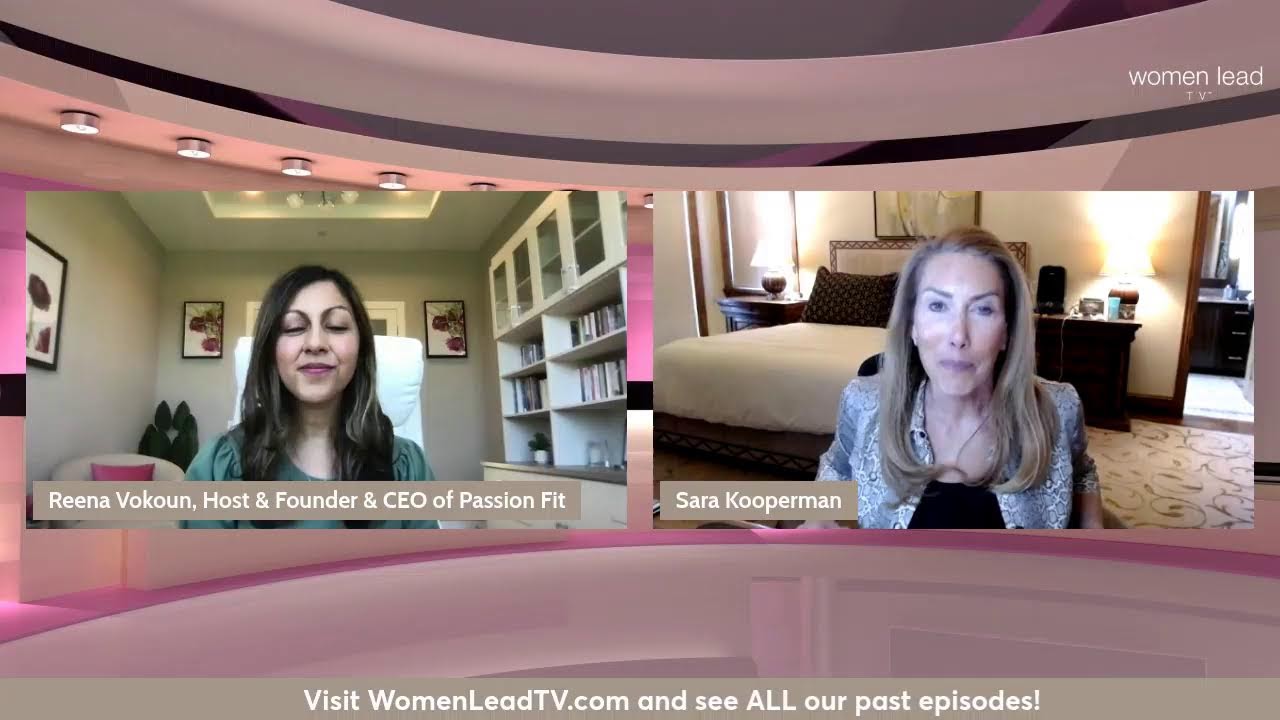
In this Women Lead TV interview, host Reena Vokoun talks with Sarah Cooperman, founder and CEO of SCW Fitness, about her unconventional career trajectory—from a childhood dancer who overcame a foot injury, to a law student, to a fitness educator and entrepreneur. Sarah recounts the personal and familial challenges she faced when shifting from law to opening a fitness studio, including the pressure of her mother’s expectations, financial risks of supporting four children, and the emotional toll of an office fire and pandemic‑driven industry collapse. She describes how she rebuilt SCW Fitness, launching new 2024 initiatives such as the SEAT (Supported Exercise for Ageless Training) chair‑work program, a forthcoming STAND (Standing Techniques for Ageless Neuromuscular Development) certification, and a stretching certification with Abby Apple, all aimed at active‑aging and recovery‑focused training. Sarah also discusses her memoir, Fit for Business, inspired by Sheryl Sandberg’s Lean In, which serves as both personal therapy and a guide for other entrepreneurs. The conversation concludes with practical advice for women entrepreneurs—handling sexism, balancing authority with approachability, leveraging humor, and cultivating supportive networks—while highlighting her personal life, marriage, and four sons as examples of integrating family with business success. The interview ends with information on where to find Sarah’s book and how to connect with her.
Chapters
Hello everyone, happy Monday and welcome to Women Lead TV sponsored by the Connected Women of Influence. I'm Reena Vokoun, the founder and CEO of PassionFit and the host of the show called Women Wellness and the Workplace. I'm so excited for our show today. It's my first show of 2024, and I couldn't think of a better person to kick it off with than my friend Sarah Cooperman, who is the founder and CEO of SCW Fitness. She's also an advisor. She's a webinar presenter. She's been on many podcasts. She's a sought-after industry leader in the world of health and fitness education. And so without further ado, Sarah, welcome to the show.
Well, it's a pleasure to be here. Thank you for having me, Reena. I'm honored to be your first guest.
Oh, well, I'm— it's wonderful to have you, and I'm honored to have you. And just a little background on how Sarah and I met. We met— I think Sarah was in during the height of the pandemic in 2020, and Sarah and her team put together these amazing conferences throughout the country for SCW Fitness. And they had found out about PassionFit, her team, and reached out to me. And so I partnered with them. I presented at some of their conferences, and I will be presenting next month here in California. So really excited. But I was immediately impressed with Sarah and just how down to earth she is. And so, yeah, Sarah, I'd love for you to tell our viewers a little bit about your background. From our title of this show is From Lawyer to Leader. So I'd love for you to share kind of your, your history and how you got to where you are today.
Well, that's really sweet. We ran, and it was really, it was such a pleasure to meet Reena. I mean, she's an amazing presenter. She's actually doing our keynote presentation to everyone at our California Mania convention. We expect, oh my gosh, over 500 people there. So that's for fitness professionals, health and wellness fitness professionals. And I actually started as, I started as a dancer when I was young and my foot grew wrong. I was in toe shoes really early. So I had to get this foot operation because I, like, I couldn't walk. So I decided, all right, I'll just go to college. So in college, I started basically, um, before I even got into college, I started rehabbing my foot. There was no rehab like 40 years ago. So what I did was I swam and I sat in a hot tub and rubbed my foot. I did my own physical therapy. So So by the time I got to college, I could dance. And I auditioned for a dance company because I couldn't afford to pay for lessons. And they had an apprentice position open, which meant you got free classes. I was like, ah, I'm going to get free classes. So I went and I got the free classes. I didn't make the apprenticeship, I made the company itself. So I had to call my parents and say, I want to go to school part-time and I want to try being a professional dancer. And that's what I did. And I started teaching when I was with the company. And that's my heart. You know, that's my— that's what I love. So I'll be honest with you, I hated dancing. I hated staring at myself 6 hours a day and eating hard-boiled eggs and grapefruit and starving myself and smoking cigarettes, right? So I quit the company, finished college, decided I wanted to be a professional, went to law school, loved it. What idiot loves law school? And I started teaching because in law school you get fat. You know, you're sitting there studying the whole time. And I started teaching in the bottom of the English department basement, which was next to the law school at Washington University in St. Louis. And the— one of the teachers started taking my classes, and I got this huge hall, and I had 50 people 3 times a week paying $3 a head. And it was amazing. And I realized I'm making like $450 cash a week, like over 40 years ago, which is outstanding. And I finished my law degree and I passed the bar exam and I decided I love teaching and I'm opening a studio. And then at the studio, I loved teaching instructors any of the new modalities. And I really was instrumental in helping low impact kind of arise to the occasion, was right when it started. So I believe in taking care of your body. All right, that is the, like, the longest version ever, Reena. So that tells you I started this business and then trained instructors, and my goal is finding better instructors than I am to teach different modalities and health and wellness and nutrition, things like that.
Yeah, no, I love that. I love that you still to this day speak so passionately about, you know, the things that you loved with instructing and dancing, and but then wanting to go into law school. So what was the most challenging aspect of making that transition? Because it's a big one, but you clearly did follow your heart, and 40 years later you're still thriving. So what would you say was the hardest part though, and how did you overcome it?
The hardest part for me was, you know, in a lot of ways, you're familial wherever you— however you're raised, the expectations your family places on you. And you can choose the voice in your head. You don't have to hear— for me, I didn't have to listen to my mother's criticism, finish your law degree, marry a lawyer, blah, blah, blah, you know. That's— I did end up marrying the lawyer, but whatever. But you can choose the person you want to listen to. And that to me was one of the biggest— that was one of the biggest challenges is getting my mother's voice out of my head. I was lucky my father was very supportive of being creative and doing things you loved. Because I don't think he did in his life. He loved music, but he ended up selling men's pants, I mean men's trousers. But so that was a tough transition. And then, um, deciding— when I passed the bar, I kept thinking, all right, I'll open a studio. My husband was my boyfriend at the time, my husband now, very supportive. But I kept saying, every time I'd hit a roadblock, like I couldn't sign the lease, the lease was too expensive on the building, the building wasn't designated as that I could do commercial purposes. I mean, all these roadblocks to get in your way. My husband was very supportive and saying, you can do this, just be patient, you'll find something. Again, it's finding that person, that voice in your head that understands your heart, and it's very hard to do, and financially it's very risky as well. Like we had 4 kids, I have 4 kids. And you've got to make these decisions. And, you know, your, your kid's not going to suffer if they can't do that second sporting or third sporting event, you know, because you need to invest in your, in your future that then will be helpful for them in the long run. So if I were talking to anybody who's thinking of really pursuing their dream, pursue your dream and just get ready to fail 9 times out of 10 and get over it and get it out of your head.
Yeah, I agree, and I, and I can relate to so much of what you're saying, um, you know, leaving corporate America to start my company PassionFit and all the fear and all of the, the worry about failure. But yeah, I think if you truly believe in what you're doing and you do follow your heart, as you're saying, um, and you know that there will be failure because that's just part of an entrepreneurial journey, then that will allow you to keep going because you're setting your expectations, you know, grounding yourself in reality but still dreaming and moving forward. So I love, I love that you've done that. And I'm curious, with SCW Fitness, what is your vision in 2024 and beyond? It has grown so massively. I've been watching the growth since 2020, and I'm excited to hear where you want to take it next. And I'd love for our viewers to hear as well.
It's, again, I, I always talk about that failure 9 times out of 10, and part of that also is, yeah, finding that voice in your head. But the other part is, it's not just believing in yourself, but it's getting through things. Like, in 2018, my whole office burned down and the warehouse. Reena, I don't even know if you know that, but— oh my gosh, We lost everything and we had to go back and I'm sitting there in the, in the, you know, out in the car park washing BOSUs off to put them back on the truck so we could go to the next conference. For the pandemic, it really decimated the fitness industry and it cut almost my events almost in half just because so many clubs closed and so many studios were permanently closed and so many facilities cut down on their personal trainers and group fitness instructors, you know, the lower end of the totem pole for, for our industry. So for me, I was at 50%. And so if I look at where the future is, I am pleasantly shocked. We started back in 2021, which was stupid. We shouldn't have gone We should have waited until 2022, but we started in 2021 and we did conventions in 2022, conventions in 2023, and now thank goodness in 2024 we are back and we are equal to our pre-pandemic levels. And I am shocked. And part of that I have to attribute it to some of my good friends in the industry that you might look at them and say, Isn't CanFitPro like a competitor of SCW? That's Canadian Conventions and Training Organization, certifying organization. And I called up my friend Mo Hagen, who runs CanFitPro, and I said, what's working for you? And she told me, and then she asked me, what's working for you with the certifications? And I told her, and it's asking for that help. Asking for that help to get you over the hump, raise your rates, um, um, go back to doing some, some tactile print work. Think about that. Think about telemarketing. That's a surprise. That was a real surprise to me. But now cell phones actually can print out the voicemail you're leaving for people. So they— everybody answers their voicemail because Nobody leaves voicemails besides some errant insurance company or your mother-in-law, you know, something's wrong with the kids, whatever. So these little pointers were so helpful. And I really think when I look at 2024, we're doing a lot of focus on wellness, meditation. We're at— we're doing meditation, we're doing tai chi, we're having— SCW just started a brand new certification on stretching with Abby Apple, which is amazing, that really works, um, um, that helps individuals that are, that are stiff. And then Active Agers, we have a SEAT program, Supported Exercise for Ageless Training, which is doing amazing chair workouts for older adults that it's supported. We try to get people to stand up. And Reena, we are going to be launching a STAND program. S-T-A-N-D. Okay, so we have SEAT, S-E-A-T. We're gonna have STAND, which is Standing Techniques for Ageless Neuromuscular Development. S-T-A-N-D. I can do this. So I think this active aging and merging the medical side with the health and wellness side and trying to focus on recovery. And it's also focus on strength, but it's not this pain to gain. It's, it's taking care of the body, working on activities of daily living for people in who are 25 or people that are 85.
So I love that. Yeah, and you're right on. I don't want to say trend because so much of wellness, it isn't about trend, right? It's those tried and true principles. But I know strength training has really made a big comeback this year, and recovery is a huge focus and longevity is a huge focus. So I love that you have this program. And I remember when I spoke last year at the California Mania conference, there was a lot of focus on the sitting, active aging, and being able to do exercises in a seated position. So I think that's fantastic. And you've really opened up an audience that's so broad in terms of age and life stage. And that really goes to show that health and wellness and fitness can be for anyone. Um, so I love that inclusivity that you've created. Um, and I have a copy of your wonderful book, Fit for Business, and I've started to read it and it's so inspiring. You are so inspiring. And I would love for you to tell our viewers a little bit about this book, um, what, you know, inspired you to write it and maybe just some key takeaways that might entice them to want to read the whole thing.
That's so funny. When I started writing it, I was, who was I was, oh my God, what's her name? She's the CEO of Facebook and she wrote "Lean In." Oh my gosh.
Oh, Sheryl Sandberg. Yes, thank you.
She loved your book, but I was listening to it as a book on tape as I was jogging. So this was quite some time ago 'cause I'm a walker now. I am not a jogger anymore. I used to be a crazy jogger every single day. And I was reading her book and I love her. I think she's fabulous, but she's the CEO and she kind of inherited this company and she had, you know, she's got these words of wisdom. And I thought to some extent, I mean, she went through personal trauma, I guess, losing her husband, things like that. But like, I sit here and I go, you didn't start this from scratch. You don't know what it's like to literally walk into a bank in stretchy clothes and say, I need $5,000 to make it through December, or I can't pay my staff. What am I going to do? And to convince them to give you this money that you have to pay back and, and build a relationship with this bank. And then learn that I need to walk in with a suit. I am not wearing Lycra anymore when I walk into a bank. I'm a professional. So I think when I would listen to the book on tape, I got very inspired. So I'm a big, I'm a big, like, I'm a bad person, I'm a cell phone person. So I would listen and I would kind of stop while I was running and I would send myself an email using Siri in my phone. And I'd write something and I would talk about the challenges of starting a business and what it was like and listening to the voices in your head and how do we overcome this? And What are some of the strategies I use to survive my office burning down, failure for conventions? Oh my God, I held a convention once. We only got 74 people registered for LA Mania. Nobody's heard of LA Mania. Why? Because I had to give all these refunds, personally call all these presenters, get yelled at by sponsors and people, and survive. So I dictated this book inspired, you know, inspired by reading Lean In. And then I just kept going. And I think a lot of it— I don't know how you feel, Reena Vokoun— but a lot of it is like sometimes personal therapy, you know. It really helps, helps you get through these hard times.
Absolutely. Yeah. I mean, I'm actually working on my second book right now, and, and I understand that. I think it can be very cathartic as an author and a writer to, um, yeah, kind of put some of those learning lessons into, into your writing and to share your stories and, and share your learnings, both failures, successes, so that you can help other folks but also help yourself in the process. For sure, I think there's nothing more cathartic than writing, and if you can write to create a good, you know, good in the world and an opportunity for other people, I think that can really be inspiring. So I love that Lean In inspired you, and, and you are showing another side of running a business from the ground up, you know, bootstraps and all as an entrepreneur. So I love your honesty and your vulnerability in that.
And it makes people feel better about themselves. In the long run, it's about— it really is about helping others. It's about saying, yep, you know what, my mother was abusive, and my mother was an addict. And I had to figure out a way to survive that. And somebody's going to read that story and go, oh my God, I can I can so relate. I can so relate. And then they look and they go, you know, if you can do it, anybody can do it. And the failures— I actually, uh, I consider myself to be a relatively funny person. Like, I really wish that I could have been doing stand-up comedy when I was younger because I really like it. I like poking fun at myself and kind of, you know, talking about others and making seem more human. And that I really do feel like it sounds so trite, but it makes the world a better place, makes people feel more comfortable and vulnerable about themselves and not as frightened about things that they need to share and just, you know, get over it, get over it. Right.
And maybe not take yourself so seriously. And yeah, maybe use humor to get through difficult times and relate to one another. I love that. So what would you tell, you know, other— what's your advice for other women regardless of industry who want to, you know, start their own business? You've already shared some great tips about, you know, blocking out, you know, other voices or opinions and not being afraid to fail and, you know, taking these risks. But do you have any other advice from your own experiences or from the book that you'd like to share?
I love how the world thinks that equality is just there now. Okay, like you can do anything, your, your sexual orientation, your race, your this, your that. We aren't there yet. We aren't there yet. And you are going to encounter situations that, you know, I always say like the 50-year-old white men, okay. We're in an industry, and I know, Reena, your TED Talk is amazing. We encounter situations where there's sexism. For me, it's been pretty substantial. It's not for me, it wasn't about standing there, crossing my arms, setting my feet apart, and doing the Wonder Woman stance. I do that in my bedroom. I do that in my bathroom before I go on to present. But when I'm talking to individuals that I kind of have to convince that I am intelligent, that I am worthy, that I am successful, I have to do a softer introduction. I have to adapt. And that's hard to do because you don't want to think you're And pardon me, I don't want to offend anybody, but you don't want to feel like you're sucking up to somebody, but you have to make yourself approachable. And that's one of the lessons I kind of had to learn. And I do that through humor. And I do that by, you know, the compliments and trying to understand things. But I don't want to belittle my talents. So it is juggling and it's a balancing. So that's another thing that I would share with people. Is don't be surprised if these are some of the situations you're going to encounter. And doing a softer approach, rather than such a strong angular approach, where you reject them and they reject you. Sometimes it does help to work from within. I liked— I like that I can say I'm a lawyer, I truly believe in education, even though, oh my gosh, I can count to 8 backwards. That's my selling point, right? You know, I teach fitness classes. But I read my hotel contracts because we do 7 very large events around the country. I have to talk to the general manager of the hotel that has worked, and I'm going to say, his way up, because every single one of the hotel directors I work with around the country, from Washington, D.C., San Francisco, Orlando, Atlanta, Dallas, Chicago, and Boston, they're all men. And I have to be able to communicate and self-deprecate a little bit. And I'm not talking sucking up, because when push comes to shove and I need to negotiate, I'm as good as the best, as anyone. But it's interesting, it will be a challenge. So, so think about it, get over it, and again, pick those people that you want in your head. My husband is always so wonderful, and my dad was so wonderful. You can do anything, SJ. SJ is my nickname, Sarah Jane, like I walked off a farm in Chicago. Not okay, but it's, it's my husband. I remember once I was in this whole room of men, and I was one— there were— I was a Les Mills agent, I think you know, Reena, for 10 years. I distributed one of the 6 territories in the USA at the largest geographic area, but the same size, um, I would say population area. And I was the only female agent of a group fitness program worldwide. And I would— and I know America, I know group fitness, I know personal training, I know America. And my husband, he could see I was just getting so frustrated because I was being completely ignored he would lean over to me because I made him come with me to the meetings, and he would lean over to me and say, you're the smartest person in this room. And I'm like, where did that come from? But it's having someone having your back. I have a bunch of girlfriends, like I said, Mohagan I talked to, Connie Worsylla was very supportive, and Gilbert's very, very supportive. I've got like some amazing friends and supporters and ask them for help, listen to them, hold your own, but don't put people off. It's a balance.
It is a balance. That's very, very good advice. And it's great that you have so many people in your corner to support you, especially in those tough moments that inevitably happen in those meetings and whatnot. So I love that you shared that. And is there anything else you'd like to share with our audience? And where can they find you? Where can they purchase the book? Again, Fit for Business. Would love for you to allow people to connect with you.
Well, the book is on Amazon, so you just have to type in Fit for Business and just Sarah Cooperman, and, and you'll find it. It's right up there. The other thing I, that I do want to share is, it's okay to be yourself. Like, I'm fabulous with an Excel chart, but you put me in a kitchen, and it's, it's gonna get ugly. You know, it's not, it's not working. So it's okay, you don't have to pick some traditional roles to feel value in yourself. And it's kind of weird, but like, you can have it all. I have a great marriage. I've been with my husband since law school. We've been married 36 years, together 41 years. I have 4 sons. I have a house of testosterone. I got a son 33, 30, 28, and 26. They're all doing wildly different things. One's a pro hockey player, the other one has his PhD in bioinformatics, the other one was selling door-to-door paint services, and the other one works at a bank, you know, an investment bank house. They're, they're all different. But you can be successful as an entrepreneur, have a good marriage, have kids, be kind to yourself and gentle to yourself. Don't let other women in your neighborhood judge you because you bring store-bought cookies to the, you know, to the PTA meeting. And find your friends. And Reena, I consider you a friend. Thank you. I'm really honored that you included me. In your new and exciting TV show.
Thank you so much, Sarah. I consider you, consider you a friend as well, and it was just such a pleasure to chat with you and hear your advice to help other women out there. So thank you so, so much for joining us today and sharing your wonderful stories. They were very entertaining as well. I think that goes hand in hand with the comedy thing. So thank you so much. And yeah, tune in next time. Our next show is going to be happening in April, so stay tuned for more details for Women Lead TV, sponsored by The Connected Women of Influence. I'm Reena Vokoun, the host of Women Wellness and the Workplace. Thank you so much.
Thank you.










