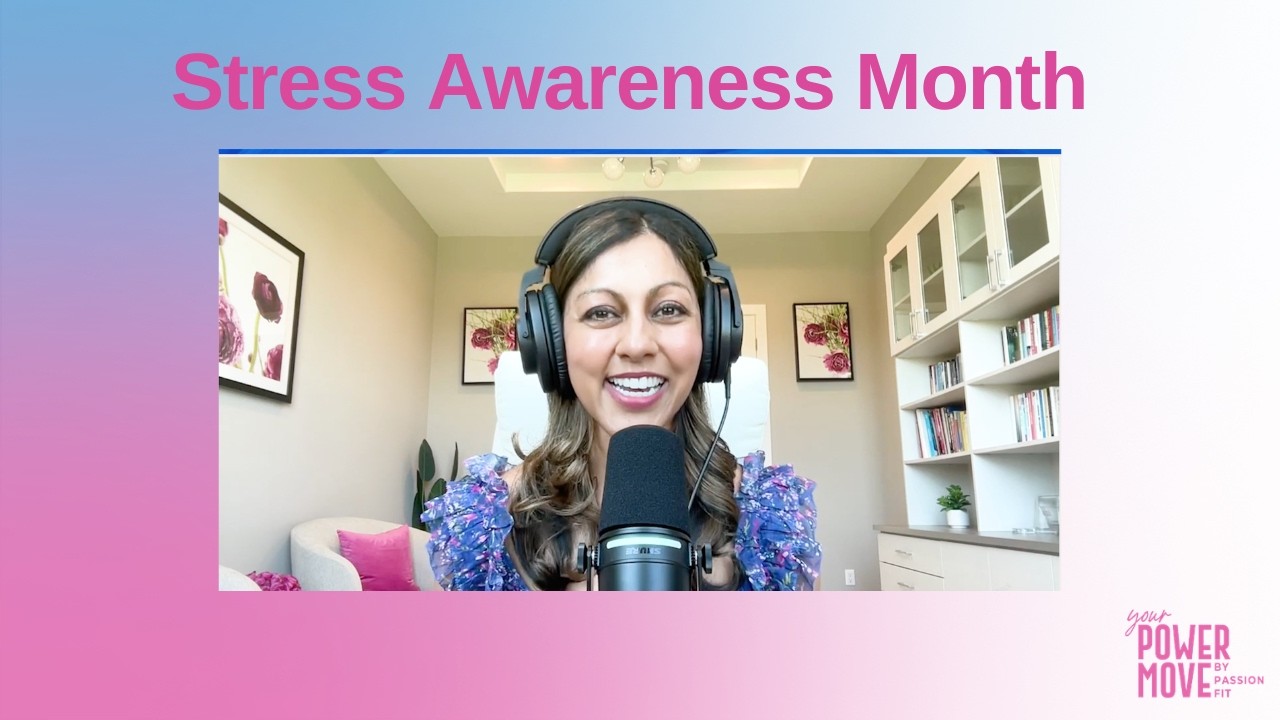
Reena Vokoun walks through five tools to manage stress and prevent burnout: recognize physical stress signals and use breath in acute moments, name mental stressors and seek support, adjust workload through delegation and boundary-setting, build daily habits like exercise and sleep, and practice breathwork and mindfulness to calm your nervous system.
Chapters
Hey guys, April is Stress Awareness Month and stress literally affects every single one of us. Since all of us are dealing with some sort of stress on a daily basis, we want to try to prevent it from becoming chronic. So coming up on Your Power Move by PassionFit, we're going to be talking about 5 tools to help you better manage your stress to stay healthy. Hi everyone and welcome to another episode of Your Power Move by FashionFit. I am your host, Reena Vokoun, and we are already into the month of April. It is pretty hard to believe we are in spring now, which is really exciting. Um, but you know, this time of year can be, uh, carefree and wonderful. A lot of people are going on spring break and taking vacations, but it can also be stressful for many reasons. Um, and this month is actually Stress Awareness Month, which is why I wanted to focus on the topic of stress so that we can all learn healthy ways to manage our stress so that we can continue to enjoy our lives. So according to the American Psychological Association, 75% of Americans feel emotional and physical symptoms of stress, and this has been steadily increasing over the last 5 years. Common reasons for stress for many people include job uncertainties, workloads, housing costs, um, family health, political climate and news, and of course, the impact and rise of AI. Um, it's creating a lot of excitement. Um, but also a lot of uncertainty, especially in the job market. According to the National Institute of Mental Health, stress can cause many health issues, including a weakened immune system, heart disease, um, digestive issues, hypertension, high blood sugar, and so much more. So again, today I wanna focus on how we can prevent, uh, that stress because stress is one of the most basic causes of human illness and disease. And if we can prevent or better manage the stress, we'll be in a better place to help prevent or manage many of those diseases that can come about. Again, there is so much happening. Companies have been downsizing in many cases, layoffs, restructuring. Different industries are facing, you know, the, the results of our current economic state. So much happening across the world. So it's no wonder that so many people are stressed. Then you add in technology and, you know, increasing uses of social media and text messaging and constantly being on our phones, and it's going to naturally just create that sense of almost overstimulation and overwhelm. So what can we do about it? That's what this episode is about, and we're going to talk about 5 different ways to really manage that stress. The first one is really about recognizing the signs of increased, you know, extreme stress. Oftentimes we are going to experience physical symptoms in our day-to-day lives that are very common. Maybe you are taking an exam, you are giving an important presentation for work, um, you are traveling abroad, um, and there's lots of things to have to keep in mind for your international flight, um, or just even exercising your body. These are all examples of everyday stress that we all experience, and our body in those instances can often go into fight or flight mode. So when that's happening, it's easy for your heart rate to start to go up. Maybe your palms are sweaty, maybe you're just feeling a little bit of shortness of breath, um, and your brain just feels like it's working harder because you need to perform. Perform in that moment. Uh, that's natural. And the best things that we can do in those moments of that fight or flight feeling and those high moments of stress or pressure is to just focus on really being present and going through whatever it is that we're going through, whether it's taking the test, giving the presentation, just focus on performing in that moment. And if you need to take some deep breaths, and we'll talk a little bit more about mindfulness later, but in that moment, do what you need to do to kind of use that extra stress or energy to perform. What ends up happening though, is we tend to then start to have this become a habit, right? When we're used to being in fight or flight mode, we're used to running 100 miles an hour, then that starts to become more common. So on a regular day-to-day basis, our heart is pounding, we're feeling shortness of breath, our brain just feels like it's working so hard that we end up getting stress headaches, our appetite might get affected and so much more. So if we are starting to see that this becomes a daily habit and we are constantly feeling that stress, which which then could lead to chronic symptoms, which could include things like insomnia, having trouble falling asleep, maybe waking up in the middle of the night and not being able to go back to sleep because again, your mind is racing, digestive troubles, changes in mood, maybe feelings of anxiousness, feeling of sadness, feelings of just that stress, that overwhelm, that burnout, maybe even a little bit of anger at the situation that may be frustrating for you, or just feelings of being out of control. Those are all things to pay attention to because again, those could lead to longer-term issues. They can also cause things like that high blood pressure in the moment, which could later lead to problems like heart disease. So if you are seeing that for a period of months, this is not going away, it's not just the task at hand or the specific stressor of that day, but it's been going on, on an ongoing basis, then that's when you really need to talk to your doctor or healthcare provider to figure out what to do for those physical symptoms of stress. The second thing is to think about the mental and emotional symptoms of stress and talk to a professional, talk to a loved one or a close friend. Sometimes what we just need to do is name that feeling or name that thing that is causing us stress. And oftentimes we may not even know, especially if it does become chronic and we're just used to operating in that fight or flight mode on a daily basis. But the more we can take a step back, um, to really think through what is it that is causing us this stress. And again, even if we don't really know it right away and we can't put our finger on it, just having the space to understand what it is can really help. Sometimes we know, sometimes it's very obvious what it is that's stressing us out. Again, it could be something with your job, if there's uncertainty or a family member is sick, you know, or some of us have the bigger life moments, right? You're having a baby, you're getting a new puppy, there's a death in the family. So many different things can happen in day-to-day life. Maybe you're moving to a new city are starting a new job, or you have teenage children and that causes stress. So again, it's sometimes very obvious and something that we can name, but if it's not that obvious, that's where we really need to dig deep and have those conversations to really uncover what it is that's causing us the stress. Once we are able to name it and figure out what's going on, then we can start to take the actions that we need to. It's also important to think about workload, right? Oftentimes our stress stems from work. That's very natural. Natural. There's obviously a lot of pressure, especially these days in the workplace with current economic times. Um, and you know, your boss may be very demanding. You may have a very heavy workload. Maybe you have to travel for your job. Um, with so many companies having people back in the office, oftentimes you're commuting to and from work and working longer hours in the office. Um, or a team member maybe thinks differently than you and has different ideas, and that's creating a bit of a conflict on a project. Um, and the list goes on and on. So what's important there is to really take a look at your work responsibilities, your workload, and figure out again what it is that's causing you stress. If it's just the sheer workload itself, maybe that's something that you can, um, you know, plan with your manager. Maybe you take, uh, you know, those projects and kind of split them up into little bite-sized chunks that you can do at different times. Um, maybe you increase, um, or extend your deadlines so that you're not feeling that pressure, if that's a possibility. Or maybe you offload some of your projects to other colleagues on your team. Um, again, you wanna obviously be very cognizant of the reflection on your capabilities when you are asking for workloads to be taken off your plate. But again, if it's truly causing you mental and physical stress and issues of that nature, it is important, um, to take care of that and have that conversation right away because nothing is more important than our health. Um, so have those conversations and brainstorm and be willing to do your part, be willing to make up for certain things that you might be giving up off your plate. Um, or just thinking about sheer priority. Prioritization, right? Oftentimes we think we need to get these 30 things done in a particular day and set ourselves up for failure because we have this, you know, huge to-do list that's just not realistic. And when we actually look at what are the most important things, we realize really there's only about 5, you know, maybe 3, maybe up to 8 things that really need to get done to help you to reach your goals on a project. And maybe the other things really don't matter at all, or they can be pushed out to the quarter or, um, when the next project cycle starts. So that's another important way to kind of take a look at what's on your plate and figure out how you can break it up, have that open conversation with your manager or team members, take on less, um, or extend deadlines or do different things creatively to still get the work done, um, but in a way that is manageable and sustainable for you. Also, if you have family obligations or household responsibilities at home and you're really having to do a lot, um, that's where if you have a family, you can talk to your spouse or your significant other or your kids and see where people in your immediate family can pitch in and help, whether it's helping to set the table for dinner or cook some of the meals, or, you know, enlist some of your neighbors or friends to help with drop-offs or pickups or whatever it is. That's another way for you to offload some of the things that are on your plate. I know many of us, myself included, in the past— something I've obviously been working on over the years— but that sort of a perfectionist mindset, or I don't want to burden anybody so I can do everything myself. I'll just take it on, I'll take it on. And before you know it, you just have so much on your plate that you just feel overwhelmed. So that's where I think we all need to realize that we can't go it alone. We need to be able to lean on others in our community, in our families, and our social circle for help when we need it. And that's what we're all there for. Again, sometimes that's a harder lesson to learn for some versus others, but important to keep that in mind as well and really try to, um, ask for help and support of others and just be open if you are feeling that stress so that others in your family or in your workplace know and understand what you might be going through. It's also important to think about all of the different wellness practices that I know we've talked about, um, at different times at a high level on the podcast. Um, I've talked about it with many of my guests, but just those overall daily wellness practices, um, that are obvious, but again, sometimes we forget when we are so stressed and in the midst of a busy day. And those things include the basics, right? Exercise, nutrition, and sleep. The more we can move our bodies, really what it is, is it's, it's a, it's practice. It's practice for how we handle things when we are in fight or flight mode, when we're putting our body and our mind in a state of stress. In the exercise itself, it teaches us, we learn then how to deal with it in that moment, whether you're lifting a heavy weight, whether you're running or you're on a machine. Or you're stretching your body, just all of that movement and that force just teaches you resilience and it teaches you mental and physical strength, which can then be applied to your day-to-day life. So exercise is a really great stress booster. It's a wonderful mood booster. It releases endorphins and dopamine and helps serotonin in your brain. And again, when you have that muscle mass, when you have, you know, your heart rate going, that cardiovascular activity and the mobility and flexibility in your body, it just can be translated into how you handle situations day to day. And when you're feeling those physical manifestations of stress, you can leverage that exercise to help you move through it, literally and figuratively. And then of course the nutrition. Oftentimes when we're just not eating well, we feel lethargic, we feel tired, and that affects our ability to handle stress stress as well. So if you are eating nutrient-dense foods, if you're eating plant-based foods, and if you're really thinking about your overall nutrition plan, that's also going to help you with staying healthy, um, and managing stress, because stress does weaken the immune system, which then makes you more prone to all of these other illnesses and diseases. So the more you can fuel your body to also handle the demands of your day-to-day life and take on the stress and keep your immune system strong, you are going to be better off from that perspective as well. And then finally, sleep. I think for so many, sleep is something that we all know we need and we all value, but it's just so easy for it to just go right out the window when life gets busy or just something that becomes an afterthought. But really what it needs to be is at the forefront of your mind and one of your top priorities on a day-to-day basis. Because when we are getting, you know, adequate sleep, high-quality sleep, good REM, good deep sleep, we're able to actually have better perspective, we're in a better mood, we're able to just function more properly, and again, have that energy and that stamina and that ability to take on whatever comes our way. So when we are lacking in sleep, it's just going to add to the problem of stress. And again, it is a bit of a catch-22 because as we were talking about earlier, when stress becomes chronic, it does lead oftentimes to things like insomnia for many people, people. So if you are wanting to get more sleep and you're simply not able to because of the stress that's causing that insomnia, that's again where you might need to enlist your doctor and other healthcare providers and professional support so that you can make sleep your top priority, um, so that you can better manage the stress and all the things you have to do. And again, sleep, just like the nutrition piece and even the exercise, can help to strengthen your immune system so that you can withstand stress and not let stress really weaken it. And again, make you more prone to illnesses and diseases. So really think about those wellness practices and make them non-negotiables and have them in your day because they are also, um, some of your biggest tools to help combat stress, um, and allow it, uh, to not progress and get worse and become chronic. And finally, um, practicing deep breathing, practicing mindfulness or meditation, these are all, um, great ways to manage stress, both in the moment, but also just as part of a daily practice. Again, we've talked a little bit about mindfulness in the past, and it really is a wonderful tool for you to just take a minute to stop and literally breathe. If you're driving in traffic, if you are about to walk into an important meeting, if you're getting ready to go take an exam or, you know, ready to drive through some intense traffic, that's where taking those deep breaths can really, really help you. Um, you know, if you can practice diaphragmatic breathing where you're inhaling through your nose or, um, and exhaling through your nose or mouth, that's just going to immediately take that stress that's all kind of wound up in your neck and your back. Um, you know, maybe creating headaches. Um, just those nice deep breaths can allow you to literally release that tension. Um, so use those tools like breathwork or focusing on just being mindful of how you're going about your day, how you're feeling, how you're eating, how you're moving. And then the meditation piece is something that can really work maybe at the end of the day or the beginning of the day where you, you know, create a meditation practice. It doesn't have to be 30 minutes long. It could be as simple as, you know, 3 to 5 minutes in your day to again, just block out all of the noise, all of the things that might be stressing you out and causing you to feel overwhelmed, and just take a second to not only breathe but turn inward and focus on the present moment. Um, again, sometimes that's easier said than done. Our minds can often wander, um, about the things that we're stressed about, about the things that we have to do, about the things that we feel like we're not performing well in, or other people's expectations, or our safety. I mean, there's so many things that come up in a given situation or a given day, but the more you can, again, just turn inward. And even if your mind wanders and goes to some of those thoughts, just bring it back to your breath, bring it back to yourself, bring it back to that central moment that you're in. And that's going to really help. And I think when it comes to mindfulness as well, one of the things that, um, is often practiced in meditation is the focus on letting go of things that you cannot control, right? There are going to be things in our lives that are are simply out of our control. There is so much uncertainty, right? You often hear the only thing that's certain is change and uncertainty. So the more we can embrace that and just let go of the things that we can't control and focus on the things that we can, that's going to help us to be much more empowered. Um, because our focus is on being productive and on things that we can actually influence and change and develop and actually make happen. And for the other things, all we can do is, you know, trust that things are going to work out the way that they're meant to. If we are faced with a challenge, we're going to meet it head on, especially if we are healthy and well-fed, well-rested, and, you know, moving on a regular basis. We'll be able to take on whatever challenges come our way. So again, in honor of Stress Awareness Month, I think it's just important to put a spotlight on the topic because every single one of us faces stress. It is inevitable and it is a part of being human. So I really want to make sure that we know normalize it and, um, just know that it is something that we should be paying attention to, um, and openly talking about and taking steps to use health and wellness tools to help us. Because again, stress is one of those things where it can sometimes go unnoticed a bit because we're so used to operating at that high stress level. Um, so the more we can be aware and take that time to stop and think about it, talk about it, and come up with solutions, the better off we're going to be. And not just within our but I think it's important to check on our family members, check on our friends, check on our neighbors and people in our community and ask them how they're doing. And if you're seeing signs of extreme stress, really be there to help them out. I think letting them know that they're not alone, lending a helping hand and really doing your part to help them manage the stress in their lives can also be, you know, a good thing to do to practice kindness and empathy. And also just figuring out what are the boundaries, right? Where do you need to protect your own stress and where can you have the bandwidth to help people with their stress as well? It is a balancing act, um, but I think it can be done if we are mindful, if we have good intentions, and if we really do practice that kindness, not only to ourselves but to others as well. So that is it for today's episode on stress management tools in honor of Stress Awareness Awareness Month in April. Feel free to check out the other episodes if you haven't already. There's so many great guest interviews, so many wonderful topics. Uh, there's more to come, uh, for season 1, and we are already planning and getting ready for season 2. So stay tuned for so many more exciting things coming on Your Power Move by PassionFit. Thanks for tuning in, and I'll be back with another episode soon. Take care.










