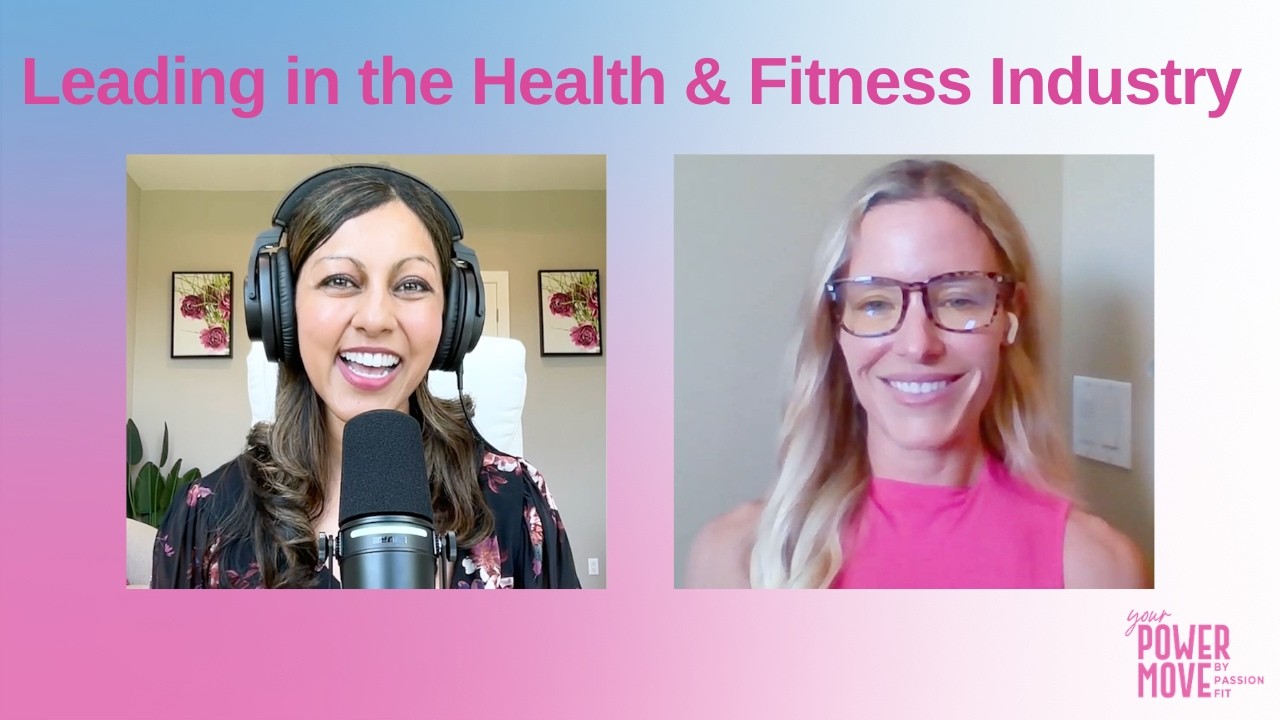
In this episode of Your Power Move by PassionFit, host Reina Vokoun interviews Kathleen Ferguson, co‑founder and CEO of Coach360. The conversation weaves together Kathleen’s personal journey—from a grief‑driven entry into fitness after the loss of her first husband in 2009, through a 15‑year career in personal training, B2B sales, and media—to the founding mission of Coach360: reducing the 80 % coach turnover rate by providing education, community, mentorship, and career‑matching services for the 45,000‑strong coach network. They discuss industry‑wide shifts such as the move from pure aesthetics to holistic health, the rise of boutique‑studio certifications, the need for emotional‑intelligence (EQ) training, and the impact of generational attitudes toward wellness, mental health, and work‑life balance. Kathleen shares her “power moves” for personal resilience—short meditations, prioritising sleep, family time, and heavy‑lifting—and emphasizes the importance of mentorship, collaboration, and women’s leadership in a historically male‑dominated field. The episode ends with a call to action for listeners to seek mentorship, engage with Coach360’s events, and adopt holistic practices for sustainable careers in health and fitness.
Chapters
You mentioned a little bit about your professional purpose, but what else drives you?
Starting in this industry, I had one purpose, and then setting an example for my children is now my purpose. Showing my daughters that, um, as a woman, you can be a leader, you can be an entrepreneur, you can be a mother, you can be a partner, you can be a friend, you can build an incredible career.
Hello everyone, and welcome to another episode of Your Power Move by PassionFit. I am Reena Vokoun, your host, and I am so thrilled to welcome my guest for today. Her name is Kathleen Ferguson, and Kathleen and I actually have been in the health and fitness and wellness industry for many years, and we met in San Diego at a conference a few years ago and have kept in touch and partnered together in many different ways ever since. Um, she is a rock star in our industry, having over 15 years of experience experience. Um, she has worked in partnerships for companies such as IDEA Health and Fitness Association, Athletec News, as well as Oxygen Magazine. Um, she hails from Southern California and is a USC alum, and she currently launched an amazing company called Coach360. She co-founded it, and really what she wanted to do was close a gap that we're seeing in the industry where health and wellness professionals and coaches maybe aren't getting the support and the education and the network that they need. So Coach360 360 was born a few years ago. I have been so honored to be a part of it, speaking at many of her conferences and webinars, and I'm so excited for you all to meet her and get to know her. So Kathleen, welcome to the show.
Hi, thank you so much for having me, Reena.
Yeah, thank you so much for being here. I feel like you and I have had a lot of wonderful conversations, and I'm excited for this one to, to focus specifically on you. And I forgot to mention that Kathleen is also a mother of 3 while balancing running running a company and being an entrepreneur. She is unstoppable and amazing. So why don't you tell us a little bit about— more about your background, Kathleen?
Yeah, absolutely. And Reena, I just wanted to add too, I'll never forget you and I grabbing lunch together right before I was about to launch Coach 360. So I feel like you and I have been— like, you've been with me from the very beginning, so I'm so appreciative of that and the full circle, um, relationship that we've had. But yeah, so, um, Kathleen Ferguson, I'm the co-founder and CEO at Coach 360. Um, I I say that this company is 17 years in the making. I got my start in the industry as a personal trainer. I had, you know, just come out of a season of my life where I had experienced profound loss, and I wanted to shift into a career that was rooted in purpose. That was very important to me. So I decided to become a personal trainer, and like so many other coaches and trainers, I struggled. I struggled big time because I was trying to figure out how do I build a career in an industry about something I am so very passionate about and really be at the forefront of others' health and wellness journeys. And ended up meeting the original founders of IDEA Health and Fitness, Peter and Kathy Davis, and started doing sales, sponsorship selling for their IDEA World Health and Fitness event that used to be about 10,000 people. It was a huge gathering. And I just, I fell in love with the industry in terms of the B2B side. I still coached and trained. I got a TRX certification as well. But I really loved going to shows and connecting brands to club and studio operators as well as coaches when it made sense. Did that for 10 years and then, you know, went through all the different acquisitions and the struggles there and took on some direct-to-consumer brands like Oxygen Magazine and Yoga Journal. And then when COVID hit and all of our lives changed, I had 3 young kids that I needed to Zoom homeschool. So I ended up doing consulting for health and fitness startups. And then early January 2024, I had an idea and I wanted to go back to my roots and, you know, what I was really passionate about, which was how do we keep coaches in the industry? Because right now they're churning out about 80% within 2 years' time. They're banning the industry altogether, which means we are essentially allowing them to leave the communities that they serve. So I really wanted to figure out how do we keep coaches and trainers working and how do we create pathways for them to build a real sustainable career in this industry? And that problem directly relates to staffing within clubs and studios. If we don't have enough coaches and the coaches are churning out, they're leaving organizations because they can't figure out how to build a career, that affects how clubs and studios are able to staff their floor. So that is ultimately what Coach360 aims to do, is to solve those two problems. We are a media platform, so we provide resources, we provide events like the Career Labs by Coach360, which you've spoken at and provided your insight to coaches looking to build careers. We have events for operators as well. And then we're able to effectively connect our community of 45,000 coaches and trainers and plug them into roles that make sense for them by telling them more about the company culture, which ultimately creates a better fit between talent and opportunity within these facilities. So that's what we're building. And, you know, while, you know, that's the description, it's so much more than that. We are truly a community and, you know, kind of this big fitness family. And it's been a wonderful journey so far.
I love it. Yeah. And everything you're saying, I mean, I can really attest to what Kathleen is saying about her vision for this company. Um, again, I do remember our, our very fun lunch when you were telling me all about it. It was just a concept and I couldn't be more proud of you and thrilled with how far you've taken it. And I have experienced firsthand this very authentic, caring community, um, that you've created and built. Um, and I've met so many great people, um, at these events that I've spoken at and panels that I've been on and have kept in touch with those professionals as well. And I really agree with what you're saying about how the industry is changing. And I'm curious to know your thoughts. I know we've talked about this a little bit in the past and how from a generational perspective, right, in the health and fitness, whether it's coaches, personal trainers, or group fitness instructors, that is changing as well. I think a lot of us that have grown up in the industry went to the IDEA conventions as I did and continue to, you know, get our certifications through the American Council on exercise and the Athletics and Fitness Association of America and, you know, a bunch of other organizations. But now we're seeing with some of the younger generations, they're really focused on boutique studios. They're getting certifications for, let's say, CorePower Yoga and only that, or a special Pilates certification at that boutique. And I'm just curious as to how we can continue to incorporate all the different generations and all of the different types of certifications so that we don't lose attendance at these events, um, and they become less relevant as time goes on?
Well, I think, you know, you kind of hit the nail on the head with the education component. Um, the shift that's happening right now and the shift that we— a couple different things. What we're talking about a lot is a shift from, you know, being a just a personal trainer to being a comprehensive health and wellness solution. And the education component is key, um, because I feel that in years past, it used to be you got your primary certification, that was kind of it, and then you would re-up your CECs and CEUs every 2 years to stay, to stay up to date and credentialed. However, now we're looking at education with a broader scope, and it's how do you become this more comprehensive health and fitness solution so that you can help your clients and members really achieve their goals? And that starts with education. We need to stay on top of trends surrounding what people are really asking about from a client perspective. And what we're seeing is that today's client member doesn't just want the aesthetics component of it. They don't wanna just look better. Of course, that's still important. A lot of us still, you know, the aesthetics is always gonna be an important component, but we also wanna feel better. We wanna live longer and we wanna feel better while we're living longer. And that's what we need to learn. And that's where coaching is going ultimately is that We're helping our members live a life where they feel healthier, they're functionally more fit, they're able to do the things that they want to do without pain, and they're really able to have a broader scope of what their health, fitness, and wellness looks like, whether it's from a nutritional standpoint, behavioral change standpoint, maybe they are trying to understand and demystify all of the data that's constantly flowing out than if they have a wearable. I have to say, I get so intimidated by all the data. I still don't have a wearable. It's kind of embarrassing as a CEO and founder of a health and fitness company. I might get converted one of these days. But anyway, I digress. The amount of data that our clients and members are getting is astounding. And coaches now are kind of responsible for helping them to understand the actionable insights that come from that data. And that essentially helps them to create a program to, you know, kind of engage and retain that particular client or member. So coaching and training has evolved significantly since I started, you know, 17 years ago. None of that really existed. It was all about getting fitter, looking better, and now we know, you know, that has changed significantly. So that's been a big shift. The other thing too I wanted to touch on is that I talked about this a little bit with ACE last week, which is, you know, beyond certification, right? Why are these technical skills that learning, you know, from courses and certifications no longer enough. And I think that one of the shifts from a generational perspective, and where like conferences and summits need to lean into, is we need to look at how are we developing health and fitness professionals, you know, from an EQ and from a people and relationship-based standpoint. Because if you're in this business, this crazy fitness business as I like to call it, you're actually in the business of relationships and people. And if we all just sit behind our Zoom screens all day long and coach and train clients or have have these conversations, we're actually not effectively building the relationship the way that we would with that human-to-human connection. So I'm hearing from at least our community that more and more people want that opportunity to come together and network while they're learning. They want to learn, but they also want to experience something. They want to feel something. And that's what this industry is all about. So I think, you know, to your question about, you know, how do we, you know, kind of bridge the gap and, you know, generationally like bring in all of these different segments of, you know, coaching and training, um, you know, I think that We need to, you know, look at how are we developing people skills outside of just the technical? How are we giving our coaches and trainers the opportunity to do that while also touching on how do we help the health and fitness professional become that more comprehensive solution?
Yeah, absolutely. I agree. I mean, the industry has changed dramatically, and I love the fact that it is more holistic now. People are focused on their mental health as much as their physical, as well as their emotional health. And I agree, being a health and wellness and fitness professional does require EQ as much as IQ. And even with AI, I think a lot of people worried that they would be replaced as coaches and trainers with AI. But as we know, that's not the case. I mean, it's not like AI is something that we're fearing that it's going to come and take our jobs. It's already here. It's been here. And we're still seeing the need for, as you said, that interpersonal communication. And I do think people's motives and purpose have changed not only on the, the industry side, those of us that are professionals, but even on the consumer side, I've seen a huge shift culturally and in society, even post-COVID where people are taking their health more seriously. Um, back to generations, I think younger generations are very focused on their wellness. They're talking about mental health on social media and really making that more of, of the norm. And so I think it's just created this huge shift in our industry. And yeah, the education, uh, component, as you mentioned, is really important for professionals so that we can educate and build trust and long-term relationships with our clients that can support them in many different stages of their health journey. So I agree, there's so much opportunity, um, and I do think Coach360 is at the forefront of it all.
Appreciate that. So yeah, I just touch on something you just said, um, about, you know, kind of these younger, like the Gen Z and younger generations caring so much about their wellness. Um, we are really seeing that. Um, there used to be this kind of grind culture, right, where if you weren't working like 24/7, um, you know, just working really hard and just, you know, being tired all the time and not, you know, giving yourself any self-care, then it almost like it wasn't, it was frowned upon, right? And now we're shifting into this era where, you know, we set boundaries, we have self-care, and, you know, Gen Z and like these younger generations coming in, they care so much about that because that really plays into that mental health component. I love so much that we as an industry are really leaning into that and helping people because we aren't, trainers anymore. We're not just trainers and coaches. We really are that holistic solution, to your point.
Yes, absolutely. And I have two kids that are in Gen Z, 15 and 18-year-old boys, and I'm seeing it. I mean, they are very much into their health, into, you know, working out, going to the gym, but again, not just for the aesthetics, but they want it to actually help them improve in their sports. They both play competitive soccer, but also for the mental aspect of it that then they can translate into academics and other things. So it is really great to see that. And sometimes I honestly I really wonder if the younger generations, Gen Z and the like, maybe they saw their parents, you know, a lot of us kind of growing up in that grind burnout culture, um, and thought, I don't want that. I want something different for myself. And I think, you know, from a corporate standpoint, I think companies are trying to figure that out because that's so different from generations that came before them where they're trying to figure out how do they get, you know, the work ethic. And I don't know that it's necessarily a work ethic. Ethic thing. It could just be a balance thing, and maybe they feel like they'll be more productive and able to produce better outcomes if they take care of their health and wellbeing, which is the cornerstone of the work I do. I know the work that you do. So I feel like it's great to see that younger generations are getting it, and hopefully that will push, um, you know, other generations and up into corporate America and others and the private and public sector to rethink corporate cultures and nonprofit cultures to accommodate employee health and wellbeing as well.
Yeah. And you're so— but, and Reena too, you are such this prime example to your kids of, you know, pursuing a life of health, fitness, and wellness. I always wonder to myself, you know, my kids see me doing it too, and like, they— I don't know about yours, but like, mine want to like lift weights with me. Um, I always wonder, like, is it, is it the generation or is it the example in the home, right? Um, I think it could be a blend of both.
Yes, the children are watching.
They're sponges. They're watching what you do and they're absorbing that. And, um, you know, that's how they're growing up, you know, with this love and this passion, um, you know, for health, fitness, and wellness. So I think that It's so important for the kids to see that.
Yeah, you're right. That's a really good point. And yeah, in fact, I was just lifting weights with my kids and husband over the weekend.
We were playing pickleball.
They love it. Yeah, and they're teaching me things too. Actually, my kids are pushing me to lift heavier, which is very important. So it's kind of funny when you're in a certain age where you're trying to, you know, maintain muscle mass, right? You've got hormonal changes and you're doing all these things and you need more protein. And then I see my teenage boys and they're talking about the same things, like, I need more protein, I need to Lift heavier. So we're kind of bonding in a funny kind of way where we have some similar goals. So yeah, I do think it can really connect families. And speaking of family, so I know you mentioned a little bit about your professional purpose and your passions around health and wellness and really bringing professionals and brands and people together. But what else drives you? What else is your sort of personal purpose for doing what you do? And my guess is your kids might have a little something to do with Oh yeah.
I mean, I think that just as individuals, your purpose and your why evolves frequently, you know, throughout your life, right? You know, obviously I've been at this for a long time, you know, over a decade. And, you know, starting in this industry, I had one purpose and then setting an example for my children is now my purpose, showing them and especially my daughters, showing my daughters that as a woman, in the industry that you don't have to be put into a box. You can be all of these things and it doesn't matter how old you are. You know, you can be a leader, you can be an entrepreneur, you can be a mother, you can be a partner, you can be a friend and an incredible, you can build an incredible career. There's no reason why you can't do that. And you know what else? You can also become a bodybuilder at the age of 43. Yes. So, you know, that is something that I am consistently trying I want to show my kids and especially my daughters. They're growing up in a completely different time. You know, I had my own struggles as a woman in health and fitness. And, you know, I think things have gotten a lot better, but I still see, you know, most of the time, you know, many of the panels, you know, at a lot of these shows are all men, especially when it comes down to technology or finance. So, you know, we're starting to see it shift. And I just want to show them that, that their opportunities are limitless and they don't need to be put in a box. And if it doesn't exist for them, that table, that seat at the table isn't available, build your table. And that's exactly what I did. And I continue to show them, my purpose is to show them that women can continue to be strong at different phases in their lives, whether they're in their 20s or whether they're in their 40s and 50s and plus. You don't have to just be a certain way because you hit a certain age. You should never stop learning. You should never stop pursuing something that you're passionate about and never stop falling in love with new things, sports, hobbies, travel, careers, opportunities. There's just, there's so many ways to evolve as an adult. And a lot of us just kind of get to this point in our lives where we stop because we think that that's what we're supposed to do. So I think my purpose right now is to show them that with all of these different things going on in my life and our lives and the chaos of raising 3 kids and being a startup entrepreneur, that there's still room. You make time and space for the things that are important to you. So I think that that's really my purpose right now is to show them the capabilities that you have as a human to pursue the things that you love and to make time for the things that you love.
Absolutely. And you are such an amazing role model for all of your kids, not only your girls, but your son as well. And, you know, I think with the bodybuilding, that's one aspect of it. And I also, which is a very important one because you're showing the level of physical strength and mental strength to be able to train for something like that. I mean, you and I have talked, Kathleen, about, you know, the strict training program you've been on, what you've had to eat. You've had to really make a lot of changes to your everyday lifestyle to accommodate the competition. But then even from the work that you're doing with Coach360 and building something from the ground up, I will never forget at the Lab by Coach360 in LA, I think it was, a few months ago, you had said, and I was saying something similar when I was on the panel about, you know, sometimes when you pursue a passion and you start something, not everybody in your family and friend circle quite understands what you're doing. And I remember I was talking about that and you were as well, like, well, when are you going back to work? And it's like, this is work. This is, I am building a company and a brand and a business from the ground up. And, you know, I think there's strength in that as well, especially as a woman to keep going, even if people don't understand exactly what you do, it will make sense later. And even if it never makes sense to them, as long as it makes sense to you and you feel like you are living your purpose and you're making an impact, that's all that matters. And that's always easier said than done. I know I am by nature a people pleaser. You know, a lot of us are, but I think you do have to continue to keep going forward with your mission, with conviction, with purpose, and not give up. Because if you truly feel as passionate about the work you're doing as I know you do, and as I know I do, that will lead you through some of those tougher days or even those days when people don't really understand what it is you're trying to do. So, you are such a great role model for that, for your girls and others as well.
Appreciate that. Yeah, I mean, it's wild. Gosh, for so many years, it's just fitness is not taken seriously. Whether you're a coach and a trainer or, you know, you run a business in fitness, it's astounding to me. And I think I did share this on stage at CareerLab, but, you know, I think a lot of times, especially as women in this industry, I think the growth around career or personal not only makes you uncomfortable, but it makes other people uncomfortable. Just because a lot of times when people don't understand something, it makes them feel fear within themselves. It's like they're looking in a mirror and they're trying to figure out something about themselves that why they can't quite, you know, take a courageous leap to do something that they're really passionate about. It exposes that. Um, so, you know, we— I did talk a lot about that because, you know, I think one of the struggles that I've had throughout my career is not just, you know, being a woman in fitness and having to, you know, in my opinion, I've had to work a lot harder to, you know, build a career. Um, I've had to, you know, be scrappy. I've had to demand a seat at the table when that table did not have the seat. As I mentioned, I built my own table. Um, but I think the biggest thing is, is, you know, people don't I take this industry and this career seriously. So I get asked all the time, oh, well, when are you going to go back and get a real job? When I have poured my heart and soul into this industry, and I don't think there could be anything more real about what we are doing when we are talking about the health and wellness of the communities that we serve. And I am so passionate about this work. Sometimes I'm told I'm too passionate, which is another thing that I think is funny because how can you separate the two, right? When you're working in purpose. There is no separation between purpose and passion. But, yeah, I think that's been really interesting. And then, taking the leap into becoming an athlete and pursuing a sport that I absolutely fell in love with after just a few months. I love it. And, I can't believe and I'm so grateful to be able to feel that again, that spark inside of me to love something so much as I do with bodybuilding. That made people uncomfortable. You know, suddenly, like, people are looking at you and they're like, oh, you're weighing your food. Because you're weighing your food, you're obsessive. You know, you— you know, what does that say about you? And again, it's like these people make assumptions without, you know, necessarily understanding it or like actually being educated on bodybuilding and physique. So it is an interesting dynamic, you know, our industry and the perceptions surrounding our industry and the work that we do. Mm-hmm.
Yeah, absolutely. I mean, I think you can never be too passionate, as you said. I mean, how can being passionate about something that's, you know, educational, that's uplifting others, that's uplifting yourself and helping you be the best version of yourself— I mean, I can see in you the passion and the excitement for these competitions. And I think if anybody has ever competed in something like that, whether it's an athletic competition a sport, you know that it requires a lot of discipline. It does require, you know, how you're fueling your body and what kind of foods and nutrients you're putting in and the quantities. So I think the level of precision that you are putting into place in your nutrition plan for this competition speaks to not being obsessive, but being disciplined and really understanding what it takes to be able to compete and do well and also change your entire body composition or enhance it. I think that's amazing and I salute you and keep going and keep doing what you're doing.
And people for the most part too, Reena, only see one season, right? Like they see the season where, you know, you are in prep, but there's so much more that goes into it. I mean, like 90% of the time you're not in prep. You know, this morning, like I ate 4 English muffins with honey and butter and 4 fried eggs on top. That's the typical after I train. So it's just interesting. It's like, it's, it comes, you know, just like any other physical challenge. You know, these things come in seasons and for the most part, people just see, you know, the one where you are you know, in the discipline and precision. But thank you for the kind and supportive words.
Absolutely, I get it. And this, for me, it was many years ago, but I used to compete in fitness competitions as well, and it did require training, you know, 6 days a week and eating a very special, you know, diet or nutrition plan as well. So I understand what it takes, and I again also understand people around you just not understanding what it is that you're doing. But you just have to keep believing in yourself, which I know you are doing. And I'm just curious for you if there was a pivotal year in your life that really impacted you, um, maybe to do the work you're doing today, but it could also just be in general in your life. What was that year and why was it so pivotal?
Yeah, I mean, that's a tough one because I, I look at the year that I started in fitness and that was a really pivotal year. Um, so I think perhaps I'll touch on that one because that's— that was the impetus for me getting into, um, this industry, into becoming a personal trainer and pursuing my certification. But the year that I had lost my first husband to cancer after 6 months of marriage and just feeling very empty inside and devoid of purpose. And I guess that year would be 2009. And that was a year where it was a fork in the road moment where you could, as an individual, really crash and burn with decisions that you make because you're in such a high state of emotional grief. It was kind of like like I could go down this road of destruction and darkness, or I could go down a road that was filled with light, hope, passion, and wellness. And that's what I chose to do. I went down that road. I took that fork in the road because ultimately, you know, channeling my grief into something positive saved my life. And it changed the trajectory of my life and where I was going. And it put me into a community that was so human-focused and so very much aligned with my own, my human nature as a person and, you know, how I live my life connecting to others. You know, it just, this industry couldn't be more aligned with who I am. So I credit a lot of that to health and fitness and this industry. So I would say that's probably, you know, the big life moment, because if it were not for choosing that fork in the road, I wouldn't have I'm grateful to have this career, although it's challenging at times. You know, it's not without its challenges, absolutely. But I'm grateful for those challenges. I'm grateful for my family that I have, you know, by choosing that fork in the road. So I think that that would be the year.
Wow. I'm so sorry, Kathleen. I did not know that about your first husband. But wow, I can't even imagine what you went through at that time. And you're right, having to kind of decide at that fork in the road fork in the road, what direction to take. And it really speaks to your strength and your ability to choose a path that was going to help you heal and also help you grow from that experience. And I can imagine that having seen him go through cancer maybe makes you even more passionate about helping for disease prevention and management for others in the work that you do and keeping yourself and your family healthy. So that, that is a very um, pivotal year for sure. And again, I'm sorry for your loss, but I'm so proud of you and impressed with what you did, how you turned that grief into something really powerful.
I appreciate that.
Yeah, very inspiring.
Thank you. I, I think, um, I think a lot of people don't realize that that's what health and fitness can be, and that's why our role as health and fitness professionals is so important, because is when you're working with clients, you know, you're working with them at a time when they might not have any confidence. They might be grief-stricken. They might, you know, be going through this crazy manifestation moment in their life. So your role as a health and fitness coach extends beyond the four walls of a gym or a facility. It is about changing lives, and in some cases, it's about saving lives. And that's why we do this work. I always say to people, it's not because of the pay. We don't get in this industry because, you know, we, you know, because of the pay. I mean, I think that that's starting to shift and it can, you know, it's getting better. But, you know, we get into this industry because it's very heart-centered and there's some, there's a spark of passion inside of us that wants to help others on this journey. So, you know, I, I shared that story and I'm pretty open and honest about it because I want coaches to know that they do change lives. We all have one that we can think about, and I have several. People that have changed my life, life at different points in my career and my personal journey. But I think it's important for us to understand as an industry how critical it is for us to keep coaches doing this work. It is the most important work, in my opinion. We are at the forefront of prevention of, you know, the preventable chronic diseases you mentioned, as well as obesity epidemic. And, you know, we are, we know that movement now is medicine. It's medicine, not just for the body, it's medicine for the mind, body, and spirit. Ultimately, so, you know, we have to, you know, continue to find ways to keep Coaches passionate, inspired to do this work. And I share that story because, you know, it is Coach, it was a Coach and it was fitness that, you know, put me onto the right path and helped me believe that I could be more at a time when I didn't believe that myself. And helped me have the courage to take the leap and to become an entrepreneur with a Coach that I had just a couple of years ago. It's always been a Coach. That's helped me to get there and to recognize the things within myself that maybe I couldn't see at the time. So that's why I share that. And yeah, that was a pivotal year.
Absolutely, yeah, you're right. I think coaches do make a huge impact. And I think every coach, every person has a story of loss or struggle or something that they can then channel into the work that they do, just as you have done. You can sort of take that pain and that suffering and try to turn it into something positive and for the greater good of other people. And I do think that that really speaks to the power of our industry and the work that we do. And speaking of power, as you know, Kathleen, the name of this podcast is Your Power Move by PassionFit. And I would love for you to share with everyone what some of your power moves, maybe just like your, your top one that you do that really helps you in those times when you are feeling exhausted, you're feeling burnt out, you just don't feel the motivation, or you feel that struggle to keep going? What is something that you do that really helps pull you out of that so you can keep going?
There's so many, um, but one of the things that I wanted to share is I've never really been a very patient person. Um, I think you probably recognize about this about me, Reena. I am very Type A, and like when I want to do something, like I, I just, I want I've had to really try to center myself. You know, being a startup entrepreneur, you know, just having all this kind of almost chaos in my life, I've had to like really work hard to be patient, to center myself. And I do that through like just mini meditations, like miniature, you know, just small short sessions of 10 minutes. And I've implemented this as part of the structure of my morning. If I don't do that, I don't feel the same. I don't feel that energetic shift that I need. I need to go about my day in the most positive way possible. So I do start my day with meditation surrounding the concept of neutrality and trying not to attach too much emotion to a particular outcome. I found that to be really helpful because, you know, I, again, Type A, like I always try to, you know, my whole life I've tried to push certain outcomes to how I want things to go. But by being a little bit more neutral about how things will turn out, it's really helped me with anxiety. Exhaustion, and, you know, just managing my expectations surrounding certain things. So neutrality has been a big theme in my meditation. Abundance is always a theme in my meditation as well. So these mini meditations have been really helpful. This is going to sound really simple too, but sleep, you know, prioritizing sleep, understanding that like I am not a night owl. I'm okay with that. I'm a morning person. Everyone else can be a night owl in my family, but I am a morning person. I like to be in I try to be in bed at 8:30 or 9:00. I know everyone makes fun of me for this, but I do want to be in bed by 8:30 or 9:00. I stop with the emails, I stop all of that, and I prioritize sleep. Other, you know, kind of power moves, I guess, would be like if I just need like an energetic boost, if I'm feeling low, just a cuddle time with my kids is, you know, helps to fill my cup. And of course, working out. Like, nothing feels better to me than, you know, just lifting heavy weights, getting into the gym and feeling like I have accomplished this extremely difficult feat in my workouts, you know, really gives me the confidence and resilience to go about my day. So I think those would be— and I know, I don't know if that's what you're asking, but those are kind of the things that help me.
I love— those are amazing. I love all of them. I think they're great, very powerful and personal power power moves for you as well. And I totally get it on the Type A thing, I'm right there with you. Um, yeah, I think it, you know, it takes one to know one, and I think being entrepreneurs in this industry, definitely that can happen. But I really liked what you said, and I think it's important for our listeners and viewers to also recognize that, yeah, you can't get too attached to any one outcome. I think we all have goals, we all have things we want to achieve. Even personally, we might want things in our lives to go a certain way, but sometimes things are out of our control. And one of the best things that we can do for our own mental, emotional, and even physical health is to learn how and when to let go. I think I've learned having teenagers and now a dog, my husband and I just got a puppy, like nothing is in my control. And I think those are important lessons to learn because I think it does offer you a chance to put in your best, do what you can towards a certain goal or a certain outcome that you want, but then let it go and trust that, you know, things will work out the way that they're meant to. And I know that's not always an easy lesson to learn, I think it's an important one. So I'm so glad that your meditation practice is really helping you with that. And I think, um, that could help a lot of people as well. If you're also struggling with wanting certain results, being Type A, having anxiety, just, you know, having, um, just that go-go-go mentality, it is good and important to slow down. And what you said about sleep as well, I mean, that is really the foundation, right? If we want longevity, if we want to have the energy and stamina to move and to serve and to be there for our kids and our families, you need to have that rest and that recovery. So very, very important. Well, is there anything else, Kathleen? You've shared so much. I really am just blown away by your thoughts and your ideas and your advice for others. Is there anything else you'd like to share with our listeners and viewers today? Maybe a final message, something that you're working on that you'd like people to know about, whatever it is.
Yeah, I think one final message, and I'm guessing that most of the people who are listening are probably working in health and fitness or are coaches or professionals. So I guess my message out to them is, you know, one of the things I've been thinking about lately has been surrounding this concept of, you know, the fact that a lot of us are working in these silos. We are working alone, we're working independently, and it doesn't need to necessarily be that way. I want to I do encourage people in our industry who are working in our industry to reach out and understand that a lot of health and fitness professionals, and myself included, I would love to be a mentor. You don't have to do this alone. You don't have to build alone. You don't have to scale alone. And you certainly should not leave the industry because you're confused and you don't have anyone to talk to. I know a lot of health and fitness professionals are willing to lend their advice, their expertise, and, you know, offer up connection to someone that could, you know, change the face of their business. So I want to develop more of a collaborative spirit, you know, with our health and fitness professional community. So I encourage you, if you're listening and you need help with something, to reach out to somebody whose career you admire and ask them for help, because you don't have to do this alone. So that, I guess, that would be my final parting word Yeah, that's really important, and I'm so glad you said that.
I do think that mentorship is so critical in our industry or any industry, and it can be lonely, it can be scary if you are an entrepreneur, you're doing this on your own, and you're hitting roadblock after roadblock and you just want to give up. And I agree, there's just too much at stake with people's health and well-being and within our industry to give up, because again, as we've kind of alluded to throughout this whole conversation, and as Kathleen has said, this is really a important work. Um, and even if you are a consumer of it or an enthusiast, that's important too, because our industry wants to help people to really be at their best. So I love what you said. I'm glad that you offered that up. Coach360 is a phenomenal resource. I'm going to have all of Kathleen's info in the show notes. Feel free to check that out as well. If you are looking for mentorship, career opportunities, um, events, and lots of other great things that she and her co-founder Al are putting together. So yeah, with that, Kathleen, I just want to Thank you so much. I feel like every time we collaborate on something, it's just magical and awesome. And this is yet another example of that. So I'm so thrilled you were able to come on the podcast today.
Thank you for having me and thank you for your continued support. Um, love having your voice on our platform as well, Reena. Thank you.
You're so welcome. And thanks everyone for listening in. And I will be back with another episode of Your Power Move by PassionFit coming very soon. Feel free to spread this podcast to your family and friends. Rate and review as well because your feedback means so much. And thank you, and I'll be back soon. Take care.










