Customer Referral Reward Design 101
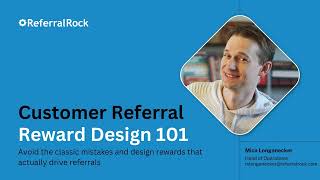
Michael Longnecker from Referral Rock walks through five mistakes in referral programs: boring offers, only using money, ignoring who your customers are, bad reward structures, and not promoting them. He gives a five-step worksheet to fix it, using the ACE framework: Audience, Compelling, Ease.
Chapters
I will get started and we can dive into it. So for those of you who don't know, my name is Michael Longnecker. I'm the head of operations here at Referral Rock. And if you're not familiar with Referral Rock, we are a referral software that makes it easier for businesses to get referrals. We've worked with thousands of customers across many different industries and company sizes. And this is our first webinar as part of an ongoing series aimed at documenting and sharing those learnings. So this one will be around rewards, and in particular, we'll be focusing on customer referral programs. But a lot of these learnings can be applied to other types of programs that you might want to run. Should also note, we'll be recording the webinar session, so after the call you can find the recording. You should be able to find it at this link. You'll also get an email. And tomorrow we will share with you the slides and any supporting material. So don't worry about taking notes or trying to copy that down. We'll all have access to that. Blake will be monitoring the chat, so feel free to ask questions along the way. And then you can also reach out to me after the webinar if you have questions. My email here is here. Just Michael Longenecker or M. Longeneckerfereferlrock.com so on today's webinar, we're going to cover three main things. First, we're going to go over the five biggest reward mistakes we see and provide some recommendations on how to avoid them. Will then give you a framework for building and evaluating your own reward offers. And then we're going to wrap up, kind of talk about the next webinar topic as well as open it up to a live Q and A. And sort of, as mentioned before, this is a focus on customer referral programs, not affiliate programs. But a lot of those learnings will transfer over. So getting into the mistakes, the number one mistake we see, or maybe the first mistake we see, is what we call the boring reward offer. As you're probably aware, people are busy. They're already distracted with their lives. They spend very little time, if any, thinking about your business. And that's why we need to create rewards that are exciting and that they stand out. You're competing for mindshare across everything else that someone could be doing. And so one of the biggest issues is just offering a boring reward offer that people don't care about. So instead, what you want to do is you want to create a reward that's so good. People stop scrolling and they want to click to learn more. The goal of rewards is really to grab that attention. So rewards should be unique. They should have a high enough value that people will think it's worth their time. Your messaging must grab their attention. So ways to do this, you know, you can frame the reward to show the maximum value they can earn. For example, one type of reward structure that we often recommend is called a bump reward. And that's where you offer a higher value, say like earn $200 for your first referral, but then maybe smaller rewards are than available afterwards. You know, in your messaging you also want to follow good copywriting best practices. You want to use active language. You want to use symbols, especially dollar signs and numbers, things that will stand out. So you know, think about someone scrolling through social media or reading through emails. What's, what's that good copy that's going to really jump out and get them, get them excited. Mistake number two is only considering monetary rewards. So for many businesses, you know, cash or cash like rewards is great, but it's a mistake not to at least consider other options. Maybe your audience doesn't care about cash rewards, maybe doesn't. Cash rewards don't align with your brand and cash is generally expensive. So the perceived value of a dollar will always be a dollar. Whereas the perceived value of another reward, maybe like an experience or sort of a free upgrade, that perceived value could be much higher than the actual cost of delivering that reward. So you know, we encourage you to think creatively about rewards that align with your brand and your audience. You know, types of non monetary rewards. You might want to consider things like experiences, account credits, swag, premium services, upgraded products. These are just a few examples of things you might look for. Mistake number three, then it's forgetting about your audience. So for some businesses, the idea of offering rewards might have a bad reputation. Maybe rewards feel, they feel like rewards will detract from the brand and the brand values. Or maybe the person in charge of the program doesn't actually want to participate in referral programs and so they assume their customers won't. So anytime you think about referrals, programs and rewards, you know, you want to consider your audience, you want to consider your brand and you want to pick rewards that match those. So don't just copy someone else's program. This is often the cause of a lot of problems if you see someone else doing something and you assume that they're following best practices. So be careful what you look for. For customer referral programs, you're often trying to reward the friend. So by giving, by allowing the person to share something of value, you know, maybe it's like, maybe it's a discount, maybe it's a free trial, whatever that is, the person doing the sharing gains social capital, and so they feel good about themselves and are therefore more likely to share with their friends. The friend is also more likely to purchase. It lowers the friction of buying. It helps create urgency. And so we always encourage, or almost always encourage you to think about the friend and the reward that you might offer. If you have budgets or there might be other reasons you can't reward the friend, then maybe you want to think creatively. Like, think about, are there any existing offers that you have? Maybe you already do, like a free assessment or a free trial. Discounts tend to work best. But if there are reasons that you, you can't afford it or you don't want to, then, you know, maybe you want to think creatively about how you might be able to reward the friend. Mistake number four, then it's the poorly planned reward structure. There's just a lot of mistakes that happen by not thinking through the reward structure. And kind of mentioned before, this mostly happens because you're copying someone else's program without understanding why they made decisions or how those decisions would affect your reward structure. And so when you create your reward program, you want to think carefully about all the implications of when people get rewarded, why they get rewarded. And this will prevent you from missing referrals or increasing fraud or potentially overpaying when you don't need to, and ultimately can lead to reduced participation. So it's really important to think through what your reward structure should be. So a couple of recommended things we suggest, you know, understand your reward triggers. It's almost always better to reward for a new customer than it is for a new lead. And that's because you know you're getting paid versus when you're paying out and greatly reduces fraud. And it just makes a lot more business sense. You don't want to cap rewards. So sometimes we'll see businesses say, like, hey, up to five referrals or up to, you know, a certain number. But what you're doing here is you're, you're actually preventing your power users. And for a lot of things, referral programs being one of them, you have power laws. Oftentimes we'll see a very small percentage of the people sharing actually generating a lot of the referrals. So you almost never want to cap your rewards unless there's some legal reason to do so. For customer programs, you don't really want to offer perpetual recurring rewards. This is often seen in, like, affiliate marketing, but doesn't make sense for a customer program. Customers don't really care about, like, all the complexity. They want to know what are they giving away to their friend, what are they getting in return? Complexity is fine. So it's fine to have multiple rewards in a reward structure, but you don't want to be confusing. And so just think about how your audience is going to interpret those rewards and when those rewards are actually being earned. So our final mistake then is around not promoting the referral program. This is a mistake we see kind of across programs in general, but it, but it relates to the reward offer as well. So without promoting the program, you know, no one's going to share it, the program's going to be forgotten, and ultimately no one's going to participate. So solution here is to promote the program across multiple channels and customer interactions. You always want to mention the reward when with using active language that stands out. You do all this work to kind of think about a reward that's going to incentivize your audience. That's motivating. Make sure you're mentioning it when you reach out to them. And then you want to balance direct and indirect asks. And so a direct ask is when you reach out and you're proactively asking someone to share. So it's part of its own message. It's not part of another message. It's totally on its own. Typically done after, you know, a moment of happiness where you're like, oh, great, you know, you had this good experience. Do you know anyone who would be like, a good fit for our. For our business? So you want to combine that the direct asks with the indirect asks. And the indirect asks are going to be those passive moments where you're sort of building it into other interactions. And the goal of an indirect ask is general awareness. Think about other customer interactions. Maybe it's an existing newsletter, a checkout page, a customer login area where you can mention the referral program, but it's not the sole part. And so it's just really important to promote the program across any of those channels. So this leads us to sort of what we recommend to do instead. So now that you kind of understand a lot of those mistakes, we're going to talk through a better way to kind of approach rewards. And so we call this our reward worksheet. I'll be sharing a tool that we sort of built around this at the End and we can talk through that. But the worksheet has five components to it. So the first is determining the cost of a referral. The second then is going to be identifying those reward events. Third, be creating your share Persona. Four, brainstorming ideas, and five, evaluating those reward ideas. First, determine the cost of a referral. So the goal here is to come up with a range that you could potentially spend for acquiring a customer. And this is going to frame a lot of what we do in terms of the types and what we can offer. So step one is just understanding what the value of a new customer is. So first step, just sort of take a gut, answer the question, what's a new customer worth to you? And then you might want to consider, you know, digging into that a little bit further. If you have additional data that you have access to or someone on the team has access to, maybe you want to consider it. So things that potentially you could look at is, you know, what's the customer lifetime value, what's the return on ad spend, what's the customer acquisition costs, you know, what's your payback period, any other data that you have? This just kind of helps frame what a potential range could look like. And so kind of once you have that assessment, you want to come up with a reward range. So this will be like, what's the min and max that you might offer for a new referral? For example, an SMB SaaS business, you know, that might be small, that might be something like 25 to $100. Whereas a car dealership, which has a much higher purchase price, you know, the reward range could be significantly higher. It could be, you know, 500 to $1,000. Step two, then you want to think about is identifying the reward events. So here you're going to map out the buying journey, understanding, you know, what are the different steps a new referral will go through. And this helps you figure out how you might want to divide up that, that reward amount. So the first step is always to sort of think about the final action that the referred friend takes. You know, this is think about the end. What's, what's the goal of the program is that to make a purchase, maybe they need to complete an install or get accepted for a job. This really will depend on your, your process, your referral flow, your sales, what you're trying to accomplish with your sales process. And then once you have that final action, you want to figure out are there any steps that would lead up to it. So kind of working backwards here, you know, trying to get to a purchase, maybe they have to fill out an online form or talk with sales, get a quote. So what are those different events and sort of mapping those out. And finally you want to ask yourself, you know, should the friend be rewarded? You know, maybe they get a discount on the first purchase. Maybe it's a free upgrade. Thinking about the audience and kind of asking yourself, does that friend get rewarded? Because that'll ultimately come out of the reward amount there. Step three, then it's going to be to create the share Persona. So here we want to understand who the audience will be sharing so that we can then use this to think about what rewards might appeal to them. So first step, we're going to identify the primary share. You know, in our discussions here, we're mostly talking about existing customers, but this framework can be applied to any type of program that you want to run. So if you, if it's affiliates or partners or employees, you know, who is that primary share? And then once you've identified them, you want to create a Persona for them. So this means, you know, who are they? Like, what's their personality, what motivates them, what are they interested in? Going back to our example of SMB SaaS, it's probably a early tech adopter. They care about things like productivity hacks, online courses, creative hobbies. Whereas the car dealership, it's probably more of this everyday neighbor, someone who cares about recreational activities or local community events or volunteering. So really this will depend on your program. But it's helpful to kind of identify who that share is so that then you can create rewards for them. And don't just consider, you know, one group. Think about anyone who's interacting with your, with your brand. You know, prospects, leads, community members. Ideally, you only have one primary share, and that's where you start from. But if you notice, like, hey, you have significantly unique profiles, maybe you want to consider a second program. So now that what you have that, what we would call like a reward profile, you understand, you know, what's leading up to the type of person that you would, you would want to reward. We want to brainstorm reward ideas. So the goal of this step is really just to kind of come up with as many ideas as possible that might appeal to your audience. And so you want to start thinking creatively about potential rewards. Here are a few questions to consider that kind of help prompt. So what would you offer if you're not allowed to give monetary rewards? What's unique about your brand or company? What are some fun rewards? And then once you have that, you want to list out all those rewards that might appeal to your audience. And again, the goal here is to be as, to have as many rewards as possible. We're going to screen them later. So don't limit your thinking to just a few. Try to be, try to come up with a large list as possible. So a couple options that you might want to consider. On the non monetary side, there's things like swag and discounts, store credits, free product service upgrades, high value items, maybe experiences that would match your audience, your brand. And then you have sort of your standard monetary options. Maybe you know, it's gift cards or cash or PayPal. You know, here are some options but you know, kind of use these as a starting point to think about what makes sense for your business. So the fifth step then it's going to be really around evaluating your reward ideas. So you want to screen rewards to determine your reward offer. So here what we have is you have this great list of ideas. Now you want to sort of filter that list to figure out which ones are actually going to make the most sense for your business and your audience. And so here we're going to add some additional details, we're going to add some text copy and then we're going to screen them using what we call an ACE framework. So ACE stands for audience compelling ease. So audience, how relevant is that reward to your audience and brand compelling, how exciting is the reward and how easy is that reward to fulfill? And then you'll repeat this process to come up with a good list and then you're going to use that to then pick your best offer. And so with that I will dive into this reward profile that we have put together. So this builds off of those five steps that we had talked about and I for here I have a few examples. So sort of going back, we have the SMB SaaS, we have the car dealership, and we also have an E Commerce example. And the goal here is to again try to frame who it is that you're going to be giving rewards to. So you know, first thing is what's the, what's a new customer worth to you? And you kind of put out the first value that comes to mind. Then if you have additional data now you don't need any of this, maybe you have some of it, maybe you have other reference points. Again this is sort of a framing exercise. And so, you know, here would be some examples from these different types of businesses that'll give you a reward range. And you can see, you know, very different depending on the type of business. You would do this for your own. Then we're identifying what those reward events are. So what's the final action? What are the steps leading up to that final action? And then making the decision like, should the friend re be rewarded? And then the third step is our Persona. So who's the primary share? This is existing customers for these particular groups. Each of these I've given a name. You can, you know, take it or leave it. But we thought this was a fun way of kind of identifying who the person sharing personality, motivation and interests actually use chat GPT to come up with these for these examples. But I think you'll know your audience best. It doesn't have to be comprehensive. Again, the goal here is just to frame it so that when you're coming up with rewards, you can understand how you might want to come up with those reward ideas. And let's see, then we have our Persona. So once you kind of have done this thought exercise and you've, you know, you've listed characteristics that you think are valuable, it's nice to create like a simplified Persona so that you can, you know, have something that you really connect with. And then in this case, there are no additional unique person Personas, but if you have one, then you can obviously add it. So that's the first three steps that's really around the reward profile. What you then are going to do is you're going to take that and you're going to just list out any ideas that you can come up with. So this spreadsheet is still a work in progress. I definitely want to continue to build off of it when we send it out next tomorrow. It'll look a little different as we start. I want to add a couple more things to it, but the goal here is ideation. So come up with the list of any potential rewards copy over the target range. Just as a good framing exercise. Who's the Persona? What's that reward event? And then once you have all of your rewards, you're going to want to add additional details here. And so this is, you know, what's the type? What's the perceived value versus the actual cost? This is really helpful to help frame like, you know, as we talked about, like cash and cash equivalents, it's always going to be, you know, 25 is $25. But are there other rewards that could have a higher perceived value? But they're actually very cheap and inexpensive to implement? Those could be nice ones because then you can actually offer something that's A higher value than what the actual cost is it to you? Does the friend get rewarded? If so, what's the type? What's the perceived value? And then what this kind of comes out to is like, okay, you've done all that work. You're totaling up like, okay, what's the perceived total value? What's the actual value? And then you're coming up with some copy to pitch it. So this is an important step because we'll actually be scoring this. So this will be like, how would you then tell the potential share, what's their offer? And so you come up with copy. Here's some examples, and then you score it. So this is that ace scoring I mentioned, high, medium, low, depending on, you know, does it connect with the audience? Is it exciting? Is it compelling offer and how easy is it to fulfill? That'll give you total score. And that's kind of the. The start of this, you know, sort of going through this exercise. A couple things. Like I want to add to it. I'll probably extend the scoring to include both a 2 and a 4, just so that it's a little bit more nuanced when comparing options. And also want to add some sort of metric for pulling out this perceived value, because some of these, I think, could. Could benefit from that additional layer. But again, this is a thought exercise. You take it, you kind of figure out what rewards might work, and then you can kind of build a reward structure based off of that.