Eric Rosenblum of Foothill Ventures on his journey to becoming an unemployable entrepreneur.
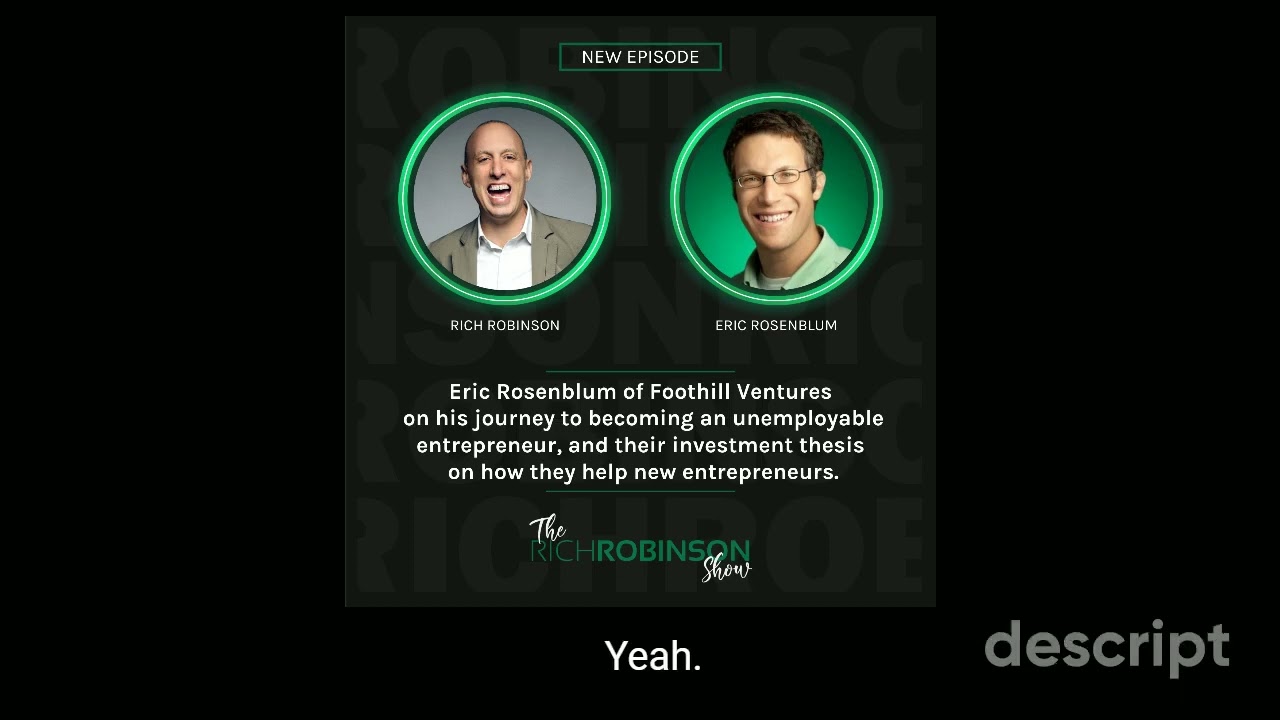
In this episode of The Rich Robinson Show, host Rich Robinson interviews entrepreneur and investor Eric Rosenblum. Rosenblum recounts his unconventional path from a small Ohio town to Harvard, his early fascination with East Asian development, and his arrival in China in 1992 as a BCG consultant. He describes the rapid, almost chaotic pace of Chinese infrastructure development and how that mindset shaped his entrepreneurial ventures – China Now, Intrinsic, Linktone, and SmartPay – highlighting both successes and missteps. Family health crises forced him to return to the United States, where he took senior roles at RealNetworks and Google, learning to adapt from a high‑velocity Chinese startup culture to a slower corporate environment. Rosenblum then co‑founded Foothill Ventures (originally the Teak Angel Fund), a cross‑border venture fund that backs technical founders from the Chinese diaspora (and later other immigrant groups) in deep‑tech sectors such as AI, autonomous vehicles, batteries, genomics, and vertical farming. He explains the fund’s thesis, the contrasting dynamics of US and Chinese investors, and the emerging hybrid culture of Chinese‑influenced companies operating in Silicon Valley. Throughout, he reflects on the cultural differences between the “do‑er” mentality in China and the more passive consumer mindset in the U.S., using vivid anecdotes about Beijing’s Olympic airport build‑out, rapid park construction in Shanghai, and the ambitious, data‑driven approach of Google’s leadership.
Chapters
Hello and welcome to the Rich Robinson Show. I'm your host, Rich Robinson. Over the past 25 years, I've been an entrepreneur, investor, advisor, and professor here in Asia. After nearly a quarter of a century in China, I'm now based here in Bali, Indonesia, the island of the gods. Asia is my home now. 60% of the world's population also lives here, but I would contend 80% of the world's dynamism and opportunity is right here in the region. On the show, you'll hear candid and fun conversations with some of my friends and colleagues, people I've met along my journey, entrepreneurs, operators, experts. It will help you unlock actionable insights around the Asia region and the entrepreneurial agility that actually defines it. This first season, season 1 of The Rich Robinson Show, is titled At the Speed of China. Like, wait for it, at the speed of light. Things happen fast in China, and in this season 1, we're gonna take a deeper look at that. The rapid economic development over the past few decades, as well as the speed and cycles of innovation taking place all day, every day, right now. Let's go, Jio!
And here we are. Welcome. Eric Rosenblum, ladies and gentlemen, all the way from Palo Alto. I'm Rich Robinson, reaching out to you from the island of the gods, Bali. Dah, sayini. And welcome to the pod, Eric Rosenblum, ladies and gentlemen.
Rich, thanks so much for having me. This is great.
That's great. So I've known Eric for, boy, coming on 22, 23, maybe 24 years. We met in Hong Kong way back. In the day, in the late '90s during the dot-com boom. And then we got to know each other better in the lovely northern capital of Beijing. And I'd love you to just first, just give a short intro of like who you are and what you do. And then I'd love to peel back your journey to the middle.
Yep. First, again, I love talking to you about this in particular. You were the first person I ever met that was an actual entrepreneur. And back in the day, I didn't even know what that meant. And so now sitting here with you 20-something years later, talking about the journey, it feels like such a long time ago that meeting an entrepreneur was such an unusual thing. And so today it's everyone we know is, is on entrepreneurial path. And so it's something that I love to think back and, and, and reminisce about. My, my path to China was pretty unexpected. And I think that in those days, that was common, right? So I arrived in China in 1992. And at that time, the early arrivals to China were people who I think were on a journey, maybe academically, or they had some curiosity, but it certainly wasn't part of a business plan. It wasn't something that you went because it was a big step for your career for the most part. And so my journey—
It was like a Peace Corps destination, I think back then, right?
It really was something you would do for the Peace Corps. It was something you might do. In my case, I was interested in developmental economics. A lot of people were studying history and language. I'm from a small town in Ohio, so I'm from the middle of nowhere. And you may or may not know this, but I didn't even see the ocean until I was 18. Like I was, I was quite like sheltered. And so I obviously had a chance to leave that town, which was great. I came to your home city of Boston and got to go to Harvard. And when I was there, I didn't know what I wanted to study. So I took EC 10 like everybody else. So the first, the intro to EC course, huge, huge room. And I thought I would just study economics, but I wasn't really sure in particular what I was interested in. And there was one amazing lecture by an emeritus professor who was already very senior at that time. And he was a very, he was a giant in his field, but he studied Japanese economic development. So how did Japan emerge after World War II? And, and I was just fascinated. I thought that was a really great topic. I went up to him afterwards and I said, I want to do what you do. How do I do this? And he was very kind to say, look, it's a long journey. Said, you're going to first take these courses. You probably, you'd have to do this thing called East Asian studies, but also economics. And then you're gonna have to get a master's and PhD. You're gonna have to take 2 languages and you should start with Chinese and then you'll do Japanese and then you'll go and live in Japan. And so I started with Chinese and I was so bad at the language, just so, so bad. And I was at the most basic level.
You're so good at it now.
Well, that was the thing. It took a long time and I never made it back to the full program. So I'd never progressed to be able to get past Chinese to Japanese. And that would have put me on a totally different path. And so it's ironic that it was because I just wasn't very good that it took me a lot longer. And by the time I was ready to graduate, the Japanese economy looked like it was in trouble. China looked super interesting to me, even though obviously it was very early in opening up, et cetera. I would just go and spend one year. And then I'd probably go back and get a PhD. And I was lucky enough to get accepted into that Nanjing Johns Hopkins program. And that was fantastic. And so for, for people that don't know it, it's a program where there's 100 students, half from mostly the US, but Australia, Europe, et cetera, and half from China. And you're paired up with roommates and the Chinese students are taking classes from Johns Hopkins professors in English. And the foreign students are taking classes from Nanjing University professors in Chinese. So I would take economics from a, from a Nanjing university economics faculty and government from a faculty of government, et cetera. And I thought it was just amazing. I thought that it was one of the most interesting courses I could have taken. The environment was amazing. And I thought that this was a great year before going into my next phase, which again would probably just be more school. The weird U-turn that my life took. Was that BCG was setting up its office that year in Shanghai, and I was fortunate enough to meet one of the heads of the office. So Bob Ching, who's also kind of a legend, he was employee number three for BCG worldwide, but was from Ningbo in China and always wanted to come back home. And so he came back in the 1980s and was excited to start BCG's presence. And so he was like a godfather in both the Shanghai government circles. But also within, within the BCG world. And so it seemed like an amazing opportunity to stay in China and learn from this legend. And I convinced my girlfriend, who you also know, Titi Liu. So we've now been together for like 30 years. So we were undergrads together.
Wow.
And convinced her to move out and that I would work at BCG and she was working at a law firm. And at that point, it just seemed crazy to want to go back to America. And, and the example I'll give you, and I was, I've tried to explain this to other people that couldn't understand why the addiction to China. And what I would tell them is, here's the difference. When we're in Palo Alto and we go out to a restaurant and it's a great restaurant, we'll talk about how we should come here more often. It's great food. We should, we should do this again. When you do the same thing in Beijing and you go to a great restaurant, the group of you get up, you say, we should start one of these. And the difference in that mentality just explains China, that you're constantly thinking of things you should start. Whereas in America, you're thinking of things you should do. And one is more passive versus active. And once you get in that mindset of like, there are endless possibilities, you can just do something. Then it's hard to go back to just being a consumer. You just really want to be a doer.
Yeah. Wow.
So that's what I'm imagining.
Because, you know, grow, grow. Yeah. If I may, like growing up like an Irish Catholic kid in Boston, right. Like the whole American, like, can-do attitude. Like we own that, right? Like one of my Irish relatives— what we thought we did, we thought we did. Right. But one of my Irish relatives said, here's the difference between an Irish and an American guy is that an Irish-American guy walking down the street and they see a guy get into his really nice car in front of his beautiful home. And the American guy says, one day I'm going to be that guy. And the Irish guy says, one day I'm going to get that guy. And somehow it's flipped around now, like compared to like the state of China and the pace and pulse of how things are changing and the opportunity. It's, uh, it's kind of put America even back down on its, on its back foot compared to what— I mean, a little bit, right?
A little bit. I mean, again, not to flash forward too much and kind of veer into geopolitics, but it's something I think it's a good anecdote. The kind of, I'm going to be that guy versus I'm going to get that guy. When you look at America's reaction to China's rise, It's a little bit, I'm going to get that guy, right? Instead of, instead of like, I can compete. And one of the ways that America has always been competitive is we keep accepting these brilliant and hungry immigrants. And not just at the top level, like PhDs, but people that are coming to pick fruit, but then their kids grow up.
They're your classmate at Harvard. Yeah.
And these, this group is what continues to nourish the kind of competitive spirit in America. And I think that that's the sort of thing that we really curtail at our, at our peril. Like that, that has been the competitive spirit in America, constantly people coming through and pushing everybody to go a little bit harder. Yeah.
Yeah.
So that's, that's, that's sort of my, my, my intention with this book. Like small intention is that like, I, I want this to be more of a Sputnik moment.
Yes.
With like, you know what, like things are happening in China. Like let's get out there and like, let's get in the arena and Because I know that America has the chops to be able to do it right. And like, and sure, IP theft and, you know, things that are sensitive and like, yeah, that, that's, that's beyond the pale. And that's not, that's not what I'm talking about. I'm talking about where's our 5G? Where's our light capability infrastructure?
Where's our, you know, and by the way, just the thing that to insult both of us, that the secret weapon America has always had is that China sends its physicists and chemists to America. And we send you a language student like me, uh, and a comedian like you, and that's what they get in return. And, and so that balance of trade has worked very well.
It turns out you're not a very good language student. And so it's actually—
But I've been getting our best. But now we're better.
Now, now we're, now we're better. Just to— I think I am anyway.
Yeah. So, so just to flash forward a little bit. So I, I, I feel like I lucked out with BCG. I'll tell you, it was like today, not just today, I think 4 or 5 years after I joined. They would no longer take someone like me for obvious reasons. They don't have to. There's so much talent coming out of Chinese schools. You're just not going to take someone who doesn't speak great Chinese, who is, is not unique anyway. But back in those days, the business of a consulting firm in China was mostly servicing their, their international clientele that were looking to come into China. And so you had everyone from Whirlpool washers to Campbell's Soup to name your foreign company, trying to figure out the China strategy. And so it was important to have people that are from the States who can be external facing to the client, but knew enough Chinese to be able to do interviews and work your way around the country pretty well and get away with not being completely competent in a lot of your day job, but you had enough going for you that you could keep the job. And so a few years later, there was just no reason when I came back to China after business school. So BCG was, was nice enough to send me to MIT for business school. So I came back and lo and behold, our clients were all trying to figure out how to exit China or how to fix things. So all the stuff we had advised them to do back in the day, like, okay, that didn't work. Let's figure out a new strategy. But by then it had been quite localized where a lot of our work was with companies already in China or Chinese companies. And so again, in this theme of China speed, in those few short years, everything had changed. So the kinds of strategies the kinds of clients, like China as a hope for the future versus China as like a problem we have to solve now. That whole framing had changed. And, and so at that point, I had already been bitten by the entrepreneurial bug. I owed BCG 2 years because they had been through, through school for 2 years. And so as soon as I was done, I wanted to start a company. And I joined up with a few friends in Shanghai and we started a company called China Now, which was essentially a proto— we had kind of copied some of what CitySearch was doing in the States. So guides to cities. And we had a Chinese version that was supposed to be the big part of the company and an English version. Uh, the English version attracted these amazing writers, right? So we had Kaiser Guo as our chief editor, Pete Hessler. Yeah. Amazing, amazingly talented group of people writing on the English side. And the Chinese side had some amazingly talented people too. So this woman, Yinzi, who was a filmmaker and photographer, and Tara Wang, and Chen Miao, who's a filmmaker. So we had a lot of talent. What we didn't get, again, this was trying to figure out internet in real time. Like it should have occurred to us, you were working on, on basically proto social media user-generated content. And somehow I never connected the dots that the thing we really should have done is like Yelp and had people generate the content that were not our employees. But to be blunt, it was a lot of fun, but we were not a terribly well-run company. And I'm saying that as the COO. And we didn't know how to monetize. There was a lot we just didn't know. And so nobody really did. No one really did.
Peeling their way through.
Right.
And all of us remember when we had the buyout offers and we would scoff at them. And so at some point we had a reasonably large buyout offer. We said, we don't get out of bed for less than how many figures sort of thing. And of course we ended up like selling the name and small amounts of IP for virtually nothing. But we learned a lot. And I think our investors at least appreciated that we're constantly learning and we, we had built something meaningful that people liked, a decent product.
It was, it was like super well regarded.
But if we had really thought through the economics of hiring editors and writers, even in China where it was fairly cheap versus the amount of money we had coming in from advertising, we probably should have spent a bit more time on the math of all of this and figured out what would, what would be the inevitable result. But it definitely scratched my itch for doing something like this. And so then I met up with a group, so Derek Soldier, Pat Benzie, Wu Jun, and others that were starting Intrinsic, as you remember, that was really based on the idea that China would have a boom in mobile data services, just like Japan. And so everyone at that time was looking at—
And this is like 2002, is that right?
This is 2000.
2000. Okay. All right.
Yeah. This is 2000.
Very early.
And they had it exactly right that of course China, like Japan, would start to have data services. And they were going to build a platform that was intrinsic that would allow China Mobile and China 2 to be able to monetize these services. And at the time they were simple SMS-based games, WAP browser sort of thing. And there were 2 other companies that they were thinking of, or we were thinking of. One is Linktone, which, which was going to do content. And the other was SmartPay. So originally we called it Summit Mobile for some reason. I'm not sure why, but anyway, it was SmartPay that was going to do payment processing. And so I was CEO of SmartPay, but we were all together in a giant kuretsu. We had a big office with Intrinsic, Linktone, and SmartPay. We all were trying to help each other, et cetera. We all found investors separately, but also with some overlaps, and they all went the opposite of how you would've expected. So Intrinsic was like the golden goose, and all of us were there to really support Intrinsic in some ways. Linktone was kind of there to show the content that could be made With it could be sold through intrinsic, and smart pay was kind of there to show that you could pay for things through this method. Intrinsic, though, basically ran to the giants. So it's such an important platform that eventually China Mobile really had to have its own platform that it owned. It was not going to let a foreign invested company have that piece of the pie. And so basically you ran to force majeure. Like you only have two giant contracts with China Mobile and China Unicom. And they just can't allow a third-party company to control such an important piece of their infrastructure. Linktone, which again, I think no one— we had gone through the dot-com bust and these content businesses people were very suspicious of became a hit, right? So you remember this, they had like news alerts during the Sydney Olympics, whenever a Chinese person would win, you got an alert on your phone and that was the big app. And so after that, it just skyrocketed and they went public on NASDAQ in 2004. And then SmartPay just kept growing, growing, growing. And it was never completely legal for us to be operating a payment network in that there was no license that was a payment license. As we were operating as an internet content service. And so the company could never be exited while you didn't have the right to be operating such a service in China. But as are many things in China, people are willing to say, well, the law is not completely settled yet. Let's see how things turn out. And eventually the nice thing, when they eventually did approve payment licenses, we got one of the first ones. And then the company was of value to a lot of acquirers. And so it was eventually bought out by Ping An Group, which is the insurance and financial services conglomerate. And so it ended up being, being a good outcome. But it was, again, there were times where I would look and think, I'm from Ohio and I'm somehow running a semi-legal payment service in Hubei. I'm not sure how this happened along the way. And so there were all these, again—
This is, this is not my beautiful payments company.
Yes.
This is not my beautiful illegal entity.
But the one quick story about speaking of the speed of China, our building was right near People's Park in where the old racetrack was in Shanghai. And it was one of the few tall buildings in this particular neighborhood, but it was surrounded by those traditional, very typical of Shanghai. So those like 5-story kind of low-rise houses, as far as the eye could see. So surrounded by block after block after block of these. And at some point, I guess I just really wasn't paying attention to what was happening in the neighborhood. I went away for a trip that may have lasted 3 weeks. When we came back, the entire neighborhood had been turned into a fully mature park. There were no houses. They had gotten rid of every dwelling, put a park that had hills in it and trees that were fully Like 20-year-old trees and the entire thing. And they had taken one building that was of historic significance and a giant building, had lifted it up and moved it to a different street. And so all these things, and meanwhile, again, a reference that you'll appreciate, it's gotta be the size of the Big Dig. And the Big Dig had been going on at that point for like 25 years. And meanwhile, over 3 weeks, they have created a park in the middle of Shanghai.
Wow. Well, at least they put some greenery in there and not just another 75-story monolith. My dad joked when he visited, he said, you know, I went to Beijing and I think the bird of the city is the crane because I saw it everywhere. Right. And he's like, some guy was camping at a construction site and he woke up the next morning on the 13th floor.
Yeah.
I mean, again, those sorts of things, like just the amount of infrastructure, the story that, and this is, I'm pretty sure this is not apocryphal. When Beijing won their Olympic bid, they Had a plan to expand the airport, which they did. They put in the new terminal and they're also going to build the Airport Express. And they brought in Norman Foster, the famous architect of Hong Kong airports. And they brought in project managers from his company and they were going to work on the moving parts of— so they work on the rail part of this. And apparently if you looked at the timelines that you do for these kinds of things, by the time they hit the ground, they were already like 5 years behind schedule. Like no, in no place. Could you ever do this by the time the Olympics need to open? And so there was just, it was a ludicrous project to begin with. So they arrive and they think they're going to have meetings where they're going to go, you know, they just got off whatever, a 14-hour flight. And, and it's going to be a difficult day because they have to explain to everyone that this just isn't going to be possible. And so they get there and they say, okay, we're going to be off to our hotel and tomorrow morning. They said, no, you're staying on site. You're already 5 years behind. They get moved to a site that's been prepared for them, but they just didn't leave until the thing was done. And I think that's like, sometimes people don't quite understand what it takes, but they did it. And it's gorgeous piece. It was done pell-mell, but, but again, the sense—
And also like insanely ambitious, you know, for the time compared to the original 2 airports. But now that airport is already like, yeah, okay, we're going to leave that there and we're going to make an even bigger one in the Southeast, Daxian, right? And like, that's, that's a monstrosity that just dwarfs That original one, right?
So, yeah, it's like fractals. Every time you zoom in, there's like exact replica, just a different scale. Wow.
That's a great, that's a great story. I have to really peel back some history on that one. I think that's a, that's a good sort of starting point. I think, I think you're right after like, it was '01 when they won the Olympic bid and then it was a race for the next 7 years.
Yeah.
And I think that, that was kind of a, a little bit of a defibrillator for Beijing to like catch up to Shanghai and stuff.
Yeah.
And I mean, they did it. It was amazing. But yeah, so that was really, as you know, my girlfriend who came out to China with me became my wife. We had our 2 kids. And, and so then our son was born with some health issues. So Max was born with some health issues. And so he was born with what's called Tetralogy of Fallot. And actually during a routine checkup in Beijing, they spotted in utero that there was probably a problem with the heart. But it was very Chinese. It was like, make sure these sorts of things, they go away. Lots of kids have little holes and they repair themselves. But you're American. So if you want to, when you're home, you could just go and get this thing checked out. And so TD back in LA went to a hospital and they did fetal, fetal echocardiogram, but also fetal ultrasound is what I meant. And they saw that actually it was a pretty severe problem with his heart. And so he had to be born at a high-risk pregnancy center in Los Angeles and then get surgery the next day and then come back for surgery a few months later. And then, so we ended up doing 4 surgeries in 2 years.
Wow.
And it was brutal. So I was trying to run my company and going back and forth with a sick son. But even then we thought my wife was working at the Ford Foundation and that was her dream job. And I was loving being an entrepreneur in China. And it's the sort of thing where your life as an expat, the thing that is the hardest is your family is so remote. And when something happens, again, I don't need to tell you this, that's where you really feel isolated and you feel like Some, somebody, you feel sometimes you let your family down, right? You're far away. And, but even with that, we were going to soldier on and we'd figure things out. But then my mom got sick. And so then it's like, we can't do this. My mom was back in, at that point they moved to Pittsburgh. And so now I'm going to LA for treatments for my son and to Pittsburgh to see my mom and going back and forth. So that, that finally just broke us. And we said, we have to figure out something. I got a new CEO for SmartPay. My wife had to give like long, long notice for her job. And eventually, you know, the path back was, all these years I had been approached by foreign companies who were always looking for their chief rep for China. And I'd always said no, because I was just enjoying being an entrepreneur. I didn't really see the point of even like a job that would seem great, like for Google. I wouldn't have done it just because I liked doing my own thing. But I was approached by RealNetworks and the CEO of RealNetworks said something amazing to me, which is he said, look, Eric. You're unemployable now. You're this China entrepreneur. What if you're gonna move back to the States? What do people even do with that? Like, what are you— you're qualified to run something in this country that the rules are totally different, but what do you do here? He said, so I will— I need a head of China. And if you do this job for me, and if I don't fire you in the next year, then I will create a great job for you in Seattle. And you'll love Seattle.
That was Rob Glaser.
That's Rob Glaser. That was—
I've met him before. He's like, he's a, he's a very, you can't really say no to that guy.
You can't. And the funny thing was he was right. Like I literally got up from his office and I called TD. I said, I just had the most unusual sales pitch, but the dude is right. Like I, this is exactly what we—
Like, like kind of, especially back then, that was probably true. Probably really wasn't just hyperbole. Like, like now it's a different story, but I think there's a different set of, but, but yeah. So that, that was a Awesome. But, but you know what, if I may, it's like, you keep having all of these strokes of luck, but I know for sure that knowing you for so long, you make, you make your own luck and people meet you and like, I can't let this, I can't let this guy go. So.
Well, some of these things are definitely luck. They're, they're, they're fate or luck, or you can kind of stumble into things. But at any rate, so I did that. I took the job. He didn't fire me. And as promised, he created a job for me back in Seattle. And he was really indifferent to what I called myself. I said, I'll be global head of strategy. He said, that sounds just fine. And it was a bit of a joke because Rob was global head of strategy. And so my job was really just to figure out what's in Rob's head and put it on paper and do whatever I could, but I wasn't really needed. I didn't know. And it was a little bit of a hard time because again, I was coming off this, this, this maker attitude in China and coming to Seattle where Life is great in Seattle.
It's too good.
It's too good. It's too good, too slow for me at that time. And like, I just was used to the fast twitch of China. But at the same time, you're just teaching yourself to relax a little bit and enjoy the greenery. It takes a little bit of time when you first exit entrepreneurship or China, but it was a great entry point to the States where I kind of learned how to be an employee in America. And I'd never worked in America before outside of minimum wage. Like I had a job at a bar in college and, and then, and then I was working in China. And so this is the first time where I go to an office and kind of learn what people are like in America and like how to joke around the water cooler sort of thing. But, you know, it was my entry point. And so the part I was going to say that the real luck was Google recruited me and they recruited me pretty aggressively and specifically they wanted me To replace Jared Smith as head of China product management. And the ironic thing was, like I said, back in the day, I would have turned that down because I was happy doing my own thing. Even then I said, I'm not coming back to China because I moved back for family reasons. And then the recruiter said, okay, I get it. But it looks like you're global head of strategy for— maybe, maybe we could get you to be one of the heads of Google strategy team. And so that was the funny thing was that my job was kind of made up. And like, I had no business doing it for real networks, let alone Google. But recruiters being recruiters, they just want to get people in the pipeline. And so I went to Google, interviewed, and really hit it off. Like just really found my people, really loved it. I didn't want to leave Seattle and that was hard, but just, just absolutely enjoyed it. And it was a fascinating time at Google.
And— But I mean, like, if I could put a, like, how long were you in Seattle?
Just one year.
Yeah. A year. And I remember you raving, like, I got a house. Yeah. But then, but then you, you actually did become like one of the 3 heads of global strategy for Google. So, I mean, like, how do you say no to that? Yeah.
So it was, it was, it was a prime job.
And that's perfect. Like I could just see you. I was like, oh, that's like, finally he's kind of met his match like that. Yeah. Like, yeah. Like, wow. What an amazing—
It was a great— and I learned a lot. So in that role, you get to see all of Google, how it's structured, how things work. And you get to meet everybody and, you know, the Google, a Googler is, you know, we say they're Googly, which sounds like a weird thing to say, but you kind of know what it means. And really what it meant to me is someone who's very smart, but super enthusiastic about everything. And it's a bit weird when you're first there and everyone just wants to be helpful and nice, but then you start thinking everything should be like this. Like, why can't we just work like this all the time? And it becomes infectious.
I visited you there and we had, you know, we had, I always liked to have free lunch at Twitch or Facebook or like, you could smell it. You could taste it. It's like the happiest place in the world is in California and it's not Disneyland.
Yeah. It was, it was an incredibly happy place. And I was so, again, fortunate. And again, I was also fortunate that I had my first entry point in at RealNetworks where I was not, I was so hard driven because of China that I rubbed probably everybody the wrong way. 'Cause I was like, why can't we get this done yesterday? Why can't we move, move? And I kind of got it all out of my system. And so when I got to Google where people were moving a bit quicker anyway, I had also calmed down a little bit. And so I think that we kind of met at the right level. So it's good that I got China out of my system a little bit.
Hey, can you, can you share a Larry or Sergey anecdote? Because I'm sure you're up against them.
Yeah. There's one thing I'll share is their ambition and just how they go back to first principles and don't think that anything is not doable. So there's, there was one kind of amazing meeting where my team was in the strategy team. Really what we were was like a captive McKinsey or BCG that worked for the top management layer. So that's really what we were. So there at the time, there's a group called the OC. And it was comprised of Eric Schmidt and Larry and Sergey, and then the heads of engineering, product, finance, et cetera. And so each of us would take several of them as our quote unquote clients. And so projects that were kind of big strategy pieces, so including all the organizational pieces, but also like new directions we might go in, would often involve our team. And there was a meeting that was really driven by our partnerships group who had signed agreements years before for satellite imagery for Google. At the time, it didn't, it was a bit of a toy. Like no one, how is Google even going to monetize this? It didn't cost them that much to license lots and lots and lots of data. And that became Google Earth and Google Maps. Obviously they bought Google Earth, but they populated their Google Maps product with a lot of this geodata. But all these agreements were coming due and the satellite companies that had the imagery knew that they were going to get Google for a billion plus dollars, it was going to be a lot of money, because there are only a couple companies in the world that had this data. And Google by this time had figured out how to monetize it. And Google Maps was a big deal. And they were just salivating. And the partnerships team, their whole tenor of the meeting was basically, look, just want to prepare you guys, it's going to be at least a billion, we're gonna try to hold it to under 2, whatever numbers they were talking about, I don't remember, but it's that order of magnitude. And we just want to see what your appetite is. Like, if we have to go to 3, can we do it? We're going to really try to hold it to this. And Larry's like, how much do you think it would cost to map the world? And like, I don't know, these guys have been doing this for like 20-something years. Like it's, it's, it's just not like, let's focus on this meeting, which is really a budgeting meeting. He's like, no, I mean, like, could you drive a car? Like what would the speed be that you could reasonably be recording data?
Wow.
And like how many cars? And literally like people start like doing math on whiteboards. And then they're like, well, but if you had these cars driving around, couldn't you be collecting other data at the same time? And so by the end of the meeting, they had the math that like, well, we could probably remap the whole United States for under this many millions of dollars. And it would take this much time and the world would take this many hundreds of millions of dollars. It would take this much time, but we'd own all this data. And by the way, you could put sensors on these cars. So then Street View was, I always thought it was just kind of funny. People were like, why are they doing Street View? But it was because they're mapping the world and they might as well take pictures. And by the way, they had sensors on the cars that would collect data on Wi-Fi, but air quality and pollen and all kinds, just because like, why not? If you drive cars around, you might as well collect a lot of data anyway. So, so one of the things that kind of blew my mind about Google was it was a very Larry and Sergey thing to both challenge the entire assumption of like, why are we having this meeting? And they would. But not in a destructive way. They would come up with something from a completely different direction that everyone thought that's crazy because it's so big and it's impossible. But then they would literally start whiteboarding math. And by the end of the day—
Reduced it down to math.
Yeah. And so anyway, so my, my, my thing with them is the, the, the, the thing that will, I'll take with me is that is kind of unbridled Not even ambition, just not seeing limits that, and a true passion for figuring things out. And so that, I thought that was just amazing.
That is a fantastic story, right? To be literally not a fly on the wall, but a person at the table at that meeting. Like that's, that's fantastic.
Wow.
Yeah. And I think I was literally like at the, I think I had no role in this. I think I was like literally just sitting at the table, but they, uh, they just, just to observe that right in the.
The body language and the, the, the, the, the temperature of the room and just like what's happening, right. And how these things spawn. It's just fascinating.
Yeah. I mean, again, so much of what I currently feel I know about how to run a business and how to be a better manager and set visions, I do feel like I learned a lot of it at Google. And I kind of wish I could go back to my earlier startups. And kind of rewind and implement a lot of things I saw about the way you set goals and were transparent about your about your work and all of that. But that the other thing that Google gave me is my current career. So my partners I met because of Google. One of my chief engineers, I transferred into Google Commerce, and so I was one of the lead product managers for Commerce. And and one of our chief engineers was from Tsinghua University. Like again, it's like home cooking for me, right? I had I had really missed China and really. Bonded with this guy. And so at that time I was working on product management. He's an engineer. So you have to spend a lot of time together figuring out what, you know, what features you're going to make and how you're going to prioritize. And we just really liked each other. And part of it might've been that common, like China background. And he was part of this group from Tsinghua that had founded a very small called Teak Angel Fund. So he's part of this Teak group. And so I first got connected through him. That's this guy, Richard Liu. And we just enjoyed working together. And I first became a small investor in the fund. And then, you know, over time, just like doing it more and more. And then eventually that was my day job. And so we built a small fund still, it's $150 million now though. So it's getting a little bigger, but we still like the core of the fund is investing in this Chinese diaspora back in the States. And so it's about 2/3 of the companies we backed have founders that are from China originally, but came to the US to build their careers.
So that's fascinating to me because if you look at Sea in Southeast Asia run by Forrest Li, he's a Chinese transplant into Southeast Asia. And I think about when I went to my friend's wedding in Quito in Ecuador, and then I did a side trip to the Galápagos. And the fascinating thing about the Galápagos, it's like, it's kind of like a Dr. Dolittle clip where you go to the fish market and there's seals and there's birds and there's lizards, like all over. Like the animals are everywhere because there are no natural predators.
Yeah.
The giant turtles there were, unfortunately, they're coming back now, but a ship would stop and they would take 300 turtles and just throw it. Oh, they would just throw them in the ship because the turtles didn't need to eat or drink for days, for weeks or months. And then they would just cut them open and make turtle soup. Right. And like, and it just decimated the population. And I sort of think of that in the same way of like some of these Chinese entrepreneurs, they come into these other ecosystems and they are just like, These apex predators just have a completely different level of like the, the, the, the rapacity.
Maybe, maybe in Southeast Asia. I don't think that's really the case in the States. And in fact, I think until now there has not been like a great record of success in the US as Chinese entrepreneurs, because they tend to come for their PhDs. They're very academic and they've done well as top-level employees, but the examples are more kind of exceptions that prove the rule. So you have obviously Eric Yuan with Zoom. You have the earlier ones. So Netscreen and WebEx.
Spotter, I guess.
These days there's a ton. And the reason is, I think, because of the rise of AI and machine learning. So suddenly it's the rise of the statistics and math people, but you also have the rise of the robotics, the automation people. So all the self-driving car companies. So you have TuSimple and Plus.ai and WeRide, AutoX before Roadstar. So all of these are from Silicon Valley based. Chinese. Covariant in industrial robotics and pick and pack robotics. Otter in natural language processing. So all of these people are machine learning, computer vision, you know, and so that the rise of this new entrepreneurial class, I think is not a coincidence. It's a certain specialty that's now on the rise. And you have a lot more in like deep tech. So chemistry, so a lot of battery companies, solar, material science. And so there's a whole rise now that's coming. But until now, I would say it has not been that notable that there's a strong Chinese American entrepreneurial presence, but I think it's coming.
I feel like that's starting to come now. Starting like that coupled with a lot of the backend maybe being developed in China, they just have like these gigantic engineering centers in China and like putting, putting that together, like that's going to, you know, change things because I love, like I said, visiting you in Silicon Valley or Whenever I go anywhere just to try to visit some of these top companies and it's a different vibe inside those top companies compared to China in that by maybe by 5 o'clock people are gone, right?
Yes.
Even, right. And like, and that's not to say that this Jojo Leo 9:00 AM, 9:00 PM, 6 days a week work culture is something that should be pursued. And there's a lot of downsides to the speed of China as well too. Right. But now there's going to be. I think with more Chinese entrepreneurs and more sort of like Chinese DNA companies in the Valley and other parts of the world, that's going to just make the clock speed a little bit faster.
Yeah, I think so. And I think there's been an exchange also of values where if you look at the companies I just mentioned, many, so if you take Pony, pony.ai or DeepMap or WeRide, or again, many others, they are founded by Chinese, but many of them took many years at Google. And then, or they worked at Amazon. And they also are taking, so when you walk into those offices, they don't feel like the early days of China or even like a classic Chinese company. They've taken a bit from both. And so their management call, they're all doing OKRs and they have the same snack selection as Google. They, they've taken a lot of lessons also. So I do think that there's a meshing of cultures that's happening that I think is great. I think that this sort of thing that the Chinese, in some ways that story I just mentioned with Larry and Sergey not seeing barriers. In some ways that's very Chinese, that you just don't see why not. You were telling me before we started talking about JD.com's launch of the latest iPhone and just how quickly, 7 minutes from ringing the doorbell to, or placing the order, ringing the doorbell, that kind of like, why couldn't we do this? Why couldn't we deliver something immediately? And then figuring out how to do it. Like that spirit sometimes was there at Google, but not always. But I think you get these hybrid companies where you have this like no holds barred of China. Where the possibilities are really with, you know, the transparency of process and kind of the, a lot more of the, we're listening to everybody versus the hierarchical nature of Mei Cai's company. So I think this hybrid is really great.
And I think also that practicality and pragmatism of Chinese people and Chinese companies is something that can be, people adopt things in China. If this works, okay, let's throw that out. And if it's something that progresses us, then let's adopt it. Right. And I think, like, I look at ByteDance. and how they've been able to expand so quickly. And I think part of it is, of course, the secret sauce is that they're not a content company. They're a machine learning algorithmic company that started doing that with news and then moved into video and a lot of other things, right? So the kind of goose that lays the golden egg is still sitting in Beijing, but they've been able to expand. I think they have 104,000 employees now, and I don't even know the number. And they're in, they're in, they're in 80-something cities around the world. And they've just gone local, as I understand, right? They're just like, let's hire a local team. Let's do it in local language. Let's not try to necessarily put the, you know, Chinese guy who speaks French there and try to run it from the mothership because we all know how that played out in China.
They've learned lessons from everyone colonizing China. Yep.
Yes, indeed. Indeed. Right. So that's incredible speed and pragmatism. Wow. Amazing. And tell me a little bit more about your investment, your investment thesis and how that's playing out to some of your investments now and some of the Have kind of like surprised you or been really interesting since you've become?
Yeah. Well, first just to spend a moment just describe what we do. So like I mentioned, this fund started with a bunch of Qinghua guys, and it started in 2010, and they had this fund called Teak Angel Fund. So the Qinghua Oshern Executive Club Fund Number One. It was a small fund, but their first really big investment was part of the seed round of Zoom, and and that is kind of the object lesson where. Eric Yuan gives interviews about this all the time, about when he was raising for Zoom, he knocked on every door, every door, and they all said no. And it's crazy if you think about it, where he was CTO of WebEx when it got acquired by Cisco. And so it's, there's just no other explanation for him not getting funded, except that he just didn't fit what Sequoia or whoever else thought an entrepreneur looked like or sounded like, because someone with that pedigree, if he went to Dartmouth, would get funded. And so. Or maybe not Dartmouth, but maybe MIT. I had to slip that in. So we were really founded to fund those kinds of people. And so over the years, a lot of our successes did come from that profile. And so our next big hit was Quanergy, which solves, say, LiDAR. Iterable, Justin Ju, who's been in the news. You can look this up.
Yes.
Amazing fun story.
Yeah. But built a great company. A couple of automotive guys. So WeRide and Plus, we're a seed round of. And so we've ridden this kind of narrow strategy of betting on these kinds of entrepreneurs. And so if you wanted to like interrogate our thesis, it was pretty simple. Bet on great technologists from China in the U.S. and then full stop. We've gotten a bit more sophisticated about it though, kind of what works, what doesn't work, what kinds of models seem to work with this kind of person. And we've also expanded from just focusing on that original group of Chinese in the U.S. to going after really immigrant technical founders is the core. And so a lot of people from India, a lot of people from other places. That share this common kind of hunger and practicality, but also deep tech technical chops and the ability to take advantage of both markets. Usually that takes the form of, you know, an offshore development team. They can move a bit faster, usually for a little bit less money. They can run a bit leaner. In the case of China, they have the additional advantage of being able to draw capital from both markets, and that can be incredibly powerful. And so we had a company in our portfolio And I'm not, well, I don't know if I should name the name, but anyway, they had a very successful funding round. And part of the reason it was so successful was all the top US VCs wanted in, but then the top Chinese VCs also wanted in. And they do not play a cooperative game. Whereas in the US, eventually if Sequoia wants in, Accel, I kind of feel like they'll work it out. They, they, they know each other well. They don't try to bid against each other. They're not going to outbid They'll meet with the entrepreneur and they'll try to tell them why we're the best for you, but they're not going to keep raising their bids for the most part. They think that's a race to the bottom and it's destructive. The Chinese investors don't give a shit. They will come in and just take the deal. They're not there to—
Win-win means I win twice.
Yeah. I mean, not even from that perspective, just that they're not part of this little boys club. And so they just don't care what you think of them. That's right.
And so.
They came in and took the whole deal. And so it was one of those things where I'm sure that if the company was only able to raise from the States, we would've been at like half the valuation because in the end, a number of firms would kind of decide what it's worth and they would've fought it out, but not with a larger check because then they all lose in that game. And so this model has been successful for us on multiple fronts. So today we invest about half software, 30% life sciences, and 20% deep tech. But I would say our deep tech portfolio is the most exceptional part of our portfolio. And part of the reason is there's an appetite in non-US VC markets. And so not just China, but China's a good example of this, where they don't mind investing in chemistry or things that are heavily scientific. And so batteries are a good example of this. It's not been a popular US category for a while since like 2011, since the clean tech bust. US VCs have been scared of deep tech investments, but Chinese VCs have not been. And so part of a lot of the people we like to fund are also, they came to the US to do their PhD in chemistry or physics. And so it also happened to align with the group of people we were pursuing. And so everything kind of lined up for us where the group of people starting companies that we could fund also happened to be able to raise money. From both coasts, from both China and the US, which has gotten them over some of the more difficult parts of building a company where you hit that stage where you're too big. It's a big bet now, and there's only so many VC firms that can write that kind of check. So our current thesis is that there are some exceptional opportunities in deep tech with this cross-border thesis, and that it's not something that most VCs are really pursuing.
Fascinating. On the deep tech side, I think it's, yeah, it's something that just eliminates a large pool of like existing, like it seems like there's a trend in venture capital. And I think a lot of it's healthy with like a16z of like, I'm an operator and I'm going to now be a VC, right? I'm not just going to necessarily be a quant job, a finance guy. But then the limitation there is that I've been in enterprise or I've been in consumer. And I don't know how many people have really been in super deep tech or life sciences that are, that are there doing that.
Yeah.
But then I think there's gotta be, in China, especially with the incredible amount of STEM graduates, I, I, I don't know how many times I've met a woman. She's like, yeah, I work in marketing. And like, what did you study? Well, yeah, I have a PhD in hydraulics. Right. And like, like the deep tech and sciences are so embedded across Chinese society, right? The number of STEM graduates like outnumbers so many, you know, other, you know, countries combined. And then that coupled with. The rise of AI and machine learning, and then just all these new medical, medtech and life science and electric mobility. Like it's just going to create a whole new like wave that we can't even necessarily even see, except you see it.
Well, so yeah, so it's been very fortunate for us. Again, I keep using the word luck on this one, but again, it's just the people that we were pursuing that happened to align with some global trends. And so I gave a talk this morning, actually. So it's top of mind about deep tech investing. And one of the things I love is when there's a clear chart that explains a phenomenon really, really clearly. And an example of that was Mary Meeker, you'll appreciate this, used to have her classic internet reports. And the first one came out in like, you know, the '90s and then she would update it. And there was a stunning chart that had the percent share of media attention. Versus dollars. And the internet at that time was commanding like 15% of our time, but only 0.5% of dollars, for example. She said, okay, this gap is worth, you know, $3 billion. And sure enough, again, they take not just $3 billion, but $100+ billion. And then she came out in 2005 with the same chart that said, okay, now I'm splitting desktop versus mobile. And mobile is now up to 12% of our time. And it's also 0.0 whatever percent of our dollars. That's worth $3 billion. And again, you know, everyone kind of laughed at that. And yet again, it very clearly, not only that, mobile advertising grew far faster than desktop and more than made up for, for that difference between time and dollars. And so the charts that I'm currently obsessed with are the cost of ownership for electric vehicles versus internal combustion engine. I think that we're passing the line right now where the cost of owning an electric car is now lower than owning a gas car. And so from every day from there forward, there is no sense of buying a new gas-powered car. That's done. And so the $240 billion per year of gas engine components, that whole market is just going away and it's gonna be replaced with batteries and sensors and software. Similarly, there's, if you think about genetic sequencing and so the cost to sequence your genome and how fast that's dropped. To just 10 years ago or 20 years ago, you're talking about a moonshot type of project, Manhattan style, Manhattan Project style, where your government's funding $1 billion. And now you're doing it for approximately $100 is the curve that we're down to. And virtually like something you could do during a doctor's visit. And so these kinds of stunning sea change technologies I find fascinating. So several of the ones today, I think favor deep tech. And so specifically batteries and storage, autonomous vehicles, genomics and healthcare, chips now because of many of these other industries, you need to now do a lot more edge computing, a lot of AI computing, which changes the amount of, the amount of processing power you need. And even agriculture, same thing. The vertical farms have been making progress year after year in how much it costs to grow a pound of lettuce. The farm that we invested in in Pittsburgh, which is called Fifth Season, This year, their pound of lettuce is now cheaper than field grown. And so from that day forward, wow. Yeah. But because they don't have transportation costs and they don't have like a lot of costs that you would normally have in terms of labor and fertilizer and transportation, they replace with energy and a building.
That's the thing is I knew we were getting there. We're going to get there. I didn't know we were already there.
That's for a factory in Pittsburgh. Yeah, sure, sure.
But, but, but I mean, once it's been done, then that can be replicated, right? Yeah.
Yeah. So anyway, so these kinds of things to me, a lot of them are in the realm of deep tech. So all of a sudden you have multiple markets. So agriculture, energy, healthcare, which are like multi-hundred billion dollar markets. And so it's rare to have all of them be transformed all at once. And so the fortunate part for us is we happen to have been betting on these kinds of, you know, the roboticists and AI experts and genomics experts and chemists. And so all of a sudden their day is here. And fortunately we've been kind of going after this group for the last 10 years.
Revenge of the Nerds, all in Chinese. It's released by Tencent Films. That's amazing.
Wow.
And all the other partners are from mainland China besides yourself. Is that right?
Yeah, they're all from China. They're all from Tsinghua and they're all PhDs. So I'm the one like non-technical, non-engineer.
You're the dumbest guy in the room.
I kind of am. That's a pretty amazing room, but it's a good place to be.
Did you guys switch to Putonghua?
Sometimes in there we do, and then everyone kind of makes fun of me and then that's the end. It doesn't last very long. They've all had very successful careers in the States and their English is really, really good. I wish. We used to have a rule that we had to speak Chinese over lunch, but I think it frustrates everyone because I'm just not as good as them.
I mean, not as good as a bunch of PhDs from Tsinghua. That's still okay. Wow. Fascinating. What an amazing journey to date. And many, many more adventures ahead of you, my friend.
Thank you. It's been amazing.
We're on the hour. I would love to peel back even more stories and anecdotes another time, but I'm going to cut you loose and say terima kasih, as they say here in Bahasa. Thank you so much for your time.
Richard, it's always a pleasure. I mean that sincerely.
Yeah. Mutual, my friend. All the best, love and good vibes to you and yours.
I got you.
Bye.
Grace.
That's a wrap. Thanks for listening to this episode of the Rich Robinson Show, Season One at the Speed of China. Visit therichrobinson.com/show to smash that subscribe button. Please also go to iTunes or whatever platform of choice. Rate and comment, and until next time, thank you very much. Say again. Cheers, y'all.
More from Richard

From MUTEK to Mawari: Building the Decentralized Infrastructure for Spatial Computing & XR








Young China: Unraveling the Rapid Transformation and Cultural Shifts with Zak Dychtwald
