Exploring China's technological initiatives and innovation
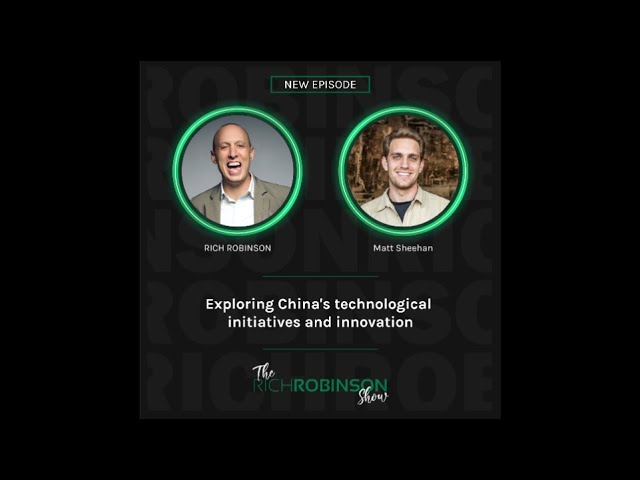
Matt Sheehan, a China correspondent who taught English in Xi'an and covered the tech pipeline between China and Silicon Valley, discusses how Chinese innovation accelerated and why U.S. views of China shifted from copycat to competitor to warning. He argues the AI advantage isn't just about data quantity but quality and diversity.
Chapters
Hello and welcome to the Rich Robinson Show. I'm your host, Rich Robinson. Over the past 25 years, I've been an entrepreneur, investor, advisor, and professor here in Asia. After nearly a quarter of a century in China, I'm now based here in Bali, Indonesia, the island of the gods. Asia is my home now. 60% of the world's population also lives here, but I would contend 80% of the world's dynamism and opportunity is right here in the region. On the show, you'll hear candid and fun conversations with some of my friends and colleagues, people I've met along my journey, entrepreneurs, operators, experts. It will help you unlock actionable insights around the Asia region and the entrepreneurial agility that actually defines it. This first season, season 1 of The Rich Robinson Show, is titled At the Speed of China. Like, wait for it, at the speed of light. Things happen fast in China, and in this season 1, we're gonna take a deeper look at that. The rapid economic development over the past few decades, as well as the speed and cycles of innovation taking place all day, every day, right now.
Let's go.
Jai Ho!
Matt Sheehan, welcome to the pod.
Thanks so much for having me.
Terrific to put a face finally to the name. We were saying earlier that Kaiser Guo, who's going to be on the podcast, wrote about your name, Macro Polo. And that was the first time that I came across you and I've been a real fan of your writing and thinking ever since then. So I'm glad that we have a chance to chat. I'm in Bali, Indonesia right now.
You are in New York City, Upper West Side.
Upper West Side suite. How's the dynamism of New York these days? You feel some of it coming back?
Oh yeah. Feel good energy in the streets. So at this point we're maybe 2 months post kind of steady reopening, but I think people still got a lot of energy in them. So looking forward to the rest of the summer.
Yeah. Just like Mark Twain wrote, the rumors of my demise are greatly exaggerated. New York is The most resilient place on planet Earth. And I'm not even talking about what lives in the sewer. So talking about energy in the streets, we're going to talk about the energy in the streets in China. But before we do, let's go back to your origin story. You told me that you were born and raised in the lovely San Francisco. Tell me about that upbringing and your path to China, please.
Sure. Yeah. So I was born outside of Chicago, was there as a little kid, and then we moved to the Bay Area to Palo Alto when I was in like middle school. And so did middle school, high school, college in Palo Alto, and then Stanford.
In Palo Alto.
Wow.
Okay.
So, you know, to me at the time, this is 2000. When did we arrive there? 1999. And probably had maybe one dial-up between the 5 family members. And I'd say just growing up there, I really was not, you know, that now might be considered like the golden age of Silicon Valley when a lot of these giants were birthed. But that was just, didn't know anything about that growing up. I didn't know who Steve Jobs was.
That was '99. Talk about peak. Palo Alto in some ways. Yeah.
I just wasn't very plugged into it. Didn't know about it. My dad's a philosophy professor, so we weren't super aware of the business trends in the area. But yeah, went to Stanford.
Of course you stayed at Stanford. I know that from your LinkedIn. So you were like neighborhood, but tell me about like high school. Were there any kids in high school whose parents were sort of in the scene? Did you get that sort of osmosis or trickle over there?
Really very, very little, you know, a couple of my friends' Parents were software engineers. Probably if I went back and looked through my high school yearbook or something, I'd learn that like probably five Qualcomm VPs among the parents of or not even Qualcomm. Some company that I was totally unaware of at the time, Cisco, and it was not part of my upbringing, not something I was very aware of. Even through Stanford, I was kind of like a Luddite. I deleted my Facebook and didn't want anything to do with social media or anything like that. I Very much came into the tech side of this through the backdoor, through eventually ending up in China and then just getting interested in how it was operating there.
So you may have been a neo-Luddite, as you say, but obviously I don't think it's easier to go from Palo Alto High School to Stanford. I think there's got to be even more of a narrow funnel. So obviously, as you say, back in Boston, you were a wicked smart kid, but you ended up going to Stanford. I mean, amazing choice, but of course. Did you live on campus or were you still at home? Were you like, like, what was the experience like? Yeah.
Yeah.
Lived on campus all 4 years, except for one year I was trying to, whatever, I was trying to save money on rent somehow, trying to live in the loft of some other dorm room until I got kicked out. And then I had to crawl home for a quarter, but I was loving it. I love California. I love the Bay Area. And so I was just kind of fully enmeshed in that. And again, it was a situation where a lot of my friends and then classmates were kind of becoming more aware of the bubbling tech scene around various friends go to work at Facebook and maybe early Airbnb and stuff like that. But again, it was not something I was interested in or into at all. It was China that got me basically halfway through.
And how did that happen?
Yeah, halfway through undergrad between my sophomore and junior year, I pretty much by chance got a job as a camp counselor at an academic camp in Beijing. And so. Pretty much splashed down in Beijing about 6 weeks before the Olympics start. No context, no knowledge of Chinese or history or anything like that. I probably like my flagpoles, my tentpoles for China were like, there's Mao Zedong, there's Tiananmen Square, and there's like factory of the world. That's what I know of China.
That's a guy who's obviously a wicked smart kid going to Stanford, right?
I was studying international relations too.
Yeah. And access to the interwebs basically your entire teen years. Right. And it's crazy that it's been 13 years since the Olympics that there's still that mindset around China. And I brought Louis C.K. out to perform in China back a while ago. And he was 2016 and he was like, none of this is here. How did this all get here? This is not supposed to be here. Right. It's just like people, that's one of the purposes of this podcast and book is just let's just Raise awareness and let people know, right? So it's fascinating to me. And even after that coming out moment in the Olympics, people still have misperceptions. So what a great era. It's, I think of China as pre and post Olympics. Like, I think that's like at least modern, really what happened after '08 in this sort of speed context. That's when things really went into 2 more gears, right? So you, so you got a little taste pre Olympics and then you got to be at the Olympics. Did you attend some of the events? Yeah.
I went to a soccer match in Shanghai at some point. I was in Beijing for 6+ weeks right before the Olympics doing this kind of short-term gig. Went to Xi'an for a little bit, went to Shanghai for a little bit, and caught a little Olympic fever. But I mean, mostly I was full-on China fever at that point. I remember sitting in the airport in Shanghai waiting for my flight home and just being like, I got to get back here as soon as possible. So then I was going into my junior year, had 2 years left. I basically said, as soon as I graduate, I'm coming back. And I studied a little bit of Chinese my senior year, basically like 2 quarters, like a semester worth more or less. And then the only way I knew to get to China at that point was to get a job teaching English. So I got a job in Xi'an teaching English in 2010 and started my sort of living study.
Tell me about some of the things that stood out that were really like game changers for you that captured you when you were there, or is it too many legion to?
No, I mean, it was the energy. It was the physical energy on the street. So I was staying in the hutongs, which is not like representative of modern China in any way, but anytime I'd wander out to the second ring row or anything like that, I'm just like, Palo Alto is just such a sort of fairyland, just like rolling gentle hills and quiet homes. And I was in college and growing up, I'm super into nature and philosophy and think I'm really like thinking about the world. China just kind of smacks you in the face when you get there. And so I just love that feeling of stepping out into a sea of traffic with me and a million other pedestrians fighting the way through. And it, I guess what it mostly is, it just took any question that I thought I had learned about or thought about or had a take on from school, anything to do with economics or politics or philosophy or psychology, or just like how people live with their families. How do you get along with your parents? I felt like China was instantly taking all those and just twisting them and turning them on their head, you know, like. Yeah. My relationship to my parents is great. And it totally does not in any way involve me thinking that like all of their hopes for not being broke and picking up bottles when they're old reside in me getting a high paying job. Like, you know, what does that do to how you think about family and responsibility and took everything?
Well, that's great. Tell me about before we dig more into your China adventures, like your dad. Was a philosophy professor.
Yeah.
And like, how did that shape your perception? Like, did you guys discuss it much? Was there like, hey, this sort of Stoicism or this sort of modern philosophy or German, was there any of that?
It's funny. We were just, just talking about Stoicism when he drove me to the airport last time. No, I mean, I'd say the way he approaches it and the attitude that I think kind of got passed on to me was just a The philosophy of living. His favorite phrase is turning the phrase from Socrates, the unexamined life is not worth living. My dad always turned it around and said, the unlived life is not worth examining. So he was just always pro, just like, go out there, get in the mix, and then you'll have stuff to think about. You'll have like raw material for that. And so if anything, that just kind of, yeah, it was always like propelling me to go out and try to get mixed up in things.
If I may ask just one more question about Stoicism, like it's become so sexy, kind of like entrepreneurship in a way, and Stoicism and entrepreneurship of kind of blended together. What's his take on it? Does he feel like it's sort of bastardized in a way, or is he still—
I don't think he's aware of the Stoicism entrepreneurship angle. He's 80 this year and he's still very with it, but I don't think he's following that thread. I forget what context we were talking about it. And I think I'm reading a book about ancient Rome. It came up somehow.
Ah, okay.
Yeah.
So I'm a big fan of Ryan Holiday and his trilogy about Stoicism. And I love Marcus Aurelius and Meditations. And I think it's one of the most profound, fascinating books because the guy's the most powerful man in the world 2,000 years ago. He's got the weight of the multiverse on his shoulders and he writes this private diary just to kick his own ass. And it's very much like a very practical handbook, right? Of him like, man, I suck. I really suck. And this is hard and I need to do this. And it's like, as an entrepreneur, that's the thing. Your weaknesses and your just fear, uncertainty, and doubt are so exposed and open and you're just like in the suck zone so much you need, and you're like, this guy was dealing with like plagues and wars and people trying to assassinate him.
Yeah.
You, you want a leader to be reflective like that too.
Indeed. So let's get a little reflective on your— an English teacher, is that right? Yeah.
So I landed in Xi'an, taught English. I mean, those jobs, at least my version of it, was quite light, leaving me plenty of time to explore other stuff. So as soon as I got there, I threw myself into language study. History, just basically trying to absorb and suck up everything I could about Chinese society. Because I told you, I was starting from basically zero. And so very interested in especially the kind of economics politics nexus. This is 2010. This is real post-Olympic, post-financial crisis stimulus boom build out. Everywhere I looked in Xi'an, things are getting torn down, rebuilt. On the outskirts of town are just miles and miles of just new construction, new housing towers. I got very interested in the housing bubble, whatever. So that first year, I really look back on it fondly, not just because of the kind of freedom and stuff like that, but also because I hadn't yet put in my head all the things that telling me what China is and what, you know, it didn't, I wasn't on Twitter. I was reading basically books and like a handful of China blogs.
Welcome.
But nowadays, I think I fear sometimes that people, maybe when they go to, especially young people, if you go to China, but you're immediately plugged into the whole China Twitter conversation, 5 different China podcasts. And it's almost like there's no space in your head to just wonder about what's going on and then wandering.
Except for this podcast where I bring in very thoughtful sons of philosophers, but don't listen to them. Just keep listening to this one. But wow, but you're right. There's so much static, especially like I installed something called Freedom on my computer and phone just to be able to just by brute force, take me out of the socials, even though I feel like I'm pretty disciplined about that, but it's just nefarious in some ways. And I go into the socials. I just give myself a very short window to do that. And yeah, for China, I mean, like you got to understand as much as you can, not about what's happening now or what's happened over the last 70 plus years of this. ruling party is like the dynastic parts of China. Like if you really want to understand China, you have to understand Chinese and they are not habits and what people are doing today is shaped by literally thousands of years of dynastic rule and Confucianism and many other things. Right. So what were some of the conclusions or what were some of the things that you came out with there? Cause I really feel like you're a really good, thoughtful, I really enjoy your writings a lot.
Probably. The most educational periods of time for me, or the time when I was kind of taking on the most learning about how a Chinese society is functioning, is from having really good friends over there who are born and raised Chinese and really just kind of looking back on their families and their lives and talking through that with them. Working at a Chinese company, I worked at a Chinese TV station for a year, and then very slowly and without a real agenda, just kind of letting people and institutional organizations that I was with unfold and watch how the people in them reacted. So one like moment of learning that was a big one for me is I had a brief, like a viral moment in China when I was basically on a flight, a Chinese Eastern Airlines flight that got super delayed, classic, just like Chinese airport mess. And at the end of it, there was basically a Fight between the airline staff and the passengers.
I've been there. I've been there.
And this was literally the first. This is 2012. I had finally given up and gotten a smartphone. This is the first video I ever took on my smartphone was of this fight where a China Eastern Airlines employee tries to throw a stool at the passengers. And I took the video. Eventually, it went up on my friend's blog, and it basically like went viral in China and became kind of like a big like public relations scandal for China Eastern Airlines. Indeed.
I remember. Yeah.
And what happened was after the video went up, China Eastern reached out and got in touch with me and they took me and my roommate, my best friend over there named Zhang Lin. They said, hey, come out to dinner and let's just talk about this. Let's just talk.
Yeah. Then they took you into a windowless room. That's what people think happens in China, right?
Right. No, they took us to a very nice, it was probably the fanciest dinner I had all year. I was extremely broke at the time. This is after I quit my job and was trying to be a journalist.
Bonus.
So he's at this extremely nice, like 5-course meal. And probably for the first 2 hours of the meal, not a word is said about the video, about them wanting me to take it down, nothing at all. Finally, after a couple hours, they basically say to us one thing. That little video. You can't understand what a blow that has been to us. And basically get around to very gently asking if I can take it down.
I'm like, yeah.
Well, I didn't really want to because I'd written an article, a narrative piece around it that had done very well. So I didn't want to take it down. And they sort of eventually come with an offer and they say, hey, you know what? We're asking you at the end of the video, but we understand and here are for you and for Zhang Wen, like $500 on China Eastern Airlines, use it whenever you want, et cetera, et cetera. And I was like, okay, this is great. They haven't forced me to do anything. So we're biking back from there in Chaoyang somewhere. I turned to Xiaowen, I'm like, this is awesome. I didn't have to commit to anything. They gave us all this money and now we just get to use it. And she turns to me, she's like, you can't use that money. And I was like, what do you mean? They gave it to me. It's a gift card. I can use it whenever I want. Like, no, they didn't make us take the video down, but if you use that money, you're entering into a relationship with them. Then my American mind is just like, whatever, fuck it. I got away with one. Now we got the money and forget it. And she's like, no, no. And I kept looking for what's the mechanism that they're going to use. Legally, they can't make you do it. She's like, "It's not legal thing. It's this relationship. Right now, we just don't want to be in a relationship with them, and if we use that money, then we have accepted their thing." Da da da da. And so, it's just stories and moments like that where I could have read tons of books about Confucianism or whatever Guanxi and relationships, but I needed to like slowly onboard what she was saying. And in my mind, like most American minds, I think resist. strongly, you know, really don't want to take that on, but eventually you kind of—
Like, that's an excellent point. Like there's resistance. There's not just, oh, you know what? First of all, people don't even necessarily are able to even cognitively process that. Right. And then once they do, they're like, nah, like it's really such an upside down bizarro world in some ways. Right. And one of my friends told me you can be successful in China. You don't have to understand Chinese, but you have to understand Chinese, right? And there really is something really different where you're like, oh, and I was married into a Chinese family for 10 years. I mean, I still have a great relationship with them. I have 2 boys from my first marriage, and that's amazing how dumb I was for so long it took me to be able to crack some of those cultural codes. So, wow. Thanks for sharing. And there was a peak time, I think around then, like 2012 to 2014, '15, where it was just Misery on a stick getting on a domestic flight, right? You were just guaranteed. But then it's actually amazing too, how quickly things change in China. Like it's become so much more optimized, right? It's something where I don't think it's changed that much in domestic flights in the, in the U.S. in some ways, right? It depends on which airline, but China somehow figures that out. Right. And it's not always pretty for sure. Right. Wow. Excellent story. And yeah, life in Xi'an, like good choice. You didn't go to Beijing or Shanghai, right? Xi'an's like a major city, the Terracotta Warriors.
Yeah.
But it's also something where it's China, right? It's really China and there's far fewer lawai there. So you probably had a better chance to really learn Chinese and assimilate.
Yeah, no, I loved it. Xi'an is still my Chinese lao dia. I just love going back there whenever I can. Some of my best friends are from there. And yeah, it was a good way to start taking on and learning China at my own pace and didn't feel compelled to maybe do all the things that one feels when they land in Beijing.
Indeed. Indeed. Yeah. It's very, talk about static on social media. There's just static, the nightlife and everything else in Beijing that can definitely be distracting. So yeah, continue the hero's journey. What was next after that?
So after that, I studied Chinese at Beiyu in Beijing. So after a year in Xi'an, moved to Beijing, study at Beiyu, Beijing Foreign Studies University for a year. At the end of that, I got a job at a Chinese TV station and did that for a year. And that was kind of my real, like, getting into a Chinese institution and seeing how that works, especially a TV station, right?
Because that's, has a strong government, you know, influence and just like it's really old school. Yeah.
So we were basically like a satellite TV station that's supposed to be in English broadcasting news about China and sort of the pitch to foreign hosts and Chinese staff was like, no, we're not like state TV. We're not like that. But after spending a little time there, you realize it absolutely is like that. And so I learned a ton about sort of group dynamics and bosses and workers and all those type of relationship type things.
Yeah. Share an anecdote about some sort of insight or confusion or conflict or struggle.
So a lot of my friction there and what I was learning came around censorship issues. So I wanted to report the news as best I could. And eventually they were just like, no, we're not going to talk about that. But what was always interesting was the way things were communicated. So there's me, I have a program, I have a producer over me, then there's kind of a middle manager, and then there's the ultimate boss. And the ultimate boss was a very sort of bicultural savvy guy. He had spent maybe 15 years in America, but he had deep connections. He was, I think if I have this correct, his grandfather was Jiang Zemin's teacher. So he's got deep connections on that side, which is probably why he got this license to run this TV station. But what was extremely confusing to me was the fact that It was on the operational level. It was so obvious that they were censoring. They wouldn't let me talk about this. My producer would say it. The middle manager would say it. Everybody at the company is extremely clear on what they can't talk about. But the boss had said to me very directly, no, you can report whatever you want. There's no restrictions. So I went back to him when all this was happening, like, hey man, you said to me that there's no control over what I can say here, but there obviously is. And what's going on with that? And he just went, I don't know. I don't know what's going on. I'm just shocked. And he said, I'm going to look into this and I'm going to get to the bottom of this. And I'm just like, this is so weird because it's abundantly clear that all the orders are coming from him because everybody beneath him is on the same page exactly. I'm just not used to having conversations where we both know that someone is lying, but we don't talk about it. But eventually I kind of put it together. I went to my producer and my producer was a good friend who I really liked. But, you know, he was dutifully passing on the censorship orders. And I said, how can he just like lie to my face like that when we both know that he's lying. My producer, like, well, if he's lying and you know that he's lying and he knows that he's lying, isn't that kind of like telling the truth? So just like, whoa, galaxy brain, mind blown. And it was like, it's a helpful thing because he's like, everybody knows what's going on. Like, why do you need him to state it? Because if he states it, then he loses face and it becomes a thing. Then we, it's like once it's been said, it can't be unsaid.
Yeah.
And so he can't put that on the table, sort of. But you both left the meeting knowing what the status quo is. He knows that I don't like it. I know that he's fine with it and we should carry on. Whereas my American self is like, no, I want you to say it. I want to argue about it. And basically I eventually left the station over things like that. But yeah, those are the kinds of things that I just like, can't learn that in a book and couldn't even learn that. I later, I went on to be a journalist and I couldn't have learned that from just being a journalist. You have to be like embedded in it and run up against it. Yeah.
Yeah. And even more difficult, I had a similar experience with somebody who's a hai gui, right? A sea turtle, as they're called, right? You lived 5, 10, 15, 20 years in the West and then come back to China and right haircut and right handshake and like very Western in some superficial way, but like still very Chinese. Right. So then it drops your defenses even more. And he was chewing me out for not doing something, but I had told the team not to do that. And I go back to the team and the team's being really sketchy about it. And finally, one of the team members says, we must go out to dinner. And I was like, okay. Another thing, he's like, we must go out to dinner tonight. And I was like, oh, and I couldn't say I didn't want to go. We went to dinner, gets out the baijiu, the rice wine, and we start drinking heavily on a Tuesday. And I don't know. And I'm like, oh, I don't even want to do this. And finally he gets drunk and he just finally said, the boss told me to do it. And the boss is chewing me out for not telling the team to do it. But he went and told the team to do it because He knew I was going to do it the right way, the Western way. I was the only foreigner in the company and he needed to do it in a different way. And then I was like, all right, okay. I'm a team player. I'll take it. Right. But until you're actually in that sort of mix, like, wow, this is really where that rubber meets the road, like where the foreigner local thing gets kind of broken down. Right.
Wow.
So then from there, excellent experience in the middle of it all, and then You went into journalism from there.
Yeah. So I quit that. I sort of ran around and freelanced for a little bit. After I quit that job, I had about 6 months left on my visa. I sort of hitchhiked around central China, just trying to, looking for stories and stuff like that. This is where I saw the airport brawl and wrote about that. And eventually at the end of it, I got a job as a foreign correspondent, as first China correspondent for the Huffington Post. They were trying to expand internationally and they hired me for that.
How did that come about?
It came about from a recommendation to somebody. At that point in time, I'd put together maybe written 5 stories, 5 things that had been published about China, translated a few things, wrote a few articles, just barely enough to kind of trick the Huffington Post into thinking that I was a journalist.
But it was still early days for the HuffPost too, right?
This is 2013. So I don't know when they sort of hit the peak of their powers.
I think they got acquired like a few years later, right? So they were still kind of a growing.
So yeah, I had that job for the last sort of 2+ years that I was there.
Did you ever bump up against Arianna at all? Did you meet her in person?
I did. I met her in Hangzhou, actually. She came out for Alibaba was hosting its first ever Alibaba Women's Conference. They have a lot of women in like senior leadership positions and they sort of turned that into like a public relations win and they held this women's conference. So she came out to that. I went to the Alibaba headquarters with her.
Yeah. My wife works in women's leadership. We're both fans of her writing and Thrive Global, what she does now. Like any anecdote you can share about her?
Nothing too revealing.
Well, not so much revealing as just a little insight, any sort of like, yeah, gotcha or aha, but like she's a pretty inspirational person. I mean, I really liked how she was vulnerable about sleep, how she passed out when she was overworking herself. And then she's like, I have to really take care of myself. And I just think she's an immigrant and super hardworking, even though she doesn't necessarily have to be, and she's a serial entrepreneur and I just really like her sort of vibe, right?
Yeah, no, I think she's done a ton in that space.
So then from HuffPost, how do you get a visa for like a journalist visa for HuffPost? Is that right?
Yeah. I mean, that was a very complicated story in itself. Basically, China doesn't love to give out journalist visas and HuffPost didn't have an existing one. So they actually Trying to think of at what level to tell this story because it's a lot of details. Basically, they had never given out a journalist visa to an all online media publication before. Everything either had to be like broadcast TV or have a print edition. And so they wanted to kind of hold that line. They felt that if they sort of opened the door, then suddenly every website wants its own journalist visa. And I'm applying right at the time of the, a little bit after the New York Times, Wen Jiabao, Bloomberg, Sheila Yeah, they're starting to expel some of the early expulsions of foreign journalists and denial of visas. But in our case, HuffPost, there's some complicated stuff, did have guanxi, pretty good guanxi, such that they wanted to actually give us a visa, but they felt they couldn't because of this. They don't want to open the door to online media. So the compromise, their version, they gave me kind of a, called a J-2 visa, which is like theoretically only for short term. Like you go there to cover the Olympics or something like that. But they gave it to me and they basically said, treat it like a J-1 visa, treat it like a full journalism visa. We just can't officially give you that because we don't want to open the door.
Interesting insight.
Yeah. So in that process, I actually had to wait back in California for about 7 months. It took about 7 months to get to this compromised version. And during that time, I was totally in the dark as to whether or not I was going to get a visa at all. We had basically no communication from them.
But were you still writing China pieces at that time or doing something?
Yeah. So I was a China correspondent for the Huffington Post, but I was in Palo Alto. And so basically what I started doing is looking for China stories there, which is actually how I ended up getting onto this kind of tech and innovation beat. I started interviewing Chinese engineers or entrepreneurs who were in Silicon Valley. And I kind of looked around and just realized there were tons, tons of stories connecting China and California. Tech was the biggest one, but there's also a lot of Hollywood China going on, a lot of real estate investment students, everything. So I basically picked up a lot of stories, published some, and then when I finally got that visa, I sort of followed those stories back to China. So I interviewed people in the Bay Area who then went back to China to found their own tech companies and stuff like that.
Have you been in touch with Eric Rosenblum from Qingyuan Ventures? Do you know Eric?
No, I don't think so.
No. So he's the guy who introduced me to Kaiser way back in the day, but he's been on the pod and he, uh, serial entrepreneur and executive and his VC firm, he's the only law eye. He lives in Palo Alto. Is their thesis is to invest only in Chinese-born entrepreneurs who live in the US. And I think their first investment was Zoom. So I think there's a pretty good thesis around that. Right. But then, yeah, every time I go back, I've been to Facebook or Google headquarters and I always try to find a buddy there and have lunch with him or her. And you can hear so much Chinese being spoken when you're on those campuses.
Yeah, no, I find that stuff fascinating. I was talking earlier about how I was a Luddite, didn't want to have anything to do with this stuff, but I kind of backed into it because the cultural, political, economic, all that stuff was so interesting that it kind of pulled me into the space in that way.
Interesting. So then now you land back in the Middle Kingdom with your J-2 visa. And what are some of the things that, you know, what's the piece that you kind of feel most proud of or the one or two that stand out with HuffPost back in that era?
Yeah, I think one that I'm very proud of and it's kind of representative of how I went about things there was the Huffington Post correspondent, but I was the only one in China. I didn't have any assistants or editors or translators or anything like that. So I was kind of like a one-person bureau. And I also didn't have like high-up guanxi or anything like that. I knew that operating totally by myself, I wasn't going to launch some deep investigation into family wealth or something like that of the CCP. But I, I basically tried to find some like cultural phenomenon in China that I thought was important and wasn't understood in the West. And then just kind of throw myself into the middle of it and look for a story. And so one of these was Chinese New Year and the big migration back home. And I figured the way to cover this was to basically get in the middle of it. So I bought a hard seat train ticket from Beijing to Urumqi.
Yeah.
So it was like a 39-hour train ride. Did it maybe 3 days, 4 days before Chinese New Year. So absolute peak, like sea of humanity, crush of people. And yeah, I brought a photographer and I just kind of got on the train and I was like, I'll just document this and just see what happens.
That's what you, that's what your 20s are for, to do stuff like that.
Yeah. So tall lawai on the train in the hard seat area. People are going to talk to me. And so ended up talking to all the people around me and just getting little bits of their life story. This guy's going home from college. This is a migrant worker trying to get a jump on the job search. This is a Uyghur train conductor who ends up like singing songs for the car. So I wrote that and did a few stories that were something like some cultural phenomenon, something in China that I want Americans to understand and just like go out and get in the middle of it and just try to make a story out of it.
Beautiful. Beautiful. Yeah, I have to. Link that in the show notes. I first came to China by train through Siberia. So that was my first through Mongolia, but I love those train rides. It was something that we did with a startup. Every time we had a big win or we shipped something, we first got on a bus. We went to, you know, up near the Great Wall, we hiked. But then after that, we went to, you know, Changbaishan up near North Korea. And we went to all these Laoshan and we would get on a train and get the whole team there. And it was first. I grew up to a couple. 240 people at one point. We took over cars and trains, but that kind of communal train rides, like, I think that captures China so well. I think Chinese people are maybe if you're on a flight and it's delayed, Chinese people at their worst or humanity at their worst, but on a train, like there's something that people are kind of almost at their best, like sharing stuff and talking and like, there's this chatter once everybody settled in. And I just love that.
Right. Yeah, it's great. I love train rides over there and see. People are going to make it work. And it's not kind of this feeling of like, we're all stuck in this train car together. And you can't, you know, I feel like so many social phenomena or issues or whatever in China come from just when you pack so many people into so little space with so little resources or formerly so little resources, then you just find ways to sort of live together and make it work. And I always felt that way about the train rides.
Yeah, that hushi on the train is interesting. Wow. Great. Thanks for sharing. And then from HuffPo, we keep shortening.
Yeah. So in 2016, I moved back to the Bay Area. The big picture goal was to write a book about China-California ties, the threads that I had first picked up when I was back there waiting for a visa, followed them back to China, and I sort of wanted to follow them home. And this is about this period of time, 2013 to '16, and then '16 to '18, kind of the takeoff in Chinese investment in Silicon Valley. Silicon Valley companies kind of interest in trying to get back into China, Hollywood-China ties. This is the period of time when growth of Chinese students is just like 30% growth every year. And so I started to see the results of these phenomena and then all the frictions that they were creating, frictions around tech stuff, frictions around so many Chinese students at U.S. public universities. And so I moved back with the goal of kind of writing this book, drawing up those connections and teasing out the implications for broader U.S.-China relations. And then also try to kind of get in the mix with any types of projects connecting China and California. So I did everything. I gave Mandarin language tours of Stanford to wealthy Chinese tourists who were in town. I made goofy, like, Chinese videos about California culture and, like, put them online in China. I worked with some VCs who were doing cross-border stuff, worked with Kind of everybody. So I had a few years of that before kind of narrowing in on where I work now at a think tank, MacroPolo.
Excellent. Wow. And tell me about some of the things that have changed since then, like that was peak, like bridge between Silicon Valley and China. Of course, now there's a different sentiment, but I mean, there's the sort of federal government sentiment, which a lot of it is correct. Like let's protect any sort of militarily sensitive things and any sort of outright theft, right? I mean, of course, who can argue with that? But I think at the commercial level, a lot of deals are still being done, but it seems to me that China's become a lot more self-sufficient and become much more of a competitor and maybe taking fewer cues from Silicon Valley. And now a lot of other markets are taking cues from China.
Yeah, no, I think that sort of not a total flip or reversal, but it basically a change in what's sort of foreground in the relationship. I, I get a lot of questions from policy people or business people. How does Silicon Valley see China? How does China see Silicon Valley? And I always think the connections between these places are very multifaceted and how you see the other side, it's less like China flips from good to bad as different aspects of China come to the fore. So I sort of illustrated this a little bit just to clarify it in my own head with a chart where you say there are like 5 threads in the way that Silicon Valley sees China. And you could say it sees it as a copycat. It sees it as a competitor. It sees it as a resource. It sees it as an inspiration, or it sees it as a warning sign about tech gone wrong. Over the last decade, one of those threads is dominant and one of them is very much sort of recessive at a period of time, just changes. Go back to 2010, it's probably copycat first, maybe resource or see it as a market is second. This is maybe pre-Google getting kicked out and stuff like that. And it was very much not seen as like an inspiration or even like a warning Sign in any way. Fast forward to 2015, 16, or 17. China is very much in some ways seen as an inspiration of sort of super apps, and everyone's getting excited about WeChat and mobile payments. And the copycat thing has fallen off. And I think probably the biggest change over the last few years is China as market has gone down substantially, especially for the big platform companies, whereas China as competitor has kind of risen to the. Forefront for most. So yeah, if you're Facebook in 2016, you're still kind of chomping at the bit thinking that maybe one day Xi Jinping is going to let you in if you are nice enough to him and you read his book or whatever. Fast forward 5 years, 2016 to 2021, and it's not that you think you're going to get in and dominate China. You're not getting in and you're more worried about sort of fending off TikTok in Indonesia or something like that. And so I just think these threads and what is dominant and what is sort of recessive, it really shifted around a lot to the point where competitor is probably the dominant paradigm, at least for the big companies these days. China as market pretty has fallen off for a lot of people, except for maybe Apple. And China as inspiration is still up there, but inspiration tinged with, but we don't want that total like surveillance state or whatever. So yeah, I think it's probably never changed as fast as it's changed in the last like 3, Well-framed.
Yeah. For a neo-Luddite son of a philosopher, I think you've really grabbed that. And I really liked that. And I'm going to talk to you about putting that exact sort of framework in some sort of introduction attributed, of course, to the philosopher's son. But I think the one sort of vein through all of those threads is the speed. And as a matter of fact, like I could literally see that in my mind, like real-time chart about how quickly that's changing. And that shouldn't make sense in a way, right? It's maybe the oldest society and one of the oldest societies in the world. The largest society in the world by population by far. And in a lot of ways, a very traditional society. How's that possible? Like, did you just talk about the last 2 generations or did you just talk about the last decade? Like how quickly things are shifting. And that's really the purpose of this book. Do you have any anecdotes or anything that you can share? Even if it's something personal about the speed of change in China and you liken it back to Palo Alto and Palo Alto is, if you could argue that there's one, like non-major city on the planet where innovation happens, it's Palo Alto, right? Cambridge, Massachusetts, Palo Alto, maybe there's some parallels between both with universities and tech hubs. But there is this sort of, I don't want to say stasis, but there is this sort of different pace and pulse just being in that area. And even the quote unquote Silicon Valley of Beijing, and a lot of people who've never been there don't really understand that Silicon Valley is not some hip Area in San Francisco, it's really a bunch of suburbs, mostly just south of San Francisco, right? And like in the northwest of Beijing, it's definitely more urban, although it's pretty far from the downtown of Beijing, but there's a different dynamism there. But instead of talking about that, some sort of like Han Journal, it's like more of what you've felt and seen in some of the personal and professional things you've done. Yeah.
I mean, I think for me living in Xi'an, just watching that whole city basically get torn down and rebuilt, they preserve the center of it and that's cool, but It's that society-wide, economy-wide pace of change was always there ever since I first got there. And I think it arrived in the tech space and I felt it for the first time in that kind of 20, I'd say 13 to 2017, '18 was like, for me, the real tech has sort of seized the main zeitgeist of a lot of Chinese life, or at least, you know, young Chinese life. Not saying that people in rural Qinghai are like building apps in their villages or something like that, but where I was in Xi'an and Beijing, I think what was so impressive in some way was the society-wide nimbleness and willingness to just kind of drop everything and jump on the next thing. And so for me, it kind of got encapsulated in watching some of my like friends' career trajectories and stuff like that. One of my good friends in Xi'an, I don't know what she studied in college, but nothing technical at all. And I think she was working in like a pearl dealing shop or something like that. And then around 2000, it was 2014. So this is Alibaba IPOs. Government launches the Shuang Chuang, uh, Da Zhong Chuang Ye, Wan Zhong Chuang Xin. It's double innovation, mass innovation, mass entrepreneurship. So Alibaba IPO puts a ton, it's the biggest IPO in history. It puts a ton of fuel on the fire. Then the government is like, okay, yeah, we had some second thoughts. We had questions earlier, but now go just like pour money into innovation. Everything society-wide is becoming innovative and innovation. It's like the ultimate buzzword. And I remember this friend in Xi'an texting me or WeChatting me. And I'd never heard a word from her about tech before. And she was like, Matt, like you're in Beijing. Can you find a startup for me in Beijing? Can you introduce me to startups in Beijing? Like, it doesn't matter what it is. It just needs to be a startup. I was like, I don't know what to do, but I can't just kind of pass you off to whatever startup I've just interviewed. But it was that kind of suddenly everyone had got like the bug at the same time. All this money, venture capital is pouring into it. At the time, I thought it was kind of ridiculous that she would suddenly want to think that she could work at a startup. But 2 years later, she was working at Wooba. FiveEight is like an online retailer. A couple of years after that, she was a product manager at DeeDee. I forget where she is now.
Oh, she's the 7th richest woman in from her province.
Yeah, it was like that nimbleness of society really can just turn on the jets. And I think you were talking about how this happened in a society that's so old, maybe so much not changed over time. I think a lot of it just has to do with the mindset that got inculcated post-reform and opening where, you know, if you were alive in the '80s and '90s, basically when a new industry opened up and was suddenly Open for business, you had to rush in there. And if you rushed in there and got in there early and staked your claim, you might be a billionaire at this point. Real estate opens up in the '90s. Like no one really knows, is this going to be like a real thing or not? And then the people who just rushed in there and bought a bunch of land as soon as they could and made it their business, incredibly wealthy. And so I think it drives both the pressure of like historical poverty and historical weight of knowing you got to take care of yourself. You got to take care of your own family matched with basically how quickly they've seen if you don't jump on something, That train has left the station, and I think that's what kind of drives the speed at which people are willing to just like grab onto new industries and flood into them.
That's great. I love that story about how the government does say we're going in this direction, and how it really can be a signal and spark some sort of action by the lao bai sheng, the average person, right? How it actually really can trickle down. And also, it's interesting. You know, one of the reasons why I'm doing this podcast is. To be able to just really explore ideas. It's kind of like doing standup comedy where you do 20 hours of material and then you can get 1-hour special out of it. Right. And one thing that you just opened up in my mind is when did this really start? Like, of course, reform and opening, like when Deng Xiaoping said black cat, white cat, as long as it catches mice, right? Socialism, capitalism, we just want people to be prosperous. But I really have to do a little work on unleashing something that's been part of Chinese society and DNA for millennia, right? Which is this kind of like natural inventiveness and entrepreneurial drive, right? And it's all this like pent up and it was against the law. It was punishable by pretty extreme incarceration or worse if you were an entrepreneur for 30, 40 years, right? So it's, there was, I think, a lot of that kind of explosion of like natural entrepreneurialism and it just has gotten faster. Yeah. Thanks for sharing. And tell us about Macro Polo under the Paulson Institute and tell us a little bit about Paulson Institute and the origin story of Macro Polo.
Yeah. So Paulson Institute has been around for, I think, about a decade now, founded by Hank Paulson, former Treasury Secretary and someone who did a lot of business in China in the '90s, where he helped when he was at Goldman Sachs, helping bring the big Chinese banks and get them listed and all that stuff. Paulson Institute kind of has 2 sides to it. There's an environmental advocacy side, which is his sort of passion and does a lot of work with sort of training Chinese government officials, helping them build up their conservation ecosystem, build up the national park system in China is pretty new. That's all over on that side. And the other side is the think tank, which is MacroPolo, which was founded in 2017. We basically do Chinese economics, politics, technology, and energy environment. And so I do the technology side of that and goal, or maybe what hopefully distinguishes us is trying to do think tank level depth of work and research, but make it very easily digestible and presentable. So a lot of data visualizations, shorter pieces, not just big, long reports are more on the academic side. So most of my work there is about Chinese technology, about some of the stuff we've talked about, a relationship between Silicon Valley and China, and then trying to gather data and analyze and visualize sort of how the Chinese AI ecosystem has grown and how it interacts with the U.S. and the world.
Fascinating. Wow. And is Hank Paulson involved much?
Yeah, I'd say he's much more involved on the other side of the institute, environmental side of it. But yeah, he dips in and we talk to him about what we're working on and stuff like that.
That's going to be fun to interact with him. He must be a fascinating guy to talk to. Tell me about AI. Of course, I'm trying to get Kai-Fu Lee on the podcast when he wrote that book, AI Superpowers, right? And I think if I, please correct me, but you know, roughly his kind of thesis is in the lab, the US is dominating, but in the wild, China has a bit of an edge just because of all the nearly 1 billion users there they can collect data from. Of course, of course, there's a lot more pushback now from the government and from the users around that. Like, what do you think about that kind of framework? And then where do you see things moving forward with AI?
I think a lot of it depends. On how you might evaluate the U.S. and China comparatively. A lot of it depends on where you think the technology is going from here. I think Kai-Fu's thesis is in some ways premised on the idea that, you know, in the last 10 years, we've gotten deep learning. Deep learning was a huge sort of level change in what AI can do. And we're currently at the stage where we just need to exploit and apply deep learning to almost any social problem, business opportunity, whatever. And you can get a lot of juice out of it.
How do you define deep learning?
So deep learning is basically a way of doing AI or machine learning that's heavily dependent on data in which you take a bunch of training data, basically examples of whatever sort of thing you're trying to do. You feed it into the neural network and it's able to use sort of the past examples to make predictions about the future. So if you feed it a million examples of sort of what people have bought online, this person who lives in this state, and we think they're male, and they've previously visited these 20 websites, and you come up with 100 different characteristics of them. Say that person, when faced with this choice, bought Samsung TV, and this person bought, or some other TV brand is. Basically, you give it enough data points and sort of characteristics and match them with an outcome, then in the future when you feed it Rich's data or Matt's data, it'll be able to predict with a very high degree of accuracy which TV I'm going to buy. Or this same technique is very generalizable. That's just kind of one of the most popular applications of it. It's what drives computer vision because it can basically predict what objects are in the world. And it's built on having very deep neural networks where there's a lot of layers to it. You could go into that at many more layers of depth than that. But the idea that I think Kai-Fu holds and advanced in the book is that we've achieved deep learning. That gives us an ability to apply this problem to a huge number of business opportunities. We're at the stage where we just need to do that application, and therefore China has the edge because it's better at applying and kind of squeezing all the value out of business. There are other people out there who think deep learning is just the beginning. We're actually going to continue to level up. If you hold that perspective, then maybe America's advantage in cutting-edge research is more meaningful. If you think we've sort of plateaued and cutting-edge research is nice to have, but you don't need it. It's not where the real action is, then you could say advantage China for various reasons. If you think there's a lot more runway with the research side of things, then you might put advantage America for a few reasons, but more complicated than that. China has a lot of really great research. America has a lot of really great applications and it's a field that's changing very quickly.
Fascinating. I'm just trying to be able to grasp AI in a way that is actionable for me as I think about business opportunities. And I work a lot with startups and entrepreneurs around the world. Even if the U.S. continues its lead in the lab, which it's likely that it will, and I think that it's basically going to be a battle of superpowers like Kai-Fu has laid out between the U.S. and China, just because of the deeper pockets and the research institutions and the sort of captive markets in the 2 largest economies. But do you think at the end of the day, and I don't like to say at the end of the day that much, but I can't think of another way to put it succinctly, is it's really about data being applied to whatever new algorithms are coming about. So if there's like, for instance, these days constantly saying, okay, I accept, yes, go ahead on every website around the world. And I think that's largely because of the European data protection laws, right? Which I can understand. People want their privacy. They should get their privacy. But are those countries, societies basically hobbling themselves because, okay, we're optimizing for privacy now, but we're really going to be on our back foot when it comes to competing in the future because we, our local companies are not going to be able to build stronger AI applications because they just don't have the data around that. Right. And it's like, I understand why people want their privacy, but I also see that it's like, 2042, China buys Benelux or something, right? Because it's dominating because they have access to so much data, right?
Yeah, I think there's a lot of different directions you can take that. And there's tons of like complicated social questions. I think maybe I'll come at it from 2 angles. One of them is about data. And I think basically the thing that needs to get added to the conversation is that data is not like this raw, natural, it's just about how much you have. And because China has a billion people, And the US has 300 million people there.
The Saudi Arabia of data, as Kaifu leads.
It's much more nuanced than that. If you're a business, you need very specific types of data to answer very specific questions. Each application or service that you're building needs to answer a different question with data. And it's not just a question of, do you have a billion people or a billion users, but is that data collected and organized? Is it structured data? Is it labeled data? Is it diverse data that is going to a Chinese company trying to build a facial recognition algorithm and you train it entirely on Chinese faces? You try to export that to the Middle East or to Africa, good chance it might not perform so well. So data, one piece I've written, it was about what I call like the 5 dimensions of data. You can have quantity of data, you can have quality of data, you can have depth, diversity. And I think when you add in all those dimensions, it's not really immediately clear that China has a huge advantage in that front. So that's kind of one angle I would take that's just kind of complicating how we think about a quote unquote data advantage. When it comes to the big sort of social trade-offs of privacy versus data collection, it's very possible that, for example, European data protection laws are going to make it harder for European startups to get off the ground or something like that. It's a little harder to bootstrap yourself when you have so much regulatory requirement on top of view, but I do think that it's like we're at a period of time when I would put the Chinese side of me, like I prize social stability above many things. If we think that issues around data collection and data gathering might've contributed to some of the social and political instability that we've had in the U.S. over the past few years, I'd take a haircut. I'd take a slight discount on exact performance of our AI algorithms in order to say long-term, like if we long-term want to compete with China, we need a stable, socially cohesive country to do that. And I put a little emphasis on, you know, we don't need to race and compete on that specific thing. Let's put our energy in some other aspect of this.
Terrific. Terrific. Well said. And on that note, like one last thoughts about using this rise of China as a Sputnik moment to say, how can we compete better? Like, what are some of your thoughts around that instead of trying to necessarily just hobble the competition, but just to say, you know what, let's keep some things in check that are beyond the pale, like militarily sensitive things and outright theft and some other unfair advantages that are really not in the, what, WTO, but then let's really up our game.
Yeah, no, I think you're talking about cutting ties or protecting this or that piece of technology. I think basically the process that we're in right now, or the best parts of the U.S. government or the best parts of U.S. society you're in right now are evaluating in a sophisticated way, when do ties and connections to China benefit the U.S. innovation ecosystem? When do they harm it? When is it neutral? When is it a public good? So for example, a lot of my work has been on when Chinese students and researchers come to the U.S., do they stay and contribute? Do they, and in my field area that I look at of elite AI researchers, it's an overwhelming win for the U.S. when Chinese people come and study. If you're working at sort of the cutting edge of AI research and you come to the U.S. Very high chance they're going to stay here. That's one area where I say, let's protect that. Let's keep that. We don't need to cut those ties just to cut them. Another area, it's very different. If it's VC funds, do we want to allow Chinese companies to acquire American chip startups? That one, I don't see a whole lot of upside of letting them buy American chip startups, which, you know, let's block that. So I think that's the China connection side of it. Then I think maybe the more proactive or sort of outward looking side of it has a lot to do with places like where you are right now, Indonesia. Yeah. I think getting both American companies and investors and the U.S. government more knowledgeable about competition in places like Southeast Asia, India, Africa, et cetera. I think that's really the next kind of like frontier. When we talked earlier about does Silicon Valley see China as a competitor? The competition is right there. The competition is outside of the U.S., outside of China. It's in other countries. And that's something I'm trying to learn more about the Indonesian startup ecosystem. So might pick your brain about that some other time.
Please do.
Yeah.
I mean, I really love the dynamism of what's happening because, you know, 4th largest nation in the world and there's been such high adoption rates here in Indonesia. And this is a really interesting, relatively fast-moving ecosystem, right? With the GoTo, the Gojek and Tokopedia merger. And there's some really big players here. And it seems to me in the early days, they were taking money from Silicon Valley. And maybe some cues, but it seems now more and more they're like, okay, we'll take the money from Silicon Valley, but we're taking our cues from China. Like China's really informing much more deeply these developing nations, like exactly what the roadmap is because it's so much more in line with Jakarta is so different from the rest of Indonesia. And there's such a disparity there, but China's had the same where you're creating an app that's for first, second, third, fourth, and even fifth tier cities. And you have to be able to market it and support it and have it relevant for all these different stakeholders that I think is much more, and then a lot of the new things around super apps and mobile payments and streaming commerce, like that's something that you don't necessarily see in the U.S. So yeah, and I think also in my experience and some of the talks I've had here, Chinese companies, it's not just COVID, are taking far fewer cues from Silicon Valley. I think there was a lot of zoo tours. Where people would go to Silicon Valley and just kind of sniff around. And I think like those have dropped off even pre-COVID, where I think China's got this kind of broke free pull of gravity and just kind of its own, the whole flywheel is just spinning inside China. So there's enough innovation there to keep things moving. But anyway, to be continued. And thanks so much for your time, Max. And really lovely to chat with you and to get to lift up that hood and see the turbo engine underneath there with all the different disciplines. I love hearing origin stories. I have a better understanding of why I enjoy reading your writing so much.
I really appreciate it. This is a lot of fun.
Thanks so much.
That's a wrap. Thanks for listening to this episode of The Rich Robinson Show, Season 1, at the speed of China. Visit therichrobinson.com. Show to smash that subscribe button. Please also go to iTunes or whatever platform of choice, rate and comment. And until next time, thank you very much. Zaijian. Cheers, y'all.
More from Richard

From MUTEK to Mawari: Building the Decentralized Infrastructure for Spatial Computing & XR








Young China: Unraveling the Rapid Transformation and Cultural Shifts with Zak Dychtwald
