What makes ByteDance unique and more innovative than other businesses
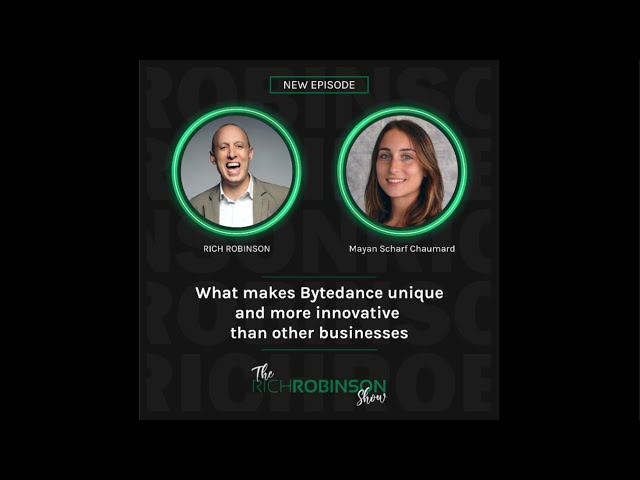
Mayan Scharf, a former ByteDance senior executive, explains how the company grew from 3,000 to over 100,000 employees by combining global thinking with hyper-local execution in each market. She credits founder Zhang Yiming's hands-on leadership and the company's willingness to staff offices with local teams rather than impose a centralized culture from headquarters.
Chapters
Hello and welcome to the Rich Robinson Show. I'm your host, Rich Robinson. Over the past 25 years, I've been an entrepreneur, investor, advisor, and professor here in Asia. After nearly a quarter of a century in China, I'm now based here in Bali, Indonesia, the island of the gods. Asia is my home now. 60% of the world's population also lives here, but I would contend 80% of the world's dynamism and opportunity is right here in the region. On the show, you'll hear candid and fun conversations with some of my friends and colleagues, people I've met along my journey, entrepreneurs, operators, experts, It will help you unlock actionable insights around the Asia region and the entrepreneurial agility that actually defines it. This first season, season one of the Rich Robinson Show, is titled At the Speed of China. Like, wait for it, at the speed of light. Things happen fast in China, and in this season one, we're gonna Take a deeper look at that, the rapid economic development over the past few decades, as well as the speed and cycles of innovation taking place all day, every day, right now.
Let's go.
Jai Ho!
Mayan Scharf, ladies and gentlemen, thank you so much for joining us here on the pod.
Hi, Rich. How are you?
I'm I'm doing well, thanks.
You are right now in in Aix-en-Provence, in south of France, after escaping China, like you and other people that escaped China when the pandemic hit last year. Yeah, working from home.
The new normal. And I love Scott Galloway, Prof G, who's a professor at Columbia, and he talks about how COVID is not so much. a change agent as it is the ultimate accelerant. So we're a decade in the future, and of course we can live and work from anywhere. So therefore, I choose the dusty northeast suburbs of Beijing. No, I don't. I, I choose the island of the gods here in Bali, and you're in the south of France. And I think we're going to see a lot more of that, of optimizing for lifestyle while people also optimize for their careers. And we're going to dig into your career Your just awesome possum amazing story hero's journey of being the first lawai at ByteDance, the mothership of TikTok, and all that you've seen along the way. And we'll you know when I when I visited you in January of 2019, two and a half years ago, you'd already been on board for a while, and I remember being really really blown away. And I'd love to hear the origin story of that. But before we do that, let's get the origin story of Mayan Sharf and like where you were born and raised and your path. To China, please.
I was born in the States, in New York. I was raised between the US and Israel, which means that— well, and I would say also China. I spent a third of my life in Israel, a third of my life in the US, and a third of my life in China. Wow.
Okay.
Yeah. We're, you know, I guess the more transforming years were in China. So my husband always says that I'm probably more Chinese than American, definitely more Israeli than American. But yeah, no, we went back and forth between the US, multiple places, New York, San Diego, Boston, and Tel Aviv in Israel until I was about 13 or so. And then we settled down in Israel and I went to the military service in Israel when I was 18, did my mandatory service.
Wow.
And then right after that, actually 3 days after I finished my military service, my mom had a business trip in China and she was like, come with me. And, you know, you never say no to a trip to a place you've never been before. So we did the whole classic, you know, Beijing, Shanghai, Hong Kong, came back home. In all candidness, I think it was a very weird trip for me just because it was my first time in Asia. I was used to, you know, the Western world, Europe, Israel. The US was sort of our playground for family vacations or, you know, trips and stuff. Mm-hmm.
And what year was that?
2009. 2009. Yeah.
Okay.
2009. Yeah.
So it was just after the Olympics. So it's like a different era, you know, 12 years ago in China.
Yeah. And then, so it was 2009. I finished my military service. My whole life, my dream was to go to like an Ivy League university in the US, but then financial crisis hit the US and sort of the US did not become the place it was, at least from how are you going to build a career? After school, you know, school is great, but what's gonna happen next? We went to China, came back, and then less than a year after that trip, I already moved to China. Registered to a small private little school in Gulmao area in Beijing to study Chinese 4 hours a day. Did that for about 8 months. Wow. Definitely really cool experience. You know, it was 2010. Beijing was growing real quick. Back then I used to go to school for 4 hours. Then we used to go to Sanlitun, which was just the beginning of the village, to have lunch. And then there was Yashou Market where I used to practice my Chinese after happy hour, 'cause it was the only time where, you know, you have a drink or two and so the barriers disappear and you start bargaining and you practice your Chinese. And so, yeah, so that was my first year in China.
Love it. Fantastic. Yeah. And you, you chose like a different path to study Chinese. It sounds like a more serious path 'cause some people say, I'm gonna go to a university, but then they end up kind of partying, but you were like, I'm going to a private school and like digging in for 4 hours.
Well, I think it was a combination of missing admissions to university because I was like, wait, I want to move. Do you think anyone will take me in so quickly? And also knowing myself and knowing that like a setting of 20, 30 people in a classroom may not work for me as well. And I may need something that is a little bit more Smaller, cuter, more attention. And so I did that and it was a great choice. I would recommend to anyone that wants to study a language. For me, what worked for me is a smaller setting. Yeah.
Interesting. That's great. Yeah. You know, I had a business partner, Ori El-Ravi, lived in Beijing for a long time. We started a company. He lives in Seattle now, but you know, I started working with him because we played basketball together and he would be the guy that had less skin on his knees and elbows after the game. Less than I did, and I was like, "Wait a second! I'm the guy that's supposed to be the scrappy guy. Who is this guy?" And I just fell in love with the guy. And I feel like you know I have a lot of Israeli buddies in China, and I feel like like you said you feel a closer connection to Israel. Like like there's a sensibility, I think, because as like Israeli, if you're going to be an entrepreneur, you have to be more globally minded. Like there is a startup nation, I think, in Israel, but the the domestic market is not so. you know, attractive or large, right? So you have to have this sort of global mindset. And I think maybe also military service, not sure what it is, but there really is this sort of fluency of like the West and America, but also like this sort of, you know, savviness, like in Asia, this, 'cause, you know, Asia's just a tougher place to navigate. I think some Westerners come out and they're a little bit naive or like, you know, and I just feel like, do you feel like the military service or some of your time in Israel prepared you better for China in some ways, or is that just my—
Probably. I think that, you know, Israel is a small country. And so I grew up in my little cute neighborhood with my little cute friends and, you know, our school and our afterschool programs and Scouts and whatever. But I didn't meet the rest of Israel. And I think that's probably correct to most people that live in their own sort of environment as kids. You don't go and explore other parts of your country and live there and meet other people. And so when you go to the military, your basic training before they place you in your, let's call it a job, but your post essentially. You meet everywhere from around the country. So different religion, different language, different background, different socioeconomic background.
Mm-hmm.
And so I think that experience, you know, alone without even learning how to shoot a gun or protect yourself or anything like that, but just meeting people from such different backgrounds, but they're from your country, but they might as well be complete foreigners to you because You guys had completely different upbringings. I think that helps a lot at a very young age because you're 18. It's like going to college in the US, I guess. But if you go to an Ivy League or a private versus a, you know, community college, your experience will be different in terms of the people that you meet. And so here you're just thrown at one place regardless of where you're going to end next. And then after that, for me, it was about a month after that I ended.
Yeah. I think in the military in the West. Yeah.
No, I was just gonna say, and then I ended in my post. And when you get to your post, because you have to, they recruit you for specific posts. When you get to your post, it's like getting to the college or the program that you've selected. You meet a lot of sort of like-minded people.
Mm-hmm. Yeah, it's an amazing equalizer because I think in the military, if you're educated or you have some means, typically you become an officer. And then also the military is like disproportionately maybe a lower socioeconomic type of status because you don't have as many options, right? But then in Israel, it's mandatory, right? So this Descriptions where everybody has to go in. Yeah. Right. So, but it's a pretty excellent preparation for life.
100%.
Because life includes everybody on planet Earth.
Yeah.
But I also think that, so if you're, if you're even—
When you go to, when you do your military service without sort of, you know, as you said, an educational background or anything like that, cuz we all go after high school and it's mandatory, then you have to deal with a lot of situations. It doesn't really matter what your post is, but they're, you know, the situations are different every single day and you have to You don't get a toolbox. You earn your toolbox in the military, so to speak. And so that prepares you for many situations that could then translate on your work and your life and your personal and your social. Yeah.
Yeah. Terrific. Yeah. I'm, I'm set. My, my oldest son is, he's 17. He's going to do a gap year and he'll be doing something, you know, working in an NGO, doing something where he's, we're going to optimize for suffering because I think it's probably a good, a good thing. At that age, and then when he goes to college, then he's like, "Oh wow! This is this is actually it's much better to be a knowledge worker." I appreciate that, right? So speaking of knowledge workers, so so then you start your career in the Middle Kingdom. You're in Beijing, and what was the first stop for you?
My first stop was at Apco, which is an American PRGR firm. So I did that while I was there.
Jim McGregor. Yes.
It was a great experience. I learned a lot about the political system in China. Five-year plans were analyzed, dissected. Translated in a way that foreign firms can understand. I realized that a career in policy in a foreign country is not something that will work for me. There's just a ceiling. So it was very interesting. I enjoyed my time there. It's a great company. It was a great start to my career in terms of building a foundation, but just in terms of sort of where I saw myself next, that wasn't the place. But I did learn a lot about China, which was Great. Yeah.
Fantastic. Yeah. Really well-regarded storied firm there.
From there I went to Picketail. Picketail is a, yes, sick interactive children's startup, interactive books for kids. And so I was leading the content efforts there for about months or 2 years or so. I think it was, I mean, it was such a great experience. It was a foreign startup in China. It was not a Chinese startup in China. And I think that taught me a lot.
Yeah.
It was a great experience. I really enjoyed my time there, whether it's learning about, you know, the startup world, the tech world, raising money challenges, scaling resources, technology, all of that was really great. But I also learned for myself, again, these are lessons that I take into my little diary in my toolbox and then decide what I wanna do with my life. But for me, I understood that if I want to be in China and to build something in China for myself, for my career, the best path forward would be to work for Chinese companies and not to work for foreign companies. Because when you work for foreign companies in China, there's some constraints, there's some opportunities, but it's not the experience. And so for me, the most important thing was, as long as I'm building, as long as I'm learning, as long as I'm figuring out what I want, it's important for me that I do it as locally as A foreigner can, and so to learn.
That's great. Yeah. So I yeah.
Oh yeah.
So that company's gone well now because a lot of things are a lot more done virtually with reading books. And hey, did you push? Did you pull Josh into the company? Was he a friend of yours? Was it other way around? Ah, okay. Little shout out to Josh Kaim. I love that guy. And Sig and I were entrepreneurs together in 2000 when we very very first got to China. And we were in the mainland and we were both kind of incubated, as they say. They don't accelerate anymore. So I've known him since back in the day. So yeah, it's great to see him do well because the default setting for startups is failure and default setting for foreign startups in China is even more failure.
But I think now they've gone through a very difficult route and that's contributing to their success quite a bit. Indeed.
Yeah. And then they got the buoy from, you know, buoyed up from COVID people doing more stuff remotely. So it was good and he just stuck with it, right? He's just a relentlessly resourceful guy and a nice guy to boot. So that's, that's great. And then from there was at GWC.
I was leading all international PR and then all international business. Spent a couple years there. That, that was great trying to, you know, help foreign companies enter China, trying to find connections for them, trying to help them build their partnerships in China and how they can grow.
So GWC is a great wall club. So that was like an industry group. Was that still something you were part of, or was it really more the international?
They're sort of connected together. So you become a member, and part of the benefits that you get are these introductions and these meetings, and then also events, and so on and so forth.
Did you get to bump up against Lei Jun? He was the chairman of GWC, right?
He was at one point, correct.
And he's the founder of Xiaomi. Yeah. Founder of Kingsoft, and he's a pretty extraordinary guy. You know, I was on the board there as a foreigner for a while. And did you ever?
I met him a couple times.
Interaction or anecdotes?
Not a one-on-one coffee type of meeting, but I ran into him either at Xiaomi or at events, or we met. I met a lot of people during my time at GWC, either foreign entrepreneurs that came to China for the conferences or our international conferences around the world, and a lot of Chinese. Entrepreneurs. I think that in terms of building a network, it was such a stepping stone for someone who's starting out their career in this world, in this country, in this language. It was a really good place to meet people, learn about the industry, understand the trends that are coming.
Yeah, that's great. That's where I first met you there. And I knew that, you know, I could feel that you were like a standout, right? You're like a different kind of, you know, I guess breed of foreigner that was, that was going into These kind of roles, right? You, it's like, you seem like you really had a lot more options and, you know, international kind of, sort of, you know, sensibilities that, but you were sort of like homegrown in a way, right? And for me moving to China in 2000, there was like a, a little bit more of like a, a wild, wild west aspect to it. And I think maybe some of the foreigners you meet not necessarily have a lot of options elsewhere.
Yeah.
But you kind of struck me as that person of like, wow, she could sort of, you know, go to New York or go to London, but she's working here and digging in deep and doing a great job at a company that has like, at that time was really making a big mark in the space. And I think one of the things you guys did really well was the Indian market startup scene that you guys were flowing a lot of Indian entrepreneurs into China before You know, there was any unicorns at all, and there was like many, many founders of small companies that then went on to be gigantic players that you guys were bringing into China. So then, then from there, you joined a not very well-known company, definitely not well-known outside of China, called Rurto Tias.
So again, as I mentioned, when I was at GWC, I met a lot of people. I met a lot of Chinese entrepreneurs. I met a lot of Chinese executives from some of the larger companies. And actually one of my friends who was the chief of staff of Li Mingyuan at Baidu, I don't know if you remember that name, but back in the day it was a, it was an interesting name. So he and I were just talking about, you know, what are the next unicorns of China? And, you know, back then Baidu, Alibaba, Tencent, the BATs were still the BATs and people were always looking for the next. Next unicorns, and he was telling me about the founder, about our founder Zhang Yiming, and he was telling me about the product, and I was you know interested, and I started looking into the company, tried to see if I knew a few people that worked there. Maybe I can get connected, but it was really a company under the radar at that point, and so it was very it was gaining a big momentum in the Chinese market, but only in the Chinese market. So it was a bit difficult to find a way in, but I found a way in. And as I found a way in, I learned that the company launched a product. I learned that the company launched a product in the US called Top Buzz.
Of course you did.
It was supposed to be to a certain extent the international or the English version of Toutiao. And so I spoke to a few people there. I convinced that if there's an international product, there should be international people working on it with an international perspective, with the understanding of a market of some sort. that could help with, you know, market entry. And so I get in, in the same building that you and I met, in the same cafeteria that you and I met. I walked in and there was— they invited me for lunch and there was a table of 12 people waiting for me to interview me. That was my first interview. And so I sat at a table with 12 people that don't speak a word of English, which is, you know, great. But when you come in for an interview and you think it will be in Chinese, that's one thing. But when you come in for an interview and you got 12 people at the table grilling you in Chinese. That's a bit of a different situation. It was a really— I mean, they invited me for lunch in the canteen, which is considered one of the best canteens in the tech space.
And yeah, oh, whoa, 12 people at the same time?
No, no, it was like—
it wasn't, it wasn't in succession.
And they asked me about my military service, about, you know, I went to university in China for my undergrad. They asked me all these random questions. I never spoke about my military service in Chinese, so I was also searching for the words. It was a great experience. It was nice. And from there on, I was invited for another interview. And actually, the, the person who was leading the international business for TopBuzz was someone that I met during my time at GWC, but he came in with a fake name, a fake English name. You know how that works for non-compete purposes. So I met him, and I mean, I didn't know it was him, right? They were like, oh, you have a, you have a meeting with Josh. Cool, who's Josh? And I walk into a room and he's like, oh, hi. And I was like, oh, hi. And so I got to work with him. I got to be part of, you know, a very, very preliminary consisting of overseas Chinese, so people that went to school abroad, or, you know. So we sat in the office in Beijing and we, and we, we started building a strategy on how to get TopBuzz partners and how to get content flow and You know, all that. So it was—
And when was that? What was that?
End of 2017.
What month was that?
So my first day was actually at CES in Vegas. I came without a computer, without anything. Like, hi, I'm your new colleague. I met my team there, or some of the team. And then a week later was my official second onboarding in China.
Wow. How many people in the company at the time?
Around 3,000 people. Yeah.
Yep. 3,000 at the time. Interesting.
But that time we had a small office in Shanghai. We had a small office in the south, but yeah, most people were, were in Beijing. There was a very small WeWork in New York and a very, very small WeWork in LA.
And now what's the official count? 4 and a half years later?
But we surpassed 100,000. But the the the exact number I don't know at the moment. But I mean over 100,000, I think you stop counting until you reach you know the next mark.
Wow wow rocket ship amazing. And at that time, like just for some of the people in the podcast that don't know the origins, like the Chinese name is Jin'er Toteo. So it was kind of like hot headlines, I guess, right? And like the the the kind of like DNA of the company was around. this news app that was the very first offering. Is that right? And then, and then how did, how did that kind of—
Today's Headlines.
Today's Headlines. Yes, yes, yes, yes. And I guess the, the sort of like DNA of the company was really around that machine learning and, you know, algorithmic expertise to be able to recommend different stories that kept people on the app for, you know, 3, 4 hours a day, right? It really became a phenomenon in China. I think, and then that sort of core expertise has been now transferred to TikTok and you know dozens of other apps. Maybe we just like a little bit about the international stuff because I think it's so fascinating. I think it's something you guys have done so well, so well, and like nobody in China has done it really well, and nobody in the U.S. has done it really well in China. I think maybe Uber did a you know had some sort. of decent attempt around it, but I think— Pin has, but they didn't really get the traction. Nobody's really, really cracked it in the way that you guys have cracked it. So you guys have been extraordinarily good at the international expansion. And of course, part of it is the fact that at the core, you guys are an algorithmic company and all of the secret sauce is in China. So you can keep that there and then do stuff around the rest of the world. You need offices and people around the rest of the world, and there really are strategic decisions to be made about how to roll those out. And your decision was, let's, let's be as local as possible. And that's more difficult. Different languages, different cultures. Most of the time, the mothership is trying to keep things connected to their language, their culture, their time. But you guys did the opposite. And, you know, tell us a little bit about that, please.
Sure. I think it's, I think it's the humbleness of understanding that we can't understand everywhere around the world. And I think it's, uh, That was made by, you know, the CEO and the management team, and it was a very careful decision. But I think it is an important decision, and that's probably what differentiates us, or that resulted in the differentiation of us and other foreign companies. I think the mindset is that we're a global company. It really doesn't matter where we're headquartered. And I think that sort of mindset to begin with is perhaps maybe a bit different than than maybe other companies that identify them as a specific, you know, American or French. And I think that when you think of yourself as a global company, you also understand that there are global things and local things that you need to address. And so for us being in the content business, it was extremely important to have everything local, to have people locally, to have offices locally, to have decisions made locally. That being said, there is a lot to learn from our success in other countries. There is a lot to learn of our success in China. And so there were a lot of exchanges. New employees would come to China to meet colleagues, to meet some of the management people, to just feel, smell the air, understand how our colleagues work in a different workplace. And vice versa, people from our European offices will go to the US, and people from my Chinese offices would go to other offices around the world to really understand more of the culture and understand more of the market itself. versus just, you know, the facts on paper, you know, total addressable market is X and, you know, potential is Y and we can do whatever, but actually listen to the voices on the ground. And so I think those were, and still are really important decisions that were made very mindfully at the company in order to drive success, understanding that local is key.
Fascinating. And I know that Jelly Ming has now, you know, stepped down and there's new leadership in the company, but it's really important to understand. And this is something that I didn't know early in my career. It was like how much culture of the company is sort of informed by the founder or founders. And how have you seen that sort of manifested? Do you have a Jiang Yiming anecdote that you can share? Maybe when the company was smaller, that when you maybe interacted with him, that How it you know opened your eyes into understanding him better and how that's shaped the company culture.
I think that he is probably the most humble person I have ever met in my life, and I think that is something that is impressive and important and resonates across the whole company. I think that especially when you look at other Chinese companies or culture where You know, I won't name companies, but in some companies, the CEO has his own elevator. And here, Yiming walks around, you know, he walks around the office, he says hi to everyone. There's interactions with him on a bimonthly basis where the whole company can ask him questions. And so there's FaceTime. And I think that the culture of the company is something that he is really, really interested and keen on. And it's something that he focuses his time on to build a healthy culture. And I think that that is something that, that's really important. And I think that a lot of our employees that have been here for a long time have taken and learned from that and are a bit more humble, both in decision-making and the way we phrase ourselves and the way we act. You know, it's, uh, I think it's an important trait that trickled throughout the whole company.
Yeah, I remember when I went, went to meet you 2 and a half years ago in the You guys had Luckin Coffee and really, like you said, very Silicon Valley-esque, world-class dining hall. And I think showed me there was a different, a new wave of company that was taking best-in-class examples and just very practically and pragmatically taking things like, does this work? Sure, let's do it. And let's do it in a local way. Yeah. In kind of a world-class way. And I think it's no surprise that the most valuable startup in the world is a company that's based out of Beijing. And I think we're going to be seeing a lot more of that. That's one thing. The purpose of this book is that even if people aren't going to compete in China, it doesn't necessarily matter because Chinese companies are going to start competing with you everywhere around the world. It's just there's going to be a lot more Of that internationalization by by local companies, and I think people really need to understand how quickly things move and understand better because I think it's very lopsided. Chinese understand the West far better than the West understands China, and I think needs to be a lot more understanding and dialogue. So thanks thanks for being part of that discussion, Mayan. Congrats on your your journey.
My pleasure. Thank you for having me.
You know all the fun on the as you continue. Continue your ride on the rocket ship. I really appreciate you sharing. Thanks a lot and all the best.
Thank you. Thank you, Rich.
That's a wrap. Thanks for listening to this episode of The Rich Robinson Show, Season 1, At the Speed of China. Visit therichrobinson.com/show To smash that subscribe button. Please also go to iTunes or whatever platform of choice, rate and comment. And until next time, thank you very much. Zaijian. Cheers, y'all.
More from Richard

From MUTEK to Mawari: Building the Decentralized Infrastructure for Spatial Computing & XR








Young China: Unraveling the Rapid Transformation and Cultural Shifts with Zak Dychtwald
