AMA on AI and Robotics: Trap or Guard
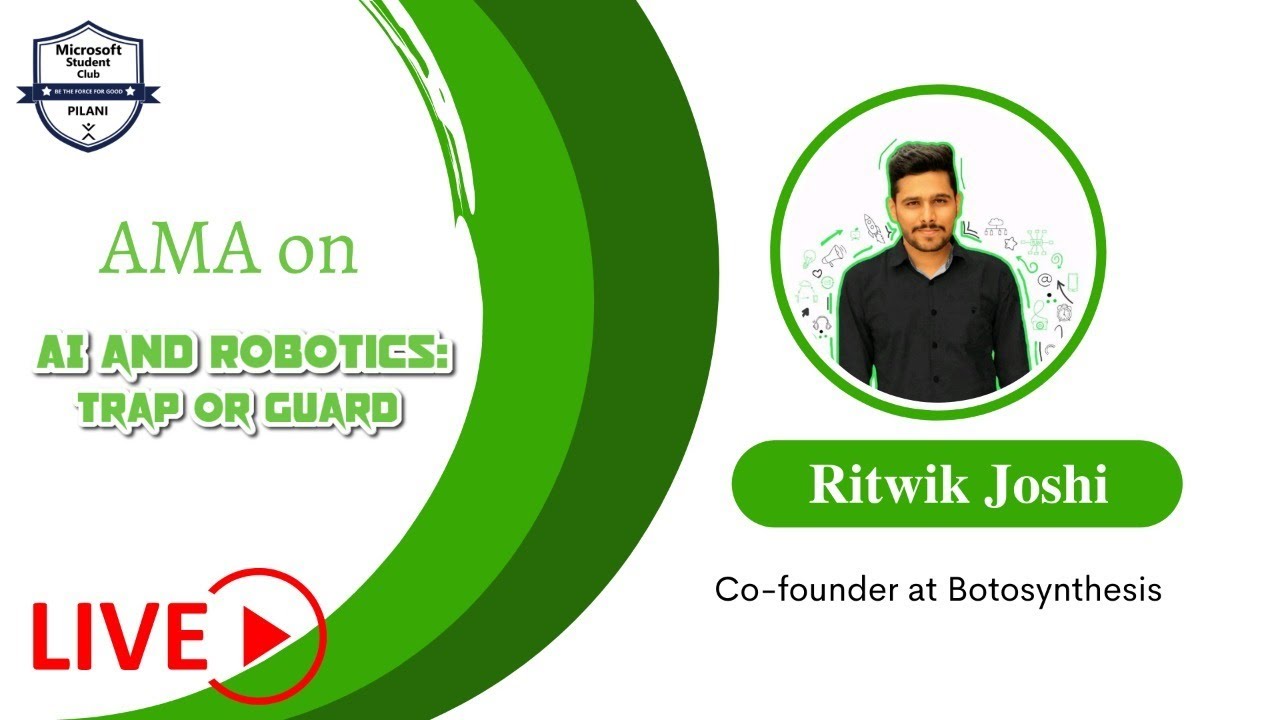
Ritwik Joshi, co-founder of Photosynthesis, answers questions on AI and robotics. A single voice bot can replace a 400-person call centre. He covers AGI, RPA, chatbot platforms like Dialogflow and Rasa, and AI applications in healthcare and education.
Chapters
Hello everyone, sorry for some technical issues.
Am I audible?
Yes, yes.
Yeah, good evening.
Oh, hello everyone, I am Ojas Sharma.
Yes, are we live already?
Yes, yes.
All right. So hey, thanks everyone for joining. Sorry for the technical issue. We had some technical issue while starting the meet. So I'm Ritwik. I'm Ritwik from Photosynthesis, and today we are going to talk about AI and robotics. So this is basically an ask me anything session. So you can ask me anything about AI robotics. So I have worked upon AI. So I have been into AI like since past four years. Now I run this startup called Photosynthesis where we work on AI technologies. We help many companies out there internationally to build their AI-related MVPs and products. So you can ask me regarding any AI technology, or you can ask me about my robotics experience. So I have hands-on experience on dealing with humanoid robots like NAO. So NAO is a robot by SoftBank Robotics. So you can ask me anything about robotics as well, and we can also discuss like, is it a trap or is it a guard for humanity in general? So I'm really excited for the session, and first of all, I would like to thank MSC Pilani. Thank you for inviting me to the session.
So let me introduce, uh, Mr. Ritwik Joshi to all. Ritwik Joshi is an AI enthusiast, entrepreneur, and co-founder at Photosynthesis. His company is among the top 15 AI companies of India. He is a certified chatbot and AI developer and also conversational design expert. He has also developed several high-end applications on humanoid robot now, and he is also among the first few persons in world to connect humanoid robot to IBM Watson. Sounds very cool.
Thanks a lot, Ojas. Thanks for the wonderful introduction. So I'm really excited for the session. So now, now we can start with the questions that we have into the query form.
Yes, so my first question that will give our viewers the basic idea about today's session, that what is artificial intelligence?
Sure, so a very great question to start with. So let's start with artificial intelligence. So there are two terms when we say artificial intelligence. First one is, as we know, artificial, and second one is intelligence. So artificial is a very self-explanatory word. Anything that is created by human that's not natural is called artificial. And when we talk about intelligence, so we always compare intelligence to the human intelligence level. Like whenever we compare any intelligence of any species, any extraterrestrial being, or any animal for that sense, we compare it with human intelligence. So what we mean by artificial intelligence in the modern world is to provide the human-level intelligence or the, the cognitive capabilities to any machine. This technology is called artificial intelligence. Now it's not a single technology, rather than it's a combined term for multiple smaller technologies like that. So artificial intelligence includes a lot more things like machine learning, deep learning. It has various branches of it, and even into machine learning. So when we say AI, it includes lots of things such as image processing, such as speech synthesis, text mining. So all of these things are combined into a technology. It's a term called artificial intelligence. Now nowadays it's responsible for lots of activities and we are totally surrounded by this technology and we don't even realize that. It's, it's become such a common part of our lives that we don't even realize that we are surrounded by AI.
Exactly, AI is all over us. So my second question is, how artificial intelligence differ from human intelligence?
Oh yeah, definitely. So again, a very nice question. So artificial intelligence and human intelligence are completely different, and we, whenever we try and evaluate the artificial intelligence, we always compare it with human intelligence. Like if we just want to check like how capable is the AI system, we just compare it with the human intelligence and then we decide like, is it a sufficiently intelligent artificial intelligence program or not? So in, in our terms, like, uh, when we— if it's a hypothetical term where we call artificial general intelligence, now it refers to such an AI which is like equally capable when compared to human intelligence. So an AI program which is like equally capable of making decisions is equally intelligent If compared to a human, that is called artificial general intelligence. Now we are far away as we are far away from artificial general intelligence as per most of the AI experts out there in the world. But there are some people who think that we are not very much far away from artificial general intelligence. That's what we are trying to achieve. So all of the science fiction movies that we see there, there is an AI which is able to think like humans, which is having all of the cognitive. Cognitive capabilities and emotions. This— all of these concepts are artificial general intelligence. This is different from artificial intelligence. When we talk about artificial general intelligence, we are talking about a super, very advanced AI system that is having human-like thinking capabilities. So when it comes to like, let's have a comparison between human intelligence and AI. So there is a very, very famous test called Turing test. which is by Alan Turing. So this test is, uh, it's like, it's a measuring criteria for any AI system to know how sufficient or how intelligent the AI system is. So for all of the AI systems, if they want to pass the Alan Turing test— let me give you some idea about Turing test. So just, do you know in general about Turing test?
Yes, I have heard about Turing test.
All right, so as you are the student in, into this AI domain only, you are aware of about the Turing test. But for our general viewers who may not be very much aware about the Turing test, so let's take a scenario where we just take a robo and put it behind the curtain, and in the same room we put a test agent. Now if the test agent is communicating with the robo, he is talking and interacting with the robo, and at the same time he is also interacting with another human. Now the test agent is not aware like whether he is talking to a robo or an actual human. In that case, if our human test agent is not able to differentiate like which one is a human and which one is the robo— so if the robo or AI program is actually able to achieve that level of intelligence that a human cannot classify, like which is the AI program and which is the actual human, then the AI program is said to be passed Turing test. So this is a very interesting test which is like a comparison which we can use to evaluate any AI system and check how close it is to the human intelligence level.
Yes. So my next question, what direction is artificial intelligence research taking?
So AI research is taking a very, very good directions. We can see lots of AI innovations coming out there, and we are like— the world is like right now full with the AI research, and it's so very exciting to see like So we used to say that we are on the edge of era of artificial intelligence, but now we cannot say that anymore. We are already into the era, era of artificial intelligence. We are living that era because we are all over surrounded by AI. And particularly talking about the research into AI, like we are constantly going towards creating an artificial general intelligence program, which is called an AGI, and which is the concept which people are very much afraid of. like they are saying, like, if we create such an intelligent system which is equal— equivalent to a human thinking capability, then it can destroy all of humanity, and that can cause a lot of harm to us. But in general, I don't think that this is going to happen because we always have that kind of restrictions that AI cannot go beyond that particular boundaries. So, uh, recent innovations in AI are like, uh, as, as we have also quantum computers coming in. So with this help of quantum computing and these technologies The AI research is, it's like very much accelerated, and this, the research is entirely speeded up. So lots of new innovations are coming into AI as well. So AI is right now, as we speak, we are using AI at Photosynthesis as well. We are using AI for lots of use cases for different industries. We are using AI for healthcare, we are using AI into legal tech, we are using AI into real estate, we are also using AI into edutech. So it's like there are barely any niches that are left where we are not using AI right now. And all of this is a byproduct of the AI research that is happening. So I think it's completely going into a correct direction.
Yes. And next is, will AI replace shift or jumpstart jobs?
Well, it has already started replacing. Now, this is also a question that arises in a lot of people's minds, and they think like AI is going to take their job. Like people think, like as soon as the AI systems are coming, it is going to take their job and they'll be jobless by the time AI is conquering all of the things. But I would like to clarify a thing here from from my point of view. Yes, AI can take some jobs, but it's like we need to constantly upgrade in order to compete with the AI systems that are coming. But we should not portray AI into a negative light rather than we should. Take it as a positive thing that if we look at the positive parts of it, while AI is taking up some jobs, but actually it is on the other hand assisting the business, or it is assisting some people, making the processes faster, making the processes more efficient if compared to a human agent. Let's take an example. I would like to take an example to explain you the same scenario. So in the customer support, there are these chatbots and voicebots coming. So, hello everyone.
I think there is some technical issue. I'm sorry for the glitch. I think there is some network issue.
Hello? Hey, hi, sorry for the interruption. Can you hear me now?
Yes, yes, you are well audible now.
There, there was something wrong with the StreamYard. I don't know what was happening. So I was talking about an example where there in the conventional spaces all of the call centers and customer support centers are using conventionally a lot of BPO manpower where there are human agents, they are talking with different customers and resolving their queries. Now nowadays, with the help of RPA, with the help of call center automation, a lot of call centers are getting replaced by the AI bots. So we are also working on a similar kind of use case where we are replacing a 400-people call center with a single voice bot. Now technically, yes, it is taking, uh, technically taking the job of those 400 call center guys out there. But on the other hand, if we look from the business point of view, it is generating— it is saving a lot of money of the business. So the amount of money that they were spending on hiring those 400 people, the chatbot even does not need like 5% of the same money that they were spending. So the spends are too less. So it's saving a lot of cost for business when it comes to the business. So on the other hand, if we look at the positive part of it, it is very useful and it is very helpful for the business. It is making processes more fast and more cost-effective and more efficient. We are getting the errorless systems out there with the help of AI.
So where does India stand in this field of artificial intelligence? What position?
Yeah, so if we talk about India's position, sadly we don't stand in, in very top positions into the AI right now. But the, the positive part about that is like we are coming up. So all of the generation that is coming up, like our young generations, they are very much into AI. Now we have a couple of universities who are offering courses into specializations into AI. So as soon as we have a lot more graduates learning about AI— so it is a fact that we have the most skilled workforce out there in the entire world, so no one can compete us in that matter. But it, uh, when it comes to the technology, we are not very early adopters of technology in terms of AI. So as we speak, like, we work, as, as I told, like, at Photosynthesis, we work upon chatbots. Our core job is regarding developing chatbots. So our most of the target client market is settled into United States. Now we don't have a lot of chatbots here in India, and we don't even have a lot of robotic applications in India. So in adapting AI, we are very fast. We are adapting it in a very fast way. But in the current position, we don't like stand in the top positions in the top countries who are having the AI capabilities. Because even if we develop something on AI, most of our technologies are dependent on some underlying infrastructure which are owned by some other countries like US or maybe Russia or UK.
So how much time will it take for India to shift from mobile first to India first, as said by Sundar Pichai in 2017 in a conference?
Well, it's, uh, it's definitely going to happen, as Sundar Pichai— and I love that session of Sundar Pichai saying that. So it is definitely going to happen, but it's hard for us to have an exact time estimate, like how much time is it going to take for that shift to happen. But if I just make a wild guess, I think in the next like 10 years we can see that shift happening. We can already see that shift happening, but in the 10 years we will be able to notice some significant changes.
Yes, so what is robotic automation?
So when, when I talk about robotic automation, uh, I, I guess just you're trying to talk about robotic process automation that we call RPA. So, uh, when, when we talk about RPA, RPA is basically— let's keep it simple— it is just automating any, any sort of business operation or any sort of operation for that matter. For an example, let me start this thing with an example. So if an employee is required to send a report, a daily report, to his, his boss or whatever, his colleague, on a daily basis. So if someone is required to send a report to his boss, his or her boss, every day at 9 PM. So this is a daily job. They'll just go to a portal, download the report, and email it to someone else. Now this is a daily process that they need to repeat on a daily basis. Now what we can do in this case is we can just create an RPA bot. They can— the bot can automatically go there, create the report, and email it to the relevant person every day at 9 PM. So in this way, we can just automate the simple processes, the redundant processes, and we can, rather than doing it ourselves or assigning a human to do that, we can just assign a bot to do that, and it can work and go on forever. So this is the basic explanation of RPA. Like, using RPA, we can automate almost any business process that is redundant. And using RPA, we can save lots of cost, like lots of time and money. It's very efficient.
So what means, uh, how chatbots work and how they means, according to you, your photosynthesis company, how they process the chatbots? So which tools you are using and all.
All right, so let me come to that one. So there are different kind of chatbots. When we talk about chatbots, there are different classifications to it. If we can say like they can be— so let me broadly classify them into 2 different categories. First one is rule-based chatbots and second one are AI-based chatbots. Rule-based chatbots are built on simple conditional logics like if-else logics. So they have simple conditioning, like if they get this response, they just provide a particular response as an output. So rule-based chatbots are very simple to build. So we can use numerous tools to build rule-based chatbots. So at our company, we use our own platform. We do have our own chatbot platform, which is a complete no-code chatbot platform called photosynthesis.ai. So it is having a no-code chatbot builder where we can build the chatbots. We can deploy these chatbots to different deployment channels like Instagram, Telegram, WhatsApp, Facebook Messenger, SMS, etc. So we have lots of deployment options out there. So at BotSynthesis, for creating the rule-based chatbots, we use our own platform. And now let me come to the second part of it, the AI-based chatbots. Now when I come to AI-based chatbots, these chatbots are used for very, very high-level use cases where we actually need to understand what the user is trying to say. We may need to extract some valuable information out of the conversation. We may want to have some advanced conversation which includes the sentiment analysis and NLP applications. In that case, we use AI chatbots. Now, for AI chatbots also, we can build AI chatbots in different ways. There are different platforms such as Google's Dialogflow and IBM Watson that allow us to create the AI-based chatbots and on their platform itself, and we can deploy it to different channels using different SDKs. Apart from this, we have open-source alternatives such as Rasa NLU. So that also allows us to create AI-based chatbots, but that's an open-source alternative. So if we are not willing to spend lots of money and just want to create a low-cost solution, we can go for Rasa NLU. So at Motosynthesis, it completely depends on the client's requirement. So we use almost from all of the tools from Google's Dialogflow to IBM Watson to Lex. We also use Amazon Lambda. We also use Rasa NLU. We also use a couple of more open-source tools. And we also do have an in-house NLP system that is also part of photosynthesis.ai.
So how do computers learn? Means what is self-supervised learning?
So this is again very interesting question. So when it comes to learning of computers, so this entire learning is the self-supervised learning and even non-supervised learning. Both of them are part of machine learning in general. Machine learning, we can say it's a very closely associated technology with artificial intelligence. Now all of this learning is based on neural networks. So I need to— I won't go delve too much into neural networks because that will, that will go too much technical here. But let me just give you an overview. So all of this learning is dependent on neural networks which are out there. Now neural networks, we can assume them, they are simply mathematical functions or mathematical programs which are used by the machine learning different algorithms that are out there. So, so there are these algorithms that are designed to have created, which are used to create the self-supervised learning models. Now what is self-supervised learning is like if we create a machine and we just want the machine to learn on himself and improve day by day. So in that case, we can use this type of self-learning machine learning models and we can just deploy them and we can start them by providing some initial data. And later on, we can feed them more data as the time passes and they can use the same data to extract insights and they keep on training the same machine learning model again and again. And at— after reaching a certain level of training The models are very intelligent. So in this way, like, these are the models that are left for themselves to train, and they just train on themselves with the additional data being fed every day.
So please tell our viewers about that humanoid robot, Now, and IBM Watson, how you have demonstrated it.
Sure, sure. So a very wonderful memories of mine, so where we demonstrated like this Now humanoid robot. So working with humanoid robots was a great experience. Like, it was a one-of-a-kind experience. So we had this really cool robo now at our college. It was owned by our college, so we were experimenting with this robo. So working on this humanoid robo is like very interesting. So what we did was like, we were among the first ones to, to connect the IBM Watson with this humanoid robo now. So we were part of a project called Project Into. Which is now a deprecated project, is closed by IBM. So while I was a part of IBM, I was an intern at IBM. We were exploring this technology's IBM Watson and Project Into. So I, along with my a couple of my teammates, Vanish and Bhavya. So we were part of this team and where we developed this entire Watson IBM Watson. We used a lots of IBM's APIs like Watson Assistant, like Watson Conversation, Watson NLP. And includes also Watson speech to text and text to speech for basic speech operations of Nao. So on Nao, it is like completely based on an open source Linux operating system that's called Nao QI. So it is an OS which is specifically built for that humanoid robo itself, which is based on a Gentoo Linux. So Gentoo is a variant of Linux, so it is based on Gentoo Linux family. So on Nao, we use the Python SDK and C/C++ SDK. To connect it to IBM Watson. And then we demonstrated later on these things to 4 or 5 conferences of IBM, including IBM Developer Connect and IBM Code Day. So there we had a great opportunity of interacting with lots of corporate people out there and also very senior executives of IBM, where we demonstrated this entire process. So that's also, uh, we, we have, do have those kind of videos out there where, where we explain in detail like what's the technical architecture, what kind of architecture do we follow. to integrate now to IBM Watson. So I, I can share those links to you, Ojas, and any of the viewers. If you want to learn about in detail of the thing, you can contact Microsoft Student Clubs and they'll be able to share these links to you.
Yeah, sure. If you have any queries or you want to know anything about artificial intelligence and robotics, you can comment below. One of our viewers is asking, Nipin Kalal, how AI is helpful in health sector and how much expenses need to develop app in mobile?
All right, so thanks, Nipin, for the question. So let's— so talking about AI in healthcare, AI is having lots of application in healthcare nowadays. Even we are working with like 4 or 5 different healthcare companies. With their AI projects, we are having those chatbots. So AI in healthcare is useful in lots of things. Firstly, let's let's take an example. They are useful for diagnosis and detection of the diseases. So where the chatbot can interact with the user on a daily basis, and it can record all of the symptoms of any particular patient, and based on the symptoms that it recorded, it can suggest that you are having probably this kind of disease. Please go and check yourself, or please go and have this kind of test to confirm if you have this disease or not. Apart from this, it can also act as a recommendation system. So currently we are working with a startup, and which is more related to cancer treatment. So that startup is a healthcare startup which is specialized into cancer treatments. So we have built a chatbot for them which is helping all of their patients. So the chatbot is recommending them if they are having any symptom, any symptom, if they are having vomiting or if they are having fever. So the chatbot will suggest that they should have this kind of remedy, they should try this medicine, and then the chatbot will follow up with the user if they are feeling good. So this is an entire recommendation system that is completely AI-based. So like use cases of AI in healthcare are increasing day by day, and it's a very hot market if you want to enter this market. And if you are looking forward to have an app with, with the AI systems, so I see the tentative cost completely depends on the use case that you want to develop on the application. So I, I cannot like tell you a specific price range that can, that can suit for your AI application. It completely depends on the use case. So I won't be able to tell you a tentative price range for it because it can start from a couple of thousands and it can go up to a couple of lakhs as well. So if you are really interested into creating any AI-based mobile application, I guess you can get my LinkedIn profile into the description of this video. So you can contact me out there and we can discuss the use case, and I'll be able to tell you some specific things about the price range as well.
If you have any queries, you can put in comment box. Want to know anything related to artificial intelligence, robotics, automation?
So just meanwhile, we are getting some comments. Do you have any questions in general regarding AI?
These were few, two three questions were mine only.
All right. So really great questions. So let's see for a couple of more minutes if we are getting some questions on YouTube. But overall, I was really happy with the questions, the kind of questions that I got.
So Ishan is asking, how does ML and deep learning differ from each other?
So hi Ishan, thanks for asking the question. So if we talk about ML and deep learning, They definitely do differ from each other, but we cannot differentiate them completely from each other because we can say that deep learning is kind of a subset of machine learning. So machine learning can have, uh, like, is also having lots of applications like image processing, speech synthesis, text mining, as I already told you. But when it comes to deep learning, it is just the core about like creating these deep learning models using the neural networks. So using deep learning, we can We can create applications like image classifiers. We can create images like— we can create different kind of classifiers if we want. We can also have classifiers that can classify the input text or the entire files into different classes. So we can have classification models. We can also have image processing models using deep learning. So if you are a student and you are looking to getting started with any deep learning thing, I would recommend you a good course by NVIDIA Learning Academy. So NVIDIA have this course, which is, which is not a free course, I guess it has some price associated with it, which is an introduction to deep learning. So you can get started with this one. And if you are looking for some low-cost alternative as well, you can go to Coursera and there you can find a course by IBM that's called Introduction to AI. So you can have that course and you can also apply for financial aid. where you can get 100% financial aid as well. So you can get started with deep learning using both of these courses.
So another viewer, Joe, is asking, you have mentioned IBM Watson and other tools, where does TensorFlow fit in it?
Yeah, so hi Joe, thanks for asking the question. So as I was talking about IBM Watson, so now IBM Watson in general, when, when I say IBM Watson, it's an AI system developed by IBM. Now they have classified this, all of this ML algos that have, that they have developed, and they are allowing us to use all of these things as a service. And all of these are accessible on IBM Cloud as different kind of services, and they are charging us for all of these services. There are different services like IBM Watson Assistant, IBM Watson Document Analysis. There is service like IBM Watson Speech Engine are there. So there are different service in, in this entire IBM Watson umbrella. Now if we talk about TensorFlow, we can also have the models that we can create in TensorFlow and we can expose them as a REST API. So if we just want a chatbot to have the capabilities of TensorFlow as well, we can just create any model on TensorFlow and then we can use the serverless function to expose the TensorFlow model as an API. And later on we can use the same API and we can call this API from our IBM Watson chatbots or the system. And there we can just make an HTTP request which can help us call the TensorFlow model through IBM Watson. So in this way, there is no direct integration option available between both of these things, but we can make this kind of REST API architecture and integrate both of these 2 different, completely different architectures.
Waiting for the queries if our viewers want to know something about Ishan is asking which language you prefer for ML, Python or MATLAB.
So Ishan, this is very subjective thing, but I personally prefer Python over MATLAB. And the reason being like, see, when we try lots of libraries or lots of different things, so we have lots of options easily available into Python. And for MATLAB, we need to install that complete IDE of MATLAB. But in most of the Ubuntu systems and any Linux systems that we use, Python is already pre-installed. And there are a huge variety of libraries and packages available in Python related to anything, not just machine learning or deep learning, regarding anything. There are lots of options available in IBM Watson. Oh, sorry, I was a bit confused. Into Python. So that's why I personally prefer Python over MATLAB.
Vishnu is asking, what are neural networks in AI and how are they different from human neural networks?
So neural networks in AI— so whenever we talk about this neural network, it is very much misunderstood. These are something or so, but actually when we talk about neural networks in AI, these are basically internally just mathematical functions. So if you are someone from engineering or mathematical background, you can understand the matrix multiplication. So that's what internally goes on in all of the neural networks out there. So there are different kinds of neural networks. We have like this CNN, which is— which stands for convolutional neural networks. We have RNN that are generational neural networks. And then we have new ones coming up, which are like GAN, which is like generative adversarial neural networks. So we have different kind of neural networks which are one or another advanced version of each other, but internally all of these neural networks are just the mathematical functions. And if we just go ahead on the web and you just try and do some research on it, you can even find the mathematical functions which are there into this neural networks. And as I already earlier recommended in the video, like if you go to NVIDIA's Deep Learning Academy, these courses are very much detailed. So in I don't remember the exact course, but in some of the courses you can actually find the mathematical functions for the neural network, and they are also explaining how this matrix multiplication is going on inside the neural networks. So if compared to a human neural network, human neural networks are completely biological that are built with neurons in our brains. So this neural networks in terms of AI and deep learning, these are created to mimic the neural network behavior of human brain. So the intent of creating this neural network was the same, to mimic the activities of human brain. And we are trying to advance these neural networks to achieve the human level, human level intelligence. I hope it helps.
So another viewer, Pawan, is asking how it is useful in education teaching's life.
So hi Pawan, thanks for the question. So in education sector also, like AI use cases are growing rapidly. So even let me give another example. So for our current 2-3 clients which are edutech clients, we are using chatbots. So one recent client that we onboarded is a very good one. So we are using the chatbot for helping the small children learn new languages. So we are having this bot which can help children learn English language just through a WhatsApp chatbot. That we are building right now. And even further into education, we are working with an amazing startup called My Athena. So this, this startup's concept is all about helping students prepare for the interviews, the actual corporate interviews that we have. So the idea is to replace the actual interviewer with a mock interviewer, which is a virtual interviewer bot. So the bot can actually take the interview and help the students prepare for the interviews. So there are this kind of amazing use cases into education. that are coming up and where the chatbots are helping into edutech sectors as well.
Further queries, please put in comment box.
Actually, on the StreamYard, I, I would love to have a feature where I can also read some comments. So here I am not able to see any of the comments that are coming up in the chat. So only Ojas can see the comments.
So I think there are no more further queries, so we shall conclude this now. Thank you so much, Ritwik, for being part of our session. On behalf of my team, I am very thankful to you for coming and being part and telling us very much and giving us knowledge about the artificial intelligence and robotics.
Oh, you are most welcome, and I would also like to thank you for this opportunity, for inviting me to the session. All of the questions were really amazing. I had fun, like, interacting, interacting with all of the viewers, and I hope I was able to answer most of the questions out there. So I have a quick message for all of the viewers that are there. So if you have any further queries, if you want to ask me anything else, my LinkedIn profile is there into the description. So you can connect with me there and you can ask me anything else which you may feel you can ask me about AI robotics or maybe anything. So again, thanks everyone for joining and thank you, Ojas. Thanks for hosting the session.
Thank you so much to you and our viewers.
More from Ritwik

The symbiotic future of AI | Ritwik Joshi | TEDxOriental Institute of Science and Technology



Success Story of Best Artificial Intelligence Startup in India | Botosynthesis