Bumps on the Road to Recovery [Candice Barley’s Story-Part5]
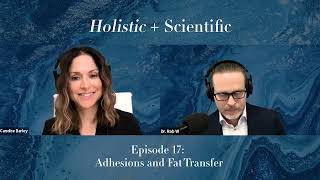
This content was created by Robert Whitfield MD. This content was uploaded by Robert Whitfield MD. This is a YouTube video titled "Bumps on the Road to Recovery [Candice Barley’s Story-Part5]" featuring a conversation between Candice Barley, Robert Whitfield MD, and another speaker. The discussion revolves around Candice's medical journey involving scar release and fat transfer procedures, complications she faced, and insights into the techniques and challenges of such surgeries. The video was created on September 15, 2022, and last edited on November 20, 2025.
Chapters
Welcome to the holistic and scientific podcast with board Certified plastic surgeon Dr. Robert Whitfield, Austin's natural choice for plastic surgery and the expert in smart laser and energy treatments.
Yeah, well, I hadn't really discussed that. I had pretty severe adhesions and I went back for I think two or three sessions of adhesion release where.
Oh, no.
Where they numb you up and then. So more lidocaine in the area. And then take what is. I don't even know what it's called. It's a needle that looks like a blade.
It's a rigoti knife.
Yeah. And just would stick it in there and go back and forth and the snapping and the crunching and the pain, I mean, and it would help a little bit. Tiny bit. And then it would be like go back and cup. And so I had the big like inappropriate looking suction cup things I'm doing at home and then had holes from where we did that so it would just look like, I mean it was, it was bloody and messy and all that to say none of these things really helped with the adhesions.
Right. So let's pause there and say like what Candacen is describing is called a scar release. And basically the rigotomy is. A famous surgeon in Italy established one of these. Not a protocol, but technically you're doing scar release and you're supposed to do fat beneath that scar release in order to prohibit the scar from forming as dense or in the same position. So think of it like you have a depressed or tethered area and then you release it and you put fat beneath it so that it cannot tether again. So that's a very standard reconstructive technique for both radiation injury adhesions from surgery, or in our case, we did it a lot for cancer reconstruction cases. So what she's describing is a very commonly utilized technique to break down scar. But the next step is to place something as a filler between that. So think of fat as the most. Yeah, I guess I would call it one of the oldest fillers we have. It's the oldest natural filler really. And fat brings with it its own adipose derived stem cells. So those stem cells are what help support and develop the ability for that depressed area to not stick back down. So she had poor blood flow. And what she brings with it when you add fat to it in the right setting is a way for new blood flow to develop in that area so it doesn't adhere back down. So when you do it without, you can have a result. But remember she's had three operations now. This is a fourth intervention and a fifth intervention. And however many interventions you do without changing plan A, plan A doesn't work if you don't change it.
Yeah, it didn't. I mean it maybe 10% improvement, but the issue was that that area would just adhere back down eventually. I knew fat transfer was going to need to be an option and so I found a fat transfer doctor. I didn't want to go back under general anesthesia even though my liver was well. And I just had so many surgeries at this point that I wanted the least invasive way to handle this. And I had realistic expectations. I only wanted to be an A cup and to just have uniformity. If I leaned forward, you could see that my skin was adhered to my chest wall. So I found a fat transfer doctor in LA that had excellent reviews as far as fat transfer to the breast and the bum and awake. My mistake was in not asking or not even realizing the importance of someone needing to have extensive experience in fat transfer after explant because obviously there's like a matrix of scar tissue there.
Yeah. Which was made worse by your other. When you have those percutaneous releases, it doesn't, you know, like those areas develop more scar. Like each intervention without a filler placement or fat transfer or something to buffer it, you get more scars. So what you're going to describe next is pretty predictable.
Right. So proceeded did the awake fat transfer. About 300cc's of fat was placed, which.
Is a large volume for you. You're a small person.
I was surprised because again, I was. I just wanted to look natural, normal. So they sat me up. When they looked at all the fat they had placed, I don't know what it looked like, but they said layer back down because I'm awake, but I'm highly drugged. But essentially what the issue was, I guess it just looked like pin tucks everywhere they placed this fat, the scar tissue. Then once they sat me up, pulled in all of these areas causing deep dimples where the scar tissue was. So then he went back in with a smaller cannula and started to just. I had, you know, 150 holes all over my breasts as they went in, individual in each one of these spaces, trying to break up the scar tissue at the same time as injecting small amounts of fat all over. So I went, went back to my. My best friend was taking care of me again and I was doing okay. And then the next morning I texted, said, does this look okay? Looked kind of Red to me. But of course I had surgery is probably going to be red. And I never saw him again before I left town. I was there another three or four days. Had just like, you know, virtual check ins. So at a week, I said, I'm larger than after surgery. And he said, great, you're keeping the fat. That's great. And I'm like, how is it possible that I'm a larger. He said, well, you should probably still have swelling. And like, okay. So a few more days go by. And I'm like, yeah, I'm not feeling good. I wear an OURA ring. And so my temperature before this had dropped really, really low, like extraordinarily low for like three days. And my, all of the other signs, like my respiratory rate was really high and all of these things. But he was like, you don't have a fever, right? No. And then I got a fever and they just kept getting bigger. And he said, and so I was like, I need to have a. We need. And I sent pictures. He said, okay, yeah, you know, this again, this is kind of to be expected, you know. Had a lot of scar tissue. Start on this antibiotic. Didn't get any better with the antibiotic. Fever kept going up. So did the breasts. At this point, they are bigger than my implants ever were. They were red and shiny and awful looking. And I kept saying, I said, they feel like they're filled with air, like helium. They're not heavy. They feel like they're blowing up with air. It was so weird because they felt bouncy, like a balloon. Eventually, another round of antibiotics. By this time, we're three weeks in. I'm so sick, I can't get out of bed. Super red. It gets passed over to a different surgeon who sees it and says, you need to get on a plane right now. You could go to the er, but they're not going to know what to do with you. This was Christmas Day. I had to get on a plane and fly back to California and meet the surgeon at the office. And he tried to aspirate with large needles. And we did get a substantial amount of fluid, but not enough. We said, let's see how that does. Then sent him pictures the next morning. He checked in with me every hour. He said, you need to come back in. At this point, he made two little incisions on each side and it just poured out liquefied fat and infection.
So just for the audience. So a couple things Candace said was her temperature got really low and she kept asking, getting asked if she Had a fever. So the prelude to get in a fever, if anybody's had a really bad cold, what have you, you get chills, right? So that's the prelude to a fever. She got cold and then her respiratory was going, her respiratory rate was going up. So had they checked her blood work at that time, she would definitely have had aberrant blood work. So her blood, her white blood cell count would have been higher. It would have been pretty obvious that she had an infection. These are things like in a hospitalized patient you would recognize pretty quickly because the nurses would be like, hey, Dr. Rob, the temperature is really low. Her heart rate's elevated, her respiratory rate's elevated. She has an OURA ring on. So she knows this anyway, so she's got her own monitoring device on. And basically now she's describing a closed space infection. So what I tell folks, try to envision a honeycomb. And this honeycomb has been broken up, but you still can't get everything out. So when the surgeon tries to get things out, he doesn't know where it is. It's a huge maze to get stuff out of. And they're fortunate they got enough out so that she could actually then, with the help of the antibiotic, I hope, get healed up. Because this can be a very, this can become a life threatening condition for someone if it's not taken care of.
Yeah, that was the issue with the trying to do it within with large needle was, it was a honeycomb. So we couldn't find where the pockets were, even though we knew that there was a lot in there. So we ultimately creating a large hole, an incision, and then manually, first of all, a lot poured out, but then he had to manually express the remainder of the liquefied fat. And then of course took samples and swapped all of that and sent that to the lab and then was able to determine what kind of infection it was or bacteria. And. And so then I was put on another two antibiotics there. So I was on four antibiotics within three and a half weeks. And then after that point, by having, having to manually mash out that, that fat and infection, it somehow created like my skin felt like there was literally a sponge sewn in there. It looked, they called it orange peel skin.
It was just, it's called peau derange. So the dermis has got fluid stuck in it and it feels boggy or soft. So we've described this on the show before, but where you put fat is between the skin and the breast tissue. Now, in a really thin patient like Candace, there's not going to be a substantial layer there. So invariably you're going to be rubbing up against the breast and that space, you're going to be in the dermis, just beneath the skin. So that the skin is composed of layers, epidermis, dermis. The dermis is where the blood flow is. So you actually want to be very close to that area. But that's when you have an infection from fat transfer or just when fat transfers are healing or we see it in revision lipo a lot where we have to un dimple skin that's been contracted down from scarring. You'll have this bogginess and it'll look like poterage, which is orange peel, basically.
Yep, that's exactly what I had. That has been a process to heal that, which I talk about a lot on my. On my Instagram account, and how I found something that really helped me with that and helped restore the blood circulation to that area. And so at least everything looks better, Substantially better. From where we were at, I would say I probably retained like 15% of that, which the only place it retained was at the bottom. The only area had breast tissue anyways.
So, yeah, okay, it is. Maybe we'll just do a simple physics lesson here on the show. So we're gonna use a couple. We'll use some Sharpies. Those are easy. So when you're doing fat transfers, there's some just basic things to remember. We're all taught how to do them. Remove fat with one instrument, a liposuction cannula, and put it back with another instrument called a fat transfer cannula. They're varying sizes, but just for illustration purposes, if you take something out with something that big and put it back in with something that's smaller, you just have this disparity in pressure that it takes to put it back. And the smaller that device is that you put it back with, the more pressure you exert to put it into the space. And the more pressure you put on things, the less control you have. And when you don't have control, no matter how good you are, no matter how talented you are, you can't get it exactly where it needs to be evenly distributed. So what I tell people and what I've shown you in the past is whatever you take it out with needs to be the same size as you put it back. So that gives you your best chance to evenly distribute the fat across the area that the. In this case, I want it to go. And I, a long time ago, used to use the technique you described. It's a hard technique to get just right, but I did that over over a thousand cancer patients, so I was very versed in doing that. And then we have Wells Johnson fat transfer equipment now. So we have this very posh system that holds it. And as I remove the fat, it's collected and kept safe. And then we were able to, with a nice little roller pump, put it back in with a fat transfer cannula so that we're in. We always are hopefully going to be evenly distributing the fat. Of course we're not in there with the camera looking at it, but you can feel it and you're not applying extra pressure to push it in where you're trying to put it, which is when you use small cannulas, especially in scarred up tissue, you can extrapolate how that happens very easily.
So do you think it's because maybe the fat was damaged as it was going in there, so then it didn't have a chance to take and then because it liquefied, it grew an infection or what do you think happened there?
I think anytime you describe it, when you have a heavily scarred area, I'll just use the most extreme example is a scarred radiated area. If you release it, no matter how much you release it, it's still like a trampoline. And then you put fat in there, there's only so much expansion tissue can, can have. And as they sat you up and looked like some of the areas didn't expand, I think that's probably a time to pause and reflect and say, maybe don't need to put more there, maybe just need to release the scar as it's been released in the past. Because that's kind of the moment where I would probably change my tact. I have these numbers that run through my head along with the voices, and they tell me what I should do and shouldn't do over years of doing these. And I will stop, as some of the best people in the world have taught me is like it will only expand so much and the more you expand it. This is not lip filler.
Right?
Lip filler and cheek filler is not dynamic. Fat is, but it's also highly compressible, so you can kill it and that will create more problems for you. So you get yourself into catch 22 when you add more and more fat. Many, many clients ask me to over fat transfer them in order to get them a better result, which if you just follow what I said, doesn't work. It can't. So you, you only have so much tissue Expansion. And when you reach that, I mean, you stop. Doesn't matter how much fat you have. That's not the point. The point is to safely transfer that. So I think there's a lot of very qualified practitioners. I would not say it's always that easy to get that and know when to stop. I think that's just something I've been fortunate with over time, I've done so many of them. I know by tactically how it feels and how it looks like. If you see the skin, get pot orange in it, you know, it's time to be done.
Right. And from my understanding, in order to avoid fat necrosis or oil cysts or things like that, I may have those. I'm not sure. You know, after explant, there was areas where I felt like maybe fat, gut or breast tissue kind of got stitching and wear place close to the scar. And then luckily I had a baseline ultrasound before this procedure.
Okay.
So that I have that to at least have as a baseline and then I will do another one soon.
Well, she brought up some very good things. So I get asked a lot, like, what's my take rate with fat transfer? How often do I get fat necrosis, how often do I get cysts in terms of take, which is, you know, you want to say how much you have over time, I'll qualify it like this. Between the ages of 20 to 30, you should be upwards of 80%. And I'll highlight why I say that. So fat works really well in premenopausal women. Take for instance, one of my holistic mommy makeover patients. They don't want a tummy tuck, they don't want breast implants. They just want me to do body contouring to give them the best shape. They want to go from a four to a two, and they want their breast size to improve. And fat is a very good tool, very good filler, and you can get really nice results. But you have to have the protective effect from estrogen and you have to counsel them on their diet and they have to have hopefully a lifestyle that they don't smoke and drink and have other issues that make it complicated for them to take care of themselves. Because all those things, you can have wonderful surgeons and nurses and anesthesia and everybody can take really good care of you. But you mentioned before, you have to take responsibility in the maintaining the result. So I can get a result. Now, when you get into the 30s and 40s, depending on, have you had children, have you had some other disruption in your endocrine system. Have you developed food sensitivities? Do you have leaky gut? I mean, there's a host of problems that seem to develop quite quickly in the. We'll just say the 30s. And you can get yourself into a little bit of a pickle with those if you don't look carefully. And I will say that, you know, people don't like you looking and asking them about these things. Most of the time, they find it to be a little intrusive. But I basically lay it out, like, if you want this procedure, this is why I asked these questions, to get these results, which I feel are better than most. And so I think if you can get good results in cancer patients who basically have their estrogen blocked, which I did over a long career and taking care of cancer patients, I think in the healthy patient, you better dot your I's and cross your T's and make sure everything's checked off so that when you do that, you're giving that woman the best opportunity to have the result. Like when people say fat transfers don't work, I just kind of say, really? Have you ever seen anybody's Brazilian butt lift? Now, I will say in the breast, it's under a lot more influence of estrogen. That is your butt. Butt's different. Your butt, you can put a large amount of volume in, and it seemingly does very well.
What you said is, like, profound, I think. I don't know that many doctors and women getting fat transfer have connected estrogen to do with the breasts. Because I know, like, some women who are like, I've been doing, I'm eating lots of protein. I'm eating lots of fat. Cause a lot of times they're told to eat a really high fat, like, healthy fat, but they're doing, like, the, you know, the fat bombs, or it's coconut oil and almond butter and all of these things which really try to up their fat so that they. Their fat keeps after their fat transfer. But if their hormones haven't been addressed, that is why, like, that's making so much sense to me, because I am on these fat transfer boards, and they're like, I did all the things, I ate exactly what they said. But I, you know, I lost a lot of. I feel like they went down a lot. That makes so much sense that it would be an estrogen issue.
Yeah. And I want to say, like, it's. It goes back to the same things. Right. It's not just one thing. Maybe they did eat everything right. And maybe their hormones were close, but not quite right. We know providers who don't like the fact that I balance hormones as a plastic surgeon. But that's okay. I mean, my entire career has been taking care of really severely injured burn patients or cancer patients. And I can tell you for, for a fact there's plenty of studies that show that wound healing is improved when anabolic steroids are used, of which testosterone is one of them. So when folks want to get on me about that, that's fine. I have broad shoulders. It's okay. If you take care of people long enough and recognize the patterns, understand your endocrine system as a female is very complicated, as you know, and the better position that system is in, the more comfortable I feel that you're going to have a good outcome.
Right. And I know many women, me included, that when your body is in an inflammatory response and state for so long that eventually for me it turned into Hashimoto's and for many women it does as well. Luckily I've been able to balance that. I don't struggle with the Hashi very much anymore at all. I'm not cold all the time. Also all of the other things that I had just not only from my implants but that were thyroid related along the way that I didn't that no one ever connected for me. So yeah, it's really, really profound to me.
Take a screenshot of this podcast episode with your phone and show it at your consultation or appointment. Or mention the promo code podcast to receive $25 off any service or product of $50 or more. Dr. Robert Whitfield is a board certified plastic surgeon located in Austin, Texas near 360 and Walsh Tarleton in Westlake. To learn more, go to drrobertwitfield.com or follow Dr. Rob on Instagram at doctorrobertwitfield Links to learn more about Dr. Rob's smart procedures and anything else mentioned on today's show are available in the show Notes. The holistic and scientific podcast is a production of the Axis T H E A X I S IO.







