FIFA bans TURF
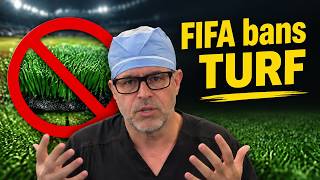
Dr. Robert Whitfield explains FIFA's ban on artificial turf, citing injury risks and chemical hazards from crumb rubber. Recycled tire turf releases heavy metals, PFAS, and other toxins when heated, linked to inflammation, hormonal disruption, and cancer in young athletes. He recommends testing individual toxic burden and practical steps like showering after exposure.
Chapters
It's kind of weird. Hey everybody, we're having a couple Technical issues will get sorted out in just a moment. Gonna have our talking go live here shortly. Okay, all right. Got a problem on a couple things on Rumble and Substack. Got a problem, but that's okay. We're letting everybody hop on. No worries. We're gonna have our talk here in a minute. I just got done filming a podcast, so I'm a little behind. This was going to be at 2 PM, but it ended up being at 3 PM, so appreciate everybody's patience. This is the life, it's a busy one. So, uh, All right, um, everybody hop on. We're going to talk about TERF just a moment. Uh, we have a little bit. Perfect. All right, there we go. Should be on, um, Facebook, LinkedIn, YouTube, X, Dr. Rob's Circle, and Rumble. Um, Substack is gonna have to be left off this time. Sorry for you Substack users. I will, uh, see if I can do it on a phone, but I don't know if I can. Maybe. Oh, there I can. Never mind. All right, here we go. Hey Danielle. All right, now I'm actually live on Instagram, Substack, Facebook, YouTube, LinkedIn, X, Rumble, and Dr. Rob Circle. So welcome everybody. I apologize for the technical difficulties, but that is the case when these things are you know, getting up and running. So no worries. We'll get our talk going here. I'll get it ready. It's already prepared, ready to roll. So without further ado, we will roll the talk. So everybody knows, uh, the World Cup's in the United States this summer, and FIFA has banned turf, right? So they don't have a World Cup on turf for a number of reasons. Uh, they want to prevent injuries. There's more ACLs, Achilles tears on turf, but there are other concerns, and FIFA has banned it. Um, and, and it's not just a performance, uh, issue. One of the things that nobody talks about is the own internal research about the, the issues with turf, right? So a couple weeks ago we did a, a live about it to talk about chemicals. And so if, if we kind of go back, you know, and think about it, if they're banning this and we're going to say, all right, it's it's for ACL prevention, but by 2031 they want it out of the EU. So there's something else going on. And, you know, my work has taken me deep into inflammation, toxic burden, what happens to the body, what accumulates in terms of chemical compounds. And today we're gonna show you you know, more of what's in the turf, why it matters beyond soccer. So, you know, it's not a sports story, it's more of a toxicology story hiding inside a sports headline. Artificial turf is made from ground-up recycled tires, so they call it crumb rubber. Sounds harmless. Here's what's in crumb rubber: polycyclic aromatic hydrocarbons, PAHs. They're known carcinogens. There's lead, cadmium, zinc, which are heavy metals. There's VOCs, volatile organic compounds that off-gas and heat. PFAS, which are forever chemicals. Think of things like organophosphates, like herbicides and pesticides. When the surfaces heat up— and they do, turf fields, uh, regularly heat up to 150, 160 in the summer. Now we're in Texas, this is a very common phenomenon in Texas. These compounds become airborne. The players will inhale them. They'll get them absorbed through their skin. They'll enter through anything that's open, through an abrasion or a cut, which often happens on turf. And it routinely happens on anybody who's sliding. Think of defenders. FIFA looked at their data and said, uh, can't really be doing these things. Not so, uh, any tournaments, you know, typically the bigger sanctioned tournaments are always on grass. So in the United States, a lot of the NFL fields, uh, stadiums are used for the games, and so they have to pull all of the turf and put down grass. I mean, you've seen this. Now, is it perfect for the matches? No. Like, if you want to see a perfectly manicured surface, see a devoted soccer field. Go to, you know, I live in Austin, if we go to an Austin FC match, the field is perfect. If you go to Paris Saint-Germain match, the field is perfect. If you go to the Camp Nou, the field is perfect. Allianz Arena for Bayern, all these places in Europe, to be a top European club, you can't play on turf. Anybody in the first division has to be on grass. So Here's where my world intersects this. I see patients every week with unexplained inflammation, elevated, um, lab values, disrupted hormones, gut problems. I just saw somebody with an incredibly, you know, bad gut problem recently, uh, today. And the autoimmune markers that, uh, we look at, they don't clearly match a diagnosis. But when we look at toxic burden panels look at heavy metals, VOCs, these other environmental toxins. I think those numbers tell a different story. And I've been very curious about this for a number of years now, like where you lived, where you grew up, the air you breathe, you know, the, the places you worked, the, the fluids or the, the water you drink, the foods you eat. These all play a role. And it's really not, uh, questions that are commonly asked in routine medical workup. Um, I think, you know, all of us through our experiences, our genetic makeup, our diets, where we lived, um, growing up, they all shape, you know, fundamentally how we behave now. And crumb rubber exposure is, is cumulative. It's not going to be from a one-time thing. A kid who plays on turf from age, you know, 6 to 18 has 12 years of this low-grade chemical exposure. It, it probably won't show up obviously as an acute problem. It shows up as more chronic problems. So chronic inflammation, hormonal disruption, immune system dysregulation, other risks in particular for cancer, particularly lymphoma and leukemia in young adults. Those are how these things are going to show up. The University of Washington soccer coach compiled a list of over 200 athletes, mostly soccer players, diagnosed with cancer. The common thread: years on artificial turf. Yeah, let that sink in— artificial turf. My son just got back from Europe on Monday and they have to, uh, many times train on turf. And I know it's bad on him, he's had multiple surgeries, but it's also a health risk. And I'm always concerned about that, especially with what I understand about toxic burden from the tests we do all the time. So, you know, Artificial turf is more of a, a case study in how toxic burden can accumulate invisibly. It's the, the same mechanism I see with other implants, medical devices. It's the same mechanism I see with mold, same mechanism I see with patients who did everything right but still feel terrible. The body has this threshold, and the threshold is something that, you know, once you exceed the threshold, you can no longer compensate for. You you can't adapt for, you no longer feel good, your systems really start to fail, inflammation becomes chronic, recovery slows, hormones go off, energy disappears. So every toxic input counts— turf fields, uh, biologic materials, pesticides, heavy metals, the food we eat, the water we drink, the air we breathe, where we work may have mycotoxins from mold, there may be PFAS in the cookware or, uh, other opportunities for PFAS to get into our systems. The question isn't just, is one thing going to kill me? The question is, you know, what is the total cumulative burden, and am I exceeding my capability? Uh, that's what we measure, and that's what my program, the Sharp Method, that I wrote the book about is built around. Um, I try, and I hate guessing about things. I like to test. I like to try to understand as much as we can to quantify what's going on in each individual case. And so, all right, we gather this information. What we do with it— so 3 things. One, we want to know your exposure. So obviously, if your kids are playing on turf, that's a data point. Um, it's just to be aware of what's going on. And there are fundamentally things you can do for them, you know, afterwards. Obviously, um, first and foremost, I'll just say this: hand washing is always very critical, uh, because they always are, you know, touching the face and, and getting things in their mouth. Um, when they get them— when you get them home, leave all that garbage, you know, out on the porch or in the garage, you know, get them showered off and, uh, let them eat at home. Um, keep them hydrated. And then, you know, it's not a, um a scared second. Like, I would prefer that somebody get tested. Like I said, my son's back, uh, from Europe. He's, he's been playing on turf since he was 9, and, uh, he gets his toxic burden, uh, tested. He's going to get it tested here shortly that he's back home in the United States. And you just want to see what these levels are. Look for things like environmental toxins, like I talked about. PFAS, which are forever chemicals, organophosphates, the heavy metals, um, the other, uh, mycotoxins. Just, you want to know, um, you want to do everything you can. Like, what's controllable, right? If, if you already identify that there's a higher burden than normal, then take steps to reduce that. You can't control every exposure, it's not about that, but you can control enough of them by you know, habitual changes to stay below your threshold. And maybe, just maybe, that keeps us, you know, in an overall better health position. Maybe that improves performance. I mean, I think that's what separates people who thrive. Obviously, some people detoxify better genetically, and that's a big reason for this to be not top of mind for everybody. But an organization like FIFA's figured this out. They looked at the data and made a decision And they do this all the time for their tournaments, right? They want to avoid injuries, ACLs and Achilles, but they also want to limit exposures. So you should be making the same or similar decisions for your family. I wish everybody could play on grass. Uh, turf was not a thing when I grew up, other than that garbage that they put on porches, that, uh, and terrible AstroTurf. Um, you played on concrete or grass. That was the deal when I So if you want to understand your total toxic burden and not guess, not worry, but actually measure it, uh, we do that. We do have testing for that. We do have a book about the SHARP method that you can learn more. We have a small mini course about the SHARP method. All those things are available, um, at drrobertwhitfieldmd.com and drrobcircle.com, where we go deeper like this on topics every week. Uh, there are no restrictions inside my platform. I don't get censored like I do on YouTube, Facebook, Instagram, TikTok. All of those platforms. Um, and if you're a patient dealing with unexplained symptoms after years of exposures, uh, to anything— doesn't matter what it is, turf, medical device, mold, chemicals— um, maybe it's worth a discovery call with the team, worth checking out the books or the videos we've made about it. Now, obviously, Fito has already decided and made their call. Now you need to make Yours. All right, with that, we're done with my talk. I am going to, uh, shut down the feeds and go into drrobcircle.com and take any, uh, questions and do a live Q&A for the next few minutes. I thank everybody for joining. I really appreciate it. Spread the word. We go live on 7 PM on Tuesday in the circle, uh, usually 2 PM on Wednesdays, but today I had to adjust to 3 PM because of podcast, and then 7 PM on Thursday. Hey, thank you all for joining.







