Is it Normal to be Emotional After Breast Explant Surgery? Dr. Amanda Savage-Brown's Insights
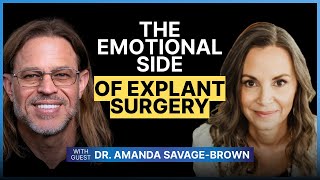
Dr. Amanda Savage-Brown and Robert Whitfield MD discuss emotional recovery after breast explant surgery. They outline physical supports like hyperbaric oxygen and lymphatic massage, plus psychological work on body image and self-compassion. Their clinic found bacterial biofilm in about one-third of explanted implants.
Questions this video answers
March 7, 2024
Over 1,000 consecutively PCR-tested samples.
About one-third showed a bacterial biofilm; the most common organism cited was Cutibacterium acnes.
Chapters
Everybody, welcome back to the show. I have a very, very special guest. We did a show in the past, Dr. Amanda Savage Brown, the author of Busting Free Amanda. Thank you for coming back and being on the show.
Thanks for having me back. I'm excited to be be here with you this morning.
So the audience knows. When I first learned about Amanda and read her book and had her on my show, I tried to get her to move to Austin. So, because honestly, I'm not a mental health professional, I think we all know that and Amanda is. And for our patients who go through the explant process, there's a lot of. I look at it as a lot of self work. If you're unwilling to do work on yourself, then the process becomes infinitely harder. And with that, I'll let Amanda explain.
Yeah, I mean, I. I see it as a hidden opportunity. And the reason that I call it a hidden opportunity is because, you know, understandably, when you're going through this surgery, it's focused on your body. And because it involves this particular body part that holds so much meaning, we will really focus on aesthetics. That's all understandable. And you know, if they're working with you, they're in good hands there. But sometimes that just sits in the driver's seat. And it's happening in a body that has a heart and a mind that cares very much about all of this. And it impacts us socially, it impacts the way we see ourselves. It can impact us, you know, relationship wise, sexually. There's all different ways that it impacts us. So the hidden opportunity here is to not just focus on the body part. Yes, do that, Prioritize that. Pick a, you know, do all that stuff, but also remember that you've got a mind and a heart that has a lot of stuff going on that needs your attention. You know, explant doesn't remove all the beliefs that we hold about that body part and we will repeat what we don't repair. So the hidden opportunity is to just finally look at all of the experience that you have around your breasts or comparative thinking, or the very human experience of feeling like you're not good enough or you're less than in some way and really use this time kind of as a sacred time to do this additional work. And that's what I love helping people with it is, you know, I know it can be overwhelming and I'm. I like to help contain that and help people move through that opportunity and just come out on the other side with a totally different way to relate to all of that. Old learning.
Well, I think, and that's an excellent explanation. When I work on our program sharp now we're really trying to be strategic, holistic, really accelerate our recovery from explant surgery. And that starts with a lot of prep work, but it's mostly biologic work. It's not psychologic work, it's not social work. So if we look at what everybody's most concerned about is, you know, outside of the, the standard movie things like waking up after anesthesia, which is, you know, unfortunately become a thing, it's pain, you know, and, and most of, of pain if you look at, we'll say little ones and it's always, you know, sad when a little boy or girl has to have, you know, surgery and say, for instance, they had a problem with their heart and they needed heart surgery. So little kids who have heart surgery, maybe they're five or six years old, they don't give them any narcotics after surgery. They typically give them Tylenol because you have not been wired pain so your perception is different. And so people really fixate on how much pain am I going to be in. So pain has obviously biologic factors. Those are my responsibilities and I have a lot of tools, processes that we go through to really mitigate the biology of pain. You know, we start with early on proper nutrition because if you don't feed the gut, the mind doesn't work. A lot of my patients, as you know, and they have gut problems as you alluded to before in the past with us. And so we use a lot of liposomal, which is just liquid formulations of supplements so that I don't get pushback for things like pill fatigue or, or I don't want to do that, or there's a lot of excuses we make about everything. So we're in the no excuse business at my, my clinic in Austin. So the supplementation is based on genetics. It's not me sitting at a bar with my friends on a cocktail napkin figuring out what to give you. So we supplement what's important for your immunity. We prepare you nutritionally with the most appropriate, you know, guidance for a gluten free, dairy free, seed oil free diet. No fructose, no sucrose. You know, if you're going to take care of yourself, it starts with how you put things in your mouth, your air quality and your fluid intake. And then around the time of surgery, we really focus on, let's prepare the nervous system, let's try to get you into a parasympathetic state. Let's, let's reduce the fight or flight response you're experiencing. Women have a lot of trouble with cortisol, a lot of of trouble with estrogen, depending on their ages. And let's try to get that calmed down. So there's always a strategy to this, to prep people with the biology of what's about to happen. And then we go through surgery and we have really strict protocols in the operating room to anesthetize everywhere we're operating. So it's pretty rare that a patient of mine wakes up in kind of a need state for narcotic. It's uncommon, actually. And then my patients leave and go home in 30 minutes to an hour and they're on their own. They can walk. I didn't operate on their legs. I mean, they're not having leg surgery. We may take fat if we're doing a fat transfer, but that's. And then that week after they're coming here and getting hyperbaric oxygen therapy because we know that, you know, despite studies and I was sort of certified in hyperbaric medicine a long time ago at a mentor pass, but he was one of the people who studied muscle ischemia, reperfusion injuries, and hyperbaric oxygen. So I've been familiar with this for, you know, 20 years. We know it helps, you know, from a clarity standpoint, clear, you know, your mind after anesthesia, anytime you can get more oxygen in the system helps. You know, we do a lot of, as you know, lymphatic massage, which helps get the fluid and other, you know, things out of your system quickly and then a new thing. And when you're in town, we'll go to the well for dinner. So we have this great restaurant, gluten free dairy free seed oil free restaurant. I just give all my patients a gift card to go there because I want them to understand this is the way you need to eat for not surgery before your life. So you need to understand, like you have to eat well to live well. And so these are all just biologic things. That's one third of the problem. Larger issues are in your purview, which are obviously psychological issues and then social issues, which the reason and you know, I'd love we'll announce it on the show that Amanda's partnered with us to provide psychologic services for our patients in group and one on one settings because it's very important for me and she's going to elaborate on how best to provide this. But you can't really get well without addressing the underlying psychological and social issues that you're facing because I can do what I can do surgically for you and I have a great team and we're expanding our team with health coaching and detox practitioners. But adding Amanda and everything that she understands and has written about will be paramount to growing our program and being more successful.
Yeah, absolutely. And it's why I've always appreciated when I get to talk with you because you do see that there's so much more to explant than surgery, you know, and it's such a great everything you were just describing. I was so envious of your patients because I didn't know that stuff when I explanted in 2018. And I certainly didn't. I didn't receive guidance about any of it. And you know, so far as working in terms of helping with the inner stuff. So I think of it as mental, emotional and social readiness. And when we say psychological, sometimes people will. Maybe that'll have a stigma or a taste in someone's mouth. So it's looking at what are the thoughts that are showing up that are pushing you around that are painful or difficult? What are the feelings that are part of that pain that you were mentioning? Right. People have a lot of concern, understandably. Humans want to move away from pain. And if we're concerned that we're going to be shunned, that if we're unpartnered, that we're not going to be able to partner, or if we are partnered, that our partner is no longer going to find us attractive or say that it's okay but really think something different, or if we've had a long standing battle within ourself and we're not really crazy about the idea of a post explant silhouette. It's all nuanced depending on your history and your level of support. But the kind of inner pain that an explant patient may be concerned about or anticipating, we can proactively direct someone's awareness to that and raise her willingness to act on her behalf ahead of time and not just white knuckle it, hope for the best, shoulder to the line, push herself through. You can look at your circumstances and mentally and emotionally and socially prepare yourself and think about what's the kind of woman that I want to be when I look back on this journey? How do I want to say that I treated myself? What matters to me about how I show up to this? What do I want to reclaim and repair inwardly so that I can go on and take all this amazing knowledge that they're going to learn with the nutritional part and the biological part. So how can I take all that and go on and still be willing to act on my behalf and focus on what matters deep inside me? And that again, that's the whole opportunity there with this. So it makes me sad when someone reaches out to me because they explanted understandably with this focus on surgery and all those elements with that. But they didn't do this work and they get to the other side and maybe they're feeling regret, maybe they're feeling, you know, difficulty processing grief. Maybe they're really just disoriented from a mind map, like a body map perspective. You know, I talk with women who have had, you know, implants in their bodies for more than half of their awareness. You know, if a woman got implants when she was 18 or 19 and she's in her 50s and she's choosing to explant, she really, that's foreign territory to her. It's a different journey than if you got them in your 30s. So there's so many different things. It's highly nuanced. It does, there's generalities, there's inner processes that are the same for us because we're humans. And that's another thing I really work to do is normalize these experiences that we're having. It's just part of being human and doing something that's important and for some of us can feel risky.
To your point we made previously in discussions, you created a framework where you, you stress mental flexibility and being able to adjust and adapt. And whether it's someone like Robert Cialdini who talks about our Click run programming like we just get into Click Run. This is what it is, this is what we do. I think a unique proposition that you bring is creating a opportunity to adjust and become more mentally flexible, if you will. And maybe you can elaborate know on that.
Yeah. What I talk about is so everything that I do, the program that I put together was adapted from acceptance and commitment therapy, which is an evidence based, process based approach to therapy. Or if you're doing coaching, it's training and it's been around for 40 years. It has so many evidence based trials showing its efficacy across all kinds of human experiences. You know, from something like test taking all the way through very intensely traumatic experiences. And so that's where my expertise lies. And when I went through my own explant journey I saw this huge gap. I'm also a former public health scientist, so I was just really aware that on a macro level there's a giant Gap in the inner services that are needed, like what we're talking about, for holistic wraparound care. And so I set about translating the proven tenants from acceptance and commitment therapy to create this way to help women move through explant or any silhouette altering surgery really. So psychological flexibility, mental flexibility, what it is about. It's like yoga will give you physical flexibility and you're, you're moving through different poses, you're creating a practice, and there's a way that you approach it so that you get your physical flexibility. It's the same thing with these six processes. You can work on any one of them. They're all interconnected, they start enhancing one another. And the big thing that they're building is this inner flexibility. So that you can have an old unhelpful belief about your body, or you can have an old unhelpful belief about women and breasts and belonging. You can have a painful memory. You can have, you know, a really difficult feeling that you typically respond to by trying to numb out or, you know, taking something else into your body, maybe like alcohol or some other substance. You can have all these things showing up in you, which they will until you die. That's just part of being human. You know, you can have difficult thoughts and feelings, and through these processes, you can learn to respond with a whole lot more flexibility. So instead of this feeling means I need to numb, or this thought means that I need to distract and minimize and downplay. We've all had enough of that. It's shown that none of those things ultimately lead us to places of peace and well being. So you can learn a flexible way to have these thoughts or feelings show up and still be the person that you want to be. Still treat yourself based on your deep down values, not your socially learned or bequeathed standards. And you can start living from the inside out with a lot more flexibility. You don't have to follow your thoughts, you don't have to follow old coping styles for painful feelings. And that's what psychological flexibility is about.
Yeah, I think everyone you know, I hope that you can begin to understand why it was so important for me to get Amanda involved in the care of our clients. I think a multidisciplinary approach is the best approach to taking care of explant patients. And I know I'll probably have some detractors. I have lots of trolls all the time that say you don't need to do testing, you don't need to do or help supervise detoxification. You don't need to add lymphatic massage, or you don't need to add hyperbaric oxygen, or you don't need to take supplementation, or the list just goes kind of on and on and on. And I feel honestly like one. I don't care about that. I just don't. I think most of it is a negative perception that seems too common in society now. It's super easy to be negative and whether it's personally or group think or, or kind of whatever it is, I, I think that's a real challenge. Somebody said to me, I sent you a. What did they tell me? They, they tried to call me on Instagram and I was like, why the hell would you try to call me? Do you think I actually answer somebody on Instagram? So it's just for everybody to know. I don't have any social media accounts on my phone. I don't look at my phone because as somebody who's had to carry around a phone to respond to emergency calls and answering service calls since 1996, I don't respond to social media and I don't have it on my phone because it's a useless endeavor. So if you're trying to call me, I have an office number and I have an answering service. And if you're my patient, that's how you get to me. If you're my family, then you have the right phone number. If you're not, then you won't get a hold of. And it provides a little room in my head. Fortunately, there's seem less of that these days. But then I wanted to go back to the negativity part for simple, especially afterwards when people are really in even a more a state after surgery where cortisol is high and it's a very stressful time to really be and remain in a positive mindset. Because your mindset going in should be this is going to help resolve what is a chronic inflammatory process and there'll be more work to do. And we talked about it before the show where if everybody just had an underlying infection, everybody would do better right after surgery. But that's not the case. In my experience of over a thousand consecutively tested samples with pcr, about a third of them have a bacterial biofilm. Judy bacterium ACNES is the most common. We're trying to get that published and put out now. And if I have trouble with it, I'll probably just resign myself to write in a white paper and move on from it. But in the overwhelming majority, it's going to take more time. And is that going to be 6 months, 9 months, 12 months, 16 months. I don't know. No one knows. The reason we built a program around it is to identify opportunities, as Amanda mentioned, to help you in the journey after, before and after. Actually, the reason we expanded all the services, you know, under my clinic is those are not surgical specific issues, the social and the mental and the detoxification. You know, ours is a unique program around the world that helps really address all those and identify those up front. But I mean, that's not a common or widely held viewpoint.
No, not at all. And I think I want to just extend something. You said, this is how I see it and talk with my patients about it. You may not feel positive, you may not have a positive mindset. Right. That's so helpful. It's a goal for sure. And that's kind of focused on a feedback feeling. And so sometimes, you know, you can get down. And then women might feel like I'm failing or worse, they might interpret if they're feeling down or negative that that means they made a mistake. So I steer them away from that and I point them towards a willing mindset. You absolutely must have a willing mindset. A willingness to act on your behalf, a willingness to follow what is important to you. A willingness even when you're having moments where self acceptance is lower or moments where your energy is lower. Recovery is a roller coaster. And sometimes you're like riding it and you're moving in the direction that you want to and you're feeling better. And then sometimes you just have to periods where it feels like you're moving in the wrong direction. And so at that point that's where you've got to have that willingness. I'm willing to keep going and to act on my behalf or to try something new or to be curious or what I've noticed. A willingness to give myself compassion, to say, I see I'm in pain and I'm willing to help. And that one little lever, just pulling that one inner lever can make all the difference in the world because it's such a great talisman against all or nothing thinking. You know, if all of my post explant experience isn't idealized or sunshine and rainbows, then I get really demoralized and I'm not, I'm not willing to act on my behalf. That's when we can really get into trouble. So to just be able to say, I see this as a hard part and I'm willing to help. I think that makes a really important distinction for depending on how your journey's going.
And I think willingness is a good word, I think. And I have a good mentor in Dan Sullivan, a strategic coach. He's in Chicago a lot and out of Toronto. And he has this little app called the Win Streak. And very, very dedicated, focused. People are also extremely hard on themselves, and they don't really acknowledge wins or acknowledge the willingness to have a positive outcome. So, you know, the. The app really. And I know y' all have phones. You're probably on them. You're probably listening to them on a phone right now. As. As we discuss this, the. The app is called Win Street. And so each day you can go in and say, hey, yesterday it was positive because of what? Before you go to bed, you're supposed to, you know, what are the three positive things from today? And then what would you like to be the positive things for tomorrow? So it automatically gets you out of, like, instead of asking how your day was, Amanda, it's like, what were the three good things about today? You're just changing the click run program, and now you're asking a different question. And it is about being willing to be positive because many of us are not willing to be positive. We're really self dep. You know, we kind of beat up on ourselves all the time. And then undergoing this type of treatment or procedure or through the process, which it is a process. It's not a day, it's not a week, it's a month. It's just as long as it takes.
The other thing that we do, like you were saying, is there's no savoring anymore, Right. And I work with women. That is what I do. And a lot of women that I work with are mothers or they're mothers who work or they have really intense positions that they're working all the time outside of the house. It's a constant. You and I were talking about it before we got on. And when that's the case, when you're moving from one thing to the next to the next to the next, even if something feels like a win, you just move to the next thing. You don't really have time to savor. And I love this app that you're describing because it's just. It's kind of making a little bit of a sacredness to pausing and having some gratitude.
Right. You know, it's going to be the next thing is like, we don't show gratitude. And I was at a meeting recently, and one of the members said, hey, I started this gratitude journal for my wife, got really emotional about saying it because he's like. Most of us just roll through life, show gratitude to ourselves or our loved ones, spouses, you know, children, and, you know, before we came over, gave my wife and daughter a kiss. They're both still asleep. And. Which is common for me because I get up and go to work between 4 and 5 most of the time, and nobody's awake. Sometimes my. My pugs get restless because they just want to eat and they think anytime someone's up, it's time to eat. But. Yeah, but you don't take time to savor that or acknowledge that. And, you know, obviously we're all infinitely too busy and appreciate all those things, but it is incredibly important to acknowledge your win. Show gratitude yourself. Good. Show gratitude to your loved ones and. And do. And have more concern about your yourself and. And working on yourself.
Yeah. And I just want to loop back to something else that you were saying. Just talking about someone on the outside looking at the various, you know, pillars of this program that you've built and, you know, if they're questioning it like you were describing. And I had that happen to me too, you know, in terms of working on the inner experience of explant and wanting to support women in the ways that I do and being told that I was making it too complicated. That explant is quite simple, that you take out the implants and you feel better, and it's just that simple. And to me, that's as foolhardy as somebody standing at the trunk end of an elephant, only at that end and feeling the trunk and thinking that they've got some idea of the whole animal. And what you're talking about and what we're trying to do here is to be able to step back and see the whole thing and recognize that it's multifactorial and it's highly nuanced and that it all deserves support. Support. If we're really going to be focused on optimizing healing and it's all interconnected.
I. I don't want to. I'll. And I'll. I'll wrap this up by saying the reason we approach it in a multidisciplinary approach is that if you look at centers of excellence, that's how they approach problems. Yeah. So if you want to be excellent, anything, it's usually not one individual that makes care excellent. It's a component. And I'll let everybody know. By adding Amanda Savage Brown to our clinic and helping our patients, we hope to make our clinic one step closer, to be a center of excellence in explant Care. And we think she's a very unique and unicorn addition to our clinic. So I want to thank her for being on the show today. And please listen to this episode, subscribe to it on the platform you listen to on Apple and Spotify. It'll be on YouTube as well. Thank you again, Amanda, for joining me today.
Thank you. I always enjoy talking with you. I appreciate it. Thanks so much.







