Live with Kashif Khan
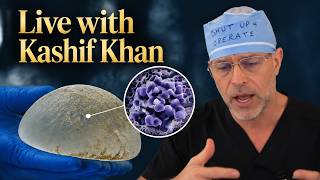
Dr. Robert Whitfield, a plastic surgeon, explains breast implant illness as a chronic inflammatory condition caused by bacterial contamination and biofilm formation. His PCR testing found Staphylococcus epidermidis and Cutibacterium acnes in 29% of explanted implant samples. He emphasizes that leaving the fibrous capsule behind after explantation perpetuates immune activation, and that genetic differences in detox pathways determine symptom severity.
Chapters
Just waiting to get started here. Gonna go live with Kashif Khan shortly. So let's go on live across my private community. My Substack, LinkedIn, and Facebook, YouTube, X. I'm Dr. Whitfield MD, a plastic surgeon in Austin, Texas, and we're going to discuss genetics, inflammation, uh, certain level of platform censorship that I get faced with a lot. So just waiting for him to invite me and then get on and get started.
What patients, uh, most commonly talk about to—
just waiting for the concept to get alive here.
I mentioned that the IEA chief basically said the Sorry about that.
I'm going to mute that for now. Just waiting. Couple more minutes. Testing. Just double-check everybody who's on. You can hit us in the chat or the DMs if in fact there's a problem hearing us.
So shouldn't be long now.
Just waiting to hop on. Really looking forward to this conversation today. Kashif is great. I just had him on my show recently. It'll come out relatively soon. Doesn't say he's live yet, um, just waiting.
Just turn to the side a little bit. And it's very natural, very elegant. You can see she was famous for her titties, and those are big naturals.
So this is back in— well, we're waiting to start here. Haven't got the invite yet. Be on in just a second.
And we'll see. Discussion. Um, we, uh, it's not working with it on, and I invited him here, uh, to discuss this because this issue of breast implant illness needs this support and then let's say advocacy, but nobody knows more— getting her to join. Give us one second. One second, Dr. Whitfield MD is going to connect and then we're going to jump right in. Good to see you guys. Hey, Beth, how you doing? Here we go, there's Robert. Let me connect with him. One second. One second. And get him in here. I'm gonna get him to join and then we're gonna start. Here we go. Second.
All right. All right, we're here, we're here, we're here, we're here.
Yeah, we're here. You're in the middle of surgery? Where are you?
Yeah, I was doing some work earlier.
Okay, cool. Well, the intention is— I think everyone knows why we're here. Uh, we're going to record this now. A lot of people are going to watch the recording when they have time later, right? Uh, intention is, uh, to just document this because I went to Austin a few weeks ago, met Dr. Whitfield. Um, I would say 7, 8 years ago, I read this article about breast implant illness and I realized that a lot of people that I was dealing with in our clinical practice with these like sort of ubiquitous, like it's just everything is going wrong type symptoms. And I realized, oh, it must be the implants because over and over again I see it. Then I met Dr. Whitfield MD at a conference and he was trying to understand the genetics of detox, etc. We put our minds together and he taught me everything I know about breast implant illness through his research. So I invited him here because now he's been doing it for so long and he's been so outspoken that I would say he's the most censored doctor on the internet right now in terms of, uh, you know, at this time last year, look at this, it was like 20 million, and now you can't find him, right? And this is very intentional because of when you start to speak loud, the people notice, right? So, um, so first of all, is breast implant illness real?
Yeah, first of all, you know, I'm glad you brought me on. I feel like, uh, I am one of the most censored people now. Um, we've put forth so much information to educate and help patients make informed decisions about implants. I feel like that's the problem. Breast implant illness is a chronic inflammatory process of which a medical device, in this case a breast implant, is playing a central role.
And so why— I know that when I met you, uh, you were in the early stages of the research, right? But you knew enough where you had already started poking holes at government bodies. I think you wanted to speak— was it in front of the FDA, or where was it?
Right. So we, uh, I was president-elect of the research foundation. I went to the FDA and gave public testimony because they didn't recognize me at that point in 2019. But now I feel like we've published the largest series in the world of PCR-tested scar tissue samples from explant patients showing that 29% have bacterial contamination. So that's a huge deal, Kashif, because the bacteria interacts with the breast tissue and causes more of an oxidative reaction. And we all know, as you know, oxidative reactions put more burden on us. And that's what leads to more and more symptoms of breast implant illness.
So you know this, and people should know the reason why Dr. Whitfield knows this is not only did he genetically sequence the patients he was studying, he also sequenced the explants. So he removed all these implants and didn't toss them in the trash. He actually researched and studied them to see the microbial activity and everything that was on the explants. How did you do that?
Yeah, so we take a thumbnail-sized piece and send it to a company for PCR testing. So they tested against 150 types of bacteria, fungus, and mycobacteria. And the two most dominant species found of bacteria are Staph epidermidis and Cutibacterium acnes, both of which are found in the skin of the face, neck, chest. Staph epi is all over the body. It's, you know, one of the bacteria we're colonized with.
So how does that happen? Like, why does it accumulate in the implant?
Yeah, that's a great question. There's three ways. So an implant can be opened in the operating room and contaminated by the staff before it ever gets to the surgeon. The surgeon could contaminate it on placement. And then the third, and really the most frequently thought of way to get bacterial contamination, is through bloodstream activity from the bacteria. So if you get a cut, a pneumonia, urinary tract infection, a bowel infection, some kind of infection or inflammatory process which bacteria get into your bloodstream, they can contaminate the implant, whether it's a breast implant, a heart valve, a knee implant, neurological implants, because they're not alive, they're prosthetic, they're, they're just devices, and they, uh, the bacteria attach to it and create this biofilm. These two readily produce biofilm. And that interaction is what causes that oxidative reaction between, in this case, an oleic acid, which is a fatty acid in the breast tissue, and that ultimately goes downstream to cause more immune system activation. So people often think they have an autoimmune disorder. Now, autoimmune disorders started in the late 1800s. They're not new, but these devices create such autoimmune stimulation, particularly the textured devices, that in 2019 were pulled from the market all over the world because of the irritation and the promotion of breast implant-associated anaplastic large cell lymphoma. So it can lead to a cancer.
So it's kind of like your, your body has exposures, your body has a detox system, but the implant doesn't have a detox system. It's just a static piece of equipment, medical equipment. So whatever accumulates just stays and accumulates and accumulates and accumulates. So what we're told So somebody might hear this and then they'll go to their doctor. The doctor will say, no, the body produces a capsule around the implant to protect you, and that capsule should prevent any of this nonsense that you're hearing Dr. Whitfield talk about. Is what you say to most people, right?
So the capsule is not impervious, so that allows communication between the bacteria on the implant in your tissues. Think of like something that's crocheted or stretched apart. You can see right through it, almost like a screen door, right? So that's really what that collagen sac is. That's the scar tissue that forms around an implant. It's not impervious. It's your body's reaction. Now, there's a great paper that came out of Denmark last summer that shows that at the tissue level, the people can have more and more reactivity, including antibody production, kind of like you're rejecting an organ. So it makes sense. Think of like, I get these calls from all over the world and they'll say, you know, I'm still symptomatic after I had my implants removed. And I say, did they take the scar tissue out, the capsule around it? And people say no. If they say no, I say, you know, in our experience, patients can still have immune system symptoms from that capsular material. Think of the shell of the capsule. It has chemicals, heavy metals in it. Debris can come off of that and stick into your scar tissue. Now your scar tissue can react to that like a foreign body reaction. It can be ongoing. So if they were just to open the incision, take the implant out and remove it and leave the scar tissue, that debris would still be there. Worse, Kashif, if it's ruptured silicone gel and they don't get the gel out, which is very hard to do, then you have that ongoing stimulation, if that makes sense.
The systemic is not even isolated here. The plastic leaches throughout the body. And, you know, speaking about plastic leaching, there's something that I learned from you that I often tell people that you got in a lot of trouble for, for no good reason. It's so silly that the things that matter the most are the things that you're not allowed to talk about because of— and that tells you who— what the regulatory body's priorities are, right? So I remember you teaching me about, hey, did you ever think about a woman with implants sitting in a red light sauna, which now everybody's doing, and that red light that penetrates deep beyond the subcutaneous tissue into the implant, which is sitting right here? It's not even deep, it's like at surface level. What is happening to that silicone? So now, I remember you talking about this, and that was one of the big reasons why it got shut down, even though it's the thing exactly that women need to know. So what is going on there?
Right, so everybody knows the story of the water bottle and phthalates. So plastic water bottles are made firm by the plasticizer phthalate, but if you heat that water bottle up to a temperature that then allows the phthalate to leach out into the water and you drink it, you raise your phthalate level, which is a known endocrine disruptor. So my client Lauren Bostic had a barrel sauna at her home she used that would reach temperatures above 200°F. So she became more and more symptomatic per her and her husband Michael once she did that. That means, Kostya, she was having a Herxheimer-type reaction. So she was causing more toxicity in her system than she could actually handle, right? Genetically, we can detox so much, but she was exceeding her capacity. She was making herself symptomatic. And then when we did her tox test after a glutathione challenge— so everybody should understand, we run a stack of supplements to support genetic pathways. That's all we do. We're trying to improve antioxidant pathways. Glutathione pathways, methylation pathways, and vitamin D metabolism. Those are the principal pathways we want to support. So we did her tox test and she had the most heavy metals, a whole page of heavy metals on a tox test in and above the 95th percentile, which is the red, the worst. And I said to her, I'm like, I printed it out for her, Kashif, because I'd never seen one like this. And I took it to her and I was like, this is from you using your sauna. And so she joked with me, she's like, I think I'm just melting my implants. And so on her show, The Skinny Confidential, which has a huge following, uh, I said that about it. I said, yeah, I think you're just melting your implants, when in fact the proper term is leaching. So I think a bunch of people took that to heart and just stopped doing that practice. So I don't— I can't give you the answer to the question, but I have I think principally the Sentinel case, if you will, or the example for that in the world with her.
What we know that silicone does melt at like 240, 250, right? So you're not too far off.
That was their argument. That was their argument. You haven't even reached the melting point, but degradation is different than melting, right? So degradation is different.
Yeah. And the phthalates themselves, like, I would say they're even more of a threat than the silicone, right? So the, like, the thing that's going to wreck your hormones, it's carcinogenic, it's leaching everywhere. So yeah, and this is unfortunate that Dr. Rob went out and educated the world and then got sort of gaslit and shut down for doing so. Now I already see people talking about, uh, you know, I want to know more, how do I work with you? We're going to keep this conversation going, uh, but Dr. Rob has been kind enough to offer his team to do free calls with all you guys to understand what your needs are. And, you know, and if you— if anyone needs help here, whether it's just understanding if you have autoimmune issues, if you feel sick, if you feel like you're depressed or low fatigue, energy, brain fog, and you're wondering if your implants are involved, just know that Dr. Rob has done the genetic research with me. So if he understands the genetics of it all, he can help you. He also has the ability to not just strictly go straight to surgery but work on things like detoxification and protocols around your detox pathways. He's done a lot of research there, so you can go ahead and book that call, right? Uh, and you'll get that, uh, that— so you'll help people just sort of get a free, uh, intake, let's say. Yeah, okay.
So I think, Kashif, one of the main things now is a lot of people are getting offered explants and there's no support around it, right? So Kashif knows we built an entire program and it's run by detox practitioners with functional medicine training, but very unique functional medicine training. They happen to be patients of mine. They've had explant surgery, so they know all too well the experiences had and the ones that are being had by patients who don't get supported. So whether it's with the proper group type support emotionally or psychologically, but we have all of the testing support all the supplement support, and we do homeopathic detox with Cellcore products. And we use other detox protocols as well, including things for mold, parasite protocols if necessary. So it's a much, much more complicated problem than just removal of a device.
Yeah, and this is where even just the simple, like, the en bloc, like removing the actual capsule or just the explant itself, like you remove this explant without the knowledge of, well, what about this fleshy capsule that's holding all the toxins? I just leave it in there too. This is where anyone that's considering doing this work or needs help, make sure whoever you're talking to knows what they're doing. And I would say Dr. Robert Whitfield MD MD is the world's best right now. And so why we started this conversation, literally at this time last year, 26 million views, everyone in this sort of podcast world and YouTube world, literally thousands of videos all educating the world on breast implant illness. And then one day, what, Dr. Robert Whitfield MD MD wakes up and they're all gone? Right. YouTube shut it down. And the silliest thing, they're saying that this is— you're using the word breast, it's sexually explicit. Right, right. Meanwhile, he's saving women from autoimmunity from their implants. And now, having said all that, okay, let the YouTube overlords not want you to help people. Does everyone need help, or are there certain genetic profiles that are more susceptible? Like, if somebody discusses with you, like, hey, I have implants, but I don't know if they're going to make me sick, is it potentially somebody that's, that's okay?
Yeah, you know, we put it in two different books, so none of it's secret anymore. We have two books out, The Sharp Method, which is our methodology, and then we wrote a book just about BII called Breast Implants Explant Surgery and Breast Implant Illness. So the thing is, I know genetically, like you know, there are certain profiles that detox better, so they can tolerate more, they have more reserve, more resiliency, and we don't see as many symptoms in those patients. But the worst possible genetic detox profiles have the most symptoms of breast implant illness. So if you don't methylate well, which 36% of the population doesn't methylate well, if you don't also have a good strong vitamin D pathway, if you don't have a good glutathione pathway, or if you have a really poor antioxidant pathway, those things, those 4 are really going to set you up. And then all you need, Kashif, is to have a, um, a pathway where your estrogen metabolism is bad, where you have high amounts of estrone, and you have the worst possible environment for this.
Yeah, so it sounds like it's not like a single lever that gets pulled, but all these multiple areas of already having some level of inflammation from poor detox pathways. So you mentioned glucuronidation, for example. So glucuronidation usually is discussed around like hormone detox, like DHT, you know, the potent form of testosterone. But now we know it also plays a role in sort of biotoxins like mold. Right, right. And so, and now we know that the one of the things that you commonly find when you do the PCR testing is mold and microbes and things of that nature. Right. And so the mold could have come from anywhere.
Yeah, I think, I think we see more people have mold as an environmental exposure. And so I see that on the urine tox test. That means, like you're saying, it's bound in the liver, it's stuck in the liver, particularly can't get out because the enterohepatic circulation then reabsorbs it because it, it sticks to the bile salt. So your body doesn't want to lose the bile salts. But when we look at the implants, they don't have mold. 5 out of my first 1,000 had fungus, which is mold, and It is, it is an underappreciated problem. I think you worked in an environment where you got a lot of exposure, and whether it was mold or environmental toxins, it put a big burden on your liver and made you sick.
Yeah, yeah, we saw the same thing. Our research is similar to yours, uh, very deep connection between breast implant illness and mold. And for those of you just joining, we have Dr. Robert Whitfield MD here. He's the world-leading sort of thought leader on breast implant illness and why some women struggle and some don't, why some get their implants and they're fine for 10 years and some get autoimmune issues and some get fatigue and brain fog. And it's all labeled as various symptoms and diseases when it's all rooted in the implant itself. And so Dr. Rob has been doing this research for some time, not only the genetic research of the patients, but he's also removed the implants or explanted them, as it's called, and studied PCR testing of the actual material to know what is in there that's causing the damage, right? So now there's a, there's a test that I saw done in California where through energetics frequency you can understand what's in the body, and it actually showed microplastics, right?
Okay.
And so I, I saw this young lady who had implants for some time, explanted them to feel better, and she went for the scan, and head to toe she was loaded with microplastics. Okay. Right, so now this area, um, is this something where— I know you have this detox protocol, right, and you set people up for success pre and post. You get them ready and you help them recover. Can we even address this microplastic issue?
Yeah, I think it's— it kind of starts where we were at in the beginning, like what are the exposures? What did you get? How did you get the microplastics? I haven't had it be a uniquely implant-based situation because I've had patients come to me for detox for other reasons and they have microplastics but don't have implants. So I don't think it's a, you know, cause and effect situation there. I think it's the accumulation of our exposures individually over time where we grew up, the food we ate, the fluids we drank, the air we breathed, the products we applied to our skin. I mean, all those things have honestly, you know, led us to where we are, you know, daily. So I talk about patients, uh, I talk about that with our patients to try to really impress upon them that the decisions they make daily about how they eat and drink and what they apply to their bodies and the things they put on their bodies make a big difference for them.
So you don't think the microplastics are necessary from the implant itself, but just general exposure?
I think so, because we've had so many instances where people have that without implants.
Okay, and now this— we keep talking about BII, breast implant illness, right? Is there something specific about that medical device, or a lot of women that are getting, you know, the, the Brazilian in the back, uh, there's people that are there— is it just that particular device, or is it for everything?
Yeah, I, I think that's a great but yet completely not resolved question because we don't have biomarkers that we can utilize outside of the research setting Dr. Mathun-Sina showed that oxylipin-10 home, which is that oxidative biomarker that's created, is measurable, but that's in a research environment. I think it would give us all a little bit more of a peace of mind if we had patients who had that elevated biomarker because everybody is so focused on, oh, Kashif, I don't have anything wrong with my blood work, but I feel like trash. Or, you know, what's the one thing I can, I can check before I make this huge decision and go see Dr. Whitfield? I mean, we know it's a big decision. I know that running our program drops inflammation. So the, the Sharp Method works by doing all the things we would do for surgical patients, but you can run it to get well, to drop your inflammation. Because I think, gosh, if you don't have a rupture, if you don't have an infection, if you don't have a degrading device, those people are going to take a period of time to recover because you have to work with them on their exposures, right? You can't just do this surgery, do a capsulectomy, and everything be rainbows and unicorns. That's just not how life works. We're accumulation of experiences and toxicity over time.
Um, so for those of you guys joining, Dr. Rob, we're talking about breast implant illness. He's the world leader in this area in terms of science, the research, and I wanted to invite him on because he's been highly censored in the last little while. So he's been saying everything on point as it should be. He's been saying exactly what we need to know. He's been solving the problems. And as soon as he started talking about stuff that made sense, they shut him down, right? He was one of the first guys to go out there and let people know that the red light sauna can actually leach chemicals from the implants back into your body. They shut him down. He's one of the first guys to start talking about, you know, the capsule that's supposedly protecting the implant doesn't actually work. It's, it's like it leaches. It has the let's say gaps and holes throughout, right? So it's not impervious to that. So, and all of what he says, what makes perfect sense and actually answer the question, keeps getting him censored. This is why I brought him on. Now, for those of you that just joined, we're going to drop a link. Uh, Dr. Rob has offered any one of you that needs a call just to understand, you can talk to his team. They're very— I've been to his office in Austin just recently, a couple weeks ago, met his team. They're incredible. They know what they're doing. So we'll drop that link right now. For you guys to just book a free call if you want, just to understand whether you have implants and you don't feel good and you want to understand if your implants are causing that. That's one, right? Or you don't have implants and you also don't feel good and you want to understand all of what Dr. Rob has learned about the various detox pathways because of all the work he's done. He's actually built a program just specifically for that. Or if you're already doing this work and you know you're there and you're about to work with somebody on an explant or your breast implant health, know that most people don't understand the prep work that you need and the post-recovery work that you need, which is the science that Dr. Rob has been building over time. So I would suggest in any one of those buckets, give him a call. He's, he's offering a call with his team for free. So just to help you guys all out that showed up today. Um, so Dr. Rob, um, We're going to post this after so everybody has access. And, you know, there's some people here live, but many thousands of people will see it. You're— you used to do a road tour. You're all over the United States speaking at conferences. You're on all the major podcasts, right? A lot of people have picked up on the science that you created, and there's people advertising explants.
Yeah.
So So what are the warning signs that someone doesn't know what they're doing? Meaning that you're not getting the full service.
Yeah, I think I'm glad you brought that up. So like, this is unfortunately become a revenue stream for practices, meaning that they're still putting implants in and now they're offering to take them out. Now there is, uh, in my mind, not a shortcut to this because your scar tissue now that's been up against this device has been shown to be reactive, almost like it's rejecting an organ. So that happens, and we already talked about debris coming off of the shell and being stuck in the tissues and creating ongoing symptomology. So I think what each person needs to understand and be educated upon is I believe strongly in capsulectomy because a third of them basically are infected. I feel strongly in it because the debris and the materials can come off and sit in that tissue and cause ongoing immune system activation. So if someone's telling you a capsulectomy is either unsafe or unnecessary or unfounded, those are not good conversations to be had because there's absolutely no evidence to support that. I have the largest series in the world that shows that they have bacterial contamination. That's done. That's not an issue. Leaving a ruptured or broken device in anybody sounds fucking stupid to me, so I would never do that. And I wouldn't encourage anybody to believe a story that they're being told that it's okay to leave a ruptured device in them, or to take it out under local in the office, which I also find to be completely unethical and absurd, which has happened recently. And somebody was sent to me because they had a rupture device taken out under local in a procedure room in an office. Do you know how stupid that sounds? Do you ever think you could take a— think of like a broken jar full of jelly, Kashif, and you're trying to get all that wiped out of somebody's breast pocket while they're awake? That sounds like a great plan. That is ignorant. That's never going to work, and you're going to leave somebody in a bad, um, like a bad, uh, you know, state of immune system activation over it. Now the other thing is all this fear-mongering about doing capsule surgery, like removing scar tissue. This is not rocket science. If the surgeon you're seeing says the capsule cannot be removed because it's dangerous, then you need to do this: turn around and leave. Because that person should not be doing that surgery because either they don't believe in it, they don't understand it, or they're not talented or experienced enough to do it. Neither of those, you know, really should come into play. The right conversation would be to say, Kashif, hey, you know, Mrs. Smith, um, I feel like a capsulectomy is probably what you need with implant removal. I don't do that. I'm not comfortable with it. I haven't done enough. That would be okay. That would be the appropriate thing to say. Or you can say, I don't know, and go see Rob. He's in Austin, or watch one of his 3,000 videos or 160 podcasts or read one of his books. But don't tell a patient it's scary, unsafe, unnecessary. Those are not founded. They're not logical. You just sound like an ass.
Yeah, there's a lot of the indoctrination of the insecurity that doctors are fed to make them the conduit to the truth, right? They're forcing that position, which maintains their position. But this is— this happens in everything. There's thought leadership, there's deep intelligence science, which is what you've been researching for. I think I met you like 7 or 8 years ago when you started, right? So for, for almost a decade, you've been building this science, and then somebody just sees a surface level and says, Well, I can put this on the menu, right?
Right.
But that same guy is also— so do you no longer do implants?
Yeah, we haven't placed an implant in over 5 years now. Um, we used to help patients who were— think of like implant cripples. So they had had multiple revision surgeries, and due to my background in oncologic reconstruction for breast cancer patients, I had a lot of experience with revision surgeries. So we would help those patients, but in general Anytime I would help one of those patients, I'd always be worried because ultimately they're going to potentially have the same problems. So finally I just stopped because it made no sense anymore. And when I was doing oncologic reconstruction using the microsurgical technique, uh, for the deep flap, the DIEP free flap, I knew before I knew that if I took all the scar tissue and the implant material out of breast cancer patient who was having trouble, and I replaced it with their own tissue, and I hooked up the blood vessels, it would basically be like their own kidney transplant or organ transplant, and they would heal because they had good blood flow. They didn't have foreign tissue. If they had an infection, you could treat it because they didn't have that, uh, foreign body anymore. So all that is just intuitive, right? That's just the way we work. That's how our body works. Now, if I take all this stuff out, we run our program, we get everybody better. That's the way it should be. That's the right way to do it. That's how we should help patients, right? We shouldn't be scaring patients.
I think the one thing you said there says a lot, which is you don't do implants anymore. Yeah. So walking into an office saying, yeah, I'll help you remove your implants, but the next room over to someone's getting implants, right? I'm not saying implants good or bad. You understand the genetics that for some people it's not such a big deal, but for many, many people it is a very big deal and it's the reason why they feel so sick, right? And so if that's your moral compass where you have the, you know, conflicting neighboring rooms doing two completely opposite things, I don't know if that's the best place to go. So yeah, and that says a lot because Robert literally cut off that part of his business because he saw the impact and how important— and he hyper-focused on the research. Now keep in mind, this research, you know, we're— I know we're going over time here, but there's one last thought. Nobody helped with this research. Dr. Whitfield paid for this himself, right? Hundreds and hundreds and hundreds of PCR testing, hundreds and hundreds, hundreds of genetic testing, hundreds and hundreds of experimenting with detox pathways that he He did this out of his own pocket because nobody would support the research, right? And that's why he happens to have this world-leading research and, and open the doors to all the other doctors that are now talking about explants that came from him. You're looking at the guy that stood in front of the FDA, was the first to actually talk about it, right? And at that time he got booed off stage. He's like, ah, it's not a big deal because of the lobbies that control things. But now they can't deny it anymore. And so you have a pioneer sitting in front of you who is the guy that opened the door to women understanding why they feel so rough. Right? So thank you for all that work. Thank you for putting your money where your mouth is and literally paying for the research, you know. Thank you for helping so many people. I'm, I, I'm sorry that what, you know, what the world is doing and censoring your many thousands of hours of content that I used to be able to watch on YouTube and learn from, and they've taken it all down, you know. And that's unfortunate, which is why we wanted to do this today. Yeah. So, okay, I'm going to be sharing and posting this, uh, on Instagram. And we're going to add a link, uh, where Dr. Rob's team— if anybody has a concern, whether you, you think that this sounds like you, that you have implants, you don't feel well, or whether you just want to understand Dr. Rob's research on detox pathways and why some people struggle more than others, right? Whatever it is, um, you can go ahead and book that call. We'll share the link when I post this video, which we're going to do right now. If you want to share it and send it to other people, any woman that you know that has the implant, any woman that you know that feels like she has autoimmunity, fatigue, brain fog, any of these random symptoms that nobody can figure out the reason, right? Let Dr. Rob's team help them on the detox pathways and understanding where these problems come from, right? So with that, thank you for taking the time. I know you're in between surgeries, so go ahead and go back into the operating room. I don't know who's lying on a table waiting for you. Uh, we will post this right now and we'll share all the links, and you guys take advantage of Dr. Robert's kindness. He's going to help you guys out.
Thank you, Kasia.
All right, see you guys.







