Parasites, Mold & Toxins: The Hidden Epidemic Causing Your Mystery Symptoms | Dr. Todd Watts
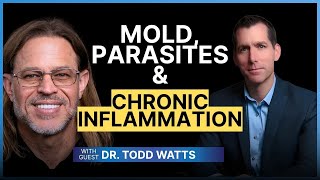
A recorded interview between Dr. Robert Whitfield and Dr. Todd Watts exploring environmental toxins (glyphosate, atrazine, organophosphates), mold exposure, and parasites as under-recognized drivers of chronic illness. They mix clinical anecdotes (patients with refractory infections, sinus aspergillus, neurocysticercosis), practical treatment concepts (detoxification, binders, concurrent parasite and toxin removal), and lifestyle/prevention advice (nutrition, exercise, indoor air and housing remediation). The conversation also touches on public-health concerns (pesticide use patterns, banned compounds abroad), diagnostic challenges, and the role of community and behavior change in improving outcomes.
Chapters
Foreign.
Welcome to the show. Today I have Dr. Todd Watts. He is a national board certified chiropractor physician in Idaho, a functional wellness practitioner. He is, as many know him, the parasite guy. With also an extensive knowledge in functional blood chemistry, biochemistry as well as he's been very motivated in helping patients with chronic illness overcome their struggles and restore their health. He is also the co founder of Cell Core Biosciences and loves to research to formulate products which will change the world. He has an amazing health journey that we're going to speak to him about today and that's what motivates him to help and lead others. We are really excited to have Dr. Todd on the show today. Dr. Watts, one of the co founders of Cellcore. We've kind of joked offline about various nicknames we won't use today, but it's a pleasure to have you on the show. I've certainly learned a lot going to ECO and from being involved with cellcore as a traditionally trained allopathic physician, it's been quite the education for me to come and visit at the meetings and learn from you and all the other folks that come and teach there because it's, it's quite a departure. So I, I look forward to this conversation today for quite a while and I know it's taken a little while to get you scheduled, but welcome to the show.
Thanks for having me on. It's awesome. I appreciate all the work you do and you know, helping so many people, whether they're self core people or even my own family. So thank you.
Yeah, I, I.
I sometimes, you know, we were, we were talking offline about a meeting I was at recently and sometimes I sit there and I wonder like, oh, how did I get here? This has been quite the interesting path.
And then I recently was granted the opportunity to come and speak at ECO this past year in Idaho, which was awesome. And somebody actually at this meeting I was at this week in Austin came up to me and said, oh, I heard you speak at eco. Thank you very much. And so it was super special for you all to have me there and speak and.
Certainly our providers that we have use CellCore to help our patients with detoxification pre op and post op. And it's certainly been impactful on our program. But I always like and remember back and subconsciously your talk you gave about Atrazine just kind of sticks in my head. And every time I see Atrazine on a report I immediately go back to your talk and maybe just start there. Like what got you so Interested in toxicity and evaluating toxicity and things like atrazine. Because obviously, probably when you train, that wasn't obviously a thing. That was, you know, part of training, a part of curriculum, other than there's a lot of environmental toxicity. But it's just getting worse now.
It. It is getting worse. I think part of what brought it to my awareness was my own health journey. So going at 40, finding out I had Lyme disease issues like Lyme and Babesian co infections, and just going to my own journey of like, okay, how do I get better? All right, I dress Lyme, addressed co infections, but I still don't feel well, so. And I still cycle to like I do well, then I crash. So. So then it got me into parasites, right? Which the nickname parasite guy that we talked about earlier. And Jay just seemed to love to introduce me that way all the time. From there, it's like, okay, I'm doing a lot better, but there's still something I'm missing. And. And then I went down the rabbit hole of environmental toxins. And one of the foremost experts in environmental toxins is Dr. Don Huber. And he's. He's probably in his 90s now, but he was an emeritus professor of plant. Plant pathology in Indiana, Purdue. So he. He'd been studying and had the most research over anybody on glyphosate.
Okay.
Came out in 1974. He started studying in 1975 and had accumulated all these things of how it affected our bodies and enzymatic reactions. And so it was the number one use. It's the most used chemical in our food supply today. We presented on glyphosate and all the different things over and over over the years. But then I started looking at, okay, what else is there? Because there's a lot of other chemicals. There's 82,000 or 86,000 chemicals out there, like 42,000 active chemicals. This is back in 2012, so even more today. And atrazine is the number two chemical. So then I dove into that. I'm like, if this is used on corn, that means all our high fructose corn syrup, anything that's a corn derivative probably has atrazine, macadamia nuts. And there's a whole list of foods that it's sprayed on separate from glyphosate. And so then that rabbit hole showed all kinds of different issues with feminization of men today and obesity and masculinity, you know, masculinizing women. Just. Just. It's a massive hormonal disruptor. So then it was a great thing to be able to present on and see the scientific research.
And I'm glad you explained it that way. So I trained at Indiana and Purdue University is obviously in the States and it has a really rich history in training around agriculture, obviously. And Dr. Huber's work is at two point very famous as it relates to glyphosate.
Which was introduced by monsanto in the 70s under the name Roundup. So everybody like glyphosate, Roundup those things, just so we can put those two together and we don't have a pathway to deal with that in our body. So that can build up in us, right?
Yeah. And it, it's a, it's an really, it's an antibiotic. It kills the good microbiome and then it also is a chelator, meaning that it binds our minerals. So those are the two things that glyphosate's doing. And it's also depleting the minerals out of the soil and killing the good microbes in the soil. And so we're not getting the nutrients in our food supply today that we once had. So, sure, it can kill, you know, weeds, but, but the fact is, is it's not good for the environment nor is it good for our, our body because it disrupts specific pathways for the bacteria in our, in our microbiome.
Right. So impairs our microbiome and then binds our minerals, things like manganese or zinc through iron. And that's obviously it can lead to all sorts of downstream problems, especially for instance in women who are menstruating, if you're, you're binding up their iron, you're going to make them have more problems. With anemia, we see that in obviously in parasitic infections or overgrowths as well. So there's all sorts of downstream effects of that. And then.
I see those on our test results routinely. And certainly I always ask patients, are you living around or did you grow up around an agricultural area? And one patient in particular said, oh yeah, I grew up in the Central Valley of California. And she's like, oh yeah, we used to run under the crop duster as kids because that was fun. So not only were you getting exposed in the food supply, you were just running under it. And certainly, and you probably obviously can speak to it more than I can. It affects, you know, DNA repair. It has all sorts of other effects as well that can really lead to. What I saw in this patient was a, a difficulty to deal with shingles.
They were treating the patient appropriately medically and.
They couldn't figure out why she wouldn't respond. And so she. I know her daughter, and I've taken care of both of them. And so she. She called up the office on behalf of her mom and said, you know, Dr. Whitfield, see my mom. And we were fortunate enough that we had a tox test on her previously from a. For a different reason. And I went back and I'm like, well, you have this really high glyphosate level. This is why this doesn't work. So, you know, we put her back on detox, and we use cell core for detox. And.
She got better finally, and those things healed. But she had open, you know, residual.
You know.
Like, on her face. I mean, she had all the distribution of shingles on her face. It was just really sad to see it. And I. I get how it's super confusing because I had. I not had that information, I wouldn't have known what was going on with her. So I feel very fortunate I've got that additional, you know, amount of. Of education. I'm certainly, certainly curious. You know, the. The atrazine. The talk that you gave about atrazine was particularly poignant because I have many, many patients who've lived on or grown up around golf courses, and atrazine was sprayed on golf courses for a very long period of time. I believe I found it. Up until maybe 2008, I found it, and then it was either restricted or taken off or something like that. I can't. Maybe you can just speak to that for a moment.
They just changed it to something else, a different chemical. Different chemical, yes, of course. It's. They're. The lawn is still really beautiful. And they just. It gets enough to where it builds up to where they're getting enough complaints about what's happening, the reactions. Atrazine was used on the lawns for years, but.
You know, it does cause so many disruptions, not only in skin quality ashes they have problems with. And glyphosate does the same thing. Like, I had a little girl that came in and her hands were just dried out. Looked like they were all dried out and bleeding holes and things. And the mom brought her in after taking her to the dermatologist, having no results with the steroid creams and stuff they were using. And I just put her on, you know, one of the binders, and literally in three weeks, completely cleared up. You know, come to find out she'd been playing soccer since she was 3, out in the playground all the time. And. And so she's just exposed to those chemicals that are in the grass. Right.
So I. I misspoke. So that it was banned in the European Union in 2004.
Not bad here, right?
It wasn't bad here. I'm sorry. I didn't mean to misspeak. I have this running joke on my computer of things that are okay here and not okay in other parts of the world. And I need my own AI agent to keep me straight, I guess, on all the things, because there's so many things that are obviously banned other places that are still okay here. Um, so that was another one where this patient just was not doing well after surgery, and.
We had to just modify the detox to help accommodate for the atrazine level. She had a really high atrazine level. And it's. It's. It's not surprising that she was, you know, having the experience she was having. But then that's why we test and retest to see, like, what's going on with the atrazine levels or the glyphosate levels. And.
I also have a lot of people with organophosphates from a state called Florida.
And it's pretty amazing, the levels that you see there.
It's.
I had a.
A patient, she's in her mid-30s, and she was having difficulty processing information and. And, you know, choosing words and, you.
Know.
Kind of synthesizing the thought and getting it out and everything. And she was, you know, rightfully so. She was getting upset about this. And, you know, we did her. Her test, and she had.
Dda, dde, tpa. I mean, she had all these organophosphates. And I was like, well, this is why you are. These are direct neurologic.
Issues from this, you know, pesticide. And she's like, really? And I'm like, I mean, that's. Yes. It's basically, you're describing the description of the side effects of having too much of this, you know, in your system.
Maybe. You know, I guess I would appreciate your opinion, too, about these organophosphates and similarly, you know, glyphosates and atrazine. I think organophosphates, my experience, seem to be the other ones that are most frequent. And we can talk about mycotoxins a little bit, but, man, these organophosphates are really bad as well.
They are, but I. I think I see those on the labs I used to run all the time in the clinic. I see the phosphates is the top thing all the time.
That was the. Okay, yeah.
So it's it's not uncommon that that's the case, but it's. It's. We're. We live in a world that you can't avoid them. The Midwest is, like, loaded with. They're the worst when it comes to atrazine and glyphosate. But then other places are much worse when it. Like the south, especially with organophosphates, all the pesticides. And then you get into stuff that they're spraying for mosquitoes. And.
I guess that's why, you know, obviously, my.
I get concerned when I get anybody, you know, from the Gulf area, including our side of the Gulf. But, you know, as it pertains to the eastern seaboard of the Gulf.
The. The amount of spraying that goes on there. Because I asked patients, like, where is this coming from? And they'll be like, well, they come by every week and spray.
And.
And then one of the spouses said, oh, my wife goes out and pulls weeds by hand.
Okay.
Or the dog comes in the house or whatever. And I'm like, oh. I mean, so literally, your whole environment is full of that.
They just go walking. You know, we go for walks all the time, and we don't. They don't spray very often here. But mosquitoes aren't near as bad in Idaho as they are because we're a dry climate, as they are in the. Down in the South. Right. But our issue where I live is. Is the agriculture, right?
Big old corn fields, and so then you got these planes, crop dust, you know, my cussing, you know. Son of a dick. And then that goes for about 60 miles away or so. And so I'm like, all right, everybody be taking your binders. But it says it's hard to avoid it. I don't want to live in the city. But you live in the city. You have other. You have other things that are going on there. So we live out in the country a little bit just to get some space. And. And unfortunately. And all we can do is keep advocating for a cleaner environment and more organic farming.
That has been the. You know, obviously, in Austin.
I think we have a lot of people interested, you know, in regenerative farming and things of that nature. And we're pretty fortunate. We go to a farmer's market every weekend, and we can get. Obviously, in Texas, I can get, you know, animal protein, really not a problem here. Now getting other things is a problem. Like fruits and vegetables are a problem here. That's a challenge because the environment around Texas is pretty dry. It gets really hot. So a lot of Things come up from Mexico. But you know, as a, as it.
And we're, we're close enough that we have a fair amount of mosquitoes plus we have water here. So and I am the, in the person the mosquitoes love the most, myself and my daughter. So we're always getting, you know, the bites and all the stuff. So I don't, you know, and we're all acutely aware of the toxicity issues. It's like this huge thing in our family. If we use something, it's got to be extremely, you know, non toxic and you know, environmentally conscious. So it's trying to find the balance obviously. Always.
The.
I'm trying to think, well we can transition a little bit to what I see on testing, which is I, I feel like going back in training and in school, like fungal infections were super deadly, but you saw them in a very specific set of patients. Usually they were immunosuppressed from a cancer treatment or a sever injury or accident or something like a house fire. And they were burned severely. And then they became setups for these really opportunistic infections. And.
The, the kind of, the gap that I see is between like the spore forming, you know, fungi and how that affects your, your airway or you know, gives you kind of allergy like symptoms versus a pathogen where you're getting like fungimia, like you have it in your bloodstream and it's going to, you know, take you out, if you will. So maybe from what you saw or, and, and certainly I see this all the time. I see mycotoxins from the food supply, the, the, the air, the coffee. Like I see it like routinely now.
I, I, I agree and it's, it's a lot more than we should have. But I think part of it has to do with the amount of toxins that are in the environment. There's a, there's a correlation especially with the fun, the fungi and stuff that are where it'll grow and proliferate to help offset the toxicity, especially in the body. Not just the environment, but the body. So when you look at areas that have gone through radioactive material, you know, like Chernobyl and these type of places, the first thing to grow is the, you know, big mushrooms and big fungi to help absorb that radiation. Well, in our body's the same way. We're going to have a lot more Candida or Candida, however you want to pronounce that. We're going to have more fungi through the body when there's more and higher levels of toxicity. So radioactive Poisoning, whether it's environmental toxins, whether it's heavy metal, toxins in the body, it's. It's going to be upregulated, and they're going to try and metabolize and help the body to offset that. So our approach. My approach changed from what I'd usually do clinically was always like, here's some antifungals to where I would look at an O test and said, okay, you have a lot of bacteria and you have a lot of fungus here. Candida. Well, I'm gonna provide detox products to help clear the toxins to why those are upregulated. Otherwise, you're on a Candida diet for life. Because it just keeps coming back because you're not addressing the root cause.
Right, right, right. Yeah, I. I'm. I feel like that's one of the things. I'm glad you brought that up, because I was. I was talking to somebody recently, and they made a big deal about elimination diets, which I think are super, like, cruel. You know, elimination is very challenging. Like, for instance, if I just tell somebody I want them to cut out gluten and dairy, they look at me like I'm cross, you know, like I'm crazy. Like, what else could I eat that, you know, if they even know what gluten is? And if they know what gluten is, they're like, oh, everything has gluten. Well, not really. I mean, obviously a protein like salmon or a steak on itself doesn't have any gluten in it. And so I look at them like, what are you talking about? Like, would you even know what you're, like, saying when you say that? I mean, it's just kind of comical. Like.
A cruciferous vegetable doesn't have gluten in it. I mean, it's just. It's kind of the lack of appreciation or understanding from a educational standpoint, like, when you're a little kid, like, the fruits and vegetables, like, understanding like that. And there's this big push in Texas to have doctors as part of the curriculum, have nutrition in it. But, I mean, the. To me, the cat's out of the bag. If. If you're trying to add this into somebody's medical training, okay, that's fine.
That's already as you remember training. You know, you're drinking through a fire hose every day anyway, so let's just add some more stuff and see what happens. The education should actually go way back in the beginning, you know, like kindergarten. Like, that's what it should start. So it becomes like your choice not. Not speaking to a physician about, oh, I should change my diet. I've been eating the same garbage for, you know, whatever. You know, I can't have a. A Red Bull, a cigarette, and, you know, a apple turnover for breakfast. Doesn't make any sense.
The.
The kind of the dietary advice, you know, I tell people, like, mold, free coffee, and then being, you know, very careful with men. You can speak of this too, like nuts, grains in general, because they. They can have a host of problems.
So I, you know, do speak with them about the food sources contributing to mycotoxins and then the air quality. Like, we have a big problem with air quality in our area. We have a lot of mold just circulating at any given time in Austin in the air. So that. And oak and cedar are our favorite things to have in the air. So I have a lot of HEPA filters running in the office all the time. So depending on where you come from, like in Dr. Todd's neighborhood in Idaho or here in Austin, Texas, we each have different stressors. And certainly I see that a lot with air. What do you all see where you are?
The issue we have more is in the mold problem is people building houses. So they have crawl spaces here versus slab on grade. And so they'll build that crawl space, they'll get soaking wet, and they don't air it out, and they'll just keep building the house up. So if they're building in the winter and there's snow on the, you know, snow on there, then it melts and eventually creates an environment that is really good for growing mold. And so even new houses that are a year or two years old.
Can bake into the.
The build.
Yeah, they're not. They're not the build. The builders don't, you know, they don't look at it as a problem. And so they're not doing anything about drying out that crawl space and. Or, hey, what if the crawl space floods? You know, so people need to look at a closed.
Crawl space that's really tightened up and that can also moderate temperature, because when you're looking at that, it heats up in the summer, it cools down in the winter. Same with your attic space. And if you have all your stuff, your ducting, you know, it can. It can definitely sweat in the summer and. And whatnot, but it can grow mold and. And so then there's the other part of sprinkler systems and things going. Water going into the crawl space, or you get a roof leak, and then next thing you Know, you know, you're growing mold in. In the attic space. And I had that with a patient of mine here years ago, that she was having tons of anxiety, and she could barely make it through work without mental breakdowns. And I was talking to her. I'm like, man, this sounds a lot like mold. Like, so I asked, how's your husband doing? And she's like, oh, man, he's super depressed and major anxiety. Like, you guys have mold in your house. There's no way this is not happening. So they want to go. Go up in your attic, see what's happening. Just start there. Well, they went up in their attic, and what happened is somebody. It's an old house. Somebody added, you know, years ago, added onto it, and they didn't put any ventilation. And then there was a roof leak, and then the whole thing was covered in mold. And then black mold, Black mold. And then they started tearing walls out in the house just to see there's black mold going in every wall and everywhere. So they ended up just tearing the whole house down. And they had a basement, too, because it's an old home. And they tore out the basement and then buried the basement and just built a new home on top of the space.
I've heard that story one too many times, and I will tell you, people get so upset when you mention their home. I don't know what your experience has been, but if you say it's their home, people just come unglued. They're like.
Somehow.
Maybe it's just, you know, striving to have a home or whatever the, you know, the. The nature of it is. But if you just bring up their home, they just get so almost, like, combative with you when you're talking to them about it. And then finally when they realize that could be, you know, a major driver in the problem.
Then they seem to be okay. But until that point, it's really a source of contention with them and trying to.
I guess, if you want to say.
Convince them. I. I'm really not. I'm just trying to give them, like, the. The potential, you know, answers to questions that are just like you. I mean, I'm not trying to indict someone's home. I'm trying to point out, like, this is a major problem. Like, you need to figure this out. And seemingly, the. The place that has this. The most around me that I see routinely is obviously on the. On the Gulf side. We have, you know, Houston. And Houston, you know, just, like many issues in Florida, has so many problems with Just like you're mentioning, you know, moisture at times and. And, you know, the natural disasters that come along with being right in the Gulf and all the things that.
That brings. We had a patient who actually had aspergillus taken out of their sinus.
And. And I said, well, okay, I would definitely be worried about your home. And so just like you mentioned, at Roof Lake, they had one at the junction of the roof and the master's wall. And so it was just behind the wall in the master bedroom. Obviously, it was affecting her. And, you know, if you have a limited, you know, pathway, that's just a recipe for disaster. So she had anxiety, like you mentioned, and depression, like you mentioned, and all these things, and it ultimately was secondary to the home.
You know, what's interesting is these people were fantastic that I worked with, and so they were willing to make the changes. They lived in a trailer on. On their thing, and their lives completely changed, literally in 60 days. I loaded them up on carboxy and could think clearly. So many symptoms gone in 60 days. Being out of the mold. But then I had another gal that had lying really bad, and her. Her hands were. I'd worked with her over years, and it's like, I feel like your house is the problem. I could smell it on her. And I said, you're living in mold. You need to sell your home and move. And she just couldn't do it. And, you know, eight years later, her hands were completely arthritic and bent over. She's almost blind, Just psoriasis all over her whole body. And I just. I couldn't ever get through to. To her on the need to get her house remediated. She said she couldn't afford it. I'm like, well, then just sell your house. Get somebody to, you know, somehow remediate. Get a loan on your house, remediate it and sell it. It just.
It was.
It killed her, essentially. It killed her. And I don't know if she's even alive anymore. And I just. I just couldn't convince her to do it.
I'm glad you bring it up that way, because I don't. You know, if we're looking at health span and lifespan and trying to get those two.
You know, more coordinated, right, because you don't want to live a long life and have a terrible state of health. If you want to.
Live and have. Instead of the last, whatever, five or ten years being in extreme decline, you want to be as vibrant as possible. And I always, like, sit there and I try to think of aging and health.
Along the lines of organ inflammation. So, like, what's affecting my brain? What's affecting our livers or kidneys, our lungs, GI tracts, joints? And they're all going to be different, right, Dr. Todd? They all behave a little bit different. The biologic clocks are all different, and sensitivities are different, certainly. But.
I just think about just like you highlight. That sounds like somebody with so much inflammation affecting so many different aspects of their. Their body that it's ultimately what's gonna, you know, take someone out.
That's sad.
Inflammation is a.
That's really at the core of everything and trying to reduce it. I often get asked too, like, you know, because everybody knows I do explant surgery, and they're like, what do you do to make the diagnosis? I'm like, all right, so if you have chronic inflammation and you have an implant, you just have more chronic inflammation. Yeah, and I have the same exact symptoms of chronic inflammation without an implant. Right. I mean, that's just. You're describing people. I'm describing people. And chronic inflammation is just a continuum. Everybody's going to do, you know, cope with their, you know, genetics and exposures and diet and air and fluid and food quality to basically present to us how they present to us. And then mine just happened to be presenting with a prosthetic device in place. But it could be the same if you had a hip, knee, dental implants, breast implants, neurologic stimulator, whatever, defibrillator. I've been called to take care of all these things at one time or another in my career that were infected or problematic. And, you know, ongoing inflammation is going to be the thing that really undoes all the. All the. The things we're striving for in terms of health and longevity.
Yeah, absolutely.
Yeah, go ahead.
It just. It goes back to so much of it is lifestyle and how preventative you're. You're making it as far as what are your priorities. If hit me, I just hit 57 here a few days ago, and people always tell me how young I look for my age, but I'm also, you know, I'm active. I'm out tennis court with my kids. I coach tennis from middle school with my. With my boys, I help coach basketball. You remain active, but I've had an active lifestyle my whole life. Also eating when I grew up, my mom was one of those organic type of people back in the 70s and 80s where we would grind our own wheat and make everything from scratch. None of this processed foods. We would never buy Twinkies and, and Ding Dongs and chips. None of that stuff was in my home growing up. We didn't have sugar. She made everything with raw honey. And I look back as a kid, I was always wondering what all those other kids had. But you know, at the same time now I look back at it like, man, that's why, that's why I. Probably a lot of us are so healthy and don't have a lot of the similar health issues is because of being active, being outside.
Right.
Yeah, that's, that's definitely a difference maker for sure. And that's not how I was raised. I was, I definitely had some ultra processed foods growing up for sure. And now, you know, give all the credit, you know, to my wife. She's been, you know, really diligent about.
And more so over the last last decade since we figured out, you know, gluten sensitivity was such a big player and my personal genetics and then that of our kids. So that has been, you know, a big.
Difference maker for us. But we're not the place where you come to get the juice boxes and the soda. So we don't, yeah, don't have any of that. Haven't had any of that in the house. You know, really probably since the kids were like, of the, you know, under 10 variety, probably at that point. We did have the.
Orange SL juice box fest for the soccer matches when they were tiny, but not, not in the recent decade.
And certainly, you know, it highlights to probably the same thing you have to do for your patients if you get somebody coming in who's really.
Wasn'T taught that way. Right. You, you had a very specific, you know, set of principles. And it goes back to what I said about, you know, trying to educate doctors in their, whatever, 20s about nutrition. That should have started. I, I told somebody, like, you should make an undergrad requirement. Like if you want to stop somebody, you know, from not knowing anything, then you just make it a requirement to get in a professional school. Whether it's np, dc, amd, whatever, whatever professional program of health, make it part of the, the.
Prerequisites and then you just build on it after that. But introducing the concept, it's just late to me.
Yeah, we learned it after post doctorate. Right. Just through experience and, and through clinical practice of knowing how important it is to implement those things. I mean, I grew up going to the chiropractor, going to the nature path back in the 70s and 80s. It's just, I had a different, my mom had a different perspective of things than most People did. But the, the standpoint of making these decisions really goes back to a personal responsibility on the patient. This is where I like what you were saying is let's go back to elementary school, let's go back to junior high and let's talk about nutrition and talk about processed foods. The food companies don't want that. But ultimately the health for our kids.
It'S a necessity because people aren't educated of how to eat right.
Yeah. And I heard some disturbing news out of one of my patients because Obviously once you're 18, we can't really help in a.
Or the power leaves, you know, the parents to help in decision making about health. And one of my clients told me that their 18 year old got themselves on a GLP1 agonist. And for everybody listening, that's thinking like sepiglutide or tirzepatide or one of the other GLP1s. And at 18.
You'Re doing that and she, the mom was like at a loss because she can't do anything. She doesn't control or have any ability to control like what's happening in a doctor patient relationship with her 18 year old daughter. And I was like, oh my gosh. Yeah. Another thing.
That we shouldn't be doing, it's like a healthcare community is putting a teenager on a, a drug that definitely works. There's no doubt about that drug working. It modifies behavior, it does all sorts of things. But that was not studied in teenagers.
I have not heard that happening, but I don't doubt it.
Yeah, it was really, it was. And the mom obviously was shook a little bit, telling me that. I was like, oh my gosh. I didn't because I've had patients.
Who have problems with.
Their body image, they have body dysmorphia, they have disordered eating, they have all sorts of problems.
You know, unfortunately, you can go online and get that medication and they'll just send it to you, which I find to be just absolutely ridiculous. And.
That kind of.
You know.
Societal perspective of gotta get a pill shot drug to sort this out, you know, versus what you said was a lifestyle change, which is, you know, if you take those drugs and you don't do any resistance training or strength training, what's the outcome? Dr. Todd?
It's not good. You're losing all that muscle.
Right.
People that I've seen have success with that and they're granted, they're older, they're 40s, 50s, but they were working out, they were walking every day, they were, they were eating a really Clean diet. And they had super, super success with it because they were probably doing hormone replacement therapy along with that and then doing the exercise, the weightlifting.
Yeah, I've seen some wild successes and I've seen some gross failures of this. And the stakes are very, very high, as you would suspect. You don't want somebody who, in the female population is older, who doesn't exercise, doesn't do resistance training, and then starts losing skeletal muscle. Oh, man. That's exactly what you want to avoid.
Right? You already have probably osteopenia because you're becoming postmenopausal or your perimen or perimenopausal. Going, gonna be postmenopausal and you're not doing resistance training. And then they put you on a drug that is going to further exacerbate, you know, the problem by losing. You're going to lose muscle, you're gonna lose strength, you're gonna lose power, like all the things you want to preserve so you don't fall and break your hip are.
I, I just, I think about it, I'm like, oh, my goodness, we're going to have even a more frail population than we already have.
We are. And thing is, is if, if the doctor is being responsible with the prescriptions in the places they need to be sending these recommendations out, you got to make sure you're getting the protein in, be sure you're doing weightlifting and you can be doing walking.
And, you know, trying to eat as clean as possible. It just doesn't make any sense to do it if you're just gonna be stagnant and sitting on the couch. And a lot of people are. I mean, I, I looked at personally, my mom struggled with her weight after she had eight kids and a hysterectomy. And she put on a lot of weight and for decades, up and down with different diets.
And, you know, underneath all that fat, there wasn't much muscle.
Well, right. And you're gonna do this. And so everybody wants to have a better.
State of health. They wanna live, you know, presumably longer, but you're actually going to.
How should I say this from an appearance standpoint, you're gonna age quicker because if you burn your fat, especially in your face, your neck will loosen and your jowls will get worse. So that's what they call ozempic face.
Yes.
So I see this all the time now. And then if you are to your point, like Dr. Todd is saying, if you're not actually actively exercising, doing resistance training, which he's talking about, you know, you lifting weights, walking, doing all these things, increasing your protein, you're just going to burn up skeletal muscle. And you know, we can discuss which, which drugs are cleaner and better, but you know, obviously tirzepatide has been better about avoiding skeletal muscle loss than semiglutide is. But still, to your point, if you don't do those other things for your, your lifestyle, it's gonna still be a problem.
Shouldn't, I mean, I think it should be required to do DEXA scans or some type of muscle scan to see how much muscle are you losing, how much fat are you losing, where is becoming. And you know, there's, I've seen online different options where you can have one at home. Not a DEXA scan, but a scanner that helps to measure fat and body weight and muscle. I think that's really good information if you're trying to lose weight to know what you're really losing.
Yeah, and What I do, Dr. Todd, is I have as you know, a lot of people want fat transfers after explant or just for augmentation purposes. So we get dexes on everybody and have in my intake now, have you been taking a GLP ever? Because you know, people are just getting put on them for quote unquote anti inflammatory purposes or the concept of microdosing. Just so everybody out there listening understands this, there are absolutely no studies on the term microdosing that is purely off label. It was never studied. It has not been studied today and nothing has been published to date.
That is absolutely, you know, uncharted territory with these drugs. And the newer drugs that are coming are far more efficient at burning fat than the drugs we have right now.
Yeah, I, I believe it.
Interesting times.
My problem is I want to put muscle on and not burn more fat. I'm the opposite. I want to gain weight.
But you want to put on healthy weight, obviously. And you do need healthy fat. You don't, you know, being extremely low body fat, it's like anything, there's a balance and, and you know, if you are, you know, super, super lean, that's not necessarily the healthiest. So yeah, just trying to have the, the right balance.
The.
I guess, you know, we'll get back to your nickname now. I have had these patients with really difficult problems with parasites. I find this to be one of the more difficult things to get an assessment on to, you know, help them understand and then from a detoxification, detoxification standpoint, have our team work with them like give us your, you know, take on that and how we can you know, help these patients the best because I, I find it like a very underserved, underappreciated problem overall.
Yeah, so you're right, it's really hard to diagnose some of these things. You can't, you can't even diagnose unless you're doing biopsies or they're in the organ systems or in the bloodstream. And they're not just being found through a typical stool sample test. So, you know, my famous quote that I said years ago was if you have a pulse, you have a parasite.
Part of living on earth.
Right.
It's a part of the microbiome we have.
We all have one.
Yeah. In actuality, the fact is, is they really help absorb toxicity within the body.
Right.
So if you're gonna, if you're going to do parasite cleanses, you have to also look and consider on doing detoxification because in the, in research studies they did on ducks, for example, they, they gave them some medical drugs, cleared out the parasites, but then they got toxicity to some of the, the environmental toxins and had a lot of health problems. So like in humans, if you're going to do a parasite cleansing, you need to be sure that you're actually detoxing with that because they do absorb thousands of times amount of their weight of toxins within their system. So that's some of the information like we presented before at past ecos within that. But the key aspect to this is understanding that you can get them from your animals, from mosquito bites, flea bites, tick bites, just living, walking barefoot in water. You can get them in all kinds of ways in your food supply.
So if we, if we understand that, then doing good gentle cleanses. The system that we set up, that I formulated the products, right, was to help address whether they're the big ones, the cestos, the tapeworms, trematodes, which are flukes, whether the liver, pancreatic lung flukes, blood flukes, intestinal flukes. There's the nematodes which then will have the roundworm pinworms. So many kids have the pin worms, the itchy buds and you know, there's thread worms and whip worms and I mean, there's a whole, whole list of them. And then there's the protozoans and the, and those are the microscopic ones. About 70% of parasites are microscopic. You won't ever see them come out. But they do damage throughout the whole body. Joint pain, leg pain, foot pain, knee pain, hips, organs. They affect every part of the body. And so the most common, which Is malaria, believe it or not, is a parasite. It's a red blood cell parasite and is one of the number one causes of death in the world. And so the formulations are put together to help people cleanse up not only out of the intestines, but systemically. They address, they address all four categories and, and then they also address the, the eggs and the larva stages. And part of doing this is you got to be sure that you're going to the bathroom if you're, if you're constipated, you have to either do enemas or take some vitamin C or magnesium, a bowel mover or something to be sure the bowels are moving. And, and not only that then allows you to detox. So if you're, if you're continuing backed up, you're not going to detox well, because that bio is going to go into the bloodstream versus into the bowels because it's backed up. So let's, let's be sure all your drainage pathways are open. And this, this is, you know, what's really important for detoxification is the body has an innate system already to do it, and then you put the binders in which help to neutralize and then allows the body to get rid of it. And so that's the approach I take is, is either way, if you're gonna, if you're gonna do it, you need to address both, both parasites and toxins at the same time.
Right? Yeah, I, I'm glad you put it that way. I think most of us obviously in.
In the United States, where we are, unless you've traveled outside to a country like say you went to India where like, literally they have public service announcements on TV about malaria because it's such a huge problem, and you're, you're basically wandering around with a stick or a spray of deet basically because, you know, you don't want to get malaria. And then, you know, from a water standpoint still, intamoeba histolytica is such a worldwide, you know, problem from just poor water. And we get that commonly because we're in Texas. A lot of people, including myself, you know, would vacation in Mexico and then, you know, get travelers diarrhea and then not treat it and come home and then, you know, you know what that ends up being like. So.
I think in their history too, like, it's one of those things, Dr. Todd, where you have to go back and, you know, talk to him about, you know, what animals you had pets want, you know, cats and toxic Plasmosis, or we're talking about intamoeba and just travel or, you know, malaria and travel too. Like, I, I get all these people who are so.
I don't know. I don't know how to like, say it where it makes sense, but it's like we've gotten very far away from history taking and very into diagnostics and just missing the complete, you know, picture. Everybody who shows up, I don't know if they do this to you, but they show up with reams of lab tests. Like, this is just like they've. They've gotten their blood drawn so much. And I just, I'm like, yeah, none of this really matters. Like, ultimately, if you didn't have a problem, you wouldn't be here. So obviously the blood work doesn't illustrate the problem. And the history probably, like, you know, is still the, the way you figure out most of these things. And, you know, they're like, oh, yeah, I went to Africa on a. Whatever and I got really sick or I got hospitalized in Costa Rica. I'm like, yeah, that's a problem.
I have some great examples of that. I had a gal that was having severe seizures, 25 plus seizures a day. She couldn't even walk into my office. And, and then right there on, on my.
On the bed there just was seizing in front of me as I was checking her out, and she couldn't function. She couldn't get out of bed because her life was so bad. And she, you know, had all these labs. Like you said, doctors couldn't figure anything out. No idea what was going on. They just blamed on Lyme disease. She has Lyme. And, and so I'm checking through this. I'm like, no, like, let's ask questions. So, you know, tell me about. Have you traveled internationally? Oh, yeah, we've been to all over the world doing mission trips, you know, eating. I'm like, did you drink the water? Like Africa and Asia and South America and yeah, we ate whatever the locals ate.
Oh, no, in this.
So, Diego, did anybody talk to you about parasites? Like, no. No doctor ever asked me about parasites. Like, how's that possible? You've been internationally eating all this food. Nobody even asked that simple question. And so I think she had neurocystor psychosis, which is tapeworm egg and assist in the, in the brain, and.
Went through and worked with her for a while. And then I even presented at Eco, just her journey and had a doctor work with her and used a medication that would help. Albendazole is what the medication was. And two weeks straight on that and her life changed. Yeah, yeah.
I, I, I'm glad you brought this up. Like a lot of folks who, you know.
Like, I think ivermectin was so powerful because it treated a bunch of undiagnosed parasite infections.
Right.
Because honestly, like, it's not an antiviral.
No. But what it does is it treats the parasite infections which drive Th2, so it balances the immune system. So T helper 2 cells suppress T helper 1, which deals with the viruses and bacteria and protozoans and indirect is what I mean.
Like, it's not a direct antiviral therapy, which we know. That's why it never made sense to me until I got more versed than parasites. And I'm like, oh, well, that's why it's working. It's treating this, allowing this to be a more, allowing your system to do a better job taking care of it, basically.
Yeah. Balances out the immune system to, oh, there's a virus. I can take care of it now. Because these aren't control suppressing it.
Yeah. Because I kept hearing like, ivermectin, I'm like, that, I just, you know, it was like, okay, I don't, I don't quite get it. But now, you know, in retrospect, like a lot of things, I was like, oh, yeah, that's why that makes perfect sense to me because once you, you know, can make your terrain better, like, your body will definitely take care of things. Your, your body has got the most elegant and aggressive surveillance system known to man. It just has to have the opportunity to do its job. And once it does, look out, it's going to take care of everything. So that's fascinating. I love that. I, I think that's where we should end up. Like, allow your body to take care of everything by cleaning up the terrain with.
Whatever it takes. Your diet, first and foremost, you know, your fluid intake, food intake, food and air intake. And then to Dr. Todd's point, using, you know, binders when appropriate, and all the things with your cell core practitioners or whomever you want to, you know, interact with. I'm not the end all, be all resource for that, as we know.
Well, final, like, thoughts, Dr. Todd. This has been great. I'm glad that's how we kind of rolled at the end.
Yeah, I just, I appreciate the work you're doing. It's, it's awesome to see. It's blessed my life as well, my family and.
You know, when it comes down to it, if we can just be like my wife's blood type, be positive and I'm O negative. So the mosquitoes like me.
Positive, you know, be positive. Yes. Exercise and, and move. I always say movements, life, eat well, all those things will just be such a, a difference maker in the quality of life that you do have. Serve and love people is, is such a key element as well.
Oh, we didn't talk about community. I think it's like so important to have your people and hang out. And I appreciate, you know, getting to know you and all the folks at ECO and your family. So thank you very much for joining.
Thanks for having me.







