PCR Testing of Scar Tissue and Breast Implants
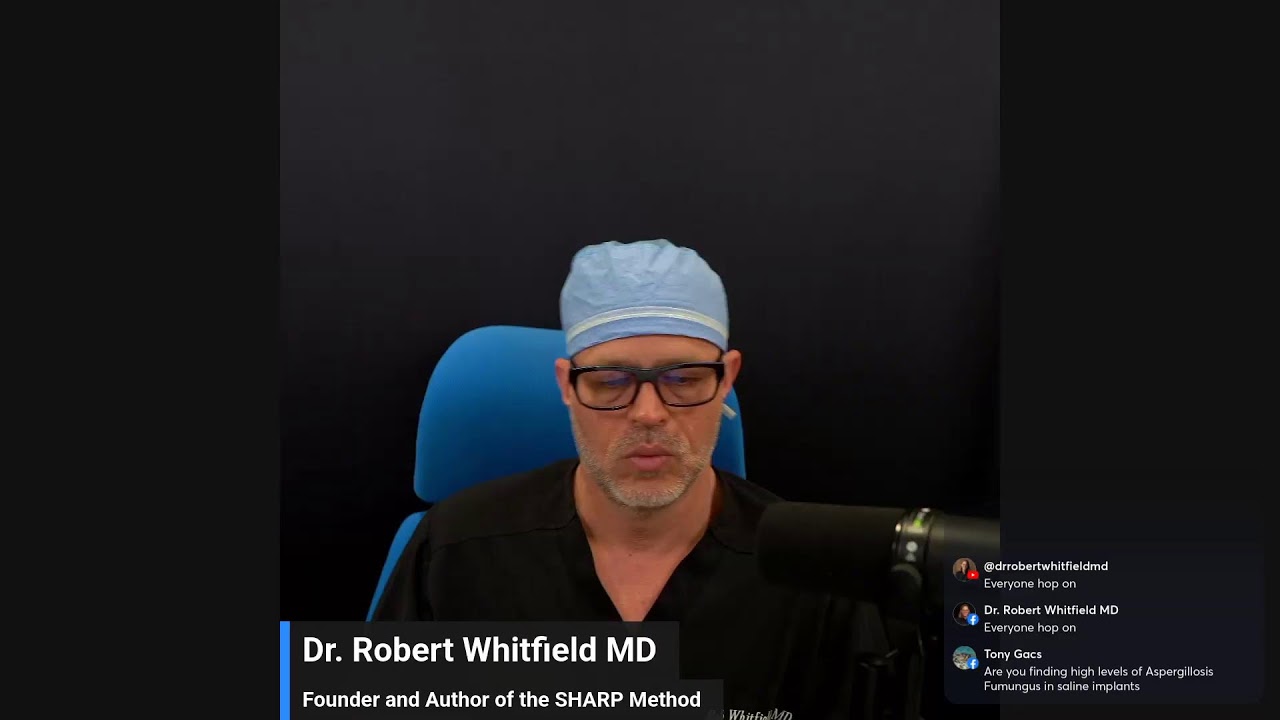
Dr. Robert Whitfield presents PCR testing results from 694 breast implant scar-tissue samples, finding bacteria in 29 percent of cases. The most common organisms were Cutibacterium acnes, Staphylococcus epidermidis, and Corynebacterium. He notes that PCR detects genetic material but doesn't prove active infection.
Chapters
Living on the house. Yes, I'm living on the house. All I got is time. Got no meaning, just rhyme. Take time with my wounded hand, 'cause it likes Take time with a wounded hand, 'cause it likes to heal. Take time with a wounded hand, 'cause it likes to heal. I like to steal. I'm half the man I used to be.
For everybody, hop on. So I can see everybody on TikTok, but I have no idea if I'm streaming on TikTok. I'm having trouble with TikTok.
Everybody run, Bob has got a gun. I think your company venture tells me how to creep. Friends don't mean a thing, guess I'll leave it up to me. Take time with a wounded hand, 'cause it likes to heal. Take time with a wounded hand, guess I like to steal. Take time with a wounded hand, 'cause it likes to heal. I like to steal. I'm half the man I used to be. I'm happy there's a dawn to face. Well, I'm half the man I used to be. I'm happy there's a dawn to face.
Oh, I think we're gonna have to do something different for the IG and TikTok. All right, sorry, we'll just do this differently. It's okay. It'll be all right. Take me just a moment. I can see everything on TikTok, but it just is not streaming, and I just got notification that the Instagram stream failed. So we're gonna do something different for Instagram.
The water flows below her hair. There she goes, out in the sunshine. Sun is mine. Close your eyes and bow your head. I need a little stamp of thee. Feel strong in love's golden warmth. Kill yourself, kill yourself.
A little technical difficulties, but we'll get rolling here in a minute. Don't worry about it, not a big deal. The IG stream failed on StreamYard, so we're just going to take it down. It's not a big deal. We're streaming on Facebook, um, Instagram, and TikTok now. LinkedIn, YouTube, X, Rumble, Substack. We're streaming in my live community— I'm sorry, my private community, drrobscircle.com. I'll just open a new window for that. Let's make sure that's all good. Maybe we'll get Crystal Hefner to come on. She just posted 4 hours ago about her implants or her explant surgery. Somebody hit her up, I'll bring her on.
Talk about it. Hey, John.
So you just need to join the circle. Um. Gotta turn off Whisper AI because everything's— it's all listening to me right now. Sorry. All right, the Circle chat is open. Okay. All right. Hey, Danielle. Everybody can join Danielle inside the circle. Acupuncture heals. Thank you. Yep, I live stream every Thursday. I don't always have as good of music every Thursday. I got the Foo Fighters tonight, so. All right, we're gonna get the talk lined up and we'll give the talk and then we'll get rolling. Switched computers recently, so it's been a little bit of a challenge, but that's all right. Everybody hop on. Share this with everybody. Hi, Lito. Share it around, everybody. If you know somebody needs to to hear this, share it with them. Give it a few more minutes since I got started late. I had all sorts of streaming trouble tonight, so I apologize. It's all right. Share the stream with everybody, anybody you think would benefit. So we're gonna do my talk, and then we're gonna roll into Q&A. I'll take some questions from each platform, and then we'll roll into my private community. It's easy to join. It's drrobscircle.com. Pop in your email address. You get a magic link. We'll do a private Q&A afterwards. All right. Oh man, it's been a long day. Share it around. Let's get some more people. Somebody share this to Crystal Harris. She just posted about her explant surgery 4 hours ago. I did not do it, by the way. So she did not come to me. Got some Metallica on. That's gonna be a little too hyper for this. Yeah, Simon's Dream. All right, all right, let's get rolling. Good evening, everyone. It's August 20th, 2026. I'm Dr. Robert Whitfield. So we're going to talk about a study that, uh, we found to be very important. In terms of findings, so historically, somebody's background: a board-certified plastic surgeon. Background is mainly in oncology, oncologic reconstruction, cosmetic surgery. Past president of the Aesthetic Research Foundation. Gave testimony at the FDA hearings on breast implants in 2019. So tonight, I want to actually slow down our conversation. And walk through what actually we learned when using molecular testing to examine the scar tissue around breast implants. And so the scar tissue is the capsule that forms around the implant. I'm not talking about specifically about the implant shell. We're going to talk about what what is the capsule? What a biofilm is, why routine cultures can have certain limitations when organisms are living in a lower metabolic state or stuck in biofilm, how PCR and next-gen sequencing differ from cultures that are the traditional ones we're taught to use, and what our published study found. We will all, you know, remain and talk about this just openly and honestly about the findings and what they just lead us towards. I think this matters because many people arrive kind of at this conversation we're having tonight after a long and rather confusing health journey. I speak to people every week who've seen multiple specialists and they're on the, you know, the functional path. They, as I was told yesterday in a consultation, they're doing all the woo-woo things to try to get themselves, you know, feeling better. Many have lots of problems with their breasts, local changes. Some report fatigue, brain fog, rashes, joint pain, other areas of discomfort. Fatigue, inability to exercise. All these things affect and alter their lifestyle, their interaction with their loved ones, their families. And, they've tried a number of whether it's protocols, cleanses, detoxes, different programs, and they're They're trying to understand, you know, is explant right for them? There's a group of people also that have explanted that now don't actually feel well, and they want to understand what was found at the time of surgery. And then there's obviously a big group who are just kind of coming across this as potentially a concern for them. So we have a lot of things we can cover and people we can help tonight. So So all those, um, you know, different paths to serve, you know, listening to, um, and I try to listen carefully because usually people tell you exactly what's wrong with them if you can listen carefully enough and long enough. And many, many, you know, practitioners, providers, doctors, um, just they don't have time, uh, seemingly to sit down and, and listen long enough to hear really what's happening. So I feel like that's the most important thing. You know, I, I don't try to take copious notes anymore. We just, you know, record and transcribe everything and I listen. So my goal tonight is not to, you know, create more anxiety or fear, is to give a more appropriate, accurate framework So you can, you know, better ask questions, whether it's of my team or anybody you're interacting with about this problem. So let's just begin with the capsule that forms around the implant. When implant is placed in the body, the body recognizes the implant as foreign. The body responds by forming basically a collagen sac around it. That's what the scar tissue or the scar capsule is. And that capsule formation is just a normal biological response to an implant. The implant is considered foreign, it's recognized, and your body tries to wall it off and protect us from it. A capsule can remain, you know, it can be thin or thick, it can be flexible or stiff, it can change over time. And it's this kind of, you know, ebb and flow that I hear sometimes from patients who have different experiences with maybe capsular contracture or what was felt to be capsular contracture. The subjective nature of examining a patient with breast implants Is a challenging one. When implants were first placed, they were placed above the muscle, and then due to capsular contracture issues, they were placed behind the muscle. And that was starting basically in the mid-'70s. You can look at studies, and then big reports of examinations of results were done in the '80s. And a lot of different Techniques were used to avoid capsular contracture, but ultimately the thing that worked the best was putting it behind the muscle. And I often am curious about this because I don't know that it really changed the capsular contracture rate other than it just made it more difficult to determine. And so this capsule, the scar tissue capsule that forms, is a surface where proteins Your own body cells and other microbial, as we'll come to find out, material can interact. So the capsule, you know, it's not the same thing, like I said, as an implant shell. The implant shell—I have an implant on my desk. We often just wrap an implant in a little bitty. piece of toilet paper that we use to cover a Mayo stand, which is a stand we use for instrumentation or materials for the rooms. And so, this represents your body's response around it, little thin layer of white scar tissue. It's just a collagen sac really. That's all it is. It's independent of the implant. And I don't care what type of implant it is. I've taken implants out from all over the world. So I'm just going to do one thing here. I'm having a little Wi-Fi problem, but that'll get corrected. And then we'll be good.
Yeah.
All right, we should be reconnected now. I just had a Wi-Fi issue, man. All sorts of technical difficulties tonight. I apologize. All right, so the scar tissue capsule is not the same as the implant shell. The scar tissue is your body's response, right? It's your scar tissue, your collagen sac. It is tissue created by the body around the device. And during a procedure where I'm explanting, like I did someone's case today, I take all that scar tissue out. And, you know, I get often asked about the en bloc versus the total capsulectomy and intact and not intact. And if you saw that thin layer, which is like a millimeter of paper around the implant, if you know that you take another millimeter, basically that's a margin. So when people are saying en bloc, you know, and taking a margin or total capsulectomy intact, I mean, all those things are relatively with the intent to take out intact. And then the margin is in this case with the total capsulectomy, basically You know, for me, the same procedure. A surgeon, you know, may document the appearance of the implant or the capsular material. The tissue may be sent in many instances for maybe examination for bacteria and fungus and mycobacterium. It may be sent for pathology. This allows for several different reports to be generated. And the reports can vary. I mean, most of the reports we see in terms of pathology show chronic inflammation, which you would expect. They have histiocytes and giant cells. Sometimes if there's a rupture, obviously there'll be other materials and other foreign bodies potentially in the report because that was found under examination. Now, the reports that look for microbiology specifically, and in tradition, you know, a Q-tip swab-like tool is used to collect the specimen, put in a tube, and sent to the lab either from a surgery center or from a hospital. And then it's put on what's called an agar plate, A-G-A-R plate, and then You see what will grow. So that's a measurement of live organisms. And so that's very different. And we'll get into why that's a different tool for use. It's been around since really the '50s, that technique, or earlier, honestly. And so each of the methods, each of the reports, you know, answers different questions.
Yeah.
There's not a particular test that replaces the listening to the patient, developing a clinical picture, and then plotting a course for the patient. Now, biofilm, the original biofilm was basically the plaque on your teeth. So, the biofilm is like this small organized community Basically, in this instance, we're going to say bacteria. And so, what is different is, you know, certain bacteria readily produce this extracellular matrix. Think of it like a little bit of a stickiness or a gooeyness. And, you know, this kind of matrix can be composed of proteins or lipids or carbohydrates. And potentially other extracellular substances. And a useful picture is to think of like the community attached to a surface surrounded, like I said, by this little layer, if you will. And that structure, you know, it supports the attachment of the community. It allows the ability to actually, you know, in a way signal, and it survives under conditions that many kind of standard free-floating organisms would be exposed to our immune system, and then our immune system would take care of them because our immune system is very, very good at surveillance. So, if bacteria are out in the bloodstream, they get surveilled and and taken care of usually relatively quickly unless they're in too high a number. So some of these differences explain the challenge of dealing with identification of bacteria that are in this biofilm. And the classic example of biofilm that was taught in general surgery and vascular surgery was vascular grafts that replace blood vessel sections can get coated with something called Staph epidermidis. That is a readily, you know, known producer of biofilm. And they found it by vibrating the vascular graft to get the bacteria to come off because they were so adherent or trapped in the biofilm, if you want to think of it like that. In the classic acute bacterial infection, organisms may be actively multiplying, the tissue may get red or painful, it may get swollen, it'll be tender. And if you do a culture under those conditions, you typically can grow a recognizable bacteria in the appropriate laboratory conditions. A biofilm-associated organism may behave incredibly differently. The cells may you know, be at such a low metabolic rate that they can't grow if you get them available. The extracellular matrix we talked about, or the gooey kind of layer, can act as a physical barrier that makes it even hard for you to get a sample of the bacteria, or it inactivates what you're trying to grow them on. So the biology is not necessarily identical in these more rapidly growing states where the organisms are, you know, if you will, floating freely. So routine cultures are still an important tool. It attempts to grow live organisms from a specimen under very specific selected laboratory conditions. And so when that organism grows, then the laboratory can provide All the information about, you know, what organisms grew. Is it one? Is it 2? Is it 3? Is it multiples? Are they sensitive to certain antibiotics? But once again, the growth will depend on the specimen acquisition. And then can it grow in that environment? Can it be incubated? What's the time it takes for that to develop? There are certain bacteria that take a lot longer to grow. Like if you're testing for Mycobacterium in particular, You have to have a specific lab that actually can check for it and grow it. And you have to ask specifically always if you're looking for a fungus because that's a whole different track. You have to alert the lab if you want to do that. So there's a lot of things that go into doing, if you will, live cultures in an operative environment. So if the Organisms, like we said, are sparse if they're slow growing. If the demand is not there for it to be able to grow, or it's embedded in a biofilm with a lowered metabolic rate or subdued metabolism, that culture actually may provide limited or no colony growth, and you would have no information as the provider, the practitioner, the person trying to help. So That is something that, you know, we've known about, we've kind of dealt with in the literature. We talked about it with the vascular grafts. And many studies have shown that there are problems with these techniques. So authors of other studies have noted that colony-forming assays can have difficulty detecting bacterial biofilms. Because of subdued metabolism as we already discussed. And they used other tools like next-gen sequencing to at least identify the bacteria in the samples. And they did this basically through PCR testing. That's the next-gen sequencing we're discussing. So, These and other studies help us because, you know, what I transitioned to in 2019 was not a new technique. PCR testing was not new. I mean, we're doing PCR testing when I was in medical school in 1996. So it wasn't new, obviously, in 2019. So Using the literature and the observations that, you know, these types of tests give us, you know, better insight, I transitioned to that. And it doesn't mean that every negative culture is wrong, and it does not mean that routine cultures miss things. Now, once again, I was doing something very specific. I was looking for basically low-grade bacterial contamination and/or biofilm on an implant. So I went for a very specific technique that was more sensitive and specific to identify that. And we did not do head-to-head comparisons in our paper. We transitioned in 2019 purely to NGS And the reason being is I couldn't and didn't want to deal with normal floricultures or things that wouldn't grow. So what does molecular testing do differently? PCR, like I said, is not new. It stands for polymerase chain reaction. And rather than waiting for an organism to grow, The PCR looks for the selected genetic targets and amplifies them so they can be detected. And so if you have a copy of the DNA of that bacteria or fungus or mycobacterium, it can be detected. So next-generation sequencing, or NGS, can then read amplified genetic regions, and they can compare those sequences with their databases to classify the material that we're looking at, the microbes, the bacteria, the fungus, the mycobacterium. In simple terms, you know, the culture asks whether an organism can grow under very, very specific conditions, and the PCR and the sequencing ask, you know, whether or not the actual microbial genetic material is present in the sample I gave them. And so, you know, they're answering different questions. I want to know if it's there. In our study, capsule and tissue sample— I'm sorry, the scar tissue capsule studies were shipped to MicrogenDX in Lubbock, Texas. It's a CLIA-licensed laboratory, and they performed the NGS Analysis on every specimen that I've taken. I take all the specimens, and so the I think the the thing I found important is in these assays that they looked at for all these different regions, it was important to me to have them examine all the different regions. So it's We'll pause for a moment. So sometimes on a hospital-based report or a report you'd send from a surgery center to a hospital to do the live growth, you would have a really limited sample of bacteria that they would check. We'll say at most, we'll say 20. You know, ours looks at 150, predominantly bacteria, but fungus and mycobacteria. So, it's a much, much more thorough examination. So, I always try to like, if we can get to the root cause analysis and this is part of it, then let's add that information. So, if one side was positive for amplification, then the entire sample was considered positive. And rather than go into the genetic details, so the test looks, like I said, at multi-species. It's quantitative PCR. And the panel we use is for over 150 types of bacteria and fungus and mycobacterium. Something they also provide to us is antibiotic resistance as it relates to those bacteria if they find the antibiotic-resistant genes. Now, there are some limitations, obviously, with all of this. Our paper noted that the analysis cannot obviously resolve every single bacterial lineage. And the assays, you know, they look for specific regions of specific species. So these are not like perfect either. They're just— there's a wider array they can look at and then compare it to the databases to then give a sequence and assignment of a bacteria, a fungus, a mycobacterium like we talked about. And so, I think, you know, for me, the reports identified organisms, the species at a level I didn't anticipate and a variety I didn't anticipate. So, the molecular testing is very, very powerful. And we're getting more and more information. The the the thing that is finally catching up, I I hope, is now that we have this DNA analysis done, there is a. Another couple papers we'll talk about that will definitely highlight the next steps of this. We we think you know this adds a large amount to the literature, and when we when we go over the scope of what we did and how we did it, so as a plastic surgeon, I took all these samples. These were all done at ambulatory surgery centers, not in hospitals. And here are the exact primary results, and the denominator is important. From June of 2019 through August of 2022, 694 samples were submitted for analysis using PCR. Of those submitted, 29% were positive. So of 694 samples, 29% were positive. So those samples are the scar tissue specimen samples. And what's important to me, you know, is that now we have, I think, a really large enough sample size To have what should be a fairly accurate incidence, and this is not because I'm in Austin, Texas. It's not an Austin incidence; it's not a Texas incident. My patients come from all over the country and out of the country, in fact. So. The, you know, I think it's important to distinguish, you know, a case is positive if a side is positive, and there is continuity with the samples. I took the samples, we submitted them, they're all consecutive in a single surgeon series. They're not random. They're not for a few months and then skipped a year. They're all consecutive. And so, the 29% results, it really describes the microbiology findings and you can't extrapolate it more than that. So, in this sample, we had 29% have Basically, positive findings bacterial contamination on the scar tissue sample, and the bacterial findings were not evenly distributed across all organisms. So the gram-positive organisms were dominant. The most frequently detected in my study were Cutibacterium acnes, which was formerly called Propionibacterium, and then Staphylococcus epidermidis, and Corynebacterium. Now, when we looked at which organism was most abundant within a positive sample, the most dominant again came from the same 3 that we just discussed. They were Cutibacterium acnes, Staphylococcus epidermidis, and Corynebacterium. And so there was one gram-negative species that was in higher amounts than others, and that was Enterobacter cloacae. A few other gram-negatives were identified in the data, Pseudomonas and another Enterobacter species. So most positive samples had relatively low species richness, which is what you would expect, meaning the number of different species detected in a sample was generally smaller. And so my paper reports that most had fewer than 5. And the— I guess if you want to say the more that were detected does not mean someone's having more symptoms or more ill. And the fewer doesn't mean the opposite, you know, either. We also looked at whether the sample was associated with any other characteristics. Implant texturing did not show an apparent association or correlation. The fill type and the age, neither actually showed anything significant in mind. There was a little bit of difficulty with mine because mine was a predominantly silicone gel-filled experience. So that I would say you can have more— a stronger debate if someone has, you know, 694 saline devices with different results. And Patient age remained a significant factor after testing. The paper that we published also notes that skin microbial communities change across lifespan, which may help frame part of that, but an association doesn't really— it doesn't establish causation. So, why do Cutibacterium acnes and Staph epidermidis keep coming up? Both are familiar members of the normal skin associated with our microbiome on the skin, and both are capable of forming biofilms. The other Corynebacterium can also be part of the skin flora. And so, this is how I got started in this because I had patients keep having normal skin flora on their culture results. And so, the location, the abundance, tissue response, contamination controls, pathology, Symptoms, operative findings, and consistency across all of this actually matter. The same organisms that you typically find in the skin that are harmless really in this setting become the problem. And this brings us to one of the more important interpretation points. PCR and NGS detect microbial genetic material, and detection does not itself prove that intact organisms were there alive at the time of testing, does not by itself prove, you know, an active infection. It does not really establish that the organism created that mature biofilm in that specimen. So it doesn't really have, you know, the causation, but it does establish like what we find, what's there predominantly. And certainly, you could argue that genetic material could be there for other reasons. If you're, you know, looking at the other side, a negative result also does not mean that something is not going on, that there's not a microbial process. Once again, these are samples, and not every sample is gonna have every organism or where the organism with the biofilm was taken. So, microorganisms may obviously be distributed unevenly, like I just said, across the specimen. The target, actually, in this case, even though you just need a copy, may fall out, um, and, you know, the test may not cover every organism. There are research, um, panels that actually cover larger amounts of organisms that I've also sent specimens independently for if we had questions. So, you know, I get asked a lot about, uh, mold. And mold is a fungus, obviously. So what is the real concern? And in my study, that was not a big player. And in my first 1,000 cases, we had just a handful. Now, predominantly, I have a silicone gel experience, and we are getting more and more salines, I would say. You know, in the last year or so, but at the point this paper was written, this is really more of a silicone gel explant experience. So, I think you know when I look at these results and I summarize, and I think like what do I need to help convey? Predominantly, it's bacteria. In my experience, it's not mold, even though I get asked about all the time. And when I look at my patients' genetics and toxicity burden and gut health, they do have a lot of environmental toxicity, and that is from many times mold toxins, which is different than what we're talking about. When I look at that, that's through a Vibrant Wellness Total Tox test that analyzes urine. And so, they're different. I think mold is playing a role in my patients. It's just very different. So, each concern like that belongs in the individual assessment of that patient and it shouldn't— it's not that it can't be a component of the implant issue because it certainly can. It Just bacteria is far more frequent, far more dominant, as evidenced by the published research. So how should we place all this in the clinical context? Start with the reason a person is being evaluated. You know, what I've seen is just a laundry list of symptoms. But if you're just thinking about breast symptoms, you could have localized pain, firmness. You could have distortion, swelling. Tenderness. If you do ultrasound, you could see fluid. That's definitely an infection until proven otherwise. There can be different skin changes, issues with the implant positioning, frankly concerns over contracture, or, you know, depending on the studies, the exam, length of device in place, a rupture. So systemic symptoms. Of chronic inflammation are, you know, why develop the SHARP Method to address these? And so those require broader history, of course. They require, in my clinic, more testing through genetics and toxicity burden, gut health, food sensitivities, and hormone analysis if they haven't had that to get a better gauge of what's going on. And once again, these things can vary. Fatigue, cognitive issues, rashes, joint and muscle pain, disrupted sleep patterns, rashes, acne, you name it, all the gut issues, bladder issues. So, the implant and the capsule are obviously one part of the evaluation, but the SART Method looks at all of this and tries to give you a broader, more holistic picture of this. And so we do it in a combined approach. We're not just looking at those surgical aspects. So, you know, if we look at the evidence in layers and your history that your client, you know, or the patient's giving us is one layer, your exam is another layer, obviously you have imaging, there's another layer. You know, if we proceed to do a case after prep with the surgical— After prep with the, I think, our methodology, and I have specific things I want patients to do based on specific results, we'll make, you know, some assessments in the operating room. And for my patients, I make a little video and we have stills of the capsules for them in their charts. And I make some comments typically about scar tissue depending on its thickness and thinness and ease of dissection many times. And then obviously we send all this off for PCR testing, pathology analysis. Histology comes back and we can look at different patterns of histiocytes or giant cells. The PCR test can come back and we can evaluate that to round out the picture. Usually my patients already come with lots of other laboratory analysis through all the different vendors. And all these layers certainly can help put together a picture, a proper picture for them and tie it all together. It's become obvious that this is super frustrating to a lot of patients, but it does take a lot of effort to put everything together. And You know, we had an IRB-approved study to look at all this because I was frustrated by what I found in the literature, which was a very high rate, almost 48% in one study that's quoted, you know, familiar frequently and is familiar to everyone. And so This is just part of our our program, and I think you know more has to be added obviously. So I feel like this is at least for the time being the largest study in the world looking at this, and I think it's a value because of that. Its size, length of duration, consecutive specimen analysis with PCR. And I think the most balanced conclusion is like, obviously it's there. What's it— what's the contribution is what is not completely understood. But we'll just— we're going to tease that for my next talk next Thursday. We're going to talk about what can be happening with the biofilm And the breast tissue, so I think you know that's actually a good place to end it. I'm going to take some questions from the platforms, then we're going to go into the community, drrobscircle.com, and and ask some more. So thanks for hanging in there. Sorry for the late start. All right, who's got some questions? Oh my gosh, we have Kiko or Kiko from Tokyo. She's normally on YouTube, but she is in the circle tonight. Welcome, Kiko. All right, who's got a question here? I'm gonna start with Instagram. All right, well. Lido 69799, it sounds like you need to, uh, head into the circle. You have a lot of questions that I can't really resolve. Joy Chag, does it cause immunity issues? I had breast implants after having a deep flap and asked for removal with capsule removal, but it wasn't done. All hell broke loose after that removal. Oh, I'm sorry to hear that, Joy. So the capsule wasn't removed and you have a deep flap. Okay, um, so you can still have a capsulectomy and you can have a fat transfer. None of those are that complicated, but, um, certainly, you know, That can be done. I'm sorry to hear all that. I'm gonna take a question from TikTok here. Let me see. Sometimes I get a little quizzical TikTok things, and then I'll take— there's one from Facebook on my Live feed there.
Hmm.
Well, I thought I had a question. Oh, Kelly Ray 13 says, why are you giving out this information? What hospital are you working at? Why don't you identify? Kelly Ray, why don't you go to my bio and click on it? All the information you could ever want about me. Is there? I'm a plastic surgeon, so yes. I'm always a little baffled by people asking me those questions. After explantation, does scar tissue cause further issues? Does scar tissue cause further issues? Well, I mean, obviously you can still. Even when your tissues heal, you can have scarring for sure. Caitlin, you sound like mast cell activation and mold, so you got to be really careful with your diet and things that trigger you. But that's very concerning. Tony is asking, are you finding high levels of Aspergillus in saline implants? No. I don't test the inside of saline implants. All right, well, did you just say fungus also? Mold is a fungus. So maybe that was the question. So I don't have all the people in London, but if you go to WhatsApp, there's a group. Hot X-plant girls ran by Karen Koroshami. She will have some information. Kaiko wants to know, is melanoma connected to breast implants? No, I haven't had that as a connection. Melanoma is obviously a very serious problem. And are you saying it's an acanthus melanoma? No, y'all can't co-host with me. What are you trying to do? Yeah, I mean, it sounds a lot like MCAS or MCAS and mold, which is complicated. All right, what else do I got there? DWT277. Um, all right, you just need to set up a All right, all right, who else do I have going here? So any more questions I can answer?
Hi, Kelly.
All right, so I'm gonna shut down the other platforms and just go into my circle. Go to drrobscircle.com. All right, I'm gonna put a comment in here. So we're moving to Dr. Ross. I could type better with my thumb. All right. Okay. All right, everybody. Sunshine Brittle. Brittle. We're gonna head over to the circle. Can you join us there? I'd like everybody to head over, okay? DrRobbsCircle.com. Hey Heather, we're gonna go over to the circle, okay? Sorry you got here late, but we're heading to the circle. All right everybody, I'm gonna head over to the circle. Okay. Sorry, somebody sent me something I'm trying to respond to. Okay. All right, everybody. Just in the circle now. Just gonna turn off the other feeds and let me know how y'all are doing. I feel like I meandered through a talk that was—I could have did better. Uh, it's always something. That's all right, just removing all the links. Hi, Rhonda.







