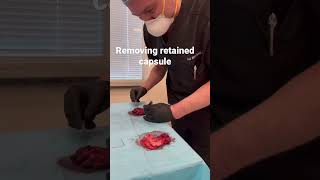
Dr. Robert Whitfield describes finding a full capsule still in place after a patient's first explant surgery, with a thickened, glistening interior suggesting biofilm or infection. In his experience with over 1,100 explants, about 45% have biofilm, and Cutibacterium acnes is the most common bacterium.
Questions this video answers
About 45%.
Over 1,100 explants.
Cutibacterium acnes.
Chapters
Hey, it's Dr. Whitfield in Austin. Patient had an explant in the past, not by me. And they remained completely symptomatic after the explant. So that, to me means a couple things. They could have retained capsule. That's usually what I would consider if they were treated appropriately and didn't have other problems like Lyme disease, mold disease, other inflammatory processes. So this is what I found inside the patient. So. So the patient's entire capsule was inside. So when I cut it open, you can see the inside of the capsule. It's very thickened. It was taken off the rib surfaces. So once again, if this has any amount of infection in it, which about 45% of cases will have some biofilm, you'll find it's kind of smooth and glistening. It may have retained biofilm, which represents an infection either on this side of this side, or both. Most common bacteria in my practice that I see is Kidibacterium acnes. I've done over 1100 explants, and that's the predominant bacteria that I find.