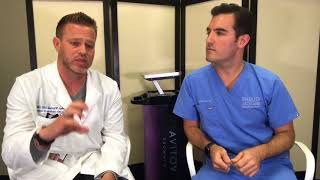
A conversational interview (Nov 2017) between Dr. Philip Ube and Dr. Robert Whitfield about vaginal rejuvenation using the Votiva bipolar radiofrequency device (by InMode/NMode). They define postmenopause (no menses >1 year), discuss symptoms from low estrogen (dryness, pain, urinary incontinence), and describe combined approaches: hormone therapy (estrogen/progesterone/testosterone, pellets or dissolving tablets) to restore tissue moisture and libido, plus Votiva treatments to address laxity and blood flow. Votiva is delivered internally/externally via handpieces (Formavi/Formava and Fractura referenced) as a series—typically three treatments spaced 2–3 months apart—producing tightening with minimal discomfort and no wound. For post-childbirth laxity, fewer or case-by-case treatments may be needed; benefits can include reduced stress urinary incontinence. Practical notes: outpatient procedure, no anesthesia, quick recovery; clinicians promote combination hormone + device therapy for best results. An open house event (Nov 14, 4–7) and an office RSVP phone number are given in the transcript.
Chapters
Hey, guys, it's Dr. Philip Ube here.
With Dr. Robert Whitkill.
So I'm a functional medicine doctor, and he's a plastic surgeon. And we're actually going to be talking about vaginal rejuvenation today. We're going to be talking about sexual orgasms and things, and we're going to be talking about both postmenopausal women and premenopausal women. So basically, any adult woman can benefit from this talk. So, first of all, we're going to start off with post menopausal women. And I'm going to start by saying that postmenopausal women, the definition of a postmenopausal woman is a woman that has not had a period for more than a year. And that usually signifies that they're not making any estrogen and progesterone. And as many women already know through symptoms that once your estrogen and progesterone fall, your vagina can dry and get painful during intercourse. It can even feel like sandpaper, almost like you have a yeast infection at all times. That can lead to urinary incontinence, all kinds of other features. So I do a lot with hormone replacement with estrogen, progesterone, and of course, testosterone, since testosterone helps boost the libido, can make bones grow stronger, improve orgasms, but the estrogen, specifically, even within just a few days, estrogen can make a tremendous benefit towards the vagina as far as restoring some of the tissue and making it more moist and healthy. But that doesn't really help much with the laxity. So, Dr. Whitfield, why don't you tell.
Us a little bit about that? We have some newer technologies. Bipolar radiofrequency is used for skin tightening. So Votiva by Nmode uses both Formavi and Fractura Void to help these areas of interest. Externally, you can treat with form of E, and internally you can treat with form of E to cause contraction and tightening. Sometimes you'll see contraction as it's being done. So this can help with the laxity described. It also increases the blood flow in the area, hopefully helps some of the collagen rebuild in the tissues as well.
So, and it seems like as the vaginal tissue improves, the stimulation gets better and orgasm should get better with that improved texture.
Right. We want to increase overall sexual satisfaction and decrease the pain that's being experienced by intercourse. And we see this also in our chemically induced postmenopausal females who've had chemotherapy.
So hormone replacement. There's multiple ways to do it. I like to use hormone pellets that we place underneath the skin. We put them in the back of the hip, and the hormone pellets slowly release hormones over four to six months. The other option is something called dissolving tablets, and these are made at local compounding pharmacies. So there's a prop. The hormones are a vital part of this. And I think both, in conjunction with each other is really the way to improve vaginal texture. Something else I was going to ask. Oh, is the procedure painful? I mean, it sounds.
You can have a warming sensation. I think it's because the area is already tender. They'll be particularly potentially a slight discomfort, just placement of the probe, but it's overall not a painful procedure at all.
Is this a one and done type treatment or.
So we're looking at doing a series of three, and we'll separate them by two to three months, depending on the response.
Oh, okay. Interesting. And then do they have to repeat it every year or every other.
No, we feel like if they've had the response after three treatments, they should be good over the next three to five years.
Okay. So I would assume that if they do a hormone replacement or have adequate estrogen that even lasts even longer, maybe.
Right. I would hope the combination is even a better solution.
Okay, Very neat. So that's the basics behind the postmenopausal women. I think both of us could talk much longer about it, but that's the basics behind it. Now we're going to switch gears a little bit and talk about premenopausal women. So that's all you women, most likely under the age of 50, who are still having periods, infertile, and maybe even still having babies. So hormone replacement in the premenopausal woman. From my aspect, I can't do too much hormone replacement. It's more about hormone balancing. You're already making estrogen and progesterone and testosterone. So my job is to make sure you're detoxifying those hormones that you're actually balancing the hormones of estrogen and progesterone. Because in women it's a lot more complicated than in men. In men, you just raise the testosterone to get to goal. But for women, it's all about the balance and not excess of any one hormone. So my job is mainly about balancing the hormones and that both improves sexual interest, sexual pleasure, orgasm, intensity, all those things. So, Dr. Whitfield, what can you offer premenopausal women with this treatment, since there's.
Not an issue, hopefully with the Lining like there has been. But after childbirth, this is a really common issue where there's laxity. So this can help improve laxity. And when you get the tightening effect, decrease in laxity. You can also minimize some of these stress incontinence that's seen after pregnancy.
What do you mean stress incontinence?
So if they abruptly cough or sneeze and they have an accident, essentially this tightening effect has helped reduce that and eliminate it in some cases.
Fascinating. So something that's becoming increasingly popular is actually the use of testosterone pellets for women, or testosterone in general for premenopausal women. And so that's one of the things I frequently talk to my women about, especially when their testosterone is low or their libido is low. They're worried, they feel like they should have a healthier sex drive. So many times we'll put in testosterone pellets or give them dissolving tablets to boost the testosterone levels. I like to warn my women that we're kind of biohacking at this point. Testosterone is really not supposed to be above 50 and 80 in a premenopausal woman, but many times with testosterone replacement, we'll actually bring them to 100 or even up to 200 in order to improve that libido, that sex drive, power of orgasms and all that. So I do like to clarify to women that that's kind of biohacking. It's not natural. I like to do a lot of natural things, a lot of functional things, and that's one of the more somewhat unnatural things. Although the studies so far look like testosterone replacement in women is perfectly safe and boost muscle growth, fat loss, bone growth, and many other things. And testosterone has a natural anti anxiety effect, which in general is why men are usually less anxious than women.
And we hope that the combination is better for both because we feel that if the balance is correct and they have these laxity issues that are simply from childbirth or overall just in general, the laxity can be corrected. It will improve overall satisfaction.
Okay, two questions for you. So you mentioned it's three treatments for the postmenopausal woman about a month apart, I think you said.
So we're gonna go two to three months apart.
Okay, and what about for the premenopausal woman?
So I don't know that we'll need to do as frequent or as many treatments. We'll do it on a case by case basis in the premenopausal one.
Okay. And then after childbirth, when should they look at considering this Treatment.
So usually the change is consistent with the thinning, the thickening, thinning of the wall over the next three to six months after. I know people want to return to intercourse sometimes as soon as possible. That can be difficult for the women. So they can have a consultation relatively early, and we can see and dictate it from there.
Okay, and what's this? Fancy.
So here's the Votiva. We don't have the handpieces, but this is the actual device. The handpieces connect here. It's a simple outpatient. No anesthetic, no local anesthesia. Nothing's necessary really to get the procedure done. It's very brief, in and out, so it's. It's simple to do. But to date, there haven't been as many or as effective treatments that don't cause some kind of wounding. There's no wound involved with doing this at all.
Okay, so they can walk home afterwards. Yeah. Very cool. How does it actually work to tighten?
So the radio frequency is what causes the tightening, Just like we talked about previously in our videos about skin tightening with body tightening. Face tight, same technology, bipolar radio frequency, but in a wand to go ahead and deliver the thermal energy that caused the type.
Oh, interesting. But this one doesn't involve the infrared camera and stuff like the body type?
No.
Oh, that's too bad. All right, anything else you have to add, Dr. Wickfield?
That's it. I want you all to come to our Open House on November 14 from 4 to 7 to learn more about Motiva and other minimally invasive and non invasive treatments.
And how do they RSVP?
You can RSVP on Facebook or Google or call our office at 877-2832.