The Future of Facial Rejuvenation with Dr. Robert Whitfield: Comprehensive Non-Surgical Solutions
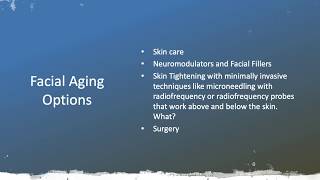
Dr. Robert Whitfield (board-certified plastic surgeon) gives a patient-education lecture on non-surgical and minimally invasive facial rejuvenation, emphasizing a tiered approach: foundational skin care, neuromodulators and fillers, noninvasive options (e.g., HydraFacial, Forma), and minimally invasive radiofrequency-assisted microneedling devices (Fractora, Morpheus8) combined with subcutaneous RF (FaceTite/AccuTite) — the combined procedure marketed as Embrace RF. He explains device differences (needle lengths, pin counts, superficial vs deep effects), typical treatment cadence (packages of three monthly sessions for some RF microneedling), a representative patient case (69‑year‑old with prominent platysmal band and neck laxity), and practical limitations (muscular platysmal bands need Botox or surgery). The talk stresses combining modalities (microneedling + FaceTite) for best results and provides practice contact details.
Questions this video answers
April 21, 2020
877-785-2832
drrobertwoodfield.com
He states he was the first person in Austin to have Morpheus8.
Chapters
This is Dr. Robert Whitfield. I'm a board certified plastic surgeon. Today I'm going to speak with you about Embrace rf. So we have someone come or have a virtual consultation for facial aging. I discuss multiple options. First, I always start with their basic skin care, what they both do in the morning and at night. And we discuss the basics. A cleanser, moisturizer, a retinol, a sunscreen and then add ons based on their desires and skin type. We discuss the use of Dermadulators. This can be Botox or Dysport. And then facial fillers. They can be the Restylane family of fillers. They can be the Juvederm family fillers that can be, you know, other products to enhance and fill facial volume loss options. Regarding skin tightening. Now, this is a wide variety of options. There's non invasive options. Those usually take the most time, require the most frequency of treatments, are most difficult for people who have busy schedules to keep up with with other options that are minimally invasive. Everybody's familiar with the concept of microneedling, which microneedling that uses radio frequency and we'll discuss that later. We have radio frequency probes and you know, these work above and below the skin. And everybody always asks me like what, what does that mean? What's that about? And then of course we have surgery for facial aging. It can be a forehead lift, a brow lift, an eyelid lift, a facelift, a neck lift, all of the above. We always have those and those are always going to fall back and be the gold standard standard. We are pushing the minimally invasive options closer to the surgical standard though. When I go through my option list, I look at skin care alone. We have different lines that we carry, specifically Elastin, Osmosis, md, Skin Medica and Eminence. For non invasive treatments where nothing's damaging or entering the skin, we use a very aggressive hydrafacial system that works on the epidermal level. Forma is a radiofrequency assisted, non invasive skin tightening device that works on the surface of the skin. We have minimally invasive options, microneedling with radio frequency. These are Forma, I'm sorry, these are Fractura and Morpheus 8. And then I have microneedling with pros which is Accutite, Face Tight, Body Tight. And then the combination of the Morpheus 8 microneedling device and the facetight probe is referred to as Embrace RF surgery. As I discussed, brow lift, either lift, facelift, neck lift, etc. So we'll dive a little bit deeper into microneedling now and try to get a better sense of microneedling. Microneedling has been around a tremendous number of years. It's well documented that injury to the skin promotes new collagen synthesis. So really, you know, what does this boil down to? What are the devices? What do I have that's different? The distinguishing things that we have are Morpheus. And I was the first person in Austin to have Morpheus 8. It has needles, somewhat difficult to see here. Very small needles that extend from the end of the device 1 to 4 millimeters, which we can set the depth for. We can work around delicate areas at 1 millimeter. So around the eye, the facial skid, around the eye, the forehead, and then as we get further out in thicker texture tissues, we can change. You can also take this and treat other areas of the body. The waist, the buttock, because you have different needle lengths that. That you can treat with Morpheus. Aid is typically one to two sessions. This is my other microneedling device, Fractura. Fraktura comes in a 60 pin or a 24 pin configuration. The 24 pin here is on the right. I always use the coated 24 pin, so avoid any kind of pigment issue. I like this because it attacks just at the superficial level. It's got a predetermined length. And in this picture, you can kind of see what we're getting at here, where we're looking at different lengths. So I want to work at close to the top layer of the skin in the, know, epidermal layer, and then deeper down. And we want a series of reactions in those levels to both stimulate collagen synthesis and tighten existing tissues. But the depth is important. More superficially, you'll affect tone and texture. Deeper, you'll get better tightening, stimulate more collagen synthesis. And. And so what kind of effects can you get from these treatments? Well, for the superficial treatment, like a fractura, I'm looking for this type effect. So you get laxity. This is just a treatment. With fractura, you get improvement of fine lines, you get softening of these. So this is a nice change. If you have a lot of neck laxity, though, it's difficult. You will need more than one treatment to get a better response. So typically I treat these in packages of three treatments once a month for three months, and then let it, you know, have time to heal, have new collagen synthesis development, and see how the result stabilizes over the next several months. So let's go over a patient case to further emphasize, you know, what we can offer how we can combine and try to make the best program for each individual. So I had recently a 69 year old woman, she wanted to come in and she had heard about the things I did with Accutitan Facetite and Morpheus aided Fractura Embracer F and she wanted to know what she could do for her neck and face. She didn't want surgery. Number one issue was her neck. She didn't have any other medical history or problems, didn't take any medications, hadn't had any neck treatments, didn't do anything specific for her neck and had no surgical history of her neck or face. So the big issue is her neck. Here I've blocked out the upper, you know, almost 2/3 of her face. We're concentrating on her jawline, her neck. As we look at her neck, there's a protrusion down her neck and this is something I can't fix with skin tightening. This is a platysmal band. This band is from an underlying muscle and we can treat it with Botox or we can actually do surgery and tighten it, but I cannot fix that with the current skin tightening devices. One of the main things when you talk to her was her profile picture. She really was unhappy about the protrusion of her neck. It's really obscured by that band as I highlighted in the frontal view. So once again I always talk about I am not going to be able to change that band. I do want to move this tissue. That's the big concern and the jowl I want to correct and move it as far up as I can and we'll highlight that little freckle that she has there just to follow along where it goes. But ultimately we want the vectors to take care of the change that we need mostly going up and backwards. So is microneedling alone enough? Like I showed you with Fractura Morpheus 8, neither of those devices is powerful enough to challenge that neck. So we refer back to that slide I had of options. You know, it's going to take a combination of therapies and that will provide you with the best overall result. So when combined techniques, I have a great team with professional estheticians, medically trained and they will use the best skin care for you, provide you treatments with hydrafacials if that's what we deem necessary to get your skin prepared for a treatment. And then the combination of microneedling with RF as well as face type 2 perform embrace RF is what this patient would derive the most benefit from. Of course, once the estheticians have got their skin prepared two weeks prior to the procedure. We use the regenerating skin nectar one pump twice a day for two weeks. After the procedure, we don't apply anything to the facial tissues for another 72 hours until the microneedling areas heal. Morpheus 8, like we discussed, has a far greater range of treatment potential from 1 to 4 millimeters. The, the issues for me are just simply getting everybody comfortable, getting the numbing cream and the underlying numbing fluids placed so that everybody can sit and comfortably get the morpheosate and the face tight combination performed to complete the Embrace RF procedure. And we have a little animated morpheosate treatment video that shows you the knee length and I'll just pause it once we get into the area. Sam. So that didn't let me pause it where I wanted it. Sorry. So essentially what I was showing was the depth of penetration and that that's what's important about Morpheus 8. You can control your depth penetration. So now I'll move on and discuss the face tight. Face tight is a procedure that allows you to move a radiofrequency probe above and below the tissues. So think of like a pair of tweezers, fine tweezers, inserted through a 2 millimeter puncture and then passed above and below the tissue. These allow heat to work between the tips to tighten the tissue tissue. And that's a way to dramatically improve the skin laxity that previously was only, you know, obtainable through a facelift. Here's a cartoon type picture. You can see these vine like structures. This is the fibroceptal network. This gets tightened by the heat. You can actually hear this happen. And then there's remodeling of the fatty layer. We don't suction any of the fat out. We just want to heat the tissues and tighten it. We don't want to lose volume in the face ever. Sam. Here's a little animated video of the face type. This one doesn't actually come with audio, so I'll try not to hit this one the wrong edge. Insert by the angle of the mandible and then run beneath the tissues along the border of the mandible, treating the whole lower third of the face. You apply the heat, Heat is distributed between the two tips and in a retrograde fashion, you perform tightening. So in summary, Embrace RF is minimally invasive. Let's go over a couple before and afters. I always want to give a lot of admiration to Dr. Ravati. He's in Italy and obviously is a Development, difficult time in Italy. He's done a great deal of work and this is his work just using face tight and Morpheus on the neck. Look at how her jowl moved in this picture. Now we always want good movement. This is a little bit thinner face, a little bit less density of tissue, a little bit easier to move. And this is our lady that we talked about initially and we can see that her neck tissues tightened greatly. Her jowl moved significantly both upward and backward towards her ear. So the one thing that I said was I couldn't control this neck band and obviously I can't. So those are things that we can treat with Botox or Dysport and that helps soften that band. If she ever wanted to do that surgically, we can do that of course. But these are all, you know, office based in my practice and she's very happy with this result. So in summary, always got to have aggressive skin care. This is why we use our master estheticians and medical estheticians from both our wellness location and our Westlake location. We have lots of both non invasive options with hydrafacials and and then minimally invasive options where I combine techniques like face type Morpheus 8 to optimize results with embrace RF surgery is still the gold standard, but obviously requires significant downtime and recovery periods. Overall, I think we're entering a new age where minimally invasive options are coming closer and closer to surgical results. So feel free to contact us. 877-785-2832. To set up a virtual consultation, visit us on the web drrobertwoodfield.com fill out a contact form, anything you're interested and we'd love to hear from you. And then back and forth, you're always getting feedback in those two temperature sensors. So this is the key element. There's feedback constantly so you can't create a burn. It tightens the tissues by remodeling the fat and the heat allows you to tighten the fiber septal network. Over the next several weeks to months, you get more and more skin tightening and that's essentially how you treat with just the face tight pro. I think I get asked a great deal about is face tight a standalone? And I don't treat faces with face tight alone because I don't feel that you get the absolute best result without the addition of the microneedling on the surface. So I always combine those two in my treatments.







