The Weight Loss Paradox
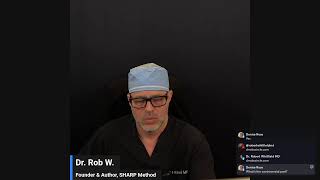
Dr. Robert Whitfield explains the Weight Loss Paradox: rapid fat loss releases stored toxins like pesticides and heavy metals back into the bloodstream, raising blood toxin levels 15-25% per 10 kg lost. He outlines pre-operative testing and warns against GLP-1 drugs before fat transfer surgery.
Chapters
Gotta give it a couple moments to get live here. Everybody hop on, wave, say hi. We're gonna get rolling here. Just give me a moment. Okay, everybody's just joining, so just, uh, take a moment, let everybody get loaded. Once everybody's locked and loaded, we'll get started. Boy, having trouble with, uh, prompter here. It's okay. Hey everybody. Glad everybody could hop on. We will get it rolling here in just a moment. Thank you. Got it. All right, almost ready. Give me a sound check. Does everybody hear me okay? Okay, make sure and share, obviously share with others that we're having this talk tonight. We're going to talk about The Weight Loss Paradox. Because I do a lot of fat transfers, uh, it's a very important topic to myself, my patients. Thank you, Denise. Awesome. So we'll start by doing everything live across all platforms, and we'll go into drrobcircle.com for live Q&A. So that's going to be, um, immediately to follow. And you can hit it in the bio, and I will be live in there to answer questions after the 10-minute talk. So, um, I still honestly don't know how to do that on TikTok. Somebody will have to help me. Um, in the chat, everybody can, uh, chime in, of course. Now, after the 10-minute talk, Dr. Rob's Circle.com. I'm going to take all the questions, do live Q&A as long as it takes, get everybody's questions answered. There's absolutely no obligation when you join. All it is is a private area where I cannot be censored to answer your questions. I get censored all the time on YouTube, Facebook, Instagram, TikTok, um, where else? Probably everywhere else too. Can't— I can't begin to tell you how many places I get censored. It's, it's a long list, but that's okay. We have put together very comprehensive, um, website offerings, um, a a ton of free content and we're constantly improving that. So just keep sharing and get the message out to everybody and, um, we'll get started here in just a minute. We'll let everybody hop on. Okay, is there anybody on Substack? We're streaming live across all the platforms right now— Facebook, LinkedIn, YouTube, X, Substack. Denise, I talk about breast implant illness and those breast implant companies are owned by pharma companies. They're not super excited about me talking about breast implants, if that helps. So I have 160 podcasts, 2 books, 4,000 videos, and somehow you can't find me. It's interesting, right? Should look into that. Hmm, have I been muted on TikTok? That's hilarious. All right, that's pretty funny. Why didn't somebody say I was muted? Guys, oh my gosh, Sammy, I have really long hair, it keeps it under control, but thank you, appreciate you commenting. Nice. If I don't wear this hat, you're going to get distracted by my long hair. So how about that? All right, let's get rolling. Tonight's 10-minute talk is The Weight Loss Paradox. I'm Dr. Whitfield MD. And so, uh, without further ado, uh, most people think weight loss is a pure math problem. Calories in, calories out. You lose fat, you get healthier. End of story. But what if I told you that losing weight, especially rapidly, might be the most toxic event one that your body experiences in any given year. Once again, I'm Dr. Whitfield MD, board-certified plastic surgeon in Austin, Texas. I specialize in a number of things including simultaneous fat transfer and explant surgery, fat transfers for augmentation, explant surgeries with and without lifts, and simultaneous explant lifts, fat transfers. And so something I see every day in my operating room is that most doctors probably don't even know, you know, something that exists like this is mostly because they're not looking for it. We're always working people up with the intention to understand their toxic burden. So we're going to talk about The Weight Loss Paradox. Right now, millions of people are dropping pounds faster than ever before. They're celebrating this. Their doctors are high-fiving them, uh, but inside their bloodstream, they're having a tough time because fat stores toxins. And if you lose weight rapidly, you can have these toxins increase significantly in your bloodstream. So let's change your frame. Stop looking at fat as just extra weight. Start looking at it for what it is. It's really where your body, like I said, stores a lot of toxins. So the weight loss paradox explained is, you know, the body is incredibly smart. When you are exposed to environmental toxins, pesticides, heavy metals, mycotoxins from mold, VOCs, Your body has a problem. It wants to protect you from all these chemicals floating around in your bloodstream that could potentially damage your brain, your heart, your organs. So what does it do? It sequesters them, it locks them away, and it locks a large portion of them away in the adipose tissue. So your fat really is a storage facility. It's a protective mechanism. Now, what happens when you unlock the doors and burn the fat is you raise the toxin level bloodstream. They don't vanish, they're released, right, directly, right back into the bloodstream. And that's the weight loss paradox. You lose fat, but you also increase the toxin burden in your system. So the data on this is very clear. Studies show that for every 10 kilograms of fat you lose— that's about 22 pounds— there is a 15 to 25% increase in blood toxin levels. Think about that. You lose 20 pounds and your toxicity spikes by 25%. You feel fatigued, you get brain fog, your joints ache. You think it's just stress of your diet, you think you just need more coffee. It's not the diet. You're literally increasing the toxic burden your body has to deal with from inside out. And the medical community, um, many times they're not recognizing this. They're just looking at the scale and seeing the success of the weight loss. They see the number go down and they feel Um, that's the best kind of situation for you, but the scale is, you know, showing that you've had weight loss, but it's not showing what's absolutely happening in your system. So let's go to my world. So in the operating room, I do a lot of fat transfers. We take fat from one area, say the posterior inner outer thighs, flanks, abdomen, wherever it may be, and move it to other areas. Predominantly for me, I do augmentations of, uh, the chest via the fatty layer over the breast tissue, not in the breast tissue. Or when I do an explant, it's not in the pocket, it's not in the muscle, it's in the fatty layer. We're augmenting the fatty layer. It's your own tissue. It's a very perfect, natural, holistic way to augment. But what we just learned is that the fat stores toxins. So we always work up our patients through genetic testing, toxicity testing, gut testing, food sensitivities, other sensitivities as well as hormonal balances in addition to all the standard routine blood work. And if you've been exposed to mold or glyphosate or heavy metals, your fat potentially has that. And if we're not looking at it pre-op, we could just move it around or break it apart or potentially cause more trouble. So I've turned people down for fat transfers without preparation because of this. So let me just say that again. I've turned people down who have a high toxic burden because we don't want to transfer that. We want to try to address it in as many ways possible preoperatively before any procedures. So we don't want to take that fat and move it around, like I said. So this is why so many patients can have more and more significant inflammatory responses, and whether it's from liposuction or for fat transfers or combos, it makes it more difficult for them. So we want to work them up, we want to help them heal. and there's lots of protocols. Obviously there's lots of, uh, homeopathic, holistic options, medical options. Um, and it's not just about taking some Advil. So in my practice, we don't just guess. Like I said, we test for this. I'm very aggressive with testing. Like I said, genetics, toxicity burden, gut health, food sensitivities. Those are just to name a few. And if your fat is you know, harboring a lot of these toxins, we'll see them on these tests and really work with patients to try to get them lower. And I want to do that before we ever do surgery. And I have this strict policy of patients who want fat transfers, they can't be on GLP-1 agonists because those all work. And I can't guide you, and nobody can guide you who does this for a living, about taking a GLP-1. And none of the folks who are telling you about taking GLP-1s can tell you how a fat transfer will work. Many people are taking them and they're having significant weight loss. And so if you have metabolic disease, hypertension, diabetes, if it's really one of those things where your health is in danger if you don't use that medication to help reduce your metabolic problems, by all means you got to do that. But then it's not, um, for the patient who's quote unquote microdosing. There is no such thing is microdosing. That's, you know, a slang term if you want to think of that. There's no FDA trial of a drug that's ever been done on microdosing. Patients are coming to me after a fair amount of weight loss on those drugs, and they really need to be off of them for about 6 months. And then many of them would like a fat transfer. Some we can do, some we can't. We look at all their markers again. We make sure their liver is functioning properly. Make sure their toxic burden is being addressed. And, you know, I think most folks will look at the charts and see that the BMI is down and they'll be like, okay, well, that's in most respects fine. But in my practice, I don't consider that to be a responsible way to function. I want to look at all these parameters. And so, if you're already, you know, have experienced weight loss, that's a fair amount of stress. If you did it and you had a high toxic burden, that's even more stress. So you really can't, you know, outrun that problem. So that's where really the reason I wrote the book about our methodology, the Sharp Method, it was really to highlight these these issues, and this is before GLP-1s even really got, you know, more prominent. So how do we fix this? We don't operate, you know, blindly. We want to definitely test and retest. Um, the SHARP method is really what I use to clarify this and understand what's going on before we ever operate. We test, like I said, your genetics. 36% of the population has MTHFR gene. Mutation, including me. Um, if you have one, you already have a little bit of limitation detoxification. We also know that in my patients, we look at problems, uh, in the glucuronidation pathway, antioxidant pathways, vitamin D metabolism pathways. These all combined are more significant in my patients, and they affect how we deal with VOCs, glyphosate, heavy metals, mycotoxins. We also get DEXA scans pre-op on my patients who are undergoing fat transfers. It really helps clarify what's going on. And I think a lot of patients who are low BMI are discriminated against unnecessarily because if you look at them carefully, you can and you should be able to perform a responsible fat transfer in many of those low BMI patients. So, you know, toxicity is real, it's everywhere. And so before I operate on somebody, I definitely want to understand that, I wanna optimize them. We want to clear their detox pathways. We have very specific protocols and our patients have been so, you know, kind and giving and working really, really hard to get prepared. So we know that our protocols are working. We see the results all the time with our patients. And, you know, if you want to go deeper on this and learn more about this, we're gonna go into the circle here in just a minute and I'll answer questions and be more clear about either protocols and how we feel is best to drive these to improve results and clarify what I mean by a low BMI patient. Um, and then, um, the, the other kind of, you know, what does it look like to have this done? What am I going to have in terms of an appearance change? Many people are scared of that component, and so Let's go into the circle and we discuss this, uh, further. Um, I can take one or two questions real quick before we go in the circle. Let me get one from TikTok really quickly. All right. Uh, do I have a— do I have no Questions. What kind of doctor are you? I'm a plastic surgeon. Well, nobody on there has a really a question. Let me go on Instagram and see if somebody has a question. Okay. No. How about on Facebook or Substack or Twitter or LinkedIn? Yeah, you did miss my definition of low BMI because I'm going to go and talk about it inside Dr. Rob's circle, but that's a good catch. Well done. All right. Let's see. All right. See. All right. Did I get a question from anywhere? No question on Facebook. Denise, do you have another question? Are you still there? Casey, do you have a question? Diane? AID, EMLAI. So that's a question for your oncology folks, and they would have to discuss it with your plastic surgeon. All right, anybody on, um, all right, we're gonna go into the circle in just a moment. This is your last chance to ask me a question before I turn everything off. That's a great question, M-A-G-A-L-I-M-C-O. It's perfect for the circle, so go to drrobscircle.com and join it. We'll, we'll address that inside. That's a great question. Absolutely, I dig it. All right, y'all, I am in the circle. I am live now inside my community. I'm going to start the chat here and turn off these other platforms. So if you want to answer or have me answer your questions, please head over to Dr. Rob's circle. Makali, I'm glad. Uh, I want you to go over to the circle. It's free to join and hop on in, and I'll answer your question there. Okay, drrobcircle.com. I'll put it in the chat one more time, then I'm shutting this down. You can also go to the link in my bio. It'll be there. Go to my main website. Okay. All right, y'all. Going into my private community now. Mm, okay, which one is this? That's fine. Move. Jesus. Move.







