Thursday Night Live!
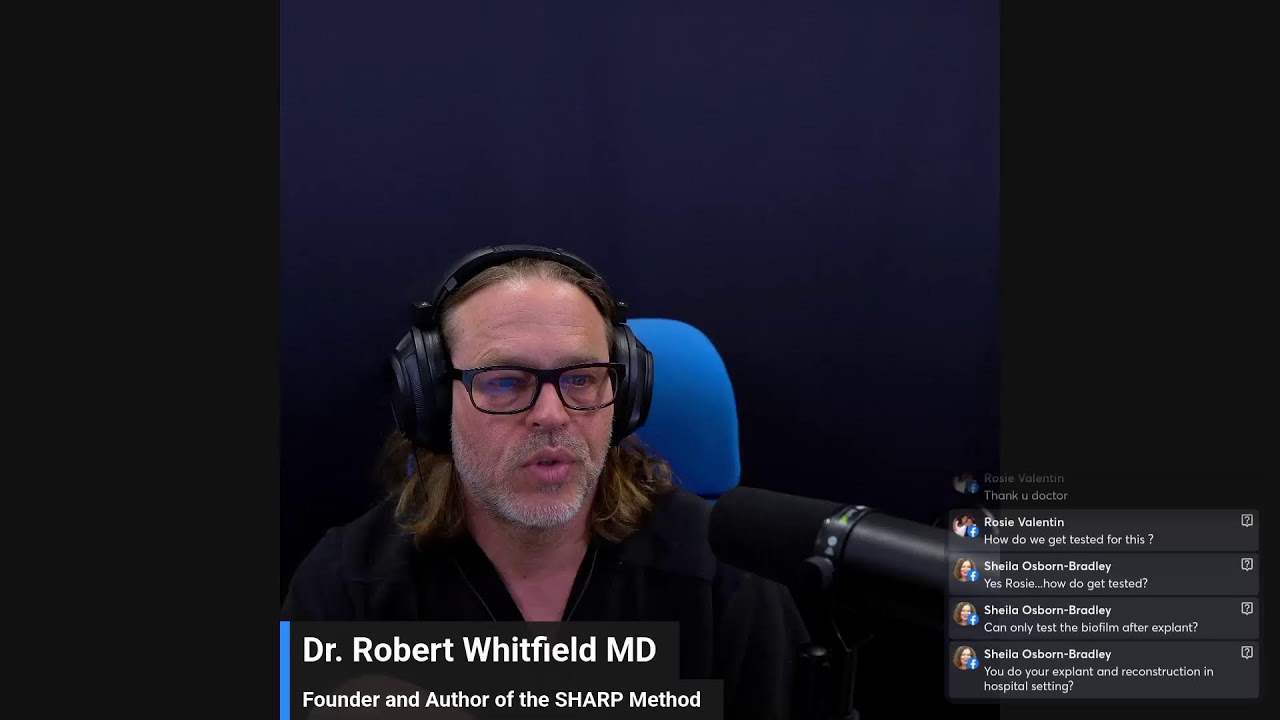
Dr. Robert Whitfield breaks down a 2024 study linking breast implant illness to bacterial biofilm that triggers immune cells to produce inflammation. The research found Staphylococcus epidermidis in symptomatic patients and showed the same bacteria caused fatigue-like behavior in mice.
Chapters
Make sure that everything is fine. If you can see me on Substack, chime in. It's interesting. I scheduled the live on Substack, but I'm not convinced it's actually working. And I apologize. I had my notifications off. Do not disturb should be on. There we go. All right, and is anybody in the circle? Everybody pass this around, we're gonna have a great talk tonight. This one is a keeper, so make sure You share it, pass it around. Let everybody know we're going live. Okay, everything's working on the circle. I'm gonna check out the live chat. Clearing the chat. All right. Okay, I am live across as many things because I can't be right now. All right, there we go. Too much technology, too much tech tonight. It's been a busy week too. For everybody who doesn't know, we have our brand new. Um, 4, uh, operating room surgery center open in Austin. So we've added days to our operative schedule because now we have flexibility to do that so we can take care of more patients, which is awesome. So we did a Tuesday, Wednesday, Thursday this week, and we have a Monday, Tuesday, Thursday next week. So yeah, we have a lot more flexibility now. All right, well, let's get into it. I'm gonna bring up, uh, the talk. I have it hidden in my 9,000 windows on my computer, but we will get it up. We'll get rolling. How's the audio? Is the audio good for everybody? Um, I tend to think like it sounds a bit better on Instagram if we use the, uh, DJI. So we'll do that. We'll see if we can just plug it in and get it working. Shouldn't be a big deal. Yeah, one of my DJIs is just not working. All right, we got this other one right here. We'll put it on. We'll get some better audio for Instagram. Okay, everybody should be able to hear me well. I'm gonna turn up the sound so we get quite a bit of volume across the board. Can everybody hear us on Facebook, LinkedIn, YouTube, X? Rumble and the Circle, as well as Instagram and TikTok. Give me a thumbs up, something. Make some noise. Okay, it's pretty subdued crowd for a Thursday. We just had a big storm in Austin. Is that the deal? Is that what's going on? All right, share this around. There's not enough people on here. Thank you, Dina. All right, we're going to do this talk and then I'm going to take a bunch of questions because this should be a good one. Okay, so biofilm, a hidden molecule and the body's alarm system. So we need to understand the possible biologic pathways in breast implant illness. That's what this talks about. And so tonight we're going to get into it. Um, certainly I appreciate the opportunity to connect with everybody. I want to begin with a problem that medicine has not handled well. And so a woman who has breast implants placed, for a period of time she feels absolutely fine. I'm sure Everything, for the most part in the beginning, is fine after the early recovery process is over. Then she may notice changes. She becomes, um, not frankly exhausted, but notices less energy. Her joints also may bother her. Her eyes may feel dry. That's a really common symptom. She cannot necessarily think clearly. She may forget names. She may feel hot. Sometimes, and maybe she might just feel unwell. She will see, after that starts, you know, her GP, another clinician. She'll get maybe blood work done. She was told that the symptoms are extremely nonspecific. Sometimes she would be told that there is no clear explanation for them. Yet many women report that these symptoms began Relatively early after implantation. Some also report a meaningful improvement after their implants have been removed. So what's actually happening? So that leaves us with a pretty difficult question. And so what if somehow there's an implication here, the— that the implant is not just sitting there as an inert object? So what if more important things are happening at the tissue level, a different story is taking place within those surrounding tissues? So a 2024 study in the Journal of Clinical Investigation examined that possibility. It does not prove that there is one mechanism that explains every single case of symptoms around breast implants, breast implant illness, BII. It does something a bit more useful to me scientifically. It gives us a specific pathway that hopefully down the road we can test. The pathway involves a bacterial biofilm, a small lipid molecule called oxylipin-10-hem, and the immune response that may help explain why local symptoms around implants can lead to these systemic symptoms. I'm going to show you, you know, the information in 3 layers. First, what the investigators found in the tissues. That's the human tissues that were taken out and examined. Second, what happened when they exposed the human immune cells to the molecule In the laboratory. So obviously there's different parts of this. So it's from a layer standpoint, the third is going to be what happened when they administered that molecule in a small animal model. So the human association, the cellular mechanism, and the animal model. So if those 3 layers point in the same direction, then we have a more stronger chain of evidence worth examining. Something that's worth taking seriously. So as many of you know, you've heard me speak about breast implants were introduced in 1962, not far from me. I'm in Austin, Texas. They were brought to market and then introduced into the first patients in Houston in 1963. Today, more than 10 million women worldwide have them. 2.2 million women worldwide get them annually. And nearly 300,000 breast implant procedures are performed each year in the United States. So those are some large numbers. For years, the implants were commonly described as biologically inert. The idea was simple. It was a passive material placed inside the body, and it would develop basically your standard foreign body reaction. So clinical experience has made that picture, I think, more complicated. And the thing to me, the thing that is fascinating is the science seems to be now catching up, so we can actually examine these things in more detail. Breast implant-associated anaplastic large cell lymphoma, BIA-ALCL, is strongly associated with exposure to textured implants, and that's why they were recalled in 2019. Chronic inflammation is is a central core to that disease, and bacterial biofilm has been proposed as one of the possible contributors. To that whole, like, environment, if you want to think of it that way. Capsular contracture has also been associated with, I think of, like, dysregulation within the tissue response, with evidence suggesting that the bacterial contamination and biofilm may contribute in at least some cases. So these conditions are not the same as BII. They should not be treated as proof that biofilm causes BII, but they change the frame. And so that, that frame change around the implant and its complications is important. So the question is no longer limited to whether a silicone itself is potentially the issue. Researchers began asking whether the implant, its surrounding capsule—so the scar tissue the body makes around it—the local microorganisms—that we'll discuss that in a moment—and the immune system could interact over time. So that is the question behind this study. So now most people have encountered a A biofilm without really understanding it, and that's the plaque on your teeth. So, that's the original biofilm. It's that slippery coating on a wet rock. That's a biofilm. A biofilm forms when microorganisms attach to a surface and surround themselves with a protective layer or matrix. Inside that matrix, the bacteria can behave differently from bacteria that are free-floating in fluid. That difference matters because routine cultures may miss them completely. Organisms in a biofilm can be difficult to recover and grow under standard laboratory conditions, which is extremely important. When I was in training, an example was used for vascular grafts. Those are the grafts or tubes that are used to replace blood vessels. And a study had to be done using a vibratory technique to get the bacteria that come off of the graft because they were trapped in biofilm. That's one of the one of the ones that stands out from training. A negative culture does not prove that biofilm is present. It does not reliably exclude it. Researchers therefore use several tools. Scanning electron microscopy can show structures consistent with bacterial communities on a surface. Specialized staining can help quantify the biofilm matrix. DNA sequencing can identify bacterial genetic material that routine cultures may miss. Each method answers a different question. DNA sequencing detects bacterial DNA. It does not by itself prove that an organism was alive at the time of the testing. Microscopy and staining provide structural evidence, but they do not tell us whether a specific organism caused the patient's symptoms. So the strength comes from asking whether several independent findings Are they converging? Are they, are they building a strong enough chain of evidence? So in this study, it included 178 participants. They were divided into 3 groups. 86 participants reported symptoms associated with BII. And then 55 had breast implants but did not report BII symptoms. These women were also undergoing explant. 37 had no breast implants. Their breast tissue was removed for another clinical reason, such as a mastopexy or a breast The investigators collected implants, the scar tissue capsules, the periprosthetic breast tissue, and blood. One point matters when we interpret the results. Not every test was performed on all 178 participants. The major laboratory analysis used smaller subsets. Scanning electron microscopy Compared capsules from 25 BII participants with capsules from 10 non-BII participants. The biofilm staining analysis included 7 participants from each implant group. I'm trying to go through all the various, you know, specific aspects of the studies. The bacterial sequencing analysis included tissue from 50 BII participants, 29— I'm sorry, 20 non-BII participants, and 16 participants from the control group. Participants without implants. The tissue 10-home comparisons included 17 BII samples and 6 non-BII samples. Those sample sizes do not invalidate the findings. They tell us how much confidence to place, uh, in them and why independent replication is always necessary in studies. So the investigators Thumb biofilm capsule in capsules from both symptomatic and asymptomatic participants. The difference was the, um, so the measured, uh, abundance, if you want to think about it, the quantities. So the BIA samples showed more biofilm than the non-BIA samples under scanning electron microscopy. Interesting. And in quantitative staining analysis. And it makes sense because the breast has its own, if you will, microbiome. So the routine cultures produce little or no bacterial growth, and that's key, right? So I moved away from routine cultures in 2019 because I was very concerned about their inability to identify either small amounts of bacteria different types of bacteria, or the fact that if it's in a biofilm, it's really not able to pick it up. So rather than stopping there, the investigators used the DNA sequencing, just like I was going to talk about, of the bacterial 16S ribosomal RNA gene to look for bacterial DNA in the sample. Several bacteria were present across the groups. Many were common members of normal skin flora. So that's important. So many times when there's not enough bacteria in a sample, when we send it to a lab traditionally, they'll come back and say normal skin flora. So normal skin flora are certainly capable of forming biofilms, and we'll go into that. One organism drew particular attention, Staphylococcus epidermidis. This is not a new pathogen, it's not exotic, it's normally found in the human skin. Its importance comes from what it can do when it gains access to an implanted surface and forms a persistent Biofilm. So just like the story I told you about the vascular graft, now this story is being found and told around the implant. Within the samples evaluated by that sequencing technique, Staphylococcus epidermidis was reported in 73.3% of the BII group and 16.7% of the non-BII implant group and 10% of the group without implants. So once again, you know, it's part of the microbiome, But here in those patients with more symptoms, you're seeing a higher amount. Those percentages apply to the sequencing subsets, not to each participant in the study. So another organism, Cutibacterium acnes, was highly ranked across all 3 groups. That reminds us that finding bacterial DNA is not the same as identifying the cause of an illness. So now, I published a large study because I was concerned with sample sizes that were publishing information about either bacterial contamination or biofilm. And so, we looked at my series and looked at specifically 694 consecutive samples, and 29% had bacterial contamination predominantly with Staphylococcus epidermidis and Cutibacterium acnes in my study. So the human data of that study that we're mentioning established an association: more biofilm in the BI samples with a disproportionate representation of Staph epidermidis. The association gives us a clue. It does not really give us the exact mechanism, of course. For that, the investigators needed to find out what the bacteria might be producing. So this is pretty fascinating because this data was, I think, interesting in terms of breast tissue. You know, it contains an abundance of fat, including lipids rich in oleic acid. Oleic acid is also the familiar fatty acid found in olive oil. Certain bacteria can chemically transform oleic acid into an oxylipin called oxylipin-10-heme. So we, for short, we'll say 10-heme. Oxylipins are signaling molecules derived from these fats. They can affect bacterial behavior, host cells, so your cells, or both. Primary research showed that tenhome can promote bacterial biofilm formation in laboratory models. So that creates the possibility of reinforcing the cycle. A biofilm produces a molecule that may help the biofilm persist, so it perpetuates itself. The investigators measured tenhome in paraprosthetic breast tissue using mass spectrometry. So in the small tissue subset tested, TINHOM levels were significantly higher in the BII samples than in the non-BII samples. The difference was statistically strong, and higher bacterial abundance correlated with higher TINHOM levels. So I think that tracks, that makes sense. The investigators then cultured Staphylococcus epidermidis with oleic acid as the source of carbon. the bacterium produced tinhome in the laboratory setting as well. So Staphylococcus epidermidis was not only the organism capable of doing this. 2 other tested organisms, Pseudomonas fluorescens and Acinetobacter species, also produced tinhome. But Staphylococcus epidermidis may therefore be an important contributor rather than the only possible source. So that's important. So It was in addition to, uh, Staphylococcus epidermidis that you got 10-hOMM produced. Now, other producers of biofilm readily are Cutibacterium acnes, um, but now you have Pseudomonas, which is found as a complicating issue in breast, and then Acinetobacter. So the study is becoming to me more and more interesting. The researchers now had a molecule they found at higher levels in symptomatic tissue A relationship between that molecule and the bacterial amount found, and laboratory evidence that the bacteria identified in the tissue could produce it as well. So, but none of that really shows that Tinham can alter our immune system, the human immune system. That was the next test, the next way to look at this problem and try to answer the questions. So the investigators examined the actual gene activity in the periprosthetic tissue from the 3 groups. So the BIA tissue group showed increased activity in pathways associated with T helper cells, type 1 cells, commonly called Th1 cells. And the Th1 cells are part of the adaptive immune system. They help coordinate immune responses to To certain intracellular organisms and other threats. Their activity includes production of inflammatory signals such as interferon gamma. The investigators also found increased expression of TBET. It's a transcription factor that helps direct developing T cells toward the Th1, the T helper 1 subtype. They also found more Th1-associated cells in the peri-prosthetic tissue from BII participants. So the finding was not limited to tissue surrounding the implants. Blood from BII participants also showed a greater abundance of Th1 cells than blood from the comparison groups. So that matters because BII is described as a systemic illness. The study found a systemic immune signature that parallels the local tissue findings. So when people ask me, can this cause, you know, these symptoms, I say yes. The persistent Th1 activation can contribute to the chronic inflammation and is biologically consistent with symptoms such as fatigue and others that we see. It is not specific to BII. However, it does not by itself— and by itself, it doesn't explain every symptom. So another question remained. Did Tinham actually drive the Th1 response, or were the two findings like just simply happening at the same time? So you can see, I mean, not only was this extremely well done study, it really answers a lot of these questions that come up. The researchers isolated naive human CD4 positive T cells from healthy donors. These mean. They had not— let's go back. I just want to make sure that we go over this. So the naive means that these cells had not yet committed to a specific T helper subtype, so not Th1, not yet. Okay, so that's important. So the, the investigators exposed the T cells, these naive ones, to the purified Tinhome for 48 hours. The cells moved toward a Th1 phenotype. So then they wanted to become that. They increased T-bet, the Th1 marker, CXCR3, and secretion of gamma interferon. So the research— excuse me— the researchers also examined several other T-cell subtypes. They did not observe the same statistically significant increase in the other subtypes tested after exposure To the purified tenHOM. That does not prove that tenHOM behaves identically inside the human body. A cell culture is a controlled system. It's not a patient. But it provides direct evidence that tenHOM can influence human T cell differentiation under those experimental conditions. So the investigators then turned to the macrophages. Now, macrophages are incredibly important. They respond to signals in their environments. Some macrophage states are associated with tissue repair, while others are more inflammatory. The BII tissue showed a greater expression of genes associated with inflammatory macrophage phenotypes. So, in this next laboratory experiment, the T cells were pretreated with Tinhome promoted inflammatory polarization. And that's— I know that's a handful. All right. So now we're trying to see if they will change. That's the whole point of this. So in this next experiment, the T cells are being pretreated with Tinhome, and that's going to basically promote them into a change. This suggests that the Tinhome-activated T cells And the signals then alter the macrophages. That's basically— that's what we're looking at. The exact signaling mechanism remains obviously unresolved, but the study now really had, uh, something more plausible. Bacterial biofilm may contribute to TINHOM production. TINHOM can push the naive T cell towards the Th1 phenotype, and then those activated T cells can promote a more inflammatory macrophage state, that polarization state. So the investigators still needed to test whether any of this could occur in a subject or in a living organism. So this comes to the small animal model. The researchers administered the tin home directly to the fat pads of mice. And so They're, they're trying to use doses of Tinhome to determine what will happen. These mice did not have implants, obviously, or bacterial biofilms. The experiment isolated the effect of the molecule itself. So after Tinhome exposure, the mice showed an increased abundance of Th1 cells in their blood. Their mammary fat tissue also showed more macrophages in And with inflammatory markers. So those findings resembled the selected immune findings seen in the human BII group. The researchers then performed an endurance test with a treadmill. They did this to see what would happen from an energy standpoint. This was a small study, and the comparison included these mice with 6 controls. The 10-home-treated mice stopped more frequently and contacted With this grid more often. The authors interpreted this behavior as more fatigue-like. So the mouse experiment can strengthen the biologic plausibility because direct exposure to TEN-HUM reproduced selected immune findings. It gave a fatigue-like picture in this mouse model. It does not prove that TEN-HUM causes complete human BII-type situations. It does not establish that. The experimental doses match the exact human exposure, and it does not tell us whether blocking Tinhome would improve symptoms in patients. It does tell us that the molecule is definitely biologically active, and it definitely deserves more investigation. And so, you know, I remember this paper when I initially read it. And it's a, it's a pretty interesting and I'm gonna say overwhelmingly complicated, but it's trying to answer a lot of complex questions. And, you know, I think further investigation, and we're going to talk about that. So next steps would be, you know, a, a study where a breast implant and surrounding capsule provide the surface, obviously, where the biofilm is forming, the bacterias persist. So certain bacteria can use host-derived oleic acid to produce probably TINHOM. TINHOM can then promote the Th1 polarization in the human immune cells under, obviously, laboratory conditions, conditions, and Th1-associated signals can promote a more inflammatory macrophage phenotype. So the participants in this study showed, uh, local and systemic Th1 findings, and mice exposed to Tinham developed similar immune changes and fatigue-like behavior. So each of these has, uh, support. The, the full chain obviously has not been proven prospectively in humans. Um, the study did not show that Tinham entered the human bloodstream. It did not show that every person would be Okay. Had elevated tenome. It did not establish whether the molecule predicts symptom severity or improvement after explant. So it also did not prove that Staph epi is the only organism involved or that biofilm is the only pathway to BII. So the authors describe BII as likely multifactorial. The study did not identify Uh, a preference for any of the device surfaces, which was shown in my study as well. And so that also was a concern of mine a long time ago about BII ALCL. And so I think that's probably a— not a, not a place to pause, but like for a moment, like I was worried about people Having BII and going to this BIAALCL, and it was so unclear. So, so we have one like proposed, you know, pathway. It's not the only one by any stretch, and it's not necessarily universally going to improve with explant. And so Like, where are we now? I, I think, you know, we, we talked, um, and we always want to help patients, right? So the, the talks are meant to like provide the evidence that's, you know, available currently so we can better understand what's going on. You know, previously I went over our paper in detail to show that 29% basically have, uh, contamination when you explant them. All right, so I, I consider that, until this place, the most, uh, representative study about the incidence of bacterial contamination. This study gives you ideas about what can be going on with that bacterial contamination. So the, the— for patients, there's value in this study. It does not settle everything. It just helps and is yet another piece of the puzzle. It does, you know, it gives us an idea of another biomarker, a biomarker that could be looked at, although it's once again, it's not going to be found in everybody. And the study itself doesn't establish or lead to any kind of medical therapy. It does not show that, you know, something like an antibiotic can treat BII, and it does not show that any other modalities, whether they're supplements or other techniques that are unproven to disrupt biofilm, will work. And it also doesn't show that blocking any cells in our immune system or macrophages is safe or effective. So, none of those was tested in this study. What it does identify are research targets. So, biofilm burden, bacterial lipid metabolism, tenome, Th1 activation, and inflammatory macrophage signaling. It also gives implant engineers potentially a practical question: can future implant surfaces or surgical strategies reduce the conditions that allow for this biofilm formation? And I think that, you know, boils down to a 4-letter word called life. I think that's the challenge, and that's the harder, uh, problem to solve. So patients with systemic symptoms still need this individualized evaluation. Fatigue, cognitive changes, joint pain, dry eyes, and malaise have definitely broad differential diagnoses. History, exam, imaging, pathology, and appropriate testing all are still important. And you know why we came up with and, and work so diligently on the SHARP methodology is because we're looking at your genomics, we're looking at your toxicity burden, your gut health, your food sensitivities. And, and definitely evaluating where your balance is in hormones, because those are extremely important. The goal is not, you know, as I've always said, I don't tell anybody to explant. That's a personal decision everyone makes on their own, after they gather their information and make their decisions. I think the goal for all this is to make sure that people are being heard. The goal is to take the symptoms and, um, from each patient, take them seriously, to really help provide as much clarity as possible. So for years, the BII conversation was trapped between, you know, 2 positions. One side said that women were experiencing these real and disabling symptoms, and the other side said there was no accepted mechanism connecting those symptoms to an implant. This study, um, it does change that conversation to me. It identifies more biofilm in symptomatic samples. It identifies the bacterial lipid molecule at higher levels in symptomatic tissue. It shows that the molecule can detect human T cells toward— or direct human T cells toward Th1 phenotype. It connects those T cells with inflammatory macrophage behavior, and it reproduces selected immune findings and fatigue-like behavior in the animal model. So although that is not final proof, I think you follow along from week to week, we're establishing a better level of evidence and It is a very coherent, very testable model. The next studies certainly need to answer more questions. And can, you know, other groups reproduce these findings? Of course. I think, you know, it'd be nice to be able to check and then follow and see if something drops after surgery. We don't have that luxury yet. And We still don't know why some develop this response and others don't. I have my thoughts about this that I can share. And in those who have this problem, can we interrupt the pathway? Can it be done safely? I mean, certainly, you know, we're making some advances on a problem that's very difficult. And I remain extremely curious about this problem because it's such a hard problem to solve. And we need to do hard things. I think we now have more information. We can ask better questions. And we can stop asking whether or not the symptoms are real. I think we can all agree they are. Maybe we should ask which biological pathways are the most active in which patients and what can be done about those to help those patients. So that is where probably better tools are needed and better treatments would begin to help more and more patients solve this complex problem. So thank you all for bearing with me. I know that's a lot of science on a Thursday. Thank you. But, um, I am done with my talk about oxylipentin and biofilm. And as much as I like that paper, it's got a lot of— it's a, it's a, a lot to go through. And so last week we talked about the incidence of biofilm that we found in our patients we explant. So 29% bacterial contamination. And then, um, in this paper now we're evaluating like, what did they find? What's, what's something in the research environment? Now, once again, you cannot go to Quest or LabCorp or Function Health or anybody selling you labs to get oxylipin 10-home tests. So you can't do that. So, um, I hope in the future you can have opportunities to get other you know, markers measured, but currently that's not available. So, I'm going to take some questions off of the platforms. I just, uh, uh, answered, uh, Rosie's question and Sheila's question. So, this is not a test that is commercially available. You cannot go get your blood drawn for this test. This was done in a research setting. All right. Do I have? Hello, Miss Tanya. I saw you in there as I was finishing my talk. Hope you're doing well. Tanya's an old friend from Las Vegas. Do I have a question? I don't know that anybody did. Anybody ask me any questions tonight? I'm going to try to get some questions going here. Oh my gosh. I don't know what's going on. On TikTok, we had so many people. That's awesome. But I can't— I don't have anybody answering, you know, the questions for me, so I got to scroll through. Sorry. Everybody wants to join and be a host with me. That's awesome. Thank y'all. Oh, let's see. I don't have questions here. Why is that? Uh, Sheila has another question. Can you only test the biofilm after explant? Currently, that's how we test it. We don't have a pre-op test we can do it because we actually send the scar tissue specimen, um, like a thumbnail-sized piece as a sample. All right. Well, is nobody asking me questions? Oh, here we go. Oh my gosh! Somebody's like messed up my feed. What do you know about chronic staph infections correlating with capsular contracture and a ruptured implant? Uh, yeah, anybody who has implant infection with staph, that's going to be hard to clear. So that can definitely become chronic and remain a problem. When we had this happen in patients who had cancer reconstruction with implants, I would take it out and remove it and do a deep flap reconstruction. That's what I mainly did for that problem. Cosmetic patients, it's different. They have to decide, you know, what their willing to do and how they want to address it. Hey, Brandy. All right. Why does everybody try to co-host with me? That's so funny. Y'all know this is my livestream, right? Hi, Leah. All right, what else do we have here? Huh? I don't know that I have. I have so many people on this now. I don't have a lot of questions here, but I'm trying to scroll through to see if I have something. If y'all want to head over to drrobscircle.com, I'm going to type it in the chat. We're going to move over there and take some questions, and you can ask me more questions there. It'll all be off, um, Instagram And all the other platforms will just be in my circle. I'll put it in the comment now. All right, I put it in the comment on Instagram. I'm gonna comment on it on TikTok. Moving to Dr. Rob's circle dot com for Q and A. Okay. All right, y'all, we're gonna wrap it up here. Just get your questions in. Please come over to drrobcircle.com. It's free to join. Simply hit your email as the login, we'll send you a magic link, and boom, you're in. And you'll be able to do a live chat. It's not video, it's just live chat. All right, all right, y'all head over there. I'm gonna shut all these other ones down. All right. Oh man, I can't thumb type. Somebody should help me thumb type. I need some fancy people who can type with their thumbs. Oh my gosh. Well, we need all of y'all to go over to the circle. Sheila's asking on Facebook if I operate at hospitals. I haven't operated at hospitals since 2019. I stopped just before the pandemic. I was wrapping everything up in 2019. Um, we have an amazing new surgery center, 4 operating rooms. Um, yeah, we do everything as an outpatient. People usually stay at an Airbnb, VRBO, short-term rental of some variety, or their favorite, uh, hotel. And, um, they just come in and out. Um, the surgery center is about you know, 5 minutes from my office, which is very convenient. And patients then, um, can come in the office the next day, and we have a vertical hyperbaric chamber lymphatic massage from New Zealand via the company called Flowpresso. Uh, I was doing a WhatsApp with their owner Desiree, uh, this morning. Um, I'm sorry, it was her morning, it was my afternoon, because I have a patient who needs to use that when they get back home to Las Vegas. And then, um, we have NanoVi therapy. We have, um, the Human Regenerator. Now, if you haven't heard of the Human Regenerator, you should go on my website and check out the Human Regenerator. This thing really helps you, uh, feel good. It calms you down after surgery. People with really, like, a lot of cortisol dysregulation, a lot of nervous system dysregulation, really benefit from it for sure. All right, who's moving over? How many people do we have? I know I have Leah over in my live chat and Dr. Rob's circle, but where are the rest of y'all at? Are you coming over? It's like, I feel like if I end these streams, you guys like don't really move over. It's kind of amazing. You have free access to me and you still just linger. It's strange. But all right, we're gonna move over. Um, you guys got to figure it out at some point here. Leah always tells me that eventually I won't be able to tolerate this. Oh my gosh. Somebody named Miss Peaches is trying to join me and be my co-host. That seems odd. Okay. Good night on TikTok. And good night on Instagram. Okay. And then we're going to start turning these down. And so we'll begin with What? We'll stop the. What's this one? Gonna stop the rumble, and gonna stop it on X. I don't know anybody ever pays attention to me on X, but that's all right. And gonna end my live stream on YouTube.







