Ultimate Guide to Transforming Your Health Through Sleep with Cal Callahan & Dr. Robert Whitfield
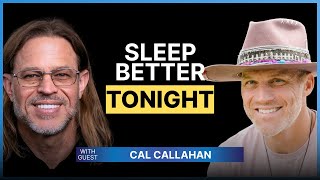
This YouTube interview (Jan 16, 2025) features Cal Callahan and Dr. Robert Whitfield discussing Cal’s upcoming memoir (inspired by personal growth, early retirement, and a 2017 Las Vegas mass shooting) and practical strategies to improve health span with an emphasis on sleep and recovery. Cal describes his book-in-progress (podcast: The Great Unlearn), training and biohacking routines (weight training, sauna/cold plunge, mat breathing), quitting caffeine, using an Oura ring for tracking, and recent improvements in sleep. Dr. Whitfield emphasizes sleep hygiene (7–9 hours, dark/cool room, screen avoidance), nutritional strategies (protein timing; ~1 gram protein per pound body weight), HRV improvement via resonance breathing, supplement options (magnesium bisglycinate, ashwagandha, L-theanine, extended-release melatonin), and diagnosing/treating sleep apnea (home sleep test, ResMed, CPAP/mask).
Questions this video answers
Early 2020.
He was in Las Vegas in 2017 at the mass shooting.
The Great Unlearn.
53 years old.
Oura ring.
Chapters
It's great to be here. And yeah, it was so nice to reconnect after so many years of our daughters playing sports way back in the day. So.
Oh, it's my pleasure today to have Cal Callahan. We went to dinner back in 24 at the end of the year and we said we'd get together and get on each other's shows. So I really appreciate having Cal on. We were just talking offline about his new book that we're going to dig into and some of his maybe his day to day practices for wellness. We were talking a little bit about, you know, some of the things that I do. So. Welcome to the show, Cal.
Hey, thanks for having me on, Rob. It's great to be here. And yeah, it was so nice to reconnect after so many years of our daughters playing sports way back in the day. So. And look at us, look at what we're doing now. It's been pretty fun. So much changed.
We had a great dinner at Este, which is a wonderful place to eat in Austin, and got to sit out on their deck, which is also wonderful and commiserate about all the days on the soccer fields. And now I'm, I'm in the volleyball world and from our, for my daughter and we, we each have. Well, my book's out now, but we're going to talk about your book that's coming out and maybe some of the impetus to write the book, what it unpacks for you personally and professionally. And we were just talking offline about how your success as an options trader in Chicago kind of led to everything. So maybe start there.
Yeah, thanks. Yeah, I've got a book that I've been working on for, and a number of years now and it's had some, a few different iterations. It's a bit of a memoir and I would say the, the inspiration for it and I would say I started it in early 2020, kind of unrelated to what was going on. It was just where I was going through my own kind of personal growth at that point. I had started the podcast and I just felt like I had a message to share. Kind of my personal journey of really seeking success in all the traditional senses of the word that we're kind of led to believe that that's the journey we're meant to be on. And I kind of accomplished that. Know, I retired early and I guess was financially successful in a way that I hadn't thought possible. And I found myself in Las Vegas in 2017 at the, the mass shooting and it was in that experience that I, I woke up to living a life that I really didn't want to live anymore. And that is pursuing these, I guess, this external validation, accumulation of assets. It was kind of never ending. And in that moment in Las Vegas, everything, everything kind of the focus gets really narrow. And none of those things were there to, to save me, so to speak. And so I left there not even knowing that that's what had awoken in me. But it took me maybe 18 months of this existential inquiry of why am I here to wake up to the fact that there's so much more out there that I wasn't aware of. And, and it's why I started the podcast, to share those people that have inspired me along the way to look at things differently. It's one of the things that really fascinated me about our dinner was how you're doing, the work you're doing is very different than anything I'd seen. And I'm really curious about people who will kind of color outside the lines. And I've tried to be one of those guys who will go into areas that other people won't just out of curiosity and to see, kind of see what happens. And so that's been a bit of the, the inspiration for writing the book. And, you know, I wish I, I, it has, it's been with my editor a few different times, and I still haven't been able to pull the trigger on releasing it yet. And even now I don't, I'm not sure what's holding me up. I haven't given it the final read through. I've had it for a month. And so there's like some stickiness there that I'm trying to sit with.
Have you read it aloud?
I have not.
That will be the unstickiness. That would be the thing that unsticks you. And it's a very. Because, like you, I sat on something for a long time, my program that we talked about at dinner that night, Sharp. I've used it for several years. And finally, with much coaxing, a mentor of mine said, you have to put pen to paper, so to speak, and get that done. And I said, well, and this is my own problem from where I came from in terms of medical training, surgical training, academics. It was beaten into you by certain people, like, do not write textbooks. They're extremely laborious textbooks in general. And so I would contribute a chapter here or chapter there based on, you know, need, but I would not commit to, or want to commit to writing text and certainly did not really think probably like you, that you'd sit down and put something out and push came to shove. And our schedules were tight, and the only window I had to get the recording done of this book was Father's Day last year. And my family was out and I was in Austin and had reserved a studio and went. And that was the first time that I had read it aloud after certain edits were made. And I read it and I was like, oh, my goodness, this does not sound right. And so I'd have to change things on the fly in the studio with the tech recording the audio and say, no, that's not right. It should be this. And so that happened to me. And so now I'm finishing editing our second book, and I am purposefully reading every single thing out loud all the time early on and sending the edits and all the things now make more sense. But it's a. You know, I don't like the sound of my voice. I'm sure a bunch of people say that. So. But I had to get over that. And then it became. I just had to sit down. I don't have to do this. I have to do, you know, whatever. Pick a time frame. You know, whether you do 15 or 30 minutes at a time, it doesn't matter. You just have to do something, get started. And then when you hear it, you're like, oh, that's what I was scared of. That's what I didn't want to hear. And then you change it and it's done, it's over, it's purged, and you move on. That's really. That was a cathartic thing for me to do because I know how I say it, because I live it all the time. Yeah. And when I hear it and I hear it the right way, it's fine. But as soon as I say it out loud, I know it's wrong.
Yeah. Yeah. I could sense that for sure. And I. There's something in there for me. Like what? Underneath all of it, there's like some sort of fear, I think that it's right. Not going to be accepted. It's not going to be good. It's in. So by not reading it right now, I am. I don't have to worry about that outcome. Right.
That's why. That's why we put it off.
Yes. Yes.
So now I know, like, there's. There's no way to get around it anymore. And this book is much bigger from a length and depth perspective than the first one I did. So this one is even. You can't just go wing it. Like, you have to do it and get it, you know, from a. It's like a stepwise progression, like, you know, creating a habit of saying, I'm going to look at. I'm going to read this for 10, 15 minutes, and then before you know it, it's done, the edits are made, and then they're gonna send it back to you and you're gonna do it again. You're like, yeah, that's a lot better. Yeah.
So, well, I'm starting today, then. I'm inspired.
That was the only thing that helped me.
15 minutes.
I'm looking at the book over here on my shelf, and the first one, as well as my YouTube plaque. And all of those things are, you know, they're from habits, you know, maybe, you know, and, and not to belabor it too much, because certainly the things you're talking about unpacking are things that, you know, accumulation of assets and, or whether they're, you know, physical assets or financial assets or, you know. Yeah. In the end game, none of that really will equate to much.
No. And I've, I've, I've gone through the, the, the, you know, the feelings of those things are bad. You know, as I started to open up to, like, maybe I was following the wrong playbook the last number of years, then I, I kind of push those things away. And then I, I realized, like, no, those things have their place. And so it's, it's up to me to decide what that balance looks like. And when I get too overweighted into the importance of those things, generally, it's. There's something's not quite right with how I'm feeling about myself. I, I put a lot of eggs in those baskets. Like, I'm not feeling super confident. So that, you know, stands in for, you know, just doing the work, you know, and it just never, it never lives up to that, you know, kind of that billing for me. And so it's always just tuning in, like, how am I feeling about things right now? And can I just be okay? And a lot of times it's, It's, It's a challenge because we have all this pressure from outside that we feel and we sense and we see and we live. It's, you know, we're anchored and we're grounded. Those things just. They just seem to flow for. Again, it's back to acceptance. This is, it is what it is right now. And as simple as that sounds, you know, I would say over the last year, I've I've, I've really kind of struggled with that and it's, there's been a few things that I've been trying to negotiate through that I haven't been able to and I've had to sit in that much longer than I would have liked. But I think it was important for me to, to have kind of some financial handcuffs on for me to, to learn the lesson. You know, this is kind of where, where I'm kind of coming out on the other side, hopefully here in early 2025 of the, of learning that lesson finally, after a number of opportunities to, to get the lesson. And so how do I want to live, you know, I'm 53. How do I want to live the rest of these years? What do I want to take from the challenges I've had, particularly over the last year or so, and, and, and live a little bit more frictionless?
Well, I'll, I'll shift now because you said that and I've listened to you.
On other.
Platforms and other interviews and I've heard you say this more than one time, that you don't sleep, you don't sleep well and you don't sleep very much. And you know, for everybody who listens to my show or has read my book, like I prioritize sleep over everything else and you know, for my patients who, whether it's sports related patients recovering from surgery, you know, you trying to go day to day, I guess we'll just say it's more self care. What does the routine have to be? And I'll take this time to go ahead and, you know, beat the drum about sleep and how much sleep is, you know, enough and how much, you know, quality. So at a minimum it's like six and a half. But there have to be some very specific, you know, you have to get to enough cycles, enough depth. And for those of us who use any kind of wearable, I know the rings and I won't mention specific rings. I have my pluses and minuses on rings and whoop straps and polar beat and what else do we have going? Oh, watches, of course, there's a whole host of watches and literally I've demoed every flipping wearable on the market. Because if you can't recover after, you know, the previous day, then the next day is, as you know, a very difficult one. And that just cumulatively over time wears us out, whether we're male or female. The anxiety, stress of day over day, you know, not enough rest, not enough recovery, not enough, you know, know, hormone synthesis and balance and lymphatic drainage and you know, we, we're in the, the land of. Or the time of cold plunges and saunas and biohacking and, and we're privy to most of this. We all kind of are. Are in my world. That's a very, you know, large part of why come people come visit me in Austin and, and stay with us for surgery because we've got our practice involved in that and sometimes it ends up being a band aid for what is a lack of rest. Yeah. So, yeah, first and foremost, I mean, thanks for sharing all that because that is not easy to share and certainly that amount of angst because I feel it too. I'm an entrepreneur. We're in the midst of projects all the time and the stress and strain of those can be a bit overwhelming, I'm sure. As you know.
Yeah, for sure.
So as we look into like U1 and things are getting better obviously and the book's gonna to come to fruition. That's. We're gonna manifest that for you.
That's right.
That's gonna come out. That'll be great to have out.
We'll.
What are the, the big things you're looking to in. In, you know, the new year that like what's. Besides the book, which is a huge project to get off your plate, what's maybe what practices or things are you going to do to. To improve, you know, your health span, your longevity. Things that, you know, I want everybody who listens to this, this podcast really is about, you know, how can we find from a, you know, head to toe if you will improve our health span and you know, if you improve health span, longevity is going to fall. That's what I would say.
Yeah, no, that's a big part of my life is exploring all the, you know, call them biohacking spaces and the different ways to play there to create more vitality and then more longevity. And so for me, the biggest thing, it's no secret, but it's, it's consistency. And within my weight training during a season that could be five days a week hitting it, you know, a pretty, pretty good, you know, bodybuilding type workout five days a week, really consistent with that. And then as we, we come into this time of year, like I don't have as much in the tank. And so I know that for me to be consistent, I need to dial it back to three days a week and then I'll do some things on the other days that she just to keep blood flow and movement. But to show up in a way that my body can support energetically. And that was like a big step for me because I always felt like I needed to push and go hard because other people are doing that right. And I finally decoupled that, that kind of mentality from what everybody else is doing. What do I really need? I've gone through my journey with the sauna cold plunge as well. And you know that that is something that you couple training, sauna cold plunge. You know, in one day, there's a lot of things for your nervous system to, to manage. So if your nervous system isn't firing, you know, at a, at a decent capacity, then, then that's going to be too much load on it. And so I've had to tune into when do I do, what types of, what do the days look like when I can do all three and what are the days where I need to just do one and I really need to recover because as much as I love the cold plunge and how it makes me feel, it is taxing. You know, I've found that my, my autonomic nervous system is generally in a heightened state. It's just the way it's been for a number of years. I'm working with someone now to dial that back and, and kind of get it working at the cellular level. It's a bit of a challenge. It's going to take some time. There's no, as you know, there's no pill to take. There's no quick fix. It's. It's literally showing up every day. I have to lay on this mat for 20 minutes twice a day. And after three to four months, I should see a significant change within that kind of autonomic nervous system. It remains to be seen. I've been doing it for about six weeks. I am sleeping better, which feels good. I'm waking up less in the middle of the night. That was one thing. I would wake up three, four times in the middle of the night to go to the bathroom and I'd fall right back asleep. But I'm waking up once now, which feels really good. Over the course of, you know, seven to eight hours, which has been a significant change. So, as you know, I'm able to stay in those cycles longer. But I would say overall it's just consistency and, and the consistency without the rigidity. For, for so much of my life I've had that rigidity of like, I need to do it this way and be super structured. And then anything outside that, I'd feel bad that I'm not Living up to this certain standard and it just becomes the snowball effect of unsustainability. And so really a lot of it anchor is anchored around as you said, sleep. Like I, I really, it's important for me to get sleep. I don't wake up to an alarm clock. So today I woke up at like 8 o' clock because I got to bed a little bit later last night. It's later than I'd like to wake up but that's what the body needed. And so I, I got a little bit later start to the day but I feel really good.
And how are you measuring recovery? Or are you measuring recovery?
I do have an aura ring and so I keep an eye on that. I'd say that's probably the main way but generally just how I feel, how do I feel when I wake up and what do I, what do I have the energy for throughout the day and is just sustained. And you know, I'd say back in September I got off caffeine and that's felt really good to not be riding that. You know, that whole peaks and valleys of, you know, for, for me caffeine ended up becoming this thing that would just get me back to baseline and wake up in a deficit every morning, drink the coffee, feel better, but never feel robust, never feel that, that jolt that I was kind of promised that I used to feel years ago. And so I know that that's just not something for me anymore.
Well, there's a lot of things there that apply to how I help people recover better. Because really the book I wrote Sharp, which is just a methodology and if you can apply it to all aspects of recovery, whether it's sports performance recovery, surgical recovery, you know, you just want to, you know, from a health standpoint improve your recovery. So you know, everybody, like what Cal's saying is if everybody listening, you only have a certain amount of genetic capability to detoxify. And when you overcome that through like his was maybe caffeine consumption that over affected his adenosine receptors. The, the way that you get around some of that and improve your sleep because if you can't get your sleep organized, everything else I'm going to tell you is not going to work well. So getting your sleep organized so that you're getting, you know, we'll just say you want to get on average 7 to 9 uninterrupted not getting up. And I'm glad he's been able to, you know, cut down his, his wake ups to go. And a lot of those can be mitigated with a couple strategies that I've done for patients, because patients after surgery have this thirst center turned on in their brain, so they drink a lot of fluid during the. Because that's a stress response after surgery. And basically my hack for that is to, instead of drinking just plain filtered water, which we always want, filtered water out of stainless or glass, we don't want you drinking out of plastic at all, you're going to add amino acids or protein to it. And that may sound gross to everybody listening, but the whole point of it is your body is telling you you're thirsty even though it's not just. It's a stress response. Correct. Cortisol has been increased due to, you know, in my case, I've performed surgery so that your. Your stress response is activated, your cortisol levels are up, that causes a whole sequence of events, and you get told you're thirsty, so you won't drink water. So now the hack is that's what you're going to do, but you're going to do it a particular way. So we're just going to add amino acids to it, or we're going to add protein to it, because that's ultimately what your body needs to go from catabolism, which is breakdown, to anabolism, which is the healing phase, the restorative phase. And you want to go from what K is describing as a sympathetic activation state, which is what we do with surgery, to a parasympathetic state, which is the healing, the recovery phase. How can we flip those switches? And the methods are very simple. It's really about a gram of protein per pound of body weight. That's a very simple number to keep. And I'm operating mostly on, you know, women. We'll say, you know, 25 to 55, average weight. We'll say 120 pounds. So like 120 grams of protein. And people are like, oh, my God, I can't get 120 grams of protein. I can't eat all that. Yeah, you can, actually. It's not as complicated as it sounds. And the way to avoid what cow's experiencing at night is use a three, two, one, you know, three, two, one method. So to get proper sleep, stop eating three hours before you're designating your time to go to bed. You know, last night he said he went to bed late. But if on average it's 10 o', clock, then you stop eating at 7 and you take in your last fluid around 8. So you want to give yourself two hours before you're actually going to go to bed because in that time you will then have to go to the bathroom before you go to bed. And that should allow you a longer restful period where you're not feeling like you have to get up and go. And then the screen thing, which is the hardest thing, people are on their screens, their phones, their pads, their tablets, whatever it is. I'm not talking about a TV where you're watching a program with your wife, Peyton. I'm not talking about that. I'm talking about this blue light stuffed up against your face. So you like, get your phone away from you. Yep. And then where you sleep, the room needs to be a little bit cooler, 1 to 2 degrees cooler. You need the ambient light or the light coming in the room to be blocked. So the room needs to be dark. Always remember how when you're at a hotel and, you know, you're on vacation, it's just you and Peyton, y' all could probably sleep till 9, 10, 11 o' clock in the morning because the room is just blacked out, dark. It's much easier, right? And there's not, there's nobody like causing a ruckus around you. There's no noise. So it's like perfect, right? Yeah. You're building this little cave to sleep in and then everything becomes that much easier. Now I always get up early because my chronotype for the last 30 years is to be up early. So I'm always going to wake up at, you know, whatever, 4, 35, 30. I mean, that's just standard for me regardless, really, of when I'm, you know, going to bed. But to get the sequence so that you get 7 to 9 uninterrupted, you get enough deep and rim and everything so that your body's all the magic happens when you sleep. That's why babies sleep so much. They grow when they sleep. They don't grow when they're awake. Like all the things you need from a hormone release standpoint happen when you're asleep. That's when the restorative things that you need to recover happen. And you sounded like you finally learned that you were over training. Oh, yeah, that was, you know, and, and there's certain genetic things about training and, and methylation. You may have heard of the MTHFR gene. So that is a phenomenon that's in almost 40% of our population. So if you don't have a, a balanced methylated B vitamin complex you're taking, you're always going to suffer a little bit more from like what Cal was Describing which was training. But he's training too much. He's, he's training every day. He's not really having a recovery period. And now with all the wearables and, or is probably one of the lower level wearables that helps you with a stress strain recovery kind of, you know, feedback standpoint. And he was talking about laying on a mat for 20 minutes. I didn't ask you, are you, are you practicing resonance breathing during that time?
No. What now talk to me about that.
So ultimately what you're trying to do is get your heart rate variability higher and higher and higher and higher and that's, that's improved. If you want to think of recovery, if you're measuring recovery by just your hrv, you know, young people like your kids and my kids have these high, high, high HRVs in the hundreds where you, you and I are, we're excited if we're in the 30s. So.
Absolutely.
The, the way to improve. One way to improve HRV is practicing resonance breathing. So think of like count to four on the inhale through your nose and count to six on the exhale out through your mouth and do the, the practice with belly breathing. So you watch a little kids, little babies breathe, they belly breathe. So that allows you to get your full expansion of your diaphragm when you belly breathe versus people suck in their abdomens. That's actually decreasing the space in the chest for the breath. And then ultimately what you were saying is correct. Over a series of months, you can improve your HRV that way. But it's not as. Just like you said, you're going to wait in C. You have to measure it and keep that consistent practice up because that's, that's part of it as well as you have. It sounds like like a lot of people suffer from a lot of overactivation of the sympathetic nervous system. So maybe during the day, Cal takes and goes to a quiet place and for 10, 15 minutes he's on, on the mat and he's just like shutting stuff out. So he's taking a break to help his, you know, sympathetic nervous system, because that is, you know, part of the issue that he's describing. And that happens, you know, that is an extremely common thing when we see that in our patients. So although our methodology is one that I established to help our patients and other patients having any type of surgery, it's really just a health span improvement methodology. If you understand your genetics, you understand how you detoxify your gut health, your hormone balance, your, your metabolism triggers in your Diet, then you can actually make decisions about what you're doing and control more of what's happening. But I always prioritize sleep. This is the number one behavior you need to address.
Yeah, no, and that's, that's beed out for me for sure. And I know that there are, there are a number of different reasons why my sleep has maybe suffered in the past. Some of it is just going through life stuff and it's anxiety and the, the ruminating mind. And I know that when, when we're able to get one. Let's speak for myself. When I'm able to lay my head on that pillow, you know, and get seven, eight hours of really good sleep. It's just how, how different I am throughout the day. It is, it is. I mean, I'm glad to hear that that's what you're hammering home, because I don't think there's anything more important than that. And that was what was so hard for me, is I knew that was important and I just was, you know, I wasn't able to kind of triangulate and get, you know, get that dialed in. And so now I feel like I'm in a much better place with that and everything else is starting to unfold in a much different way.
It's a very, if, like you said, quieting the mind because that can be really, really complicated for patients experiencing, you know, stressful events or times in their lives. Obviously from our experience with taking care of patients for 30 years, surgery is a hugely stressful event. And then, you know, that disrupts sleep patterns. And like we talked about, the strategies that, you know, know we implement are easy strategies to implement. And then certainly, you know, people don't want to rely on prescriptions and, and we don't prescribe medications for people to help them sleep. I use just holistic things from a supplement standpoint. You know, certain types of magnesium is certainly magnesium bisglycinate is, is a, is a good one for sleep. Adaptogens, Ashwagandha, valerian root, L Theanine are, are good for sleep. And then we use extended release melatonin in, in our line mostly because if someone wakes up, like you said, in the middle of the night, that that can be avoided just with some extended release melatonin. And I, from a strategy, I know that that works because I've done all these myself. So if, if you come in and you say you can't sleep and like, okay, well, I'll tell you what I do every night and that that will put most people Completely asleep, and you can, you know, get the. The time, then it's, can your body do the rest, you know, to recover? And so that's a whole different discussion because your brain needs oxygen. And, and for the. I have sleep apnea. So for everybody listening, if you. And you don't need to snore to have sleep apnea, and if you're, you know, I'm 55 now. I can't remember, honestly, uh, when my wife Ashley started, you know, banging on my shoulder at night to wake me up so I would stop snoring. But. And I. I'm not overweight. I don't have a specific neck or jaw problem. I just have a narrower airway, you know, at the back. So that just makes it so I. When I'm asleep and relaxed, it creates, you know, an obstructive type situation, you know, from. For my anatomy. And then to preserve brain health, you obviously don't want to have sleep apnea. That's one of the number one risks for Alzheimer's is having sleep apnea. So you don't want to do anything to jeopardize your brain. And if you're worried about that, you can go see your GP and request that they get you a sleep study. If they don't want to do that and you have the means, then you can go online. And there's a company called ResMed R E S M E D and they'll help get you a device. You can just do a sleep test like I did at home. And it showed I was having all sorts of events at night. And so now I wear. I have to use like a mask because I have a beard. And I guess I'm a kind of a restless sleeper. So I do that at night. But you can tell if you don't do that, how things are versus, you know, when you have it on. And I'm very consistent with wearing it. And you check it and make sure that, you know, it tells you how long you had it on. That basically gives you the amount of sleep you had and then how many events you had per hour. So that's important. So obviously the quality of sleep, the quantity of sleep, you want to make sure your brain's getting oxygen while you sleep. Those are obviously paramount to recovery. Whether it's from a exercise standpoint, some kind of stressful event, a surgical event, like we're dealing with all the time, just day to day life is pretty stressful. So you want to put everything that you can into your, you know, your efforts to recover. So that you can be present. I know Cal wants to be present for his family like I do for mine. I have the teenagers and a 20 year old and that's. It's all in front.
Yeah, it seems to take a lot more time and attention than it used to when they were a lot younger. I thought it was supposed to get a little bit easier, but that hasn't, hasn't really been the case. No.
For everybody listening, it's been a great conversation with Cal. I think his journey, like many of ours, it's one to both learn from and admire because he recognized some things and started to make changes and he understands that, you know, gotta be consistent with the changes for them to stick and become habits. So I want to thank Cal for, you know, coming on the show. And Cal, tell us, do you have the title of the book and the title, obviously give your, your podcast a shout out as well?
Yeah, still working on the title of the book. It's, there's the, the name of the podcast is the Great Unlearn and so there will be some, some version of Unlearn within the title.
Okay.
So, yeah, we're still one of the things we have to hammer down, but yeah, excited for that to finally be out there and off my desk. And today is the step in the right direction there.
Well, thanks for hopping on. I appreciate it. There will be links to the show for him and for this show in the show notes. Until next time. Thanks, Cal.
All right, thanks, Rob.
Sam.







