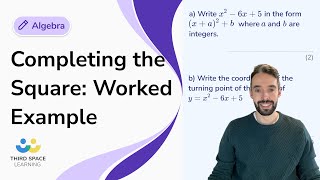
A short GCSE maths tutorial by Paul (Third Space Learning) demonstrating completing the square. He rewrites x^2 + 6x + 17 as (x + 3)^2 + 8, identifies a = 3 and b = 8 (each worth one mark), and uses this form to find the parabola's turning point at (-3, 8). The clip includes step-by-step algebra, brief marking guidance, and a closing voiceover pointing to further resources and one-to-one tuition.
Questions this video answers
a = 3, b = 8
(-3, 8)
Chapters
Hi, this is Paul from Third Space Learning. Let's have a look at completing the square as usual. I'll use our online classroom and our lesson slides to go through the topic and look at some questions. Check out the links at the end of the video for access to loads of free resources and information on our one to one tuition. Let's have a look at the question. It says write x squared plus 6 x plus 17 in the form x x plus a all squared plus b, where a and B are integers. So this means we need to write this in the completed square form. And to do that we first need to find the closest perfect square we can. So let's do that by taking the coefficient of X and halving it. So if we half six we get three. That means that the closest perfect square is is X in a bracket plus three and then the whole bracket is squared. So let's expand this bracket out. If we expand this, we can see that the perfect square is x squared plus 6x plus 9. Remembering that when we have a bracket squared, that's a double bracket. So we need to expand down carefully. Now let's compare that to the original expression. Well, the original expression is x squared plus 6x plus 17. Now what do we have to do to the perfect square to give the original expression? Well, we have to add on 8 to it. So that means that the completed square format is X +3 all squared, which was the perfect square. Then to change that into the original expression, we just add eight to it. So let's see where those marks come from. We get 1 mark for A which is 3, and 1 mark for B which is 8. Now let's have a look at part B. It says write the coordinates of the turning point of the graph. Y equals x squared plus 6x plus 17. Now that's the same equation that we have just rewritten in the completed square format. So let's write that as y equals x plus 3 squared and 8. Now we can see that because this is a positive quadratic that the graph will be a U shape. So the turning point will be at this point here. At that point we want Y to be as small as it possibly can be. Well, to get Y as small as it can be, we're going to need this bracket to be as small as it can be. And the smallest thing that this bracket can be is zero. Because when we square anything, we can't get a negative answer. So this bracket at its lowest point must be zero. That means that the turning point, the y value is 8. So if we open up a pair of coordinates here, the y value is 8. Now if x3 0 at the lowest point, that means that x must be negative 3. So that means that negative 3 is the x value and the turning point is minus 38 and that's worth a mark.
Now over to you. Check out the links in the description below for step by step examples, questions, worksheets and tons of free resources to help you practice. You'll also find information on our one to one personalised maths tuition. Don't forget to like and subscribe to Stay up to date with all the latest Thursday learning videos.