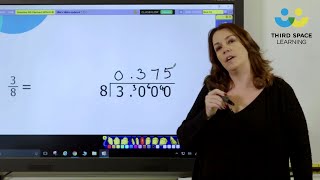
A short instructional video (narrated by Rebecca) showing how to convert fractions to decimals by dividing the numerator by the denominator. It begins with simple place-value cases when denominators are factors of 10, 100, and 1000 (e.g., 3/10 → 0.3, 8/8000 → 0.008), then demonstrates the bus-stop/short-division method on 3 ÷ 8 to produce 0.375, and closes with a note about recurring decimals and rounding to a desired number of decimal places.
Chapters
Hi, I'm Rebecca, and in this film we're going to have a look at how to convert fractions into decimals using division. Now, previously, pupils will have worked with fractions where the denominators are factors of 10, 100 and 1000. And they can use that easily using their knowledge of equivalent fractions to solve problems. But that might not always be the case. So let's have a look at how we can do it. Now, to convert a fraction into a decimal, you simply need to divide the numerator by the denominator. So let's have a look at using a fraction where the denominator is either a tenth, a hundred or a thousandth. That's a really good place to start. So if we take the fraction 3/10, for example, we need to divide 3 by 10 and pupils will have their knowledge of place value, knowing that the answer would be 0.3, as the 3 goes in the tenths column. Similarly, if we had a fraction such as 8,000ths, they would use their knowledge of place value to know that the 8 would go in the thousandth column, giving us a fraction, a decimal of 0.008. But what about something a bit more difficult? Here I have the fraction 3, 8. So I need to divide 3 by 8, and I can't do that in any other way other than using something like the bus stop method and short division. So I've put my numbers in into the bus stop, but because I'm going to get a decimal answer, I need to turn my three into a decimal. So I've given it three zeros to help me and now I can start dividing. So how many eights go into three? Well, there is zero, so I'm going to put my zero up here and make sure that I put my decimal point in lined up with the other one. Now I'm going to carry my three ones over into the tenths column to give me 30 tenths. How many eights are there in 30? Well, three, eight are 24, so I can put my three up here and I have a six remaining. So I'm going to put that in my hundredths column, giving me 60 hundredths. How many eights are in 67? Eight are 56, so I can put my seven at the top. I have four remaining, so I'm going to put that in my thousandths column, giving me 40,000ths. And how many eights are in 44? Five, eight of 40. So I can put my five here and I've finished dividing. So here we can go back to our original fraction 3/8 as a decimal. Well, 3 divided by 8 gives us a decimal of 0.375. Sometimes your pupils might get an answer where it's a recurring decimal. And at that point it's a really good idea to teach them about rounding to two or three decimal places. So there you go. That's how to convert a fraction to a decimal using division.