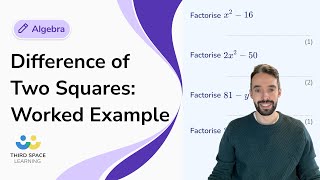
A short GCSE-level YouTube maths lesson (speaker: Paul, Third Space Learning) explaining how to factorise using the difference of two squares. The video walks through four worked examples—x^2 - 16; 81 - y^2; 2x^2 - 50; 3y^2 - 12—demonstrating direct difference-of-squares factorisation and cases needing a common factor pulled out first, notes mark allocation for exam-style questions, and ends with links to resources and a call-to-action to like/subscribe.
Chapters
Hi, this is Paul from Third Space Learning. Let's have a look at the difference of two squares. As usual, I'll use our online classroom and our lesson slides to go to the topic and look at some questions. Check out the links at the end of the video for access to loads of free resources and information on our one to one tuition. Okay, let's have a look at the question. It says, factorize x squared, subtract 16. Now we notice that X squared is a square number and 16 is a square number and they're being subtracted. So we can use the difference of two squares here. So let's open up a pair of double brackets. Let's square root this first term. So the square root of X squared is X. So let's put an X at the start of both brackets. Next, let's square root the second term 16, and the square root of 16 is 4. So let's put a 4 at the end of both brackets. Finally, we put a plus in one and a minus in the other one. And the order doesn't matter. And there we go. We have fully factorized this expression using the difference of two squares. And that's worth one. Mark your turn. Pause the video and have a go. Let's go through it. So it says 81 subtract y squared. Now we notice that 81 is a square number and Y squared is a square number. And they're being subtracted. So we can use the difference of two squares. Let's open a pair of double brackets and let's square root that first term. So the square root of 81 is 9. So let's put a 9 at the start of both brackets. Next, let's square root the second term, while the square root of Y squared is Y. So let's put a Y at the end of both brackets. And finally, let's put a plus in one and a minus in the other one. The order doesn't matter and that is worth one mark. Let's try this question. Now, this says 2x squared, subtract 50. Now we notice that 50 is not a squared term and 2x squared is not a squared term. But what we can do is bring out a factor of two. Now if we do that, in the bracket, we'll have x squared, subtract 25 and look at that. Now in the bracket we have two squared terms that are subtracted. We can use the difference of two squares. So let's have the two outside and open a pair of double brackets. Let's square root the first term X squared to give us X, and that goes at the start of both brackets. Let's square root the 25 to give us five and that goes at the end of both brackets. And then let's put a plus in one and a minus in the other one. Remember, the order doesn't matter. And there we. There we have it. Four, fully factorized. Let's see where those marks come from. We're getting one mark for factorizing with the two. And the second mark is for the fully correct answer. Your turn. Pause the video and have a go. Best of luck. Let's go through it. It says 3y squared, subtract 12. Now we notice that we don't have squared terms here that are subtracted. So let's start by bringing out a factor of three. If we do that in the brackets, we've got Y squared, subtract four and look at that in the brackets. Now we've got two squared terms that are subtracted. So we can use the difference of two squares to factorize it. Let's write the three on the outside and then a pair of double brackets. And then let's start by square rooting the first term, the Y squared. If we do that, we get Y and that goes at the start of both brackets. Next, let's square root the four. If we do that, we get two and that goes at the end of both brackets. And the plus goes in one and the minus goes in the other one. The order doesn't matter. And that's it. Fully factorized, we have two marks. The first mark is for factorizing with the three and the second mark is for the fully correct answer. Now over to you. Check out the links in the description below for step by step examples, questions, worksheets and tons of free resources to help you practice. You'll also find information on our one to one personalised maths tuition. Don't forget to like and subscribe to Stay up to date with all the latest Thursday learning videos.