Essential free secondary maths resources for 2024/25
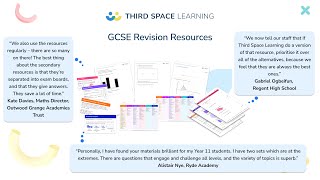
Webinar (Third Space Learning) demonstrating free secondary maths resources and how teachers can use them for classroom, independent revision and intervention. Hosts Tash (New Schools team) and Paul (lead for secondary resources) outline a colour-coded library split into six curriculum areas and give practical walkthroughs of: revision PowerPoints (large banks of exam-style questions with hyperlinks), A4 revision mats, diagnostic multiple-choice questions (targeting misconceptions), printable revision cards, GCSE practice papers (higher/foundation, examiner-informed, with planned 2025 model walkthrough videos and model answers), online revision guides (collapsible worked examples, self-marked diagnostic quizzes, exam questions), GCSE worksheets (skill → applied → exam progression), separate exam-question bank, formula revision sheets, and revision/exam timetable templates. They announce forthcoming grade-targeted booklets (Aiming-for grade 1–9) and invite schools to sign up; the webinar ends with a live Q&A covering exam-board coverage, extension routes and KS3/primary options.
Questions this video answers
2024-11-28
hello@thirdspacelearning.com
Edexcel, AQA, OCR
Yes — the webinar states all secondary resources are free to download.
They stated they hoped to have the new model walkthrough papers ready by Easter (2025).
Chapters
Okay, I think we'll make a start because I am sending out the recording after this, so if there are a few latecomers, it's not a problem. I'll start by introducing myself. So I'm Tash, I'm a former teacher. I now work on the New Schools team at Third Space Learning. So I work on the intervention side of what we do. So if you're not already familiar, just for a bit of context, there are two sides to Third Space Learning, two areas that we focus on. We have our one to one maths interventions, so we've got a team of our own, specialist math tutor tutors that we pair up on a one to one basis with students and we've got various different programmes, we've got key stage three programmes and we've got GCSE revision programmes as well. We've been doing that for about 11 years now. And then the other side of what we do is our resources, so that's what we're focusing on, this webinar. So we've got a really extensive resource library and at secondary they are all free. So all the resources that we're going to talk about today are downloadable for free. And I will send out the recording and the slides. Any links that you see on the slides, once I've sent them out, you can follow them there. And if you have any questions at any point about the resources, just pop them in the chat and we will come to them at the end. And I'm joined by Paul. So he is the brains behind a lot of these resources and the sort of beacon of knowledge for our resource library. So he's going to talk us through our resources, which are the most impactful and how they can be used, and of course, answer any questions at the end. So let's make a start then. Paul, do you want to start by introducing yourself?
Yes. Hello, everybody. Good afternoon. My name's Paul. I am a former maths teacher. I have about 9 years experience in the classroom. I've done loads of different roles within different maths departments as a lead practitioner TLR holder, and then I spent a few years as a specialist leader of education supporting departments around the Northwest. I'm now very proud to work at Third Space Learning, leading on our secondary resources and content, as well as all of our academic content on our tutoring. So today we're going to have a look at some of our resources. Everything is free. I'm going to give you some tips on how we can use them in the classroom, how we can use them for the revision I know mocks will be happening around this time, but also with one eye on the summer exam series. So really excited to get going. We'll try and do this as quickly as possible. I know everybody will be very tired after a long day.
Great, thanks, Paul. And let's get straight into it, like you said. So in terms of the way that we've organized the resource library, it's split into six main topic areas, is that right?
That is correct, yeah. So we've taken the entire maths curriculum and split it up into six main areas. We've color coded them and you'll see as we go through some of the resources, the colours go across all of our resources. So there they are. And we've separated out the curriculum into those areas.
Great. Very clear with this color scheme. Thanks, Paul. And we've got a list then of all the resources that we're going to cover today. Do you want to just give us a whistle stop tour so everyone knows what we're going to cover?
Yeah, absolutely. So we're going to look at our revision PowerPoints, which contain hundreds and hundreds of questions. We're going to look at our revision maps, which take larger topics and condense them down into one piece of A4 paper. We'll look at our diagnostic question collections, which will highlight misconceptions. And we'll look at our revision cards, which is one of our newer resources, and they're really, really nicely designed and all free. And then on the next slide we will also look at our practice exam papers, which are our most popular resource. And we have some exciting new developments for 2025 Tash, which I'm excited to share. We'll look at our revision guides, which are very much the heart of our revision library. And leading on from that we'll have our worksheets and exam questions. And we'll also touch on a few little extra things at the end which we're designed to try and support your students.
Great. Lots there, Paul, and I'm sure they'll all prove really helpful. So let's get into the first one, our revision PowerPoints. So what are these and how do you recommend they can be used?
Well, these were requested by some of our customers. These were very much designed for just before the exam season. So I remember being in the classroom, being a teacher in the final few days, running up to the exams, we often want a large bank of exam questions. We might be collapsing the timetable, we might be in the hall, there might be quite a few students in front of us. What we have here is hundreds and hundreds of questions categorized by those six topics we talked about before. They're all exam style questions. They're all typical exam style questions of the particular topics. So what we do is we want to put it on the screen, get the children with many whiteboards, get testing them, and we can go through lots and lots of different topics very quickly. What's great about these as well is if you wanted to email this resource out to your students, if you have a little look down there, tatash, at the bottom of the picture, it says angles and polygons. That's the topic of that particular question. But it's also a hyperlink. So if you click onto that, that will take you straight to our revision resource library. And you can find information and examples and questions and even some videos on that particular topic. So it's a great way of promoting independent revision.
Yeah, sounds great and really helpful. Thanks, Paul. It's so useful just having a really large bank of questions because you run out of past paper questions so quickly when you've got year 11s that you're revising with. And I also know how much time I spent as a teacher trawling through trying to find questions on a particular topic. So it's great that we've got a really, really extensive bank that you can dip into and hopefully won't run out. Okay, next resource we have revision mat. So really nice visual resource. Can you talk us through this, please?
Yeah, absolutely. So I really like these. What we've done is we've taken large areas of the curriculum. Again, the color code in there is running through all of our resources and we've condensed them down into a series of revision maps for each topic. And we have one for hire and one for foundation. So in this example, this is a probability hire revision mat. And what we've taken is a question from each of the key areas, a typical question, and put them in one place. So what you might want to do is give this to your students as part of a revision session, as part of a form class, as part of a lesson, even, or homework. Let them go through each question, then we can mark it. Everything we do comes with extensive mark schemes and answers. So we can mark it. You might even want a red, amber, green, each of the questions, and then what we can see at a glance is how many green topics, how many red topics, how many amber topics, and then they can use that as a template to then go on to our revision library and revise some of those topics. So Venn diagrams I've got a red. I haven't got it. I haven't got it fully. Right. I can go on to the third space learning resource library, type in Venn diagrams and I'm presented with loads and loads of resources to help me practice that particular topic.
Yeah, and really nice for their own independent revision as well. I think if they can have this mat, give them a visual representation of the whole topic, they can tick things off as they go. They're not feeling overwhelmed, they know what are all the different subtopics within this topic and make sure they're confident on all the areas once they're. When they're revising that topic and know that nothing's been missed. Off. Yeah, big fan of those. Okay, next, so we have our diagnostic questions. Obviously so important for teachers to be able to address their students misconceptions and know what they are and understand where students are with their topics. So yeah, talk us through diagnostic questions, Paul.
Diagnostic questions are absolutely amazing. So again we've got hundreds of these broken down by a topic. What's so wonderful about these is we have our question and then we have four answers. So one of the answers is correct and the other three have been very carefully selected to represent a very particular misconception. So by giving these to our students again in form as a starter, we can even build a whole lesson around this. We can identify those particular misconceptions and then start to unpick them and help them to revise them for the examination. One of my favorite ways to use these would be to give them the question and then say, okay, the answer here is a. The answer is a. We're not interested in the answer, but look at these three misconceptions. What is the misconception? Ask them. They can do it in groups, they can do it individually and then they can then adjust the question to make each of those misconceptions correct. It's a really, really lovely way of getting the children involved thinking about those misconceptions. Lots of lovely deep conversations can be had here.
Great. Sounds really valuable. Especially giving them they know what the correct answer is. They need to identify the misconception. That's such a valuable skill for them. And it's a similar approach in terms of using diagnostic questions that we take in the GCSE revision programme we run. So we'll use a baseline assessment which is made up of 20 different diagnostic questions and then the tutor knows the starting point that that student is at for each particular topic and then can plan the sequence of lessons in that programme around that priorit where they need the most support. And then the other thing we've done is we've taken a diagnostic question and put it at the beginning of each individual session they sit with their tutor so that they know the tutor knows. Right. This is the most up to date information on where the student currently is with this topic and then they can make that lesson as scaffolded as necessary. Or if the pupil has actually shown a lot of understanding and confidence with that topic, then they can embed a bit of stretch and challenge and get through maybe more exam style questions that lesson, just to optimise the revision time. So, yeah, lots of ways that can be sort of replicated in the classroom. It's quite a versatile resource. Absolutely. Okay. And a revision tool. I really like these revision cards.
Yeah. So what we've done is we've taken our online revision guides, which we'll talk about in just a minute, we've condensed them down into a revision card. Really beautifully designed. We've got them for loads and loads of topics. Something that would often happen. And I know, Tash, you can relate to this as well. Lots of students can often spend a lot of time making these beautiful, beautiful revision cards, but then they don't necessarily use them. So what we've done is we've made them here and they're all done. As we've said, everything that we do is completely free. We're here to partner with you, with schools, to support you, to support your students. You can buy revision cards. We used to buy revision cards when I was teaching for the students and they're very nice, but they're, they're quite expensive. So in a world of decreasing budgets, these are completely free. Download them, print them off, give them to your students and they're all there for you.
Yeah, definitely. I remember there were always a lot of students in year 11 that were making very pretty flashcards with colour schemes and highlighters. And I did always tell them the most valuable thing about them is when you actually use them rather than spending too long making them. So I love. Yeah, the idea of giving them ones that are already made. They just need to start using them. Okay. And I think these are our most popular resource. Is that right, Paul? The exam papers?
They are indeed.
So.
These are our most popular resource for secondary. We've become really well known for these. We've been making them now for the last four years, so we've got a lot of data to back these up. The people that make all these resources are all current and former maths teachers, but they're also current and former examiners. So what we've done is every single year at the end of the summer exam season, we take a moment and we look back across the last five, six, seven years worth of exams. We take all that data and we analyse it so that we can then say how the different types of questions are progressing over the years. We write a blog on that every single year, which we will send out as well when we send out these slides. But we use that data then to create our papers every single year. So they are predicted papers based on what has been happening in the past few years. Obviously we don't know what's on the paper, but it's a relatively good approximation. These are absolutely wonderful. We make them for edexcel, aqa, ocr, we make higher versions and we make foundation versions. Antash incredibly exciting. We have a brand new addition to these for 2025, which was a request again from our teachers from our custom and that is we have beautiful mark schemes here. But in order to make these really student friendly, we're going to create model walkthrough papers. So our team will be going through the brand new papers, creating model answers for them and then putting on where the marks come from so students can really see. If I write that down, I get one mark. If I write that down, I get two marks. And while we're doing that, we're going to also record ourselves doing it. So we'll have a video of that. So there's loads of different ways that you and your students can access these new papers. They are currently in the process of being created. We're hoping to have them done. Well, we will have them done by the by Easter, so watch out for them. They're going to be really, really great. Really excited about these.
Great. Thanks, Paul. Yeah, I think more exam papers are always welcome. You can never have enough in your collection when you're trying to help your year 11s. And I love the idea of a walkthrough as well, where they can really see you painting the picture of how to approach questions and where you can pick up all the marks. Okay, our next resource, our online revision guides. These are really versatile, aren't they?
Yeah. So these are very much the heart of our resource library. They're all online, these are all web pages. And if you go to thirdspacelearning.com, click on resources, click on Revision Guides, you will see a revision guide for every single topic you can possibly imagine. You can See down there that there's about 500 of these on the site, all broken down into topics or broken down into hubs. So similar pages are grouped together. These are designed to support your students, to work independently. And we can have a little look through one of the pages now so we can see how a student might want to use one of these pages. So if you go onto the revision library and you type in simultaneous equations, or even if you just go to Google and type in simultaneous equations, you'll see this click on this and this left hand side here is what you'll be presenting. Presented with. So we start off with a quick overview of the topic and then lots of these now have an accompanying video which talks through some examples and talks through some questions and it's there as a guide to support the students while they're having a go. Scroll down the page a bit more. We come to this right hand side, we have a quick overview of the topic. And then that's that revision card I was talking about before. It's on the page as well. It flips round so students can write down any information from it, flip it on the page and they can see if they've got it correct. So that's a really nice little feature. We keep scrolling down that page on the left hand side. Then we get how to solve, in this case, simultaneous equations. We've taken every topic and we've broken it down into steps. And then we go through about five, six examples using those steps. Now what I really like about these is they're all collapsible, so the student can try the first ones just by reading through. Then they can have a go at the second one and then they can click on each step as they're going through it. So it's there as a scaffold, it's there as a support for them so they can make progress all the way down those six examples. We keep going down the page and then we get to our practice questions. These are all diagnostic in nature. One correct answer, three misconceptions. And they are all marked. They're self marked, so the student can click on it and they can see instantly if it's right or not with an explanation. And then at the bottom of every single revision guide we have exam questions because ultimately we are revising for our GCSEs. So these are really, really helpful. Again, made by examiners with full mark schemes so your students can see where the marks come from. So they're a great way of your students revising. You might want to use these as part of a revision session. You might want to use these as part of a flipped learning. You might want to send your student to these when you've completed one of the exam papers or one of the revision mats. These form the heart of everything that we do and they're a lovely resource, all three, all available online.
Great. And because it's self marked, it can obviously be used as an independent resource as well. So I know I spoke to some teachers who were saying that all their students have Chromebooks, so if they ever have a supply lesson or a cover lesson, then maybe you could assign a specific revision guide online and they could all work through that as another example.
Absolutely, absolutely.
Okay, let's move on to our GCSE worksheets. So these are really clever because they're divided up into three sort of sections that build up logically. Explain how that all works, Paul.
So we wanted to create resources that maths teachers want to use. We are maths teachers, so we wanted to create resources that we would want to use. So every single one of those revision guides comes with its own bespoke worksheet. And we split it into three sections so you can use it in lots of different ways. So that first section on the left is the skill section. In here we have three or four little subsections of different types of skill based questions. Each of those sections is intelligently varied, so students aren't able to guess the next answer. They're constantly having to think. And this is a lovely way of starting off the topic and getting students used to the particular skill. Now, once the students are feeling good with that, what you can do is move on to the middle section, which is the applied section. This contains diagrams, or it might contain charts, or it might bring in different topics. And what we're doing is using those skills in an applied way. So this is the next section following this. Again, we are preparing our year 11s for their GCSEs. So we have exam questions, again, written by our examiners, broken down very, very carefully, and we've got full mark schemes to go along with these. So we have a real progression there all the way through. And they're available to use as you want to use them. You know your students the best. What we're trying to do is give you all the tools at your fingertips so you can deliver amazing maths lessons.
Yeah, it's a really effective way to move through a topic, isn't it? I know sometimes if you have a student who's not very confident with a topic and they're presented with an exam question that can be really quite overwhelming. So I think this is a nice way to sort of strip it back, take it right back to the initial skill that you need, then build up to applying it and then build up to an exam style question. So it can really help with any student who's overwhelmed or behind and they need to go back to the prerequisite knowledge to be able to access the exam questions. Sticking to the topic of exam questions, then our next resource is our bank of exam questions.
So again, we're trying to make things that are really useful. So we thought, well, maybe when we get to the exam season, maybe we don't want to look at the skills or the applied section. Maybe we just want our students, some of them, to practice that exam technique. Well, if we left it as it was, those worksheets have three big sections that would mean that teachers would have to download the whole thing, which is going to be quite, quite a lot of pieces of paper, paper which is ultimately going to cost quite, quite a bit of money. So we thought, well, let's just take the exam questions and make them a separate resource as well. So that's what we've done. The exam questions are all available to download separately. So if you just want to focus on exam technique, you can without having to download the other areas. And what's really nice about these is these link to our topic list which we've created, which seamlessly tash, hopefully on the next slide.
Yes.
We have a topic list. Now, this is quite simple, but also really, really lovely. This shows every single topic that your students might need for their GCSEs. We have a higher one and we have a foundation one. So we can see all the topics there in a big list and they can tick them off. You can direct them to different areas following an exam. They can red, amber, green them so they can see very clearly how many topics they need to revise. And if you fancied emailing this out to them, they're all hyperlinked. So click on that and it will go straight to one of those exam question packs so they can download actual questions in their hands that they can use. And what we often do, tash, is every year during the summer exam season, once paper one's done, we'll adjust this topic list so that topics that have already appeared will grey them out. After paper two topics that have already appeared will grey them out. Now, this is not to tell students not to revise those because I those Topics can, of course, come up. Again, it is just to direct students to some of the topics that may come up that haven't come up yet. It's a lovely resource. I really like this. This would have been a really useful thing for me when I was in the classroom.
Yeah, I think one of my favourites would have been the exam questions as well. And like you said, saving on printing and lots of bits of paper is always helpful and needed in the classroom. But yeah, it's also something I think teachers could use if they're running any extra interventions or any extra sessions, whether that's small group or one to having a big collection bank of exam questions is always a help. You can never have too many. And the way our interventions work in terms of the GCSE programs is they do work through these GCSE style questions each week so that you're sort of getting them more exposure to them and also more familiar and more confident. So I think it's always useful having as many questions that they can be exposed to as possible. And then, like you said, the topic lists are also such a good organisational tool, so they can tick things off as they go and feel more confident that they're making lots of progress with their revision. Okay. And moving on to another great revision tool, our formula sheet. So I think the first thing to just quickly clarify is these. These aren't the formula sheets that they get in the exam. This is a revision tool.
Yes, absolutely. So any formulas that may or may not be needed in the exam that has been changing over the last couple of years that will be identified by the exam board. What we wanted to try and do is produce a resource that would give all the formulas that a student may need to use for hire or for foundation so they can use it as a revision tool. Quite often students will struggle to access some of the questions simply because they don't have the knowledge of the formula of, let's say, a cylinder. Well, this is a resource that you may want to use to support them to scaffold the learning so that that's not a barrier to entry for them. So it's here if you want to use it higher and foundation. And we've highlighted as well any crossover formulas.
Yeah, I really like these. I think they're really helpful for revision lessons so that if you've got students who haven't committed things to memory yet, they can still access the practice that their peers are accessing, they can still get value from practicing questions because they've got these and they're not just sitting there waiting for the answers to come up, feeling quite stuck and frustrated. They can just check what the formula is and then still benefit from going through and practicing some exam questions. Okay, our next resource is another sort of organizational tool. We've got revision and exam timetables. How do these work?
Yeah, so these are really, really simple, but can be really, really effective. So we've got a blank revision timetable which students can use to fill in and structure their revision. So you might want to use this as part of a revision session. You might want to give them this and talk through different techniques on how to revise. This comes with an accompanying blog. The blog gives tips based on the research on how and how students might want to structure their revision. It's a really nice resource if you would like to use it. And the one on the right is even more simple. But this would have been a lovely, lovely thing when I was in the classroom. It's a blank exam timetable. So I remember particularly around the mock season, I'd ask one of the students, when is your mock? And they go, oh, I don't know. And then I'd say to them, well, we gave you a piece of paper and then they go into their bag and pull out this ragged bit of paper and then they couldn't read it. So here is a lovely template where they can write it in beautifully. It can go on the wall, it can go in their books. It's there if you would find it useful.
Yeah, I've definitely seen my fair share of crumpled up papers that have been pulled out of blazer pocket or the bottom of a backpack. So I think, couldn't agree with you more. Nice to have something that they can stick on the wall. Be really clear where they need to be and where. Okay, coming soon, what can teachers keep an eye out for? Paul?
Oh, so in addition to our brand new paper walkthroughs, we have a brand new resource coming this year. It's currently in production. We're going to have it ready for the exam season. So around Easter time, this was another request from one of our teachers. This will be exam aiming for grade particular, grade five aiming for grade four exam booklets. So we're going to make them for grades one up to grades nine. We're going to go back through our vast library of exam style questions and skill questions and applied questions and we're going to bring them together into different grade bundles. So we're going to have lots of grade one questions in the grade one booklet, lots of grade seven questions in the grade seven booklet and then what we can do as teachers then if we have a student who say targeted a grade five but got a grade three in their latest assessment, what we could do is then give them the Aiming for grade three booklet, get them confident on that, then get the Aiming for grade four booklet and then the Aiming for grade five booklet and everything will be broken down by those topics we talked about earlier. Everything will be hyperlinked and linked back to our online revision guides and our exam questions. So hopefully this will be a really helpful resource for you. Really excited to share this with you all. It's currently in production and I think we're going to send out a form so that where you can put your email address. So the second these are live we will send them straight to you so you don't miss out because that would be terrible.
Yes, really like these means you've got something for everyone, for all your students regardless of what their target grade is. Come this summer. And yes, we will have a form that you can fill in which means you'll get these as soon as they're ready. So don't forget to sign that if you feel like this will be a something that's helpful for your students. Okay, so what we've covered today is sort of just the tip of the iceberg really. So we do encourage you to log on to the intervention, sorry into the resource library, have a look through all the different resources. Like we've said, you all know your classes best so do just have a look through and see what else is there and what you think is suited to your class. Some of the things that we haven't covered are up on the screen now just so you can see what else there is. So we've got SLT guides, we've got gcs, GSCE maths intervention packs, we've got one to one interventions, we've got blogs and articles, Fluent in five, which is our fluency program. And then of course we do have our Key Stage 3 resources on there as well. These GCSE maths intervention packs are just the second square there. They are taken directly from our GCSE intervention program. So I'm often speaking with schools about these because I'm speaking to them about their approach to extra mass support and extra math interventions in the run up to GCSEs. And something I hear a lot is that your run lots of different things in school in house but it's really hard in terms of staff being stretched really thin and being at capacity. It's really Hard to reach every single student. So that's when schools sometimes come to us and ask for help. And we will take a group. So whether that's a group of students that are targeting grade four, whether that's a group of students who are targeting grade six or grade seven, we've got a program for each target grade. So we can take that group, pair them off with their own one to one tutor that they meet with each week. So that's via a headset and a shared screen. And they'll get an hour of dedicated one to one time each week to work through exam style questions and getting that live feedback and support helping them achieve their target grade. So if you do have any students that come to mind, we are running those programmes, the GCSE programme, we will be signing up lots of schools to start in January. So if you did think that's of interest to a group of your pupils, if you get in touch as soon as you can, then we can try and fit you in in terms of time slots and get you set up for January. The best way to have a conversation about it is just to email hello, thirdspacelearning.com and then we can set up a call and chat about your situation in your school and how we might be able to help. So, Paul, that's all the resources. Do you have anything to add or should we take a look and see if we've got any questions?
Yeah, if you have any questions, I'd be absolutely delighted to answer them.
Okay, I'll stop sharing my screen so I can read off if anyone's got any questions. If you have any, do just pop them in the chats and we can go through them. But I also appreciate people. We said we'd finish at half four, so people probably do need to rush off, but we'll give it a few seconds. Okay. I can see we've got a hand raised, which I'm guessing means, Christina, you have a question, but it's not coming up. So if you put it in the chat, if you type it out, then we can answer it from there. Oh, we've got someone who's come through and said thank you for the session and information. No, you're welcome, but yes, thank you so much, Paul. That was really insightful and I think we went over a lot of resources in a quick period of time. So thanks for all your knowledge, Paul, that's my pleasure.
I'm absolutely delighted to share these. The team are maths teachers and we're here to support and if you do have any questions, please do reach out to us or if you have any ideas of resources that we can make in the future, please do get in touch with us. We are maths teachers, we're here to support you to deliver great maths lessons. So anything we can do, we're here for you. Everything we do, we make on the resources front is completely free. So please do get into attention.
Yes, great. And we've had another comment that's saying that it's the Q and A section where you put the questions, not the chat, just in case there's any confusion there. But so far we've just had comments about the session rather than any questions, so I think we will just. Ah, we've got a question here, just coming in now. Paul, any chance of, of tailoring to caie in international exams?
Really good question. So at the moment, try and reach as many teachers as possible. We've gone for the big three exam boards at edexcel, AQA and ocr, but never say never. We can certainly look into this, but at the moment we're focusing on those big three exam boards.
Yeah, lots of things that we obviously want to do in limited time to get everything in. Another question from Christina. Do you have any extension materials for these main worksheets?
Yeah, so with those worksheets there's about 500 of them. What I do for extension materials is I would start off with those skill questions. The applied section then takes some of that knowledge a little bit further. The exam questions. Take the applied knowledge and apply it to an exam question. And then what I would do is take that to the online revision guide where we've got more complex questions down, down towards the bottom of the page. So I would direct students onto there so that they can stretch themselves a little bit more.
Great. Sounds really good. And another question's just come in from Michelle. Do you have any resources for lower ability primary but who are secondary age?
So we are. That's a great question. Thank you so much. So we are building up our Key Stage 3 resources collection as we speak. We have some lovely resources on there, including end of year assessments and different quizzes. So I would watch this space in terms of that. What I would recommend doing as well though is we have have thousands of primary resources as part of our maths hub, so it's well worth going onto there and having a look. Loads of those are free, some of those are premium which have to be done through a subscription, but loads of them are free. So I would have a look on there and see if there's any resources that you particularly like.
Yeah, it's about the first six weeks of each resource that's free at primary. So you can definitely log on and have a look at different resources and see if it's something that you think will be helpful, helpful for your lower ability students.
But just say again, secondary is free. Secondary is absolutely free. Everything is free. Go on there, take it all, download it, it's here, it's there for you.
Yes, Secondary is all free. You just need to go to thirdspacelearning.com and the resources are downloadable, all from there. So sometimes it can be a bit confusing. The primary is what we call our mass hub. And if you're logging into there and you can't see secondary resources, you can just see primary. You just need to log out of that and go on thirdspacelearning.com and then there's a banner at the top that says resources and scroll down to secondary and they're all in there. And a comment from Christine's just come through. Thank you for all your hard work at Third Space Learning. I found the resources to be fantastic and hugely supported me as a non specialist teacher. That's lovely to hear, Christine, and that's a credit to you, Paul, and all your really helpful resources.
We have a wonderful team working to support, so please let us know any way that we can partner with your school to support your students.
Great. Well, thanks so much, Paul. I think I haven't seen anything else come through, so I think we're ready to sort of wrap it up. But if anyone did have any more questions they didn't have a chance to type in, then the best way to reach us is hello, thirdspacelearning.com and then Paul or someone from the resource team will be able to answer any questions. Or if you've got questions about the interventions, then email them again to hello, thirdspacelearning.com and we'd be happy to have a chat. But thank you very much for joining everyone. I really hope this was helpful and thank you so much, Paul, for taking us through everything.
My pleasure. Thanks everyone.
Thanks, everyone. Take care.
More from Rob





The Top 20 SATs revision topics 2026: A focused revision approach for maximum impact in minimum time

GCSE maths marking 2026 decoded: using examiner insight to improve teaching and results


How To Embed AI Literacy In Your School: Practical Steps To Get You Started [Webinar Replay]


Reviewing And Planning Your School's AI Approach: A Strategic Framework [Webinar Replay]
