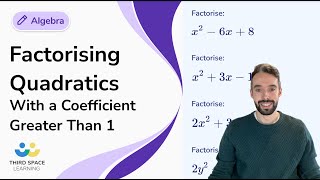
A GCSE‑level YouTube lesson by Rob Langman (Third Space Learning) demonstrating how to factorise quadratic expressions when the leading coefficient a>1. The video explains the multiply‑and‑split (ac) method, works through several examples (including 2x^2+5x+3; 2x^2+3x-2; 2y^2-y-3), and shows how marks are awarded for partial and full solutions. It also points viewers to additional resources and tuition in the description.
Chapters
Hi, this is Paul from Third Space Learning and today we're going to look at factorizing quadratics where A is greater than 1. Remember, the general form of a quadratic is ax squared plus bx plus c. We previously looked at factorising quadratics when a equals 1. So make sure you check out that video first in the description below. As usual, I'll be going through the topic using our online classroom and we'll have a look at some questions together. Make sure you check out the links at the end of the video for access to loads of free online resources, practice questions and information on our one to one tuition. Okay, let's have a look at factorizing a quadratic when A is greater than one. Grab a pen and let's dive in. So let's look at factorizing a quadratic in the form ax squared plus bx c where a is greater than 1. So to start with, we need to multiply the two n numbers together. So 2 times 3 is 6. Next we need to find two numbers that multiply to give positive 6 and add to give the middle number, which in this case is plus 5. Well, we know that 2 times 3 is 6 and 2 add 3 is 5. So what we have to do now is take the original quadratic and rewrite it so that middle term plus 5x is going to be rewritten using our numbers. So plus 2x plus 3x. Next we split it right down the middle and fully factorize the left hand side. Then fully factorize the right hand side. Now you'll notice that we've got an x plus one in both of those brackets. And that's great news because we can just bring that to the front and factorize it one more time. So at the front now we have X +1 in a bracket and in the second bracket we put what's left, 2x and +3. And there we go, all done, fully factorized. Now this requires lots and lots of practice, but it's a great skill. So let's have a go at one together. Grab your pen and let's see how we get on. So the question says Factorise 2x squared plus 3x. Take away 2. Now we noticed this is a quadratic and A the coefficient of the x squared term is greater than one. It's two in this case. So to factorize this we're going to take these n numbers and we're going to multiply them together. So two multiplied by negative two is just negative four. And we need a pair of numbers that will add to give positive three and the same pair of numbers should multiply to give negative 4. So let's start by writing out the factors of 4. So that's going to be 1 and 4 and 2 and 2. Now I need a pair of those numbers that will multiply to give a negative four. Well, that tells me that the signs of those numbers must be different because if we do a positive times a negative we get negative. And if we do a negative times a positive we get a negative. So let's choose our pair. Well, because they need to add to give three going to be this pair here, one and four. The only question is which one's positive and which one's negative. Well, it's going to have to be a negative one and a positive four because if we add those together we get a positive three, which is what we want. And let's just double check negative one multiplied by positive four is negative. So that works brilliantly. So our numbers are negative 1 and positive 4. Now the next job is to rewrite the original quadratic. But we're going to replace the plus 3x with our numbers negative 1 and 4. So we're going to have negative 1x or negative x and positive 4x. Then the minus 2 is just there on the end like that. Now let's split it right down the middle. Notice how I'm putting the line here because on the right of my line is a plus and that plus belongs to the 4x. So the line goes down the middle. And we're going to fully factorize this left hand side. Well, what do we have in common here? We have a x in common, which means in the brackets we're going to have a 2x subtract one. Right. Let's fully factorize the right of that line now. Well, what do we have in common? Well, we got a two. So I can bring out a positive two and that means in the bracket we're going to have a 2x take away one. Now we'll notice that we've got a 2x subtract one here and a 2x subtract one here. Now this is great news because this means I can take 2x subtract 1 and bring that out to the front and then I can open another bracket. And in this bracket we're going to put the x and the plus 2. So x plus 2. So this means the final answer is 2x take away one bracket x plus. And there we go, fully factorized. Let's see where those marks come from. So we're going to get one mark for having a 2x and a 1 in one of the brackets with some sort of sign in the middle and an X and a 2 in the other bracket with some sign in the middle. So even if we mess up the signs, we can still get a mark, but we want full marks. So the second mark comes from the fully correct answer, 2x. Take away one bracket x plus two and that's worth two marks. Okay, your turn. Pause the video and have a go at this one. Take it step by step. Best of luck. We'll go through it in a sec. Okay, let's see how we've done. So we're factorizing it and we can see that A is greater than 1 because the coefficient of the Y squared in this case is two, which is bigger than one. So let's start by multiplying the N numbers together so it's two multiplied by negative three which is negative six. And we need two numbers that will multiply to give negative six and add to give negative one. Because remember there's a one in front of that Y. So let's write down the factors of six. So that's 1 and 6, 2 and 3. And I need a pair of those numbers that will multiply to give that negative six. So that tells me that the signs are going to have to be different because I know if a positive times a negative is a negative and a negative times a positive is a negative, to get that negative I want I'm going to have to have different signs. So let's choose our pair. Well, because they must add to give negative one it's going to be these two, the two and the three. So one's positive, one's negative. Well, to get that negative one it's going to have to be a negative three and a positive two. Because if I add those together, think of the number line. We're going to get a negative one which is what we want. And let's just double check. When we multiply them, three times two is six, negative times positive is negative. And there we go. So we've got our numbers. They are negative 3 and positive 2. So let's rewrite the middle term of our original expression. So it was, now it's going to be negative 3Y plus 2Y and there is a negative 3 on the end. And let's split it right down the middle. So we're going to fully factorize this to the left hand side. Well, what do we have in common? Well, I can see a Y in common there which means that in the brackets we're going to have a 2Y subtract 3. Let's factorize the right hand side now. Well, I can't see anything that's in common with those terms, but we can always bring out a factor of one. So in this case let's bring out a factor of plus one. And that means in the bracket we've just got 2Y, take away three and look at this great news. We've got a 2Y take away three in both of those brackets. So this means we can factorize this whole expression one more time. Bring out the two y, take away three. And then in the other bracket we can see we've got a Y and a plus one. So we get a y in there and a plus one there. And there it is, fully factorized. Let's see where the marks come from. So there's one mark for a two y and a three, one bracket with a sign in the middle and a Y and a one in the other bracket with a sign in the middle. But we want full marks. So the second mark is for the fully correct answer. 2y subtract 3 bracket y plus one 2 mark question. Thanks so much for watching the video. Check out the description below for loads more information on this topic and for access to our library of free online resources and loads of information on our one to one tuition. Don't forget to like and subscribe to stay up to date with all the latest third space learning videos.