Transcript of a spoken presentation introducing 'Fluent in Five', a primary-school arithmetic resource (Years 1–6) from Third Space Maths Hub. The speakers describe recent updates—editable PowerPoints and SAT-style PDF versions for each year group—suggested use of manipulatives in Key Stage 1, prompts to encourage choosing mental vs written methods in later years, and practical deployment ideas (starters, settling activities, interventions) to build regular arithmetic fluency.
Chapters
So we're starting with none other than our most popular resource, Fluent in five. I'm sure there's lots of teachers on the call now who already use this. I know when I'm speaking to schools, they often know us because of Fluent in five and is the one that they're most familiar with. So, Hannah, what is it and why is it so popular?
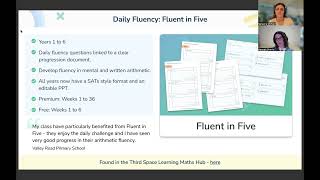
Fluent in five is a fantastic resource, in my opinion. You will probably hear that a lot, but I really do think that all of our resources are fantastic. So Fluent in five is, for years one to six, it is our arithmetic resource. If you have used it before, you can see from the picture on the screen that it has had a bit of a facelift, a bit of an update. One of the major things that we've done in the update is that we have added an editable PowerPoint for every single year group and we have also got a SAT style test style PDF for every single year group, which is really good because it then gives you the option of how you want to present it to your class, to your pupils. What we have got, what we've done to try and make arithmetic a bit more accessible and progressive throughout the years, is we have tried to add a bit of support to help your pupils. So for Key Stage 1, Years 1 and 2 on the PowerPoints, we have included some concrete manipulatives or some prompts to help your pupils think about what they could use to solve this problem. They're just suggestions. You can get the manipulatives out yourself, you can offer them a range so that they can try and solve these problems themselves. As we then move into year three and four, we have taken away the images of the manipulatives on the screen. Obviously, you know your class best. If they need to use those, they need to use those. Not a problem. But what we focused on instead is should you be using a mental method or a written method? One of the things I really remember from teaching is you would teach a method and that suddenly be all that the children could remember to do, that be every time you did something, they'd use that method, regardless of if it was the most appropriate method for the question or not. So we've added those. You can decide if you want to include those or not, because we do have a slide that doesn't have them on. So again, up to you how you present that. And then as we move into year five and six, we remove that so that the pupil has to choose between a mental or written method. The most appropriate method that they think should be used. But as a prompt on the slide with, with the answers, we have included that little symbol of a mental or written method just so you can have a discussion about which method did you use? Was it mental? Was it a written method? How is your method different to someone else's? So you can really start a conversation if you want to.
Yeah, we've got those symbols on our intervention slides as well. Just a nice sort of prompt to make the pupil think about should I be using the written method or the mental method here? And it's nice if you've got people, pupils who are on the interventions and whose teachers are also making use of Fluent in five, whether it's a starter or whether it's in the maths lesson. Because then they get really familiar with that symbol and they know what it means and builds into their sort of routine when they're thinking about maths. And Hannah, I was going to ask. So when I'm speaking with teachers about Fluent in five, they often tell me that they use this as a starter activity. I think that's a really common way to make use of it. Are there any other ways that teachers tend to make use of it or anything you can recommend outside of a starter activity?
Again, as I said, you are the expert in your classes, so you will know how you think your pupils will access this best. One of the things I really love that we've done because of the editable PowerPoint, you can use this in a lot of different ways. You can use it as a settling activity. As they come in at the beginning of the day, children know they unpack their bags, they put everything out, they sit and do Fluent in five. You could use it at the start of a lesson, as you say again, a settling activity after lunch. Or. Or if you want to take some of these questions and put them in throughout your day at any point, you can do that with the editable PowerPoint now. So it's just about getting that regular fluency practice, that regular arithmetic practice so they can be exposed to this all throughout the week that they have.
Yeah, really invaluable skill, isn't it, having good fluency.