Free GCSE Resources to Maximise Revision Time
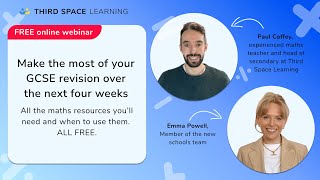
A webinar (Apr 2024) by Third Space Learning staff—Emma and Paul Coffey—presenting a guided tour of the organisation’s free GCSE maths revision resources. They describe and demonstrate revision PowerPoints, diagnostic questions, revision maps/cards, downloadable worksheets and exam papers with analysis spreadsheets, online revision guides with videos/self-marking practice, formula sheets, timetables and teacher-facing materials aimed at supporting teachers, students and parents in the weeks before GCSEs.
Chapters
Let's get started. Well, good afternoon everyone and thanks for taking the time to join us today. We thought that since the GCSE exams aren't far away, it would be a great time to take you through all the fantastic free GCSE revision resources we have at Thirdspace Learning. I'm Emma, part of the New Schools team. And for those of you who aren't aware, Thirdspace are a DFE approved tuition provider who specialise in maths. We've supported schools for 10 years now and we do this by pairing students one to one with specialist maths tutors on personalised lesson plans. But we also have thousands of free resources to support teaching and revision. And these are all created by our in house team of content specialists. And I'm here with Paul Coffey who leads our secondary resource team to create our library and he's going to be taking you through how we create them and how you can use them and to support your students revision. So hello Paul, thank you for joining us.
Hello Emma. It is absolutely wonderful to be able to share our resources.
Great to have you with us, Paul, and might be worth. To begin with, could you give us just a brief bit of background on you and how you came to be here at Third Space and leading the team?
Absolutely. So I have been a secondary maths teacher for about 10 years. I've worked with loads and loads of maths departments and I've been with Third Space for about three or so years. In that time we've been focusing on getting as many free resources out to maths teachers as possible. We are here to be your partners and to support you to deliver amazing lessons. So we have an incredible team of current and former maths teachers and examiners and we're going to talk you through a whistle stop tour of some of our revision resources in these final crucial weeks running up to those GCSE exams.
Absolutely. And I mean we've got so much on there, but it's pretty much all sort of split into six different main topic areas, isn't it?
Absolutely. So what we've done is we've taken the curriculum and we've split it up into these big six topic areas. We've got algebra, stats, geometry, number ratio and probability. We've got higher and foundation versions, we've got loads of practice questions and exam questions and everything, absolutely everything is designed to work together and go back to the secondary online resource library. As I say, it's all made by teachers for teachers and the best part, Emma, is it's all completely free Absolutely free.
That's right, Paul. So whether you're a teacher, students, parent, it's all free and there to help with your teaching and revision to help those hard working students achieve the grade that they deserve and are capable of at the end of the day. Now there will be an opportunity to ask Paul any questions at the end, but please feel free to drop anything in the chat box throughout and I'll try and keep an eye and get it answered for you. I'll also be sending out the recording with the slides to everyone later on when we finished in case any of you need to run away. So I mean, what are we going to be covering today, Paul?
So we've got, we've got loads and loads of stuff. We're going to try and do this as swiftly as possible because I know everybody is incredibly busy. So we're going to look at some revision PowerPoints, we have Revision Maths, we have diagnostic questions and we have our latest resource which is Revision parts. And then moving on from that we're going to go and have a look at our most popular resources which are our practice exam questions. We'll move on to them and have a look at our revision guides which are very much the core of our resource library. So everything feeds back to those and hopefully we'll be able to give you a quick tour of one and then also we'll go into our exam question collections and our worksheet collections and also at the end I'll talk through a couple of bonus resources which we've created to try and support yourselves and your students in these final few weeks.
Brilliant. Well, there's a lot to get through so let's crack on with our first resource which is the Revision PowerPoints. Now Paul does what it says on the tin read, doesn't it? But what does that include?
It absolutely does. So this is a repo, this is a request from maths teachers and I would have absolutely loved this when I was a teacher. We've got four weeks left to go now and then that quickly becomes three weeks and two weeks and then it's the week of the exams and then all of a sudden we've got the day before. What we wanted was a resource where we could have hundreds of exam style questions at our fingertips, categorize into topics and subtopics where you can use them in multiple different ways. So that is what this resource is. So what I might do with this is I might say, okay, I've got my class, it's a few days before the exam, it's a few weeks before the exam. Give everybody a mini whiteboard, choose a topic, and then let's go through some exam questions together. Some great conversations here to be had about who can do what, get some discussions going. Everything has answers, we have higher and foundation versions. And what we can do here is really look in and see who can do what and then direct them on to further revision resources that we'll go onto in a little bit.
Brilliant. I mean, you mentioned that there are hundreds on there and you said it's best perhaps to be used as a teaching resource. But I guess you've said before that it's easier for teachers to direct students if you want them to use them to a specific PowerPoint rather than them getting sort of over overwhelmed with all the various PowerPoints that are on there.
Absolutely. In fact, another way that we could use this is email it out to your students, direct them to a specific area, and then if we have a little look at these screenshots, they're all categorized and at the bottom there we can see that that one is on angles and polygons. So it might be that the student has a go at the exam question, feels a little bit unsure about it. All they have to do is click on that angles in polygons and that will take them directly to the corresponding online revision guide, which has examples and questions and step by step guides videos. We'll have a look at those in a little bit. So it really encourages independent revision.
Yeah, it keeps on looping back to that revision library that we've got online, doesn't it? Now, moving on to our diagnostic questions. Now, it's so important to recognize those weaker areas, isn't it?
Definitely. So once we've identified a topic or two that we're a bit unsure about, we obviously want to practice questions. So it's one thing being able to answer that specific question, but a really valuable skill then is to be able to identify, well, where have I gone wrong? What are the misconceptions around this question? That's where this collection comes in. So every question has four answers, one correct answer and three common misconceptions. So we could just use these as have a go at the question. Answer it, is it right or not? But what I might be tempted to do with these is maybe not worry too much about the answer, focus on those misconceptions. We could ask the class, okay, what misconception has been made in order to get to that particular answer? Could you adapt the question so that that becomes the right answer? So There's a really rich conversation to be had here around those misconceptions. And what we want to try and do is prepare them for exams where the questions could be on multiple different things.
So really good tip, actually making them not only learn how to get the correct answer, but trying to see in terms of exam technique what those misconceptions are so that they can look for questions which are perhaps trying to trip them up or also good skills like proof checking answers where marks are often easily lost and they get sort of caught up. So definitely helpful for developing those important skills. And I mean, we take a similar diagnostic approach with our one to one tuition program because we're always hearing from schools that, particularly at this stage, it's about prioritising time and knowing what to revisit and optimising that revision. So, I mean, we have students sit an initial assessment quiz and exam questions at the beginning of each session so they can highlight those areas of weakness and those misconceptions are found, inform the tutor's pace to optimise that time. So I guess even if you don't have pupils on our tuition program, you can use these questions to help with that prioritisation.
Absolutely.
So moving on to our revision maps. Tell us about these, Paul.
Love these. Absolutely love these. So sometimes it can be really.
You love all of them, Paul?
I do love all of them. Do love all of them. And it's going to be really difficult for students to know where to start. And I know maps is the best subject in the world, it can sometimes appear a bit overwhelming. So we wanted to create a resource where the student could quickly look across a topic and know that they have then covered all the different types of questions that are likely to be tested on that topic. So what we've done is we've taken those big six topics, we've created them subtopics, and then within each subtopic, subtopic, we've created a series of revisions. That's what this is. So we have foundation and higher versions. But this example of probability, what we've taken here, is the key areas that you might be expected to be tested on on that topic. So what the student could do then is go through them. We could answer the question on relative frequency, answer the question on tree diagrams and see how we get on. Because of course, everything has answers and we can read amber green, these. We want to identify topics that we are struggling on a little bit. So, for example, maybe relative frequency, you get no marks, but the tree diagrams, maybe, maybe we get one or two. So I could do a red dot on relative frequency, amber dot on tree diagrams, maybe. We absolutely smash ven diagrams, so big green dot on that. So then we can focus on those two areas, relative frequency and tree diagrams. We can go to our online library, type in those keywords and then have a look through our hundreds and hundreds of resources. These are great for form time, they're great for intervention sessions. They're brilliant, for starters. They make a great homework as well. So it's a lovely, lovely, versatile resource.
Brilliant. And for the student themselves as well, just being able to isolate those areas in that wider topic that they're struggling with to help optimize their own revision as well. And then they're not wasting time as well, clicking through notes. They can go straight to our revision section in our revision guide as well, because they've got loads of other exams to advice for as well. So making it as quick and quick and snappy with sort of revision in mind for the pupils themselves. We've got revision cards as well, haven't we?
We do. So these are brand new for the 2024 exam season. I don't know if anyone on the call has had a look at our online revision guides. If you have, you'll have noticed that there's a flip card on there that condenses the information down from that topic guide. So what we've done is we've taken that information, we've given a bit of a re, and we've created these beautiful collections of revision cards. There's hundreds on there already. We're releasing more and more every week and it just gives a snapshot of that particular topic. And it's a really nice way of students being able to revise those key topics, have a look at an example and identify those areas they need a bit of support on. And revision cards. Lots of people make them. They can be quite expensive. These are completely free. They're on the. On the website now. Please go and download them. But they're for you and your students.
Yeah. All made there for you. And I'm sure a lot of teachers will agree that some people spend a lot of time making beautiful, pretty notes and not enough time ratting through questions. And math is a sort of doing subject, so they're there, not wasting time making them, they're there for you, so you can actually go on to practicing the questions. So we've also got some practice exam papers for when that section comes around.
We do indeed. Now, these are our most popular resource, so we got them for edexcel aqa, ocr, all made by current and former examiners. They've got detailed mark schemes. They are a wonderful, wonderful resource. This year Emma, we have got a brand new edition for the 2024 papers and it is my favorite resource. And it's a spreadsheet. It is a spreadsheet. So expecting nothing less, slightly anticlimactic, but it is brilliant. So if we go on to the next slide, here it is, it's an analysis spreadsheet. Now I cannot tell you the number of hours I have spent making these things or filling them in. They're really useful things. At a snapshot you can see how the class is done. The great ways of identifying areas you need to work on take forever to make. This is all done for you. So here's what we do. We have a go at the 2024 Third Space Learning Papers. Then all you have to do with this is fill in your students names, type in the data and this will then do the rest for you. So to produce these beautiful really clear analysis spreadsheets, on the left hand side there we've got the revision priorities. So you can see red, amber, green at a glance which topics the class has not done as well on. You can see in more detail there. Then what it does is if you have a look at some other tabs, it automatically creates revision lists for your students. And we thought about how they appear on the page so you can just print them off without having to worry about chopping it in half. You can see there, we've just taken student D, they can take that, they can see how many marks they've got on each question. They can see at a glance color coded the topics they should go and have a, have a look at online. And in that top right hand corner there Emma, you can see a grade. Now that grade we have based that on the last few years worth of of grade boundaries. But if, if you want to do a different grade boundaries, wonderful. There's a tab on, on the spreadsheet you can edit that, change the grade boundaries and it will then go back through the entire spreadsheet and change it for you. I just love this. I hope you all will too. It will hopefully save everybody a lot of time and give a really clear indication of what your class and your individual students need a little bit more support on. In these last few weeks I can.
Already see hours and hours of time being saved. So certainly the appropriate amount of excitement on your end. Paul, would you say it's a favorite one for this year?
Favorite One top resource this year.
And even if some of you have been using our resources for the past year or so, this is new for this year. It'll save you loads of time. So better go and hop on and take a look and start making use of it in the, in the coming weeks. So moving on to our online revision guides.
So you will have heard me throughout this talk about these online revision guides. So this is very much the heart of our revision library. So if we go on to the next slide, let's have a look at some screenshots of what this actually looks like. So if we just imagine a little, a little line going down the page there to the right of that video with my face on it. That is what you will see on the left hand side there when you go on and you type in simultaneous equations, type it into Google, type it into the revision library. That's the page. So lots of these pages now have a video which goes through examples and goes through a quick overview of the topic. We scroll down a bit and then we get to that right hand side and we get a what is section which gives a very, very brief overview of the topic. And there's that revision card I was talking about earlier. Scroll down a little bit more onto the next slide. We get a little how to section. So this will then give us step by step by step. And then we can use these steps to go through multiple examples on the page. And lots of these have little. Those steps will then collapse. So imagine that. Eliminate one of the variables. All you see is eliminate one of the variables. So the student can have a go. And then they go, step one, eliminate one of the variables, have a go. They can then reveal the step and see how they've done. Have a go at step two. Find the value of one variable. Okay, have a go at that, reveal the step. So it's supportive of the students. They can use as much of it or the middle of it as they like as they're getting more and more confidence going through exam examples that cover the different styles of questions you would expect to see in this case on simultaneous equations. Next, scrolling a bit further, we've got practice questions, practice questions which mark themselves. So you click on one and it gives you the answer. So it's really quick, really independent. And then the final bit is, we've then got exam questions on there as well, all written by examiners, all with hideable mark schemes, really designed to try and encourage students to work as independently as possible. Lovely, lovely resource. And there are hundreds and hundreds and hundreds of these on the site.
Yeah. I mean, hopefully get an opportunity to show you this, live in a moment. But it's really, really nice that it's arranged in sort of an intuitive structure for revision. So starting off with the concepts and understanding that knowledge and getting to grips with it, and then moving down towards some more practice questions towards the end for that application section, so you can pinpoint at which point in that revision you need to be working at. And being interactive online as well, just perhaps makes it more engaging with the collapsible elements and things, just to really get the pupils off working with computers and things now. So it just makes it a little bit more interactive and engaging for them.
Absolutely. And this, this makes you can use these as part of the flipped learning lesson. Perhaps we could use these as part of an intervention lesson. If you have a supply teacher, this could form from the basis of. Of the lesson for them. There's loads of resources, loads of ways we can use this in the classroom as well.
Brilliant, versatile resources. That's what we're going for, isn't it, Paul?
Absolutely.
However you want to use them, I'm sure you'll probably all think of other great ways to use them as well. And if you do, let us know. We'd like to hear from you. So now, these GCSE worksheets, well, they're split into three sections, aren't they, Paul? So how. How so?
So every one of those topic guides comes with a downloadable worksheet as well. So we try to make these as applicable as possible to as many different scenarios. So, got three sections. The first section, you see there is the skill section. This is broken down into further groups and this is the opportunity for students to intelligently practice the skill. Now, this is a great way of differentiating. We can chop those up, give them to different students, encourage them to work through them intelligently varied so that we can really practice that skill. Once we're feeling a bit more confident with that skill, the next stage will be the second section, which is the applied section. So this is the opportunity for students to practice and apply what they know to diagrams, to charts. We're going to bring in different skills into this section, so we're taking the learning that little step further. Once we've done that well, GCSes are almost upon us, so we want to get them used to practicing for that exam technique. So we have exam questions written by our examiners, they're all on there and they all have detailed mark schemes. So really versatile resource so that you can use it however you want to.
And I mean, we've also got the specific GCSE exam questions as well, haven't we? So when it gets to that stage, I say closer to the exams and it's just a case of building up that familiarity and confidence and exposure to those questions so that you can build up that exam technique and apply that knowledge, which is often sometimes a stumbling block for some, isn't it?
Yeah, absolutely. As I say, all of this is made by current and former maths teachers. So we were thinking, okay, how can we make these worksheets more useful? Well, in this exam season it might be. Now, we don't necessarily want to practice the skills, maybe we just want to give our students some exam practice. Well, in order to do that, we thought, well, you're going to have to print off this three page worksheet. Well, that's going to cost us a fortune in printing. So what we've done is we've just taken the exam questions and made those downloadable as a separate file so you don't have to do that. So if you just want the exam questions, they're here as well.
I mean, even certainly topical and a lot of teachers who are watching will like the idea of saving a bit of money because we know that budgets are particularly tight for schools and so anywhere that we can help with that as well is, is useful. And you've got not got paper flying all around the classroom, so.
Exactly.
We've also got. So moving away to more from sort of specific exam questions, just some, some tools that they can use in the, in the run up to the exams as well. So we've got those maths topic lists. What does this involve?
So what we wanted is then a really clear, beautiful way of identifying all the topics that your students might want to revise. So we've made that here again. We've split it up into those six topics and we've listed the big topics that are likely to come up on the exam. So print these off, give them to your students. Students can then tick them off when they're feeling more confident or when they've proven to yourselves that they can, they can answer questions on these ones. You could even read on the green them following an assessment. Really, really lovely resource. You can print it off, put it in their books, put it in their revision files and even better, if you email this out to them, all of those topics are all hyperlinks, so the students can just click on the topic they want and it will go directly to those online topic Guides. So everything is at their fingertips.
Brilliant. And we've just had one question from someone come in, not necessarily Tuple, but someone's joined late and they just wanted to know what's. What's going on and what point we're up to. Now, I will send out the recording to you as well, but just let you know we've worked through a number of our resources. Now we're just looking at some of the. The other tools that we've got available, all for free, but absolutely. I'll send it out to you later on, so. So don't worry. But. Yeah, looks brilliant, Paul. And you. It's more of a smart way of. Of revising as well, because I said it adjusts after paper one, doesn't it?
So it absolutely does. So what we do is, you know, once paper one's happened, the classic thing is then we go, we go through and we identify those topics that come up and we can use that to perhaps suggest what might come up in paper two and three. Now, obviously we know that is not to be trusted. Everything could come up, but if we wanted to do that, we produce versions of these so that you don't have to. So we condense them. We condense them down, showing only the topic that come up and we do that after paper one and paper two, so they will be ready as the.
Exam season unfolds, doing all the work for you. And then we've also got some formula sheets. Now, it's important to remember that these aren't the formula sheets that will be provided in the exam. This is a revision tool. Yeah.
What we wanted to do is maybe some of your students need a bit more practice and you just want them to not worry about having to remember a big list of formulas. You just want them to focus on practicing. So what we've done is created these really clear, really beautiful formula sheets so they can have them with them as a revision aid. We've got foundation and higher versions. We've got a bit of a higher one there. You can see that we've highlighted the bits that are higher only so it's super clear for anybody that wants to use them. Just a nice revision aid.
We've just had a question from Jason saying, is the paper revised for all exam boards now? It is. Isn't.
Absolutely is, yes. So we've got, on our team, we've got Current Informer, edexcel, AQA and OCR examiners. So those papers are designed specifically for those exam boards.
Perfect.
Now, this one isn't perhaps the Most exciting one in the world. But I think it's a really, really useful, useful thing.
Beautifully colour coded, so exciting to us.
Students would always, always come and say, I don't know how to revise. Maybe I struggled to organize things a little bit. I know I always used to when I was revising. So this is all done for you. It's a really clear timetable. They can put in the topics and the different areas they want to revise so you can make sure you're covering all those key bases. And what this has got as well is a lovely example and detailing some research on the best way to separate out your revisions. Really nice little resource. Definitely recommend having a look at this.
And sort of similar, similar vein, but we've got a timetable as well, just in case, just for when it gets down to the final week, the number.
Of times that you would print off the exam timetable, give it to the students. It would be that black and white thing, there'd be a big list, be quite difficult for them to read and then they come back the next week and they've forgotten it or they've lost it or it screwed up in a ball. So what we've got here is a beautifully designed exam timetable so they can put in everything you need, stick it in their book, stick it on the wall, put it in their revision folders and it's there for them. So it's just another way of trying, trying to, trying to support them and.
Then, no, no excuse for missing it or being late. You've got the, Got the timetable there, all ready to go.
Now we have a question from Kerry. Emma.
Ah, so, Kerry, are the practice papers a prediction? Do they take into account previous topics for each exam board?
They absolutely are. Thank you so much. That's a really, really great question. They absolutely are. So our team who create them, take into consideration what has happened over the past four or five years and they build the paper up from there. We've had quite a good track record of giving questions that tend to end up being on the exam. It is only a prediction, of course, because we don't know, but they are, they are designed with the last few years in mind. Absolutely.
Brilliant. Hope that answers your question, Kerry. Now, because we have got a few minutes, we're just going to very quickly try and jump over onto the Live Hub. I'm just going to stop sharing and jump across so that we can show you how it's. How it also works and where you can find specific resources. So one of the things we find quite often is that secondary staff are struggling to find the secondary resources because they're on the primary maths hub. Now, all of our secondary resources are actually housed on thirdspacelearning.com so all you need to do is head over to Resources and then the secondary maths resources section and then here it all is. So lead me, Paul, what would you like to show us?
Oh, there's so many great things on here. So if you just scroll down a little bit there, Emma, you can see all those collections we just talked about and a few more. A few more that I haven't. You can click on those and explore them. We always. Each week, then we put up some resources that we think might be useful for that particular week. So we can see at the moment. If you scroll up a little bit, see, at the moment we've got revision PowerPoints on there. Because we're only a few weeks away from the exam, we've got some popular. We then highlight our most popular resources and we also have. What would you like to see next? Because we're here to help you. Everything here is free. We want to create resources that are going to support you in your classrooms to have the biggest impact on your students. So there's some examples there, but if you. If you want to give something else, there's a free text box. Please, please write your suggestions in there. They are really, really appreciated.
Yeah, absolutely. I mean, you mentioned some of the other resources that we had previously were actually suggestions. So we do listen and we'll hopefully try and make even more useful resources for you.
Should we show everybody what you might do if you were looking for a particular topic?
Yes, absolutely.
I went through above the topic guide for simultaneous equations. So we have a lovely big search bar there. Emma, could you type in simultaneous? And there we go. It automatically starts to list absolutely everything that we have on that particular keyword. So you can see there we have three different guides on it and we've got loads and loads of different resources there. We've got worksheets, exam questions, loads of great stuff. If we pick another topic, let's say fractions, And it does the same thing again. So we've got this lovely big list, loads and loads and loads of stuff now.
Oh, huge list for fractions. Big topic, massive.
So if we wanted to be a little bit smarter about this, let's head over to the GCSE Revision Resources bit. So if you click on View GCSE Revision Resources. Okay, this is the revision area, so we can see there that we've got quick links to our worksheets and our papers. But we can see here that we've got all topics algebra, geometry. So if we were to click on those, those tabs it would give us all of the topics in those areas. But let's just search for simultaneous equations.
Ah, here we are.
It's brought up, everything has to do with that particular topic. So it's organized into hubs, so we can see it's in the hub of equations and then we've got still taste equations there. And on the right hand side those buttons show absolutely everything that we have on that particular topic. So you can download everything at the click of a button. It's all there in one place. But let's have a quick look at the revision guide.
Absolutely. And also I know our teams worked really, really hard in linking all those hubs together to make it so easy for you to navigate round. So please do go and make use of it. And yeah, so simultaneous equations.
So here it is. This is what we looked at before. You can see at the top there, there's a GCC maths button will take you back to GCC maths. There's an algebra button which will take you to algebra. But we're in here so you can see there's our video, we can watch it. There's loads of great stuff in there. If we scroll down a little bit we've got the what is section.
And.
A little bit more, we've got that flipkart we were talking about a little bit more and we go into our examples. So there's tons and tons and tons of great stuff on here. And then if you just jump onto the left hand side there in the where it's on the menu and click on practice questions. This will jump us straight to those practice questions and then we can click on one of the answers and it'll mark it for us.
Oh, I've got one in four chance. Never mind.
And I'll get the answer there as well. You can see also the worksheets popped up there as well. So the related worksheet, click on that, download it, it works alongside this resource. And if we were to go down to the bottom, we've also got the exam questions down there as well. So lovely resource together the team has thought about sequencing them. So we'll have a little next lessons box at the bottom. Do have a look. It's a wonderful resource for your students.
Absolutely. We have had just a couple of questions come through. Someone asking about a level resources. Unfortunately we don't have a level Resources on our resource library? I'm afraid so. Apologies for that. And yeah, Paresh, I will be sending the recording out to you so you can have a good look through in your own time. And someone is struggling to find the revision maps on general topics split in subsections. Where can they find the revision maps.
They should be in? If we go back to the main page. And then if we type. So this, this will give us all of our, all of our individual topics. Let's go right back to the secondary resource library. Here we are. So then if we scroll down there, that's got revision maps. They're all in there.
There you go. I hope that answers your question. Now I know a number of you will have to jump off. Now we have had another question come in. Is there any chance you could add, for example coloring for foundation topics and higher topics to this beautiful revision site? I teach recent learners and it could be a struggle to choose for the learners the right topic to revise if they do some self study revision. Well, I can absolutely pass this on to the team and we can take a look and see if this is something that we can add. Are there any.
Wonderful idea. I think we can definitely, definitely have a look.
I was very interested, so thank you very much for that. And Adam, I keep ending up in primary. What am I doing wrong? So the secondary resources are all housed on thirdspacelearning.com I think you registered for our primary maths hub. So what you need to do, ignore the maths hub. You don't need to sign up for that. Just go to thirdspacelearning.com and then at the top there's resources and then secondary maths resources is sort of nested underneath there. Any other questions for myself or Paul? And I've run a little bit over, but all useful stuff, I think. Oh, I think we have had another question come through. How does functional skills fit into your plan?
So at the moment we've really tried to focus on just those key topics for general gcse. Functional skills is something that we really, really do want to look at. It's such an important qualification at the moment. There's no way of just filtering that on the side, but it's definitely on the list of things to explore.
We've got so many things on the list, haven't we Paul, that the team wants to get through to, which is finally the time to get round to it and so. And have we had another question question come through? Oh, thank you very much, Saint. It's a very useful session. So thank you very much, Paul. And I mean, that's just really the sort of tip of the iceberg of what we do. I mean, we've got hundreds of blogs as well, guides for SLT, which are all free on our website, thirdspacelearning.com and of course there are our one to one tuition program sessions where we not only help students prepare for their GCSEs but we also help plug gaps and build confidence for other secondary cohorts by pairing them with our specialist maths tutors on personalised lesson plans. So we do have schools joining us for that at the moment, but others are looking ahead to next year. So if it is something that you're interested in, then please do get in touch and we can give you some more information. And that's via helloirdspacelearning.com As I said, we'll be sending the recording out to everyone, including the slides, which all have the link at the bottom, to take you to the specific resource in the library and for those who aren't able to attend. But we, we hope that you found this very brief tour of the library useful and it's able to support your, your teaching and students revision. So thank you so much, Paul, for taking the time to take us through all of that. I hope everyone's found it, found it useful.
Absolute pleasure. Thank you everybody for taking the time to listen. We know what it's like. There's only a few weeks left. We are here to support you. Everything is free. We just want to wish you all the best of luck with GCSE exams. We're right behind you. They're going to be fine. A few weeks to go.
Yeah, absolutely. Make use of all the resources we've got and I'm sure your students will find them useful as well. So thank you so much everyone for joining us. Enjoy the rest of your afternoon and evening and yeah, best of luck from Third Space Learning.
More from Rob





The Top 20 SATs revision topics 2026: A focused revision approach for maximum impact in minimum time

GCSE maths marking 2026 decoded: using examiner insight to improve teaching and results


How To Embed AI Literacy In Your School: Practical Steps To Get You Started [Webinar Replay]


Reviewing And Planning Your School's AI Approach: A Strategic Framework [Webinar Replay]
