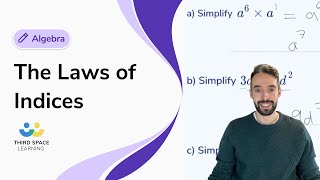
This content was created by Rob Langman. This content was uploaded by Rob Langman. This is a YouTube video titled "Laws of Indices | GCSE Maths | Third Space Learning" (created 2023-01-06). It is an English instructional GCSE maths tutorial that explains the three laws of indices (multiply: add powers; divide: subtract powers; power of a power: multiply powers), includes multiple worked exam-style examples, mark breakdowns, and closing information about additional resources. The transcript features multiple speakers: Rob Langman (the main presenter, who in the transcript introduces himself as 'Paul' from Third Space Learning) along with two other participants labeled 'Speaker B' and 'Speaker C' who prompt, guide, and consolidate the worked examples.
Chapters
Foreign. Hi, this is Paul from Third Space Learning. And today we're going to look at the laws of indices. Now they tell us how to simplify expressions and calculations that have the same base that's just the same big number or letter. There are three main laws. Let's have a look at them. So the first law of indices is when we are multiplying together by terms with the same base, all we do is add the powers. The second law is when we are dividing terms with the same base, we subtract those powers. And the third one is when we have a power outside of a bracket and all we're going to do is multiply those powers together.
Let's take a look at each law.
In a little more detail. So the first law of indices we'll look at is when we are multiplying terms together with the same base, all we have to do is add the powers. So for example, if we had A to the power of three, So a times A times A, and we multiply that by A to the power of two, A times A. Well, all together there we have A to the power of 1, 2, 3, 4, 5. So that's the same as 3. Add 2 is 5. So all we do is add the powers. Let's take a look at an exam style question to see how this works in practice.
Part A says simplify A to the power of six, multiply by a. Now this is actually just A to the power of one. Laws of indices tell me, when I'm multiplying terms together with the same base, in this case A, I can just add the powers. So this is the same as saying A to the power of six plus one, which is just A to the power of seven. So let's pop that on the answer line, part B. Pause the video and have a go. See how you get on. Okay, let's go through this one. So this has a little more going on. We've got three multiplied by D to the power of five multiplied by three multiplied by D squared. Now because this is multiplication, I can multiply these in any order I want. So let's do the numbers first. Three times three is nine, right? Let's look at the D's now. So we've got D to the power of five and we're going to multiply that by D squared. Well, laws of indices tell me, when we have the same base D and we multiply, I can add the powers. So that's D to the power of 5 +2, which is D to the power of 7.
Let's put it all together.
The final answer is 9D to the power of 7. Part C very similar, but with a little more going on. So let's do the same thing as we did in part B. Let's start off with the M's. So this is M to the power of 4 multiplied by M. But it's actually, remember M to the power of one. Laws of indices tell me to add those powers. So it's going to be M to the power of 4 +1, which is M to the power of 5. Let's look at the ends. So we've got N to the power negative 3 multiplied by n to the power positive 3. And again laws of indices tell me to add those powers. So negative 3 plus 3 3. Now thinking of the number line minus 3 plus 3 is going to be 0. So this is just n to the power of 0 and n to the.
Power 0 is 1. Anything to the power of 0 is 1.
So let's put the answer on the answer line. It's just M to the power of 5 multiplied by 1, which is just M to the power of 5. Let's see where the marks come from. So part A, one mark for the answer, part B, one mark for the nine, one mark for D to the power of seven. And on part C we're going to get two marks for writing M to the power of five. Now if you make a small mistake and you write N to the power of something here, don't worry, as long as you've still written M to the power of five, you will get one mark.
Let's take a look at the second law of indices. This is where we are dividing terms. We subtract those powers. So for example, if we had A to the power of four, that would be A times A times A times A. And we divide that by A to the power of two. So on the numerator we'd have A times A times A times A. On the denominator we'd have A times A. And we can divide A by a. So A divided by A is one. And we can do that again. A divided by A is one.
So what we're left with here is.
Just A times A which is A squared. So all we've done there is subtracted the powers 4 subtract 2 is A to the power of 2.
So let's have a look at this.
In an exam style situation.
So part A says simplify three to the power of nine divided by three to the power of five. Now the Laws of indices tell me when I'm dividing terms with the same base, I can just subtract those powers. So this is 3 to the power of 9, subtract 5, which is just 3 to the power of 4. Pause the video for part B and have a go see how you get on. Okay, let's go through it now. Let's start with the numbers first. Here we've got 12 divide by 4. Well, 12 divided by 4 is 3. Okay, let's look at those Fs. So we've got F to the power of 8 divided by F. Now, it's not just F, it's always F to the power of one. Laws of validities tell me when I'm dividing terms with the same base, I can subtract those powers. So it's F to the power of eight, subtract one, which is just F to the power of seven.
Let's bring it all together.
The answer is three F to the power seven. Part C. Okay, now there's a little more going on here, but we're going to do it in exactly the same way. So let's start with those X's. X to the power of negative one divided by X to the power of six. Well, laws of indices tell me I can subtract those powers because I'm dividing terms with the same base. So this is X to the power of negative one, take away six. Well, negative one, take away six is just negative seven. Let's see what the Y's look like. So we've got Y to the power of 5, divide by Y to the power of negative 1. Right, I've got to be really careful here. So it's Y to the power of five, subtract negative one. I'm taking those powers away. So five, subtract negative one. Okay, now we've got a negative and a negative next to each other there. So I know that's a plus. So this is exactly the same as saying yes to the power of 5 plus 1, which is just Y to the power of 6.
Let's bring it all together.
We've got X to the power of negative 7, y to the power of 6. And there's my answer. Let's see where those marks come from. So question one. One mark for the answer part B, we get two marks. So one mark for three and one mark for F to the seven. And for C, just one mark for the correct terms.
The third law of indices is when we have a bracket and a power, all we have to do is multiply the Power together, the power inside the bracket by the power outside the bracket. So for example, if we had a to the power of two in a bracket, all to the power of three, we would do two times three, which is six. So it would be A to the power of six. The reason that works is because A squared to the power of three is the same as saying A squared multiplied by A squared multiplied by A squared and the laws of indices. That first law of indices we looked at tells me I can add the powers together when I'm multiplying. So two at two at two is six. So it's A to the power of six. But a quick way of doing it is just to multiply the powers together inside the bracket and outside the bracket.
So let's see how we can apply.
This to an exam style question.
Part A says simplify B to the minus two, all to the power of five. Right. Now laws of indices tell me I can just multiply those powers together. So it's negative 2 multiplied by 5. Well, negative 2 multiplied by 5 is negative 10. So this is B to the power of negative 10. Pause the video and have a go at part B. Right. Let's have a look. So there's a little more going on here. And we need to be careful to apply the -3 outside those brackets to everything inside those brackets. So we've got F to the power of three, G to the power of one. Always to the power of one. And let's deal with these terms separately. So let's start with the F. Well, this is F to the power of three. And we're going to apply that third law of indices and multiply the power by the power outside the bracket. So it's three multiplied by negative three. Well, three multiplied by negative three is just negative nine. Let's look at the G. So we've got G, G to the power of one. And we're going to multiply that power by the power outside of the bracket, which is negative three. One multiplied by negative three is negative three. So that's G to the power negative three.
Let's put it all together.
We've got F to the power of negative 9, G to the power of negative 3. Part C very similar, but this time we've got a number in there as well. So we're going to deal with it in exactly the same way as we did with B. This two is actually two to the power of one. So let's start by looking at this two. So it's two to the power of one and we're going to multiply that by the power outside that bracket, which is three. One times three is three. So this is two to the power of three. Now that means two times two times two, which is just eight. Let's have a look at the C. So this is C to the power negative four. And we're going to multiply that power.
By the power outside of the bracket. So times by three.
Negative four times three is negative 12. So that's C to the power of negative 12.
Brilliant.
Let's put it all together.
We've got eight. C to the power of negative 12 dot let's see where those marks come from. So one mark for part A for the answer, two marks for part B. One mark for each term. And for part C again, one mark for each term.
Thanks so much for watching the video. Check out the description below for loads more information on this topic and for access to our library of free online resources and loads of information on our one to one tuition. Don't forget to like and subscribe to stay up to date with all the latest third Space learning videos.