Linear Equations | GCSE Maths | Third Space Learning
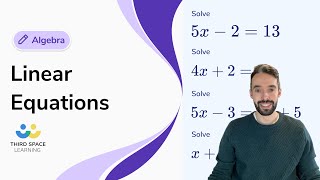
A GCSE-level instructional video (presenters Paul and Speaker B) introducing linear equations (degree ≤1) and methods to solve them. Covers solving one-variable equations, variables on both sides, equations with brackets, and equations with fractions through step-by-step worked examples and exam-mark guidance, with pauses for practice and links to further resources and tuition.
Chapters
Hi, this is Paul from Third Space Learning. Today we're looking at linear equations.
Linear equations are equations that contain variables.
With powers no higher than 1. Linear equations produce straight line graphs which we can use to work out gradients, y intercepts, and also to solve the linear equation itself. In this video we'll look at solving a linear equation with one unknown with an unknown on both sides of equals, with brackets and with fractions. As usual, I'll use our online classroom to go through the topic and look at some questions. Check out the links at the end of the video for access to tons of free resources, practice questions and information on our one to one personalized maths tuition. Okay, let's have a look at linear equations together. Grab a pen and let's dive straight in. Lets start by solving a linear equation with one unknown. So for example, let's solve 2x 8 equals 20 because we only have one unknown variable there, x. Well 2x8 20 means we start with a number X, we multiply it by.
Two, add eight to it and we get 20.
So let's work backwards to work out what x is. So let's start by subtracting 8 from both sides of the equals. When we do that we're left with 2x equals 12. Now 2x means 2 multiplied by x equals 12. So the opposite of multiplying by 2 is divide by 2. So let's divide by 2 on both sides. 2x divided by 2 is just x and 12 divided by 2 is 6. So the solution to the linear equation is x equals 6. Let's have a go at 1 together.
So the question says solve 5x take away 2 equals 13. Now this means 5 multiplied by some number, take away 2 will give us 13. So let's work out what that number is by going backwards. So let's start by doing the opposite of subtract 2. Well that's add 2. So let's add 2 to the left and add 22 the right. So on the left hand side we're left with 5x because negative 2 and 2 is 0. On the right we've got 13 add 2 which is 15. 5x means 5 multiplied by x. So to undo that we use the inverse operation which is divide. So we'll divide the left and the right by 5.5x divided by 5 is just 1x or x 15 divided by 5 is 3. So the solution to this equation is x equals 3. Let's see where those marks come from. So we're going to get one mark for a correct attempt to isolate x on one side of the equals. And the second mark is for the fully correct answer. Okay, your turn. Pause the video and have a go. Best of luck. Let's go through it. So it says solve 4x add 2 equals 22. Now this means 4 multiplied by a number add 2 is 22. So to solve it, let's work backwards and let's start by doing the opposite of that. Add two, which is subtract two. So on the left and on the right of the equals, we'll take away 2. On the left hand side we have 4x because positive 2 take away 2 is 0. And on the right hand side 22 take away 2 is 20. Now, 4x means 4 multiplied by x. So to undo that, we're going to divide both sides by four on the left hand side and the right hand side. So on the left, 4x divided by 4 is 1x or just and 20 divided by 4 is 5. So there we go. X equals 5 is our final answer. The marks come from attempting to isolate x on one side of the equation. And then the second mark is for the final answer.
Next, let's look at solving a linear equation when we have an unknown on both sides of the equals. So for example, let's look at 4x.
Plus 8 equals 3x take away 5.
Well, the way to solve this is to get all the x's on one side of the equal sign. And a good way to do this.
Is to get rid of the smallest number of X's.
Well, we can see the 3X there is smaller than the 4X. So let's get rid of that 3X. Let's subtract it from both sides of the equal sign. When we do that, on the left we have x 8, and on the right we've got negative 8 5.
Now we've got all the x's on.
The left hand side, which is good. But the left hand side says X +8 and we don't want that +8 there.
So let's get rid of it.
Let's subtract the 8 from both sides of the equal sign. So on the left hand side we're left with x. And on the right hand side negative 5 take away 8 is negative 13. So the solution to this linear equation is x equals negative 13. Let's try some together.
So the question says solve 5x take away 3 equals 3x plus 5. So we notice we have an unknown variable on both sides of the equals. So what we want to do is get all the x's on one side. Now a good way to do this is to get rid of the smallest number of X's. Well, on the left hand side we have 5X and the right hand side we have 3X. So 3X is the smallest number. So let's get rid of it. Let's take away 3x from the right hand side and from the left hand side. So 5x take away 3x is 2x. The takeaway 3 is still there and that equals 3x take away 3x is 0. So we're left with just 5 on the right hand side. Now this means 2x take away 3 5. So let's undo this. The opposite of taking away 3 is adding 3. So we'll add 3 to the left and to the right. That means on the left hand side we just have 2x because negative 3 add 3 is 0 and on the right hand side 5, 3 is 8. Now 2x means 2 multiplied by x. So the opposite of multiplying by 2 dividing by 2. So let's divide by 2 on the left hand side and the right hand side, 2 x divided by 2 is 1 x or just x equals sign lined up and 8 divided by 2 is 4. And there we go. X equals 4 is our answer. Let's see where these marks come from. So we're going to get one mark for a correct method to isolate the variable one side of the equal sign. And the second mark is going to come from the correct answer. Okay, your turn. Pause the video and have a go. Best of luck. Right, let's go through it. So it says solve the equation. And we notice we've got x's on both sides of the equal. So we want to put all the x's on one side and it's a good idea to get rid of the smallest x. So we can see here we have 1x on the left and 4x on the right. So the 1x is the smallest one. So let's get rid of it by subtracting X from the left hand side and also from the right hand side. Well on the left x take away x is 0. So we're just left with 6. And on the right 4x take away x is 3x and the takeaway 3 still there. Okay, next. Well, we've got all the x's on the right hand side, which is great, but that negative 3 is still there, which we don't want. So let's get rid of it by adding three to the right hand side and to the left hand side. So on the left 6 add 3 is 9, and on the right negative 3 add 3 0. So we're just left with 3x. Now we want to work out x. But at the moment we have 3x and 3x means 3 multiplied by x. So the opposite of multiplying by 3 is dividing by 3. So let's do that to both sides, 9 divided by 3 is 3, and 3x divided by 3 is 1x, just x. So the answer is x equals 3. And let's see where the marks come from. So we're going to get one mark for a correct method to isolate the variable. And the second mark is going to come from our fully correct answer, 2 marks.
Next, let's look at solving a linear.
Equation with some brackets.
So let's look at solving two bracket X. Take away three, close bracket E equals 16. Now, there's two ways we can do this.
We can either start by expanding those brackets, adding 6 to both sides, and.
Then dividing by 2 on both sides to get X equals 11. Or we could start by dividing by 2 on both sides, then add 3 to both sides, and we get X equals 11. Whichever way you do it, you get the same answer. Let's have a go at a couple.
Together question says solve three bracket X plus 2 equals 18. Now we can do this in a couple of ways. We notice that the three outside the brackets means multiply everything in the brackets by three. So we could start by expanding the brackets. So let's try that. Three multiplied by X is three X and three multiplied by positive two, positive six, and that equals 18. Now we just have a linear equation here. So let's start by subtracting 6 from both sides to get the x's by themselves on the left. So we get 3x is equal to 12. Next, 3x means 3 times x. So let's divide both sides by 3 to get x equal to 4, which is our fully correct answer. Now, on this one we notice that 18 will divide by 3 really easily. So it might be easier just to start by dividing by 3. This means 3 multiplied by the bracket is 18. So let's divide both sides by 3. If we do that, 3 divided by 3 is 1, and we're left with x plus 2 on the left hand side. And 18 divided by 3 is 6. So we're left with 6 on the right hand side. So we're nearly there. All we have to do now is take away two from both sides to get X equals four. Now you only need to do one method, but either of those will work. It's a good idea to be aware that there are multiple ways we can do this. Let's see where those marks come from. So we're going to get one mark for an attempt to isolate the X on one side of the equals. And the final mark comes from the answer x equals 4, 2 marks. Okay, your turn. Pause the video and have a go. And we'll go through it in a sec. Right, let's go through it. So we've got five bracket X take away three equals 15. Okay, well we know that the brackets mean multiply everything outside them by everything inside them. So let's try that. Let's do 5 multiplied by Y is 5 Y and 5 multiplied by negative 3 is negative 15 and that equals 15. Okay, now let's try and solve this. So let's get rid of that negative 15 by adding 15 to the left and adding 15 to the right. That means on the left we've got 5y because negative 15 and 15 is 0. And on the right we've got 1515 which is 30. The final step then is to get Y by itself. Well, this means five times Y. So to undo that, let's just divide by five and we have to do that on the left hand side and the right hand side. So 5 y divided by 5 is y and 30 divided by 5 is 6. And there's our answer. But it might be easier on this one if you wanted to to rather than expand the brackets, we could just start by dividing. Because we notice 15 is is divisible by 5. So 5 times something is 15. Let's divide the left hand side and the right hand side by five. So five divided by five is one. And on the left hand side we just have y take away 3 on the right, 15 divided by 5 is 3. Then it's just a case of doing the opposite of take away three, which is adding three to the left hand side and to the right hand side. Y is left by itself on the left because minus three and three is zero and three plus three on the right is six and we get the same answer. Whichever way you do it, you will get full marks. And let's see where those marks come from. So we're going to get one mark for a correct method to isolate the variable on one side. And the second mark comes from the fully correct answer of y equals 6.
Let's solve a linear equation now with fractions. So for example, let's look at x plus 3 all divided by 2 equals 5. Well, that means some number x at 3.
Then divide by 2 gives us 5.
So let's work backwards to work out what x is. So the inverse of dividing by two is is multiplying by two. So let's multiply two on both sides of the equals. We're left with X plus three on the left hand side and 10 on the right hand side. And then finally just subtract three from both sides to get X equals seven.
And there we go.
We have solved our linear equation. Let's try more.
So the question says solve this equation. Now we've got 2x take away 3 on the numerator we have a 3 on the denominator and that equals 5. So this means some number multiplied by 2, take away 3. Then divided by 3 is 5. So let's start to undo this. Let's work backwards. So the last thing we did there was divided by three. So the opposite of dividing by three is multiplying by three. So let's multiply the left hand side and the right hand side 3. Now if we do that, we're left with 2x, take away 3 on the left and we've got 5 times 3, which is 15 on the right. Now 2x take away 3 equals 15. So let's start to undo this. The opposite of take away 3 is add 3. So let's add 3 to the left and add 3 to the right. So we're left with 2x on the left and 18 on the right. 2x equals 18. Well, 2x means 2 multiplied by x. So let's do the opposite of that and divide the left hand side by 2 and the right hand side by 2. So 2 x divided by 2 is 1 x or x and 18 divided by 2 is 9. So there we go. X equals 9 is our answer. Let's see where those marks come from. So we're going to get one mark for a correct method to isolate the variable on one side. And the second mark comes from the fully correct answer of nine. Okay, your turn. Pause the video and have a try. Best of luck. Right, let's go through it. So it says solve the equation. And we can see we've got 3x2 take away 1 on the numerator and 2 on the denominator. Now this means 3 multiplied by some number. Take away 1, then divide by 2 is 10. So to solve this, let's work backwards and let's undo the last thing we did. So the opposite of dividing by two is multiplying by two. So let's multiply the left and right hand sides by 2. We have 3x take away 1 which equals 10 times 2 which is 20. Now let's undo the minus 1. So opposite of taking away 1 is adding 1. So we'll add 1 to the left hand side and add 1 to the right hand side. That means on the left hand side we're left with 3x minus 1 and 1 is 0 and 20 add 1 is 21. Now 3x means 3 multiplied by x. So the opposite of times by 3 is dividing by 3. So let's do that to the left and right hand sides. 3x divided by 3 is 1x or just x and 21 divided by 3 is 7. And there's our answer. X equals 7. Let's see where the marks come from. So we're going to get one mark for a correct method to isolate the variable on one side and the final mark comes from the answer.
Thanks so much for watching the video. Check out the description below for loads more information on this topic and for access to our library of free online resources and loads of information on our one to one tuition. Don't forget to like and subscribe to Stay up to date with all the latest third Space learning videos.
More from Rob





The Top 20 SATs revision topics 2026: A focused revision approach for maximum impact in minimum time

GCSE maths marking 2026 decoded: using examiner insight to improve teaching and results


How To Embed AI Literacy In Your School: Practical Steps To Get You Started [Webinar Replay]


Reviewing And Planning Your School's AI Approach: A Strategic Framework [Webinar Replay]
