Make the most of your 2022/23 maths interventions strategy - TSL Webinar
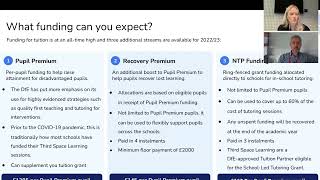
Practical webinar (Third Space Learning) presented by Emma with guest John Kilbane (deputy head, St Michael's, Reading) explaining how primary schools can use 2022/23 tutoring funding and deliver effective maths interventions. Key topics: the three funding streams (Pupil Premium, Recovery Premium, NTP tuition grant), delivery options (tuition partners, academic mentors, school-led tutoring), diagnostic-led one-to-one online tuition (Mission Zero, SATs booster), implementation details (technical setup, parental engagement, attendance and slot management), and DfE reporting/data returns (school-level hours/cost return). The session includes a Third Space pricing example and practical school experiences from John to illustrate uptake, attendance challenges and admin/reporting workflows.
Questions this video answers
£1,385 per eligible pupil.
£145 per pupil premium pupil (minimum floor payment £2,000 per school); special schools: £290 per pupil premium pupil.
£162 per pupil premium pupil (paid in three instalments).
Average cost model: £18 per hour and an entitlement of 15 sessions per pupil (used to derive the £162 figure).
Up to 60% of tuition cost, capped at £10.80 per hour.
Chapters
To get started. And thanks very much for joining us today. So I know quite a few schools have had parents evening this evening, so unable to join. So if you're watching it back, I hope you find it useful. So my name is Emma and I am part of the the schools team at Third Space Learning. Many of you may have used our resources or read some of our blogs, but we also provide one to one math interventions as well. Oh, we appear to have lost John. Well, also joined by John when he comes back. John Kilbane is the deputy head at St. Michael's in Reading and he uses our third space interventions. And so we're going to be hearing from John about his experience and how interventions look in his school. And so the purpose of today is to take you through the updated guidance on the funding streams that are available to to you for this year to provide tuition in school and to look at how you can use that to facilitate tuition within your school and how it's going to work best for you. So there's been a number of changes that have taken place for this year. The idea being for it to give you some more freedom on what you can offer and to make it simpler for you to use. But I know that here we are. Got John back.
Sorry.
No problem, John. Well.
I am still here. Hang on. Okay, hopefully that will work.
Now here we go now, all ready to go. I was just mentioning, John that you are deputy head at St Michael's in Reading and we'll be taking a look at your experience using Third Space and the interventions in your school at the moment. Now, I mean we've at Thirdspace has spoken to a number of schools and found the funding being a bit of a minefield, to be honest, and it's confusing and the uncertainty has made it really tricky for schools to put things in place. So I'm hoping by the end of today you will have a bit more clarity on your options and what you can use to put in place some maths interventions, you know, whatever route you choose to go down. So I've picked out a few key points on what I think is really key and worth bearing in mind when you're looking to use your funding. And then we'll take a look at, I mean, third space. We've provided math interventions for nine years now. So we'll look at a checklist, if you will. So this is what we're going to cover. We'll look at sort of a checklist of how to provide effective tutoring in school and what you need to Track and then we'll be hearing from John about his experience and then, as I say, opportunity to ask any questions at the end. And I'll also be sending through some further information via email at the end to our blogs and some government guidance as well. So, I mean, before we jump in, John, if you perhaps want to introduce your school very briefly, your pupils, and how interventions and tuition looks in your school at the moment.
Yeah, sure. So I'm the deputy head, I'm the maths lead and a few other responsibilities as well. So we're at 24 mentoring school in Tyler, which is a kind of suburb to the west of Reading. Last year our kind of PP percentage was just over 30% and we just started our second year with third space. We've got a mixture this year of year sixes, year fives and year fours. We did last year have a few year threes, but it proved to be quite sort of intensive in terms of getting them familiar with logging in and all that kind of thing. So we just opted for the older children this year because they're really familiar with the Chromebooks that we use. And, yeah, it's just a bit smoother. We generally, we selected children whose progress has not been what we would want to it to be. But then there are other factors around how we select children, which I guess we'll go into a little bit later, perhaps. And it's after school on Tuesday, so we've literally just finished it and generally it runs really smoothly. We had a few technical issues at the start of the year, but that wasn't anything to do with third space. But my advice to people would be that you need to be quite forthright with your kind of desktop support and your broadband providers and filters. Because I had a lot of to in and fro ing and people saying, oh, you know, we've done what you've asked, it's not us. But in the end it was down to broadband filtering, so you need to be quite persistent about getting that. But once everything's in place and there's really clear steps on the website, it runs really smoothly.
Perfect. Are you running any other interventions in school as well at the moment, or is it just third space?
The main intervention we use is one called is a pre teach intervention, which effectively is just our TAs who work in the year group will take the bottom 20% out and they will look at what's going to be covered in the maths lessons the next day. So it's not any particular scheme or bought in intervention, it's Familiarizing the children with the topic they're going to look at the next day, giving them a bit of a heads up to get their confidence up to know that when they go into that lesson they're at least going to understand the initial part of it. Having gone through it already, we've started doing that over the last couple of years and found it to be much more effective than basically filling in the gaps after a lesson with children. Didn't get it.
Okay, so you've got a bit of a mixture of things going on in the school then. I mean, when we spoke beforehand and you were looking at your sort of funding options, it was mainly through Pupil Premium that you were looking to support pupils, wasn't.
Was? Yeah, I mean, we use our Pupil Premium funding for lots of different things and when we had that conversation about funding, it was actually really, really useful because you were able to, to clarify some of the, you know, some of the detail around the funding that's available and how it can be used. Because as you said at the outset, it's really not very clear. But we use our PP funding part of it to support tutorial music for other things as well. Obviously, you know, we try and use it for some individualized things, specific things for specific children. A certain amount of it goes on staffing because, you know, those staff that deliver interventions for disadvantaged children might be like training for specific interventions that teachers or skills to help, you know, improve teachers to meet needs that we've got in the school. So for example, in our foundation stage at Q stage one, we're looking at a thing called intensive interactions, which is all about language and communication. So we use our people premium funding for, you know, a lot of different things. Certainly tutoring.
Yeah, yeah, absolutely. I mean, well, that brings us sort of nicely on really to the three funding streams that are available to schools for this year. So last year there was sort of three pillars to the tutoring route. So there was the tuition partners, which schools would rely on that partner to pair them with specific tutors. TSL were one of those specific partners that were accredited by the DfE. There was also the option for Randstad to connect you with salaried academic mentors, but you could also provide it in house as well through your school led tutoring route. Now a lot of you, I'm sure, had experience with the NTP platform and it being pretty tricky to use and adding to workload4u. So they've actually sidestepped that central provider for this year and just giving money to schools to use as you as you see fit through through tuition. So looking at that pupil premium initially. So once again per eligible pupil schools will receive £1,385. Now the GFE is putting more emphasis on schools using that to provide tutoring for this year to help bridge that attainment gap and to plug those gaps that have emerged post lockdown and that can be used to supplement your tuition grant which you'll be given and I'll go into that in a moment. So as John's found, that's been the primary stream that you've used to access third space this year. Schools will also be given a recovery premium fund which is the extension of the catch up funding and that is allocated on the basis of the number of pupil premium pupils that you have in school. So you will receive £145 per pupil premium pupil. And that's not limited to being spent on pupil premium pupils. So it can more flexibly support maths or whatever you choose across the school. And you know that's on activities that are either sort of quality first teaching or to provide academic support or tackle non academic barriers as well. So it could be anything that's preventing them from academic success, attendance, behaviour or social and emotional support. So a wide variety of things that you can spend your recovery premium on and that we paid in four installments. And there is also a minimum floor payment of £2,000 that all schools will receive. So irrespective of the number of people premium pupils you've got, each school will receive at least £2,000 in that fund. There is also the NTP funding as well, which John, I remember you mentioning that you weren't totally aware of, which I suppose just justifies why it's important today to sort of go through through this so everyone's up to speed with what's available and can make use of it. So that is a ring fence grant that all schools will be given. You don't need to apply for this, you're automatically allocated it and it is calculated on the number of pupil premium pupils we've got in school. So that's 162 pounds per pupil premium pupil and it's paid in three instalments and it can be spent on tuition and it has to be done so by the end of the year because it will then get called back to by the DfE. So if we just, I mean it's worth noting as well, if you are a special school then you will receive slightly more. So in the recovery premium pot, it's £290 per pupil premium pupil and all schools will be eligible. So if we take a look at how that funding is calculated. So that tuition fund is calculated at an average cost of tuition for £18 per hour. So and that is calculated across the average cost for small group. So pupils are entitled to 15 sessions. This isn't actually a requirement. I know last year schools had to provide information and people had to sit 15 hours of sessions. That's not requirements, that's just the entitlement. So hence where your £162 comes from. And that can cover a maximum of 60% or up to £10 80 per hour of funding. So if your average cost of tuition is higher than £18 an hour, then ten £80 will be covered per hour. If it's less than 60% will be covered and the remaining can be spent can be covered by pupil premium or other core budgets. So for whatever route that you choose to go down, then the grant can cover up 60% and then the remaining is just covered by pupil premium or other core budgets. And as I said, all funding that's unspent will be returned to the DFE at the end of the year. Now it's worth noting that your recovery premium can't be used directly in tandem with that tutoring grant. So you can't use that to supplement the school contribution. But at Thirdspace we recommend just a bit of sort of creative budgeting and just reallocating some of those pots to free up some people premiums. So you know what you mentioned, John, you've used people premium in a variety of different ways. So you know, perhaps if you wanted to free up some of that people premium to use, you could allocate that recovery premium to free that up to make up the school's contribution.
That's actually pretty much exactly what we've done. I know when we had the conversation I said I wasn't really aware about some of the funding. She's. But the head certainly wasn't, the business manager was. And that's exactly the route they've taken.
Oh, brilliant. So it's interesting to hear that. It's just the. Perhaps lower down in the school aren't as aware of the funding, but I think the. Those sort of. Obviously business managers and heads are more aware. I don't know whether that's, you know, conversations that had internally or just kept more at high level.
It's probably more to do with having the time to actually have those conversations, to be honest.
Yeah, most likely. So just to give you all a Bit of an example. So at, you know, using an example of third space, obviously you could use multiple different routes, but for us it is, it works out at £230 for 12 weeks of sessions per pupil. Now we're just slightly above the average cost of tuition at £19.17 per hour. This is because we offer one to one and so due to our global tutoring community, so our tutors are based globally, we're able to offer one to one at a price that's similar to the average of small group. So if you were to have, as you can see in the example, 20 pupils each sitting 15 sessions, so with 300 hours of tuition be a total of £5,750, that funding grant could cover £3,240 and then the school would contribute £2,510. So I mean, that's assuming that your grants can cover £3,240, you may have slightly less, meaning that your school will just contribute slightly more, but, you know, it's up to you. So the school could maximise the grant or you could use it across different, across different avenues. So, So where can your tuition funding be spent? So there's, there's different routes. I mean, as I mentioned, Thirdspace, we're an accredited provider. You could also spend it on academic mentors or you could also spend it by using in house staff, you know, previous teachers, TAs, other staff members to provide tuition. I do know that if you're using in house staff then it has to be in excess of their base salaries, so you can't use that funding in order to pay their salaries. And irrespective of the route you go down, it covers 60%. So I'm just going to focus on the tuition partners route simply because that's where our area of expertise lies. And John's experience of us is with. So the tuition partners route is there's 56 partners who have been approved by the DfE, so they're a mixture of online, in person tutors, group or one to one. And we're all quality assured through a rigorous approval process which includes ensuring value for money. There's also efficacy impacts, tutoring, recruitment and training and safeguarding policies as well. So John, why was it that you initially chose to look towards a tuition partner or going for an external provider rather than just providing in house?
There's a number of reasons, really. The short answer is because it was quicker and easier and as long as we were reasonably confident that the sort of the quality of the tutoring was going to be, you know, similar to what we could provide if we were to do it in house. Doing it in house would have required, you know, a certain amount of organization, a certain amount of training, communication between staff. Because it's very unlikely that the, you know, all the children we wanted to get tutored will be tutored by staff who were already working with those children and knew exactly where they were. So the kind of, you know, the diagnostic elements of it, if you, if you want to put it like that, where the children's gap. So all those things would have to be communicated and accounted for. So it would have been quite a big job and we were under a. Not a huge amount, but the local authority was starting to press about, you know, you need to account for this money you're going to get, how are you going to spend it? So there was a certain time pressure, so. And then there was no guarantee that we would have found enough staff to do it, you know, so kind of that organizing, doing it in house is feasible, but it's a bit, it's a big job. So we decided actually if we can get some decent external tutoring, then that will be with everything else that's going on in school, that would be a good idea. So that's why we decided to look externally.
I suppose there's a lot of variables, isn't there, if you're looking to offer it in house. So I mean, staff shortages at the moment are a particular issue and providing that consistency is really important. I mean, our sessions run once a week, the same time and the same day to try and provide that consistency with the same tutor. So I mean, ideally it would be, you know, being able to offer, have all pupils have one teacher same time, same day on a one to one basis, but it's just not, it's just not feasible, is it?
No, it's not. And you know, it requires, you know, a lot of, there's a lot of detail to be thought about, you know, particularly around the staff. You know, are they, are they familiar with the curricula for the year group they might be teaching? If not, what are you going to do about that? You know, have we got the sufficient stuff to do it? Because lots of our staff, you know, they have children, they have to leave. If they're support staff, they have to leave pretty much at the end of the day. Are the teachers going to want to do it? You know, the workload is massive already. So, you know, there were lots of reasons why we felt external was actually going to be better for us. That doesn't mean it's better for everyone, but it was certainly better for us.
No, of course. I think that's why it's worth exploring different avenues, looking at different partners, different routes and just seeing what's going to be best for the school. Because I suppose you've selected a specific group to receive one to one interventions through an online format. It's always a case of schools making that judgment of what's right for them.
Yeah, it is. I think one thing that perhaps we didn't anticipate was the. Because it's novel, it's a novelty to the children actually. That's kind of helped with a buy into it. You know, it's a different way of doing things. They don't typically have their math lessons delivered by somebody in another country via one of the Chromebooks. So, you know, that's turned out to be another benefit of it as well.
Yeah, absolutely. And well, I'm glad that they're enjoying it, enjoying the novelty with their learning something a bit different. I suppose so. I mean, that sort of brings us on really to what we've learned about sort of key features of effective tutoring. I mean, we've looked at the one to one element really. I mean, we exclusively offer one to one and it takes place through a computer and a headset. I mean, was opting for one to one over small group down to the personalized nature.
Yeah, obviously it gives the children, I mean they typically, they maintain the same tutor so they build a bit of a rapport with them. You know, there's research to show the effectiveness of one to one tutoring for us. We know we've got an issue in school around explaining and reasoning and having that one person to kind of, you know, to that person to be the person that you have to explain and reason to and use that mathematical vocabulary. Because even in a small group, if you're, you know, if you're one of a group of six, it's quite, you know, you can hide, you can hide to a certain extent. Whereas if it's one to one someone asks you a question, you're the only person who's going to be answering it. So, you know, you've almost got that guaranteed engagement and they're going to have to, they're going to have to explain their thinking, they're going to have to use that mathematical vocabulary. So yeah, it certainly was a big factor in, in why we went for third space because one to one was something that we wanted for our children.
Brilliant. I mean, I Suppose when other schools and those, you know, who don't, looking at their intervention strategy, it's looking at the gaps that their own individual pupils have, whether there's lots of similarities and I guess they could small group but I suppose post Covid those gaps are really specific. I mean there's no one size fits all curriculum, there's no people's gaps are never exactly the same. So it's taking a look at the severity of those differences and whether, you know, that's the route that they need to, need to go down.
Yeah, I think the kind of, as you say, I mean it's always been the case that you know, the gaps are individualized if you like, but the pandemic has kind of exacerbated that really, it's made it worse. So the having a one to one tutor really with the other kind of elements that you can, the kind of personalized element, personalizing elements you can add from third space means that you can make it very individualized, you can really target those gaps.
So yeah, yeah, I mean, I suppose, yeah, targeted and personalized sort of goes hand in hand with one to one, doesn't it really? And there's also you have limited time at the end of the day to run your, your interventions and so you need to make the most of those. So ensuring that it's targeted and personalised, whatever route you choose to go down is really, really important. I mean what we choose to do is to go for diagnostic assessments. I mean you all schools will run internal assessments but we also run that effective diagnostic as well. So I mean we've got an example of ours here. I'm sure it's you run obviously run your own school, which is slightly different, but ours is called Mission Zero for those who aren't aware. And it's a space assessment and it's adaptive. So off the basis of that we create the lesson plan and we have programs that are based on the desired outcomes. So there's SATS boosters, diagnostics catch up programs as well. So it's taking a look at where you want those people's, where you want these pupils to be and putting in place what's going to be right for them in that sense. So I mean did you opt for, was it mainly on our diagnostic program to plug gaps or did you have any pupils on a SATS booster specific program?
We've had both. So when we began everybody started on the diagnostic program and then when the SATS booster became available, which I think was after Christmas if I remember rightly, yes. So the year six children, we switched them to the SATS booster and the. There's positives about both really. So the diagnostic, obviously the diagnostic, if they complete the mission 0 Firstly it kind of, if you allow a bit of time for the children to do that before they have their first session, it kind of, you know, they get familiar with the, they get familiar with the platform and then obviously it gives that useful information back to the tutors so they can really target the teaching to the children. So they diagnostic and it doesn't take long. I think one thing I will say is that because it's kind of in sections, children often think they finished it when they actually haven't and you have to kind of go back and say, no, there's a bit more to it, but it doesn't really take very long and they're quite, you know, they quite enjoy it in the format that it's in the SATS boosters. That was really valuable in that, you know, you could really drill down on what you wanted each lesson to be for that child. So. And you know, as I'm sure any year six teachers will know the story of, you know, by the time you're after Christmas, heading towards February, you are really drilling down and plugging those gaps. And as long, as long as whoever is kind of administering your tutoring is able to have that conversation with those teachers about, okay, what are you covering this week? Which children have found that difficult, you can really drill that down. So that is what they're going to cover. So what's being, you know, your curriculum is matched by the tutoring in that build up to starts. It's really, really useful. And the other good thing about the SATS booster was that you have that facility where you're looking at the different strands and it tells. You've obviously done some sort of analysis on marks available in sats over the years. You know how important it is that children get that in terms of the likely amount of marks, the impact it's going to have on the score. So that was really useful as well.
Yeah, that's.
You can choose what is going to have the most impact.
Yeah, that's exactly what we do to our curriculum team. We've gone through past SATs favour questions and ranked topics from high impact to low impact. I suppose in terms of diagnostics, however you're running them in school, I mean, whether you choose to use online programs such as our diagnostic or you're using them in school, some tips that we have generally for schools is if you are going to be running diagnostic assessments is to make sure you take the tests in a controlled environment and also to adequately prepare pupils as well. So springing on them is not going to be beneficial for anyone and they're not going to perform at their best and you're not going to be able to get the data from it that you need. So if you are running those internal assessments, make sure you prepare those pupils well and give them plenty of time. I mean, ours, we say, is a 40 minute assessment, but sometimes they take slightly longer, sometimes it's slightly less. You know, it's giving them enough time to be able to perform at their best so that it's the truest reflection of their current working, current working level. So on that basis, you know, whatever form of tuition you intend to go down, then you can really tailor it to their individual needs and make the most of that intervention time. So I mean, really, it sort of goes without saying, really, but engaging lesson plans and tutors is always, it's super important to keep them engaged and keep them learning. I mean, we run ours through a interactive classroom. I mean, how did your pupils, you said it was a novelty for them, that they enjoyed. How do they fare working in an online interactive classroom?
I mean, obviously, you know, every child is different and some children, you know, a few children have kind of said it's not for them. Although if I'm honest, I think that that's more about staying behind the school to do some maths rather than, rather than the actual, the format that it's presented in. But the children seem to really enjoy it. They engage well with it. They like the kind of the effort points thing, you know, they're always saying at the end of the session, I've got this many effort points, I've got this many, you know, so they bought into the elements of it. And I think the kind of the representations on the screen, you know, are quite lively, the children and they're similar to things we're using in classrooms anyway, so the children are familiar with them. So yeah, you know, the kids do seem to enjoy it. I haven't ever had a single child after a session say to me it was really boring, you know, oh good. So, you know, so, you know, unless they're just, you know, being diplomatic about it. But I think really they're too polite.
In your.
Generally, if they don't want to do it anymore, then they'll go home and say to people at home, look, I'm not, I don't want to do it anymore. And you'll get that message and a few do, but it's quite a small percentage of those that we offer it.
To, I suppose flexibility as well. Sorry John, I was going to say.
It'S a slightly different story about actually getting them in the door in the first place. And one thing I would say is that you need to kind of think carefully about who you're going to offer it to and I don't know if that's something you want to want to cover later on, but from our point of view it's worth considering things like attendance because effectively the school is paying for this, you know, for the tutoring and you know, when children don't turn up, that's money that you're not getting anything for. So the other thing I would say is it's worth having a conversation with parents and I mean a proper conversation about what it's going to be and why you've selected those, their child to do it and you know, why you think they will benefit from it. Because rather than just the kind of blanket email, you know, we're going to offer your child a place in this tutoring, please let us know if you want them to accept it. I mean, in our case probably the vast majority of parents did accept it thanks to the blanket email, but the ones that don't, it's worth chasing them up because they're often just refuse it because they're not clear or because their child has said, well I don't really want to do any more maths. Whereas if you go and have that conversation, well actually they need to do it because in our case we use standardized score data and that kind of thing. If you just go give the parent simple message, look, you want a child to have a standardised score of 100 and your child's standardized score is this much below that they need the help, then quite often they will say to their children, no, actually you're going because you need it. So it's worth it if you really feel a child needs it and you really, it's worth going that extra mile to get them through the door. Because having those conversations makes a difference, doesn't get them all, you know, it certainly doesn't get them all, but it's worth doing that little bit extra to get them through the door.
Yeah, parental engagement is certainly something that we've found to be a barrier for a number of schools and as you say, it's often the pupils who perhaps need it most who have lacking parental engagement. So if it's an after school session then it's just. It's just not viable for them. So I suppose the takeaway point there really is if you are going to be making the most of your tuition because you've got this funding that's available, I mean, most schools are looking to use that to provide tuition. You could be using people premium or recovery premium, whichever, to really select those pupils and look for a route that's going to offer you that flexibility. So if, you know, you say pupils aren't able to attend, being able to switch them out, so you're not constricted to certain ones, that it's not going to have the most benefit and make the most of that funding that you've been given. So picking a provider or whatever programme you go for that offers that flexibility is important and really selecting those pupils which are going to make the most out of it and make the most progress, I guess, yeah.
I mean, what you say about switching them out is, you know, because quite often they won't attend, but you won't, you won't know they're not going to attend until they're not there. And then when you think, okay, you know, maybe something's happened, you don't, you don't really get that message that often that, you know, they don't want to come anymore, they'll just stop attending. So, yeah, if that goes on for three or four weeks and, you know, that's quite, quite a lot of, you know, it's space that's wasted. You could have another child in there. So we've actually, our admin team now have got a list, a kind of priority list. As soon as somebody drops out, they go to the next person on the list, offer them the place. If they don't accept it, they drop down the list. So that's just something we've kind of learned over the year that we need to be quite quick about getting those spaces filled. Children drop out.
From the tuition partner side. We try and be as flexible as we can because we know that things come up, pupils can't make it sometimes, it's just not quite right for that pupil. And so trying to be as accommodating to schools is really important because the end goal for us and for you is for pupils to make progress and for you to get the most out of the programme. So I think searching not just for third space, any, I'm sure anyone that you go to, if you're looking into different types of tuition this year to ensure that that flexibility is in place, because as we all know, schools, it's constantly changing. Things come up all the time. So you want to be able to. To be able to make the most of it. And I mean, finally on this point, really. So reporting is obviously important to map progress and we do offer a weekly interview report in which when we spoke, John, interestingly, you don't tend to actually make that much use of. I still thought it was worth touching upon because it just shows that you can have that there at your disposal to pick up when you want to, but you don't need to go through it with a fine tooth comb. It's just useful to have there anyway, should you need it.
Yeah, the option is certainly there. And I have you, as I said to you at the kind of onset, when you set up your pupil accounts, you're given the choice of who you want those who to have access to those reports. And I decided that I was going to do that mainly because of the impact on teacher workload. I was, you know, I didn't want there to be a big impact on teacher workload. I didn't want them to feel. Because, you know, most teachers are really conscientious to feel that they would. They'd have to trawl through all those reports and find out what was going on. So I get the reports, I do look at them a bit generally in response to queries from parents about how they're getting on and that sort of thing. So they're really useful for that. I've been using them this week, not so much the detail of the reports, but just little bits of data like, you know, how many sessions they've attended when I'm looking at kind of analyzing the effectiveness of our interventions and that sort of thing. So, you know. But there is potentially a lot of detail there and obviously they can be printed off and given to parents if parents are interested. So, as you say, it's really up to individual schools about how much they want to make use of that facility. But it is certainly there.
Yeah. Oh, brilliant. And from your side as well, you mentioned not wanting to put that pressure on your teachers because they've got that excessive workload already. So taking that and stopping them from feeling obliged to keep looking and checking is something which I'd. We'd not heard from many other schools. So it's interesting. I'm sure that there's others who are. Who are doing the same and it's just nice to know that it's there. But, you know, it's letting you do what you do best, which at the end of days Teach and not having to necessarily keep checking things all the while when you perhaps don't need to and I suppose not needing to check those reports but you're able to see the progress made in class anyway just you know, demonstrates the benefit of running one to one interventions by an external provider. As you can see the, you can see the benefit in class. You don't need to be checking reports to see it, I guess.
No, you know, they will see the benefits from, as the children progress. But the reports are useful to have even, you know, from my point of view, you know, there are always certain children in school who you need a little bit of extra information for. You know, it might be children that you're, you're looking to get some extra support for. It might be children with social care involvement or children where you're trying to push for an ehcp. So having that, that extra information, you know, if you need it, like I said, I don't pass it on to the, to the class teachers as a matter of routine but it's there if they want it and it is useful for other things as well.
Brilliant. I mean, I guess, well, what I'll sort of do now then is if I move towards looking at the sort of data returns. And John, I can imagine when you use third space last year and you had to provide data and information on the number of hours and things received. Were you involved in that area of data return yourself?
Kind of indirectly in that our admin staff do most of our census related things and our data returns but they asked me for the number of hours. So I was kind of going through looking at the, you know, because you know, children change over the course of the year as we talked about, some of them might drop out for whatever reason and new ones come in. So I was kind of going through the data and picking out okay, this child's had this many hours, this child. And then once I'd collated it all, I just fed it all back to the admin team. So I didn't fill in the return myself, I just provided them the information they needed.
Yeah, and we've got all that information available on the platform so that's it's going to be similar again this year. So you will need to record the total cost incurred by the number of hours you've delivered and you'll need to share that with the DfE by a funding return in the summer of 2023. Now there will be the terminologies school census so that'll be in October, January and in May and will also be the mandatory end of year statements, as I said, at the end of the summer. So it will be in September actually. So you can also include summer tuition. So if you were looking to put tuition in place and you're able to facilitate summer tuition, that can be covered in that statement as well. So the DfE does recommend that you track the pupil premium pupils and the non pupil premium pupils separately throughout the year and the return is provided on a school level basis. So it's not a pupil level basis. It will be the number of people receiving tuition and the total number of hours that have been provided and the type of tutoring that you provided, you know, whether it's by an employee or a tuition partner. And it's just, it's the average across all of those streams. So you might be using multiple different streams. You know, similarly to you, John, you've got third space running, but you've also got some in house tuition. That's happening as well for your TAs, whether you're using that tuition funding to pay for that anyway, or it might just be their salaried amounts. But if you're using multiple different types, it's just collectively the hours provided and the average cost across that. So the ESFA is expected to make the form available in June of 2023 and schools will be alerted to when this goes live. Now, if you choose not to make use of the grants, then you still have to return that statement and funds can't be rolled over, so it will get clawed back if you haven't spent it and it will be returned along with that statement. Now further guidance is expected to be released later on in the year, so keep an eye out for that. But we expect it to be fairly similar to the return of this year. So I suppose takeaway point really, I mean is, you know, you've got to use it or you'll lose it really. And at the end of the day it's the pupils that we want to have making that progress and benefiting them. So it's important. Hopefully this has given you some bit of background and a bit more clarity on what your options are and an example of a route you can go down. But I suppose, yeah, try and make use of it while you can. I mean, John, have you got any sort of final, final sort of thoughts on providing external providers within school or other routes that you've perhaps been looking down?
Well, as I said, we run our intervention, our pre teaching intervention. We've got first place going for maths. Obviously we started to Think about English tuition, but we've got a member of staff who's recently retired who's willing to do it and she's an English specialist. So for us, we're not really looking to change too much, but obviously for the return, yeah, it's going to be slightly different because obviously we're using a tuition partner for our maths, but we'll be using in house staff for our English. So I think that I'll look forward to that updated guidance, shall we say, and see what that says.
Yeah, well, they like to shop and change things, so I'm sure there'll be many changes to come over the year, but hopefully we're all in a position now where we're sort of up to speed at the moment and moving forward. It sounds like you've got a great program in place at the moment and a good strategy working for your pupils at the minute, that you're not perhaps looking for other avenues. I mean, that might change over the year as the attainment of pupils and your internal assessments as well, and identify other pupils. But I hope that everyone else who's joined us today has got a bit more clarity on what's on offer, moving forwards and for developing that intervention strategy in school and hopefully you'll. You'll make use of it for, for next year. They're expecting it to be a 25% subsidy on the cost of tuition compared with 60% this year. So. But again, that might change. They love to change things, so that's where we're looking at the moment. So now I'm just going to give everyone the opportunity to ask any questions that they might have come up to throughout our chat. So for anyone who's looking at a keely. Anyone who's looking at perhaps organizing some tuition, my email address will be sent out to you in an email that follows with some further resources as well. So just pop me an email and we can. We can have a chat. And so from Tom, do you offer any content for secondary schools or just primary? So we do offer secondary content as well. So on our website there is a secondary section where we've got GCSE revision content and that's all free, so. And that's across all exam boards as well. So if there's any secondary schools that are listening or you've got colleagues who working at secondary schools and they want some additional resources, then those are there available for you to use for free. Are there any other questions from anyone at all or perhaps anything they would like to direct to John and His experience. Well, as I say, I will pop you all an email at the end with some extra resources and our blog with further information on the funding that's available and some government guidance as well. And then if anyone's got any other questions, then my email address is there. More than happy to help, but sort of. So, John Keeley has got a question for you. So what is the most challenging thing to organize with third space, would you say?
I'm not. I think the kind of initial. It was much worse last year, if I'm honest, because there was so much confusion about the funding and there was a specified percentage of Pupil Premium children that you had to offer places to and had to give places to, whether, you know, you had to have of your children, a certain percentage of them had to be Pupil Premium. That made it very challenging. And to answer your second question, how do we get past it? Well, they did remove that, so that made it a lot easier. I think the challenging bit, I think really is what I talked about earlier, which is getting the pupils you want through the door initially, if they are, you know, not really that inclined to stay behind. Our tutoring runs after school. We wanted that because it means we don't create any gaps in any of the areas of the curriculum. That was really important to us. So getting a day of the week that works for your school community. Last year we had a Friday, which wasn't ideal, but actually, you know, it wasn't too bad. This year we've got Tuesday, which is. Which seems a bit easier. But getting those pupils through the door, so having those conversations with the parents, selling it to the pupils a little bit, so, you know, getting them to talk. Obviously we're in our second year now, and some of the children who are doing it this year also did it last year. And so you've got some kind of ambassadors there, if you will, you know, go and talk to so and so about to see what they think. You just have to, like I said, you've got to be. You've got to be persistent about it. As I mentioned earlier as well, you know, a little bit of challenge around the technical setup, but that's, you know, that's about making sure that you talk to the right people. If you don't have that technical expertise yourself, that whoever provides you with that support, the information is all there. You know, third space is very good about kind of giving relatively detailed technical information that you can pass on for people to make sure that, that everything that they need to work isn't blocked by your Filters. So the kind of, you know, the interface between the parents. Sorry, between the pupils and the tutors so they can, they can hear them and they can see the screen. It all works correctly. So the little challenges, nothing was major really. So in answer to that question from Bev, last year we have 45 pupils. Started with 45 pupils, this year we've gone down to 30 because last year we just found that it was difficult to keep those places filled all the time. So we were constantly kind of chasing to fill places because over the course of the year, you know, things change for people. You know, your gymnastics class might move to a different day of the week or they move up a group in the swimming and the lessons on a different day so they can't come anymore. So you get a certain amount of dropout. So we start with 45, but this year we've got 30. But you know, we're a two form entry school so if we're just looking from years four or five and six, you know, we've got 180 pupils to choose from. So. Depends on the size of your school obviously.
Yeah, of course. I mean just to add to that, we've got schools that have five pupils on the program and schools that have 100. So there's no maximum really. It's just a case of what need there is for your school and you know what you're going to be able to facilitate in house and in terms of devices and space. And we also have a finite number of tutors as well in various different slots. So it's taking, taking a look at where we can accommodate you and what's available. I mean largely it's up to the school but as I mean John, you found out joining later on in the year slots became full up and you actually weren't in your priority slot, were you?
No. So I think as you, as you did again this year you gave first choice to the people who were already signed up with you, which is kind of fair enough really. And we haven't already been signed up. So by the time we came in on it, the only after school slot we could get was a Friday. So we went with it and it wasn't ideal but it wasn't terrible. So. Yeah, but this year we were offered some different slots so we've got a different day that seems to, it suits the staff a bit better. But the other thing people often have asked me about local schools who've been interested, have said about what to do about where do they all go. But we've Got them split into two classrooms. They've all got a Chromebook and a headset and we kind of. With 15 children in each class, it's not too noisy. They can hear their tutors, their tutors can hear them. You know, to be honest, now when it's all set up and running, they're sat there getting on with it and I can get on with other stuff I've got to do. Occasionally I have to go and, you know, explain to somebody that they've switched their microphone off or they've some minor technical issue, but it runs really smoothly.
Yeah, Just a question from Tracy. So last academic year, NTP provided funding for the academic mentor, in addition to funding for 15 hours of per pupil premium child. Am I correct that this has ceased and it's just the NTP funding? Yes, that's correct. So rather there being the subsidised route for academic mentors this year, they've just given you that pot of money, so you've got that NTP funding to use down whichever avenue you choose, whether that's through tuition partners, through academic mentors or through providing school led tutoring. So using your internal staff or, you know, perhaps ex teachers, you know, employing other staff members as well. I hope that covers your question, Tracey. So the idea being there that you've just. It's rather than there being different routes to go down, it's all just there in your, in your pocket to allocate as you see fit. So unless there's any other questions at all, I think, I think we will finish up there. John, thank you so much for joining us and having a chat today.
Thank you for inviting me.
No, thank you so much. It's been really insightful to hear your experience and always great to hear firsthand your ways or the best ways to be providing tuition within school and how you fared. And I'm sure lots of parallels can be drawn from other people listening. I hope everyone found it useful. And of course, any of the questions, please feel free to email me or if there's something that you want to ask John, I can pass it on to him and I'll send everyone over some resources. Again, John, thank you very much and I hope you all enjoy your evening.
All right, thank you.
Thanks, John. Take care.
Bye bye.
More from Rob





The Top 20 SATs revision topics 2026: A focused revision approach for maximum impact in minimum time

GCSE maths marking 2026 decoded: using examiner insight to improve teaching and results


How To Embed AI Literacy In Your School: Practical Steps To Get You Started [Webinar Replay]


Reviewing And Planning Your School's AI Approach: A Strategic Framework [Webinar Replay]
