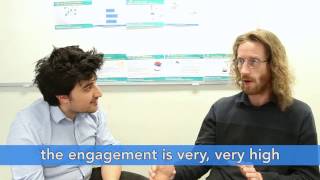
This is a short interview-style YouTube video featuring James Clark (Third Space Learning design team member, former secondary maths teacher) interviewed by Jeremy. James explains his role building personalised maths learning journeys, describes Third Space Learning's three-part diagnostic assessment program (initial diagnostic per topic, a post-session check at the end of every 45-minute one-to-one tutor session, and an end-of-term reassessment), and discusses the relative advantages of online one-to-one tutoring compared with face-to-face instruction.
Questions this video answers
Two years.
About five years.
45 minutes (one-to-one tutor session).
(1) Initial diagnostic assessment before the first session (topic-based multiple-choice), (2) a post-session check at the end of every 45-minute one-to-one tutor session, (3) an end-of-term reassessment similar to the initial diagnostic to measure progress.
Hi, I'm Jeremy. I'm part of the team here that works directly with schools. But today I'm meeting one of the experts behind Thirdspace Learning. So, James, what's your background?
So I've been working here at Thirdspace for two years. Before that I was a secondary maths teacher in inner city London schools for about five years.
So, James, can you tell me a little bit more about what you do at Thirdspace Learning?
Okay, so I'm part of the design team here that involves many things, but largely looking at the progress our children make. How do we create an individual learning journey that's bespoke to that child and their needs? And then of course, part of that is how do we communicate that to the tutor so they can tailor the lesson exactly to that need? There is no such thing as a classic primary school child in maths, so our job really is how do we tailor our provision so that that child gets what they need to build their confidence and to establish a stronger fluency and ability in mathematics.
So what is our diagnostic assessment program?
So, in simple terms, the objective of the diagnostic program is to create the best personalised journey for that particular student. Now, we can break that down into effectively three parts. The first part is the initial diagnostic assessment that child needs to do before their first session. And this goes, the teacher selects a strand, so number and place value calculation, fractions, decimals and percentages, for example, and the child will answer multiple choice questions on these. The second one part of it is how well is that child doing on the topic that we just taught them? And we ask them that at the end of every 45 minute, one to one tutor session. And then the third and final part is how much progress have they made in those substrates that we've taught them? So it's very similar to the first diagnostic assessment, but done at the end of the term. And then we see what difference is that child showing in terms of their ability within that topic? We know that a child might have just missed a concept from year two or year three and that can be causing them real problems in year four and year five and year six. And it might not even be noticed so much because it might fall off the radar. So it's very important when a child arrives at third space learning that we give them the opportunity to show what they can do so that we don't waste time teaching that. And of course we can report that to the teacher, saying, this child seems fine with this, but also really identifying at what level is this child having an issue within a certain topic. With that we can then order the lessons that we're going to teach that child from the, from the easiest that they've shown they've got some issues with to their current year group of lessons in the same topics. And we work through those. So we're plugging those gaps that might be really undermining that child's progress, but perhaps quite easy to confront.
What would you say to those people who'd say that online teaching can never be as effective as face to face?
I think anybody that says never needs to reconsider the question a little bit more carefully. I suppose if you had the same tutor you were saying, if they literally went into the school and sat next to that child, would they deliver the same or better as online? I suppose you could start to start to argue that there might be an argument there. But I think realistically what we find is we're teaching students within their school day. Now. The students are very used to sitting in a classroom with 30 people having one teacher teaching them. And when I go into schools and I see the pupils interact with third space learning, the fact that it's on a computer almost the fact that they can't see the tutor but they can hear them. So they genuinely feel that they have that one to one support. There is definitely an adult that is only concentrating on them. So they all fully appreciate, generally the engagement is very, very high. They actually focus more on what's on the screen. Obviously being a 10 year old and working on the computer as well is quite exciting. The idea that you are speaking to somebody that you can't see but is definitely responding to you, it's quite exciting. So I think there's definite advantages with it online. I suspect there's different advantages in face to face but I certainly don't think it's. I don't think it's a question that you could say one is definitely better than the other and the other has no merit. Brilliant.
Thank you.
If you want to download free resources or find out more about our one to one interventions, just visit thirdspacelearning.com.