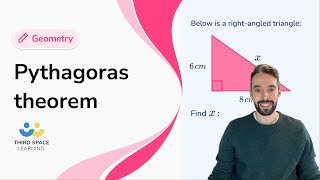
A short instructional GCSE maths video by Third Space Learning presenting Pythagoras' theorem for right-angled triangles (a^2 + b^2 = c^2). The speaker defines the theorem, demonstrates several worked examples (3 & 4 → 5; 6 & 8 → 10; 7 & 12 → √193 ≈ 13.8924 → rounded 13.9 cm), explains how to identify the hypotenuse, shows substitution and square-rooting steps, highlights unit notation and rounding to one decimal place, and notes exam-mark allocation and further resources/tuition in the video description.
Chapters
Hi, this is Paul from Third Space Learning and today let's look at Pythagoras Theorem and how we can use it to work out the longest side of a right angle triangle. As usual, I'll be using our online classroom to go through the topic and look at some questions. Check out a link at the end of the video for access to tons of free resources, practice questions and information about our online one to one personalized tutoring. Okay, let's look at Pythagoras Theorem. Grab a pen and let's dive in. Pythagoras theorem is used to work out the side lengths of right angled triangles. In order to use it we need to know two of the three lengths of the triangle and it has to be a right angle triangle. Pythagoras theorem says that the square of the longest side of a right angled triangle equal to the sum of the squares of the other two sides. A squared plus B squared equals C squared. Okay, let's have a look at this then in a little more detail. So we have our triangle. We've got a length of four and a height of three. And we want to work out the longest side. So let's call it C. Lets start them by squaring three. So three squared means three times three which is nine. Next let's square the four. So four squared means four times four which is 16. Let's add those together. Well, nine add 16 is 25. What we've worked out there is the square of the longest side of that triangle. And this will work for any right angle triangle. So we can say that A squared plus B squared is equal to C squared. And then to work out C we just do the square root of C squared. Now let's see what this looks like in an exam style situation. Below is a right angle triangle and we can see that we've got the right angle in the corner. We know two of the three sides of this triangle. Well this tells me if I want to work out X, I can use Pythagoras theorem which is A squared plus B squared equals C squared. Okay, next job, let's label our triangle. Well, C is the longest side of the triangle. It's called the hypotenuse. And a great way to spot it is drawing an arrow across from from the right angle. It's the length opposite the right angle. So that is C the longest side. Now for A and B, it doesn't really matter. So A there and B there. Right, let's substitute then the values into Pythagoras So A is 6, so that's 6 squared plus B, which is 8. So that's 8 squared equals C, which is X X squared. Okay, so 36 is 6 squared, 64 is 8 squared, and that equals X squared. When we add them together, 36 plus 64 is 100. So 100 is X squared. Now all we have to do now is work out X. So to undo a square, we need to take the square root. So X is equal to the square root of 100 and the square root of 100 is just 10. Now remember, this was 10 centimeters long. Let's do a quick check to make sure this is sensible. Well, we wanted to work out the longest side of the triangle. So it should be longer than the other two sides. And 10 is longer than 6 and, and longer than 8. So let's write that on the answer line there as a sensible answer. Let's see where those marks come from. So it's a two mark question. One mark is for correctly substituting in the values into Pythagoras. And the second mark comes from the answer. Let's try another one. Let's have a look at a second question. So pause the video and have a go. Okay, let's go through it. Now it says it's a right angle triangle and we can see the right angle just here. And we know two of the sides and we want to work out the third corrector one decimal place. Well, this means we can use Pythagoras. So A squared plus plus B squared equals C squared. Okay, next job, let's label our triangle. So the longest side is the side opposite that right angle. So that's C. And then it doesn't matter for the other two. So let's call that one A and that one B. Let's substitute these values into Pythagoras theorem. So A is 7, so that's 7 squared plus B, which is 12. So that's 12 squared equals C squared. Well, C is Y, so that's Y squared. Now because this says correct to one decimal place, the answer is probably going to be a decimal. So at this point just put this straight into your calculator. So 7 squared plus 12 squared is equal to 193 and that equals Y squared. Now to work out Y, we need to do the square root. So Y is equal to the square root of 193, which is 13.8924. It's always a good idea to write down a good number of decimal places. Now it says to one decimal place. So let's round it. Eight is in the first decimal place, so let's draw a line to the right of that and the number on the right is nine. Well, nine is bigger than five, which means I'm going to have to round up. That means my answer is 13.9 and it's centimeters. Really important to put the units in. Let's just do a quick check to make sure this is a sensible answer. Now we want to work out Y and Y is the longest side of the triangle. So my answer 13.9 should be longer than 7 and 12. And it is. So this seems like a really sensible answer. And let's pop it on the answer line. Let's see where those marks come from. So two marks, one mark for correctly substituting into Pythagoras and the second mark for the answer. Thanks so much for watching the video. Check out the description below for loads more information on this topic and for access to our library of free online resources and loads of information on our one to one tuition. Don't forget to like and subscribe to stay up to date with all the latest third Space learning videos.