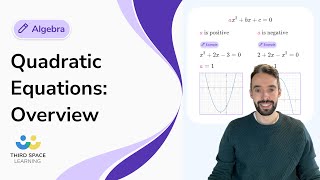
This content was created by Rob Langman. This content was uploaded by Rob Langman. This is a YouTube video titled "Quadratic Equations: Overview | GCSE Maths | Third Space Learning" (created 2023-05-26). It is an English educational tutorial presented by Paul from Third Space Learning that provides a GCSE-level overview of quadratic equations: definition (ax^2 + bx + c), graph shapes (U-shaped for positive a, inverted/N-shaped for negative a), and solution methods (factorising and the quadratic formula). The presenter works through an example (solutions x = 1 and x = -3), explains roots as x-intercepts, and directs viewers to links for step-by-step examples, practice questions, worksheets, and one-to-one tuition.
Questions this video answers
x = 1 and x = -3
ax^2 + bx + c
Chapters
Hi, this is Paul from Third Space Learning. Let's have a look at quadratic equations. Remember, you can access loads of free resources and information on our one to one tuition at thirdspacelearning.com Quadratic equations are equations that are raised to a power no higher than 2. They're in the form ax squared plus bx plus c. They produce curve graphs that are U shaped when the coefficient of x squared is positive positive and they produce N shaped graphs if the coefficient of x squared is negative. We can solve quadratic equations in loads of different ways, but two main ways would be factorizing and by using the quadratic formula. If we're going to factorize it, we put it into two brackets that multiply together that to equal zero. Check out the link in the description below for our video on factorizing quadratics to see how to do it. Now we have two terms that multiply to give zero. This means one of them must be zero. So x plus three equals zero, in which case x equals negative three or x take away one is zero, in which case x equals positive one. So our solutions are X equals negative three and x equals positive one. Now let's solve it using the quadratic formula. Where A is the coefficient of x squared in this case 1, B is the coefficient of x in this case 2 and C is the constant term. Now we substitute those values into the quadratic formula and then we evaluate it. Now we notice that there is a plus minus sign there. That means we have to do this twice. Once with the plus which gives us x equals 1, and once with the minus which gives us x equals negative 3. So we get the same solutions as we did when we solved it by factorizing. Now we notice that these two solutions are where the graph crosses the x axis. These are called the roots of the equation. Now it's over to you. Check out the links in the description below for access to step by step examples, practice questions, worksheets and loads of free resources. You'll also find information on our one to one personalized in school maths tuition.