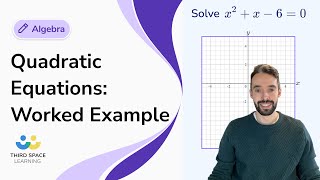
A short teacher-led GCSE maths video (Third Space Learning) demonstrating how to solve quadratic equations by factorising. The presenter (identifying as Paul/Rob Langman) works through two example equations step-by-step, explains finding factor pairs, how sign choices affect solutions, and notes how marks are awarded; the video pauses for viewer practice and points to further resources and one-to-one tuition.
Chapters
Foreign. This is Paul from Third Space Learning. Let's have a look at quadratic equations and how to solve them by factorizing or by using the quadratic formula. As usual, I'll use our online classroom and our lesson slides to go through the topic and look at a couple of questions. Check out the links at the end of the video for access to tons of free resources and information on our one to one personalized tuition. Let's start with this question. It says solve x squared plus 10 x 21 equals zero. And we're going to solve it by factorizing. So we need two numbers that will add to give this number here the plus 10 and multiply to give this number the plus 21. So a good way to do this is to write out the factor pairs of positive 21. Well, they're going to be 1, 21 and 3 and 7. Now I've got to pick a pair of these numbers that will add to give 10 and multiply to give 21. And because two numbers are multiplying to give a positive answer, that tells us they both must be positive or they both must be negative. So in this case, we're going to have positive three and positive seven. Because if we add those together, we get positive 10, which is what we want. Next, we've got three multiplied by seven, which is positive 21, which is what we want. So all that's left to do is to open a pair of double brackets. The variable is x. So that goes at the start. And then we put three in one and plus seven in the other one. And that equals zero. Next, we have two terms here that multiply together to give zero, this one and this one. Well, when we have two things that multiply to give zero, that means that one of them must be zero. So either x 3 0, in which case x is minus 3, or x 7 equals 0, in which case x is negative 7. And there we go. We have worked out the solutions to our quadratic. Let's see where those marks come from. So we're going to get one mark for correctly factorizing it and then a second mark for our correct answers. Okay, it's your turn. Pause the video and have a go. Best of luck. Okay, let's go through it. So it says solve x squared plus 3x take away 18 equals 0. Now let's solve it by factorizing. So we need two numbers that add to give this number plus 3 and multiply to give this number negative 18. So let's start by writing out the factor pairs of 18. There's 1 and 18, 3 and 6 and 2 and 9. Okay, now we need to pick a pair of these numbers that will add to give three and multiply to give negative 18. Now if two numbers multiply to give a negative answer, the signs must be different. One must be positive and one must be negative. So it's going to be the three and the six. And it's going to be negative three and positive six. Because if we add those together, negative three add six is positive three. Thinking of the number line, let's just double check that that works when we multiply them. So negative 3 times 6 is negative 18, which is what we want. Next, pair of double brackets. And because the variable is X, let's put an X at the start of them both and then just put the numbers in. So negative three and positive six and that equals zero. Now because we have two terms multiplied together to give zero, this one and this one. That means that one of them must be zero. So either X take away three equals zero in which case X is positive three, or X add six equals zero in which case X equals negative six. And there we go, full marks. Let's see where they come from. We're going to get one mark for a correct method to factorize and the second mark comes from the correct answers. Now over to you. Check out the links in the description below for step by step examples, questions, worksheets and tons of free resources to help you practice. You'll also find information on our one to one personalised mouse tuition. Don't forget to like and subscribe to. Stay up to date with all the latest thirds based learning videos.