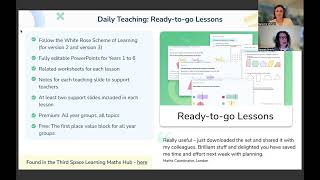
This YouTube discussion (Third Space Maths Hub) explains a suite of "ready-to-go" primary maths lessons designed to save teacher/tutor planning time. Two versions are provided (aligned to White Rose v2 and v3). Each lesson includes an editable PowerPoint, companion worksheet, dyslexia-friendly formatting (off-white background, off-black text, dyslexia-friendly font), and teacher notes with suggested questions, common misconceptions and extension prompts. Separate vocabulary lists and sentence-stems exist to provide consistent mathematical language across year groups. Support/pre-teaching slides cover prerequisite skills and can be used conditionally based on a short diagnostic/formative question included with every lesson; tutors often use mini-whiteboards to gather responses and decide whether to deploy support slides or stretch tasks.
Chapters
Okay, let's move on then to the ready to go lesson slides. I always see these ones as the ultimate time saver and I know back when I was teaching this would have been my favorite one because this does just save a whole lot of planning time. Yeah, talk us through it, Hannah.
So first of all, it might look a little bit confusing first because we do have two different versions of our ready to go lessons. That. That is because these are aligned to white rose. So our version two is aligned to white rose version two and our version three is obviously aligned to white rose version three. So everything I'm going to talk through applies to both. It's just the content is a little bit different depending on what version you're using. First of all, I will admit that I pinched almost all of the idea of the formatting from this from our own tutoring lessons, so I will hold my hand up to that. We have got editable PowerPoints for every single lesson and then as a counterpart to those, we also have worksheets. So I'm going to sound like a broken record, but you know your class best, so you can move around the slides. You can decide how it is that you want to teach based on your class and their needs. As I said, I was an acting senko, so send is very close to my heart, very important to me. So we've designed these so they have an off white background, they have an off black text, and they have a dyslexia friendly font. They also have minimal images on the screen that aren't to do with the question. So that you don't have that one child who keeps on asking why is that in the corner rather than focusing on the maths. One of my favourite things that we have on the slides, well underneath the slides I should say, is our teaching notes. These have got some suggestions of key questions that you could ask to individuals or the whole class. They've got common misconceptions and errors that could arise in that particular part of teaching. And where appropriate, we've got things like extension ideas.
Yeah. Like you said earlier, Hannah, it's a really similar approach to the tuition. And I know all the tuition slides and I know that the tutors really appreciate having those tutor notes, or instead this case, teaching notes. Because it means that instead of spending hours and hours making the lessons from scratch, they can actually just use their preparation time to go through those prompts, familiarize themselves with what the mis, sorry, the common misconceptions at each part of the lesson. What are some strategies to address those Misconceptions, what some teaching prompts or some questions that I could ask to tease out understanding from pupils, like I said, rather than just planning the lessons from the beginning and then not having as much time to think about the delivery. So I think both on the intervention side and the ready to go lessons, it's great having those notes for tutors and teachers alike.
Yes, definitely. I would 100% agree with that. So then again, similar to our tutoring, there were two other things that I did pinch from our tutoring slides. The first is our vocabulary list and our sentence stems. We actually have a separate document. If you go on the maths hub, you can find find our sentence stems and vocabulary lists. Completely separate. But the idea being that you can introduce a vocabulary, you can use a sentence stem throughout the lesson, you can expose the children to this fantastic mathematical language. But it is also consistent from year one to year six. So those pupils aren't going to get caught up by a change in language as they go through the year groups. The other thing that I did pinch from the tutoring is our support slides. The idea of the support slides is that you could use them with an individual, a group of pupils before the lesson as pre teaching. These are all prerequisite skills that they need to access the lesson that you are teaching. Or if you're in the middle of a lesson, you're looking around and we've all had it. You look around, you think everyone is looking at me blankly, they don't understand what I'm talking about. You could just introduce these slides just to see what prerequisite skill have they not quite got, so that we can then go back to the main body of the lesson or go back to it a different day if it's not the same day.
Definitely. I'm a big fan of the support slides. The way that our tutors do it, which I'm sure can be replicated in a classroom and I'm sure lots of teachers are already doing. They will ask a formative question at the beginning of each session and then based on the pupil's response, they'll decide whether they're going to make use of those support slides. So if they haven't shown much understanding or they haven't shown perhaps much confidence for tackling the question, the tutors know that they're going to be making use of those support slides and build the prerequisite knowledge and improve that starting point and help them access the topic that day, versus if they show lots of understanding or they show some confidence already, then the tutor will decide they're not going to make use of those support slides they're going to skip over them and embed a bit more stretch and challenge into the lesson that actually reminds.
Me of something that I did forget about the ready to go teaching lessons there's just so much that's within them we have at the beginning before all the teaching slides we do have one diagnostic question for every single lesson. You could take this and you can put it anywhere within the lesson at the start in the middle so that you can assess where your children are with the learning for that lesson which I think is a real strength as well.
Yeah it's really helpful when you can then tailor the pitch and pacing of the lesson based on that initial diagnostic question. I used to always do it with mini whiteboards so you can get a nice big sample size and then decide how you're going to approach the topic and how much support you're going to need from there.