Simultaneous Equations | GCSE Maths | Third Space Learning
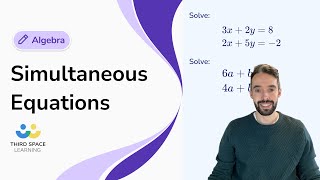
A GCSE-level instructional video (Third Space Learning) teaching how to solve simultaneous equations using elimination and substitution. The presenter demonstrates multiple worked examples (X/Y and A/B notation), including scaling equations to make coefficients match, subtracting/adding to eliminate variables, substituting solved values back, and explains where exam marks are awarded. The video also points viewers to extra online resources and one-to-one tuition in the description.
Chapters
Hi, this is Paul from Third Space Learning and today we're going to look at simultaneous equations. Simultaneous equations are algebraic equations that share variables. For example, X and Y. They're called simultaneous because we solve them simultaneously at the same time. As usual, I'll be using our online classroom to go to the topic and look at some questions. Check out the links at the end of the video for information on loads of free free resources, practice questions and our one to one personalized tuition. Okay, let's have a look at solving simultaneous equations. Grab a pen and let's dive straight in. Simultaneous equations are equations that are solved at the same time. To do that, we need to eliminate one of the variables. So for example, here we can see we have the same number of Y's on the top and the bottom. So let's eliminate them by adding the equations together and then solving it to work out a value for X. Now once we have a value for X, we can substitute that back into one of the original equations, rearrange it and solve it to work out Y. And there we go. We have solved our simultaneous equations. Now you'll notice when we plot those two equations on a graph where they cross or intersect, we get the same values for X. And so there's loads of different ways that we can solve these equations. Simultaneous equations are one of my favorites. So let's have a look at these in a little more detail by going through a few examples. Let's solve this pair of simultaneous equations together. So we need to eliminate one of the variables. And we can see that we've got a B on the top and a B on the bottom. So that's the same number of B's. So we can eliminate them. So let's start by labeling equations. So let's call the top one A and let's call the bottom one B. And because we've got the same number of Bs, to eliminate them, all I'm going to do is subtract these equations. So 18, subtract 14 is 4. Keep the equal sign lined up B. Subtract B is nothing. It's gone. And 6a. Subtract 4a is 2a. So 2a equals 4. And then if we divide both sides by 2, We get A equals 2. So we've worked out A, so that's good. Now we need to work out B. So we're going to substitute this back into one of the original equations and it doesn't matter which one. So let's go for B. So I'm going to substitute A equals 2 into equation B. So let's write out B. So B was 4. A plus B equals 14. So we know that A is 2. So that's going to be 4 lots of 2 plus B equals 14. Now, top tip, make sure that you show this step where you're substituting two into your equation, because there's a mark for that. Let's now work this out. So 4 times 2 is 8 plus B is 14. Well, to get B by itself, we're going to subtract 8 from both sides of the equation. Both sides of that equals. And B equals 14. So subtract 8, which is 6. So there we go. On the answer line, A equals 2 and B equals 6. And if we wanted to double check, we could substitute these back into A or B and it should work out perfectly. Let's see where those marks come from. So we're going to get a 1 mark for attempting to eliminate one of the variables, which is this line here. The second mark comes from correctly substituting in your value into one of the equations. And the final mark is going to come from the final correct answers. 3 marks. Okay, your turn. Pause the video and see how you get on. Best of luck. Okay, let's go through it. So it says, solve these equations. Now, these are simultaneous equations because we're going to solve them simultaneously at the same time. So let's label them A and B. And we need to eliminate one of the variables, either X or y. Now, we can see we've got 3Y on the top and 3Y on the bottom. So let's eliminate those. The only question is, shall we add these equations together or subtract them? Well, let's try subtracting them. 12, subtract 2 is 10. The equal sign is lined up. And then we've got 3Y, subtract negative, 3Y. Now, a negative and a negative make a positive. So this is the same as saying negative 3y add 3y. Which if we think our number line is 0. So we've eliminated those. Let's do 6x take away 4x. Well, that's going to be 2x. And let's now divide both sides by 2 to work out x. So x is equal to 5. So we worked out X. So that's great news. Next job is to work out y. So we need to substitute that back into one of the original equations. So let's substitute it into either A or B. So let's go for a substitute. X equals 5 into equation A. So let's write down equation A equation A says 6x subtract 3y equals 12. Well, X equals 5. So that means that 6 lots of 5 subtract 3y is equal to 12. So 6 times 5 is 30. Subtract 3y equals 12. Now we need to work out Y. So let's get rid of that 30, that's a positive 30. So let's subtract the 30 from both sides of the equal sign. So 30 take away 30 has gone. We've got 3Y on the left hand side and on the right hand side we've got 12, subtract 30, which is negative 18. Now we want to work out just Y. Now negative three Y means negative three multiplied by y. So to undo that, we're going to divide both sides by negative 3. So negative 3y divided by negative 3 is just going to give me 1y because negative 3 divided by negative 3 is 1. And the negative 18 divided by negative 3 going to be positive 6. Because negative divided by negative is a positive. So negative 18 divided by negative 3y is positive 6. Let's write down our answers on the answer line. So x equals 5 and y equals 6. And that is worth 3 marks. We're going to get one mark for correctly eliminating one of the variables, a second mark for for substituting the variable into one of the equations. And the third mark is for both answers fully correct. Let's have a go at this question. So it says solve these simultaneous equations. So let's start by labelling them A and B. Now we have to eliminate one of the variables in order to solve this. But we've got 3x on the top and 2x on the bottom and a 2y on the top and a 4,5y on the bottom. So we don't have the same number on the top and the bottom. So we need to make that before we do anything else. Now, it doesn't matter if we have the same number of x's or y's, so let's make the same number of x's. Let's go for 3x and 2x. Now we need to make these into the same number of X's. So we need a number that 3 and 2 will go into. Well, that's going to be 6, isn't it? So let's turn 3x into 6x. We can do that by multiplying it by 2. So let's multiply the whole equation by 2. 2 times 3x is 6x. 2 times 2y is plus 4y and 2 times 8 is 16. Okay, let's turn the 2x into a 6x. Well, 2x multiplied by 3 is 6x. So let's multiply all of equation B by 3. 2x multiplied by 3 is 6 x 5y multiplied by 3 is positive 15y equals sign lined up. And negative 2 times 3 is negative 6. So we've rewritten our equations and these equations are exactly the same. We're going to end up with the same number of X's and Y's. So let's use these two now to solve it. We've got six x on the bottom and on the top. So let's eliminate them. And we're going to do that by subtracting the equations. So let's do 16 subtract negative 6. Well, 16 subtract negative 6. That's the same as an add. So 16 add 6 is 22 equal sign lined up. Now we've got 4Y. So we've got 4Y subtract 15Y. So we're going to go into the negatives here. Well, that's going to give me negative 11y and then 6x take away 6x is 0. So that's gone. So we have negative 11y equals 22. So let's work out Y by dividing both sides by negative 11. So on the left hand side, negative 11 y divided by negative 11 is just 1 y or y. And on the right we've got 22 divided by minus 11 is negative 2. So we have y equals negative 2. So this is good news. Now we need to work out X. So let's substitute this back into one of the original equations. It doesn't matter which one. So let's go for a. So let's substitute y equals negative 2 into equation A. And let's write down equation A. So 3x add 2y is 8. Right, let's substitute y equals negative 2 into here. So we have 3x, add 2 lots of y. And y was negative 2 equals 8. Okay, let's start to work this out. So the 3x we'll keep for now. And 2 times negative 2 is negative 4 equals 8. And all we have to do now is solve the equation. So let's add 4 to both sides. So 3x equals 8 plus 4, which is 12. Then 3x means 3 multiplied by x. So let's divide both sides by 3 to get x equals 4. And there we go. We have our two solutions. X equals 4 and y equals negative 2. Now let's see where those marks come from. We're going to get one mark for Working out the same number of variables. So in this case, we, we've got six X, but we could have done the Y's instead and we would still get the same answers. The second mark comes from correctly eliminating one of the variables. Third mark is for substituting it into one of the equations. And the last mark is for both of our final answers. X equals 4 and y equals negative 2. Your turn. Pause the video and have a go. Take it step by step and we'll go through it together in just a moment. Let's go through it. Let's start by labeling them A and B. Now, in order to solve a pair of simultaneous equations, we need to eliminate one of the variables. Well, we notice we've got different A's and different B's here. So let's make the B's the same because that's going to be the easiest. This is good news for us because it means that A stays exactly the same. So 3a plus 2b equals 23. Now, let's take the second equation and we want to turn B into 2b. Well, we can do that by doubling it by multiplying by two. So we need to multiply the entire second equation by two. So 2 times 2a is 4a, 2 times negative b is negative 2b and 2 times 6 is 12. So we've now got the same B. So this is great news. The only question now is do we add them or subtract them in order to eliminate those 2B's? Well, let's try adding them. So 23 add 12 is 35 equal sign lined up. And then I've got 2B. I'm going to add that to negative 2B. So the positive and the negative there gives me a negative and 2b. Take away 2b is zero. So we've eliminated the Bs. So that's good. Now let's do 3a and 4a, which is 7a. Next job. Let's divide both sides by seven. And we get a equals 5. So we've worked out A. Now we need to work out B. And we can do that by substituting it into either of those two original equations. And it doesn't matter which one. So let's do B. Let's substitute A equals 5 into equation B. And equation B was 2A. Subtract B equals 6. So A is 5. So that's going to be two lots of 5. Subtract B equals 6. 2 times 5 is 10. Subtract B equals 6 dot now we need to get B by itself. So let's do that by subtracting 10 from both sides. So on the left hand side we have negative B and on the right hand side we've got 6. Take away 10 is negative 4. Well, negative B equals negative 4. So we divide both sides by negative 1 to get B equals 4. And there we go. We have solved our pair of simultaneous equations. A equals 5 and B equals 4. 4. Let's see where those marks come from. So we're going to get one mark for getting the same variable. So here we've got two Bs on the top and the bottom. So that will give us a mark. However, if you had got the same number of A's on the top and bottom, that would still get you a mark as long as you've done it right. Second mark is for correctly eliminating one of the variables. Third mark is for substituting in the answer E into one of the original equations. And the final mark is for our two answers of A equals 5 and B equals 4. Thanks so much for watching the video. Check out the description below for loads more information on this topic and for access to our library of free online resources and loads of information on our one to one tuition. Don't forget to like and subscribe to stay up to date with all the latest third Space Learning videos.
More from Rob





The Top 20 SATs revision topics 2026: A focused revision approach for maximum impact in minimum time

GCSE maths marking 2026 decoded: using examiner insight to improve teaching and results


How To Embed AI Literacy In Your School: Practical Steps To Get You Started [Webinar Replay]


Reviewing And Planning Your School's AI Approach: A Strategic Framework [Webinar Replay]
