Solving Equations | GCSE Maths | Third Space Learning
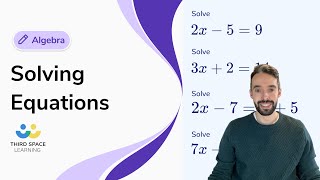
A GCSE-level instructional video (presented by Paul from Third Space Learning) teaching how to solve linear and quadratic equations. It covers: linear equations—definition, isolating the variable using inverse operations, and several exam-style worked examples with marking guidance; quadratic equations—factorisation method for integer roots and the quadratic formula (x = (-b ± sqrt(b^2 - 4ac)) / (2a)), with calculator use and rounding to one decimal place. The video repeatedly prompts viewers to pause and try practice questions and refers to additional resources and one-to-one tuition.
Questions this video answers
Paul (from Third Space Learning).
x = (-b ± sqrt(b^2 - 4ac)) / (2a).
A = 1, B = -2, C = -24.
Chapters
Hi, this is Paul from Third Space Learning and today we're going to look at solving equations. Solving equations allows us to work out the value of an unknown variable in an equation. In this video we'll look at solving linear equations and quadratic equations. As usual, I'll use our online classroom to go through the topic and look at some questions. Check out the links at the end of the video for access to loads of free resources. More more practice questions and information on our one to one personalized maths tuition. Let's have a look at solving equations. Grab a pen and let's dive in. Let's start by solving linear equations. A linear equation is an equation where the variables are raised to a power no higher than 1. In order to solve them, we have to get all of the variables together on one side of the equal sign. And then we can solve it by using inverse operations. So for example, let's solve 3x 6 equals 18. Now this means 3 lots of some number x. Add 6 gives us 18. So to solve it, let's work backwards. Let's start with 18. And we're going to subtract 6 from both sides of the equals. When we do that, we get 3x is equal to 12. Now 3x means 3 multiplied by 12x. So the inverse operation is divide by 3. So we divide by 3 on both sides of the equals. So 3x divided by 3 is x and 12 divided by 3 is 4. So x equals 4 is the solution to our equation. And there we go. We have solved the linear equation. Let's have a look at some examples together. Let's look at this exam question. It says solve 2x, take away 5 equals 9. So this means 2 lots of some number. Subtract 5 is 9. So let's solve this by working backwards. So let's start with this negative five. The opposite of taking away five is adding five. So what we'll do is add five to both sides of the equal sign. That means on the left we're left with 2x and on the right we're left with 9 plus 5, which is 14. Now this means two lots of something is 14. So to work out what that something is, we do the opposite of multiplying by two, which is divide by two. So we divide by two on the left hand side and we divide by two on the right hand side. 2x divided by two is just 1x or x and 14 divided by 2 7. And there we go. X equals 7. Let's see where those marks come from. So we're going to get one mark for an attempt to isolate x on one side of the equal sign. And then the second mark comes from the fully correct answer. Okay, your turn. Pause the video and have a go. Best of luck. Right, let's go through it. So it says solve 3x plus 2 equals 14. So this means 3 lots of something. Add 2 is 14. So to solve this, let's work backwards and let's start by doing the opposite of add 2. Well, that's going to be subtract 2. So we're going to take away 2 from the left hand side and from the right hand side. When we do that, on the left we have 3x and on the right 14 take away 2 is 12. Now 3x means 3 multiplied by x. So to undo that, the opposite of multiplying by three is divide by three. So divide by three on the left hand side and divide by three on the right. Three X divided by three is just X and 12 divided by three is four. And there we go. X equals four. We've solved the equation. The marks come from one mark for an attempt to isolate X on one side. The second mark comes from the answer. So the exam question says solve two x take away seven equals x plus five. Now to solve this, we need to get all the x's on one side of the equals. So a good way to do this is to get rid of the smallest x. Well, we can see 1x on the right and 2x on the left. So the 1x is smaller than the 2x. So let's get rid of that. Let's subtract 1x from the right hand side and also from the left hand side. So the left hand side now becomes x take away 7. Because 2x take away x is 1x is lined up X take away X is zero. So we're just left with five on the right hand side. Next we've got an X on the left which is good. But we've also got a negative seven there which we don't want. So let's get rid of it by doing the opposite, which is add seven. So we'll add seven to the left and add seven to the right. So the left hand side. Now we're just left with x because negative 7 add 7 is 0 equal sign still lined up and 5 plus 7 is 12. So there we go. X equals 12 is our answer. The marks here come from attempting to get the x's on one side of the equal sign. And then the second mark for the final correct answer okay, your turn. Pause the video and have a go. Best of luck. Right, let's go through it. So it says 7x take away 3 equals 4x plus 15. And we're going to solve it to work out what x is. So let's look at all the X's on one side. So it makes sense here to put them on the left because 7x is bigger than 4x. 4x is the smallest number of x's. So let's get rid of it. Let's take away 4x from the right and take away 4x from the left. So 7x take away 4x is 3x. The minus 3 is still there. Equal sign lined up 4x take away 4x is 0. So we're just left with 15 on the right. Right now we've got 3x take away 3 on the left hand side. Now we don't want that negative three, so let's get rid of it. Let's add three to the left hand side and add three to the right. So on the left now we've got 3x by itself because negative 3 add 3 is 0. On the right we've got 15 plus 3, which is 18. Now 3x equals 18. So that means 3 multiplied by something is 18. So to work out that something we do the opposite of multiply by 3, which is divide by 3. So divide by 3 on the left, divide by 3 on the right, 3x divided by 3 is 1x and 18 divided by 3 is 6. So our solution is x equals 6. And let's see where those marks come from. So we're going to get one mark for correct method to get the x by itself on one side. And the second mark comes from the correct answer. Next, let's look at solving a quadratic equation. Now a quadratic equation is an equation that contains variables with powers no higher than 2. And there's lots of different ways we can solve these. Let's have a look at two ways, factorization and using the quadratic formula. So let's solve x squared minus 2 x minus 24 equals 0 by factorization. So if we're going to factorize a quadratic, we need two numbers that will multiply together to give the end number, in this case -24 and add to give the middle number in this case minus two. Well, those numbers will be negative six and positive four. Now for lots of practice on how to do that, check out the link in the description below for our video on factorizing quadratics. Once we factorized it, we get X minus 6 in a bracket and X plus 4 in a bracket, and that equals 0. Now, in between those two brackets, that means multiply. So what we have here is two terms multiplying together to give zero. Now, that tells us something. That tells us that one of those terms must be zero. So either x minus 6 equals 0, in which case x is 6, 6, or x plus 4 equals 0, in which case x equals negative 4. So our solutions are x equals 6 and x equals negative 4. And we solved it. Let's have a go at a couple of these solving quadratics through factorization. The question says solve this quadratic equation. So let's solve it by factorizing. Now, to factorize the quadratic, we need to start by writing down all the factors of 15. So the factors of 15 are 1 and 15 and 3 and 5. And we're after a pair of those that will add to give negative 2. And the same pair need to multiply to give negative 15. So I'm thinking two numbers need to multiply to give a negative answer. That means the signs must be different or one must be positive and one must be negative. So that means the numbers are going to be negative 5 and positive 3. Because if we add those together, negative 5 add positive 3 will get negative 2, and then negative 5 multiplied by positive 3 is negative 15. So those are our numbers, negative 5, positive 3. All we have to do now is open a pair of double brackets. Because X is a variable. We'll put an x at the start of them both, and then we'll put the numbers in. So negative five there and positive three there. And remember, this equals zero because all we've done is we factorized that quadratic. Now we need to solve it. So We've got here two brackets that are being multiplied together to give zero. So when we have two things that are multiplied to give zero, one of them must be zero. Well, that means that either x5 is zero or x plus 3 is zero. Well, if x minus 5 is zero, all we have to do is add 5 to both sides to see that x equals 5. Or if x plus 3 is zero, all we have to do is subtract 3 from both sides to see that x equals negative 3. And there we go. Our two solutions are x equals 5 and x equals negative 3. And let's see where those marks come from. Well, we're going to get one mark for a correct attempt to factorize. And then the second mark comes from both of our answers. Right, your turn. Have a go at this question. Best of luck. And we'll go through it in just a sec. Right, let's go through it. So it says solve this quadratic. So let's do it by factorizing. So again, let's start by writing the factors of this n number 20. So it's going to be 1 and 20, 2 and 10, 4 and 5. And we need a pair of numbers that will multiply to give negative 20. And the same pair need to add to give negative one, because remember, that's a negative one as the coefficient of x. Well, because we're multiplying to give a negative answer, the signs must be different. A positive times a negative is a negative. So let's choose our pair. So it's going to be this two here, four and five. And it's going to be negative five and positive four. Because if we add those together, thinking of the number line, we're going to get negative one, which is what we want, that middle number. And if we multiply those together, we're going to get negative 20, which is what we want, the N number. So our numbers are negative 5 and positive 4. So let's open up a pair of double brackets. Because the variable is X, we'll put an X at the start of one and at the start of the other one. And then we'll put those numbers in. So negative five and positive four. And remember, that equals zero. Now, we factorized it, but we need to solve it. So we've got two brackets here that are multiplying together to give zero. Well, when we have two things that multiply to give zero, one of them must be zero. So that means either X take away five equals zero or X add four equals zero. If X takes away five equals zero, all we have to do is add five to both sides and we get X is equal to 5, 5. If x plus 4 equals 0, all we have to do is take away 4 from both sides and we get x equals negative 4. So our solutions are x equals 5 and x equals negative 4. And let's see where those marks come from. So we're going to get one mark for a correct method to factorize and a second mark for for our two correct values of x. Now let's try solving the same quadratic using the quadratic formula. The quadratic formula is X equals minus B plus or minus the square root of B squared minus 4ac all over 2a where A is the coefficient of the X squared. So in this case A equals 1, B is the coefficient of the x. So in this case A, B equals negative 2 and C is the constant term. So in this case, C equals negative 24. All we have to do is substitute those values carefully into the quadratic formula. Now, you'll notice that there is a plus minus there. That means we have to do the calculation once with the plus and then once with the minus. If we do it with the plus, we get X equals 6. And if we do it with the minus, we get x equals negative 4, which we notice is the same answers we got when we factorized it. So either method here is absolutely great. But sometimes factorizing will be easier than using the quadratic formula. So let's have a look at a few examples together to see how to spot when to use which method. So the question says, solve this quadratic equation. Now, there's lots of different ways that we can solve quadratics. We can factorize some of them, or we can use the formula. And the formula will always work. Now, because this says give the answer to one decimal place, that tells me we're probably going to need to use the quadratic formula. So let's write it down. It says that X is equal to negative B plus or minus the square root of B squared -4 AC all over 2A. And let's write down what A, B and C are. Well, A is equal to one because it's the coefficient of the x squared term. B is equal to negative 5 because it's the coefficient of the x term. And C is equal to negative 8 because it is the constant term. Once we've identified A, B and C, let's very carefully substitute them into the formula. So X is equal to minus B. So it's minus whatever B is minus 5 plus or minus the square root of B squared. Well, B is negative 5, so that's negative 5 squared. Take away four lots of A, which is 1, multiplied by C, which is negative 8, and let's all divide that by two lots of whatever A is and A is 1. Now, we can use this. Now, we can solve this with our calculators. So at this point, this can go straight into the calculator. But it might be an idea just to simplify a few of these negatives first. So X is equal to. Well, minus minus five is positive five plus or minus the square root of negative five squared is negative five times negative five, which is 25. And here we've got negative four times one times negative eight. Well, a negative four and a negative eight multiplied together give me a positive. So we're going to have plus 32. And we're going to divide that all by two times one, which is two. Now that steps optional. I just find it a little easier to see when I put it into the calculator. Now we have to do this twice. We're going to put this into the calculator, once using a plus and once using a negative. So let's start by writing down the fraction button on our calculators. And we're going to have 5 the square root of 25 32 on the numerator and on the denominator using the arrow buttons, we're going to divide that by 2, so we get 6.12749 or 6.3 to one decimal place. Let's try using the negative version now. So again, fraction button on the calculator, I'm going to say five, subtract the square root of 25 plus 32 on the numerator. And using the arrow buttons, the denominator, we're going to divide that by two. So the answer negative 1.274, which means when I round it to one decimal place, it's minus 1.3. And there we go. There is our final answer. And let's see where those marks come from. So we're going to get one mark for correctly substituting all the values into the quadratic formula. The second mark is for a correct method to achieve one of our answers. And the final mark comes from both answers fully correct. Okay, your turn. Pause the video and have a go. Best of luck. Right, let's go through it. So it says solve the quadratic equation. And it says to give the answer to one decimal place. So this is our clue that we're probably going to need to use the quadratic formula rather than factorizing. So let's write it down. The quadratic formula says X is equal to negative B plus or minus the square root of B squared minus 4ac, all divided by 2a. And let's write down our A, B and C. So A is equal to 2 because it's the coefficient of the x squared term. B is equal to 5, positive 5 because it's the coefficient of x. And C is equal to three positive three because it is the constant term. Once we have our values, let's substitute them in to the quadratic formula, taking great care. So X is equal to minus B, which is negative 5 plus or minus the square root of B squared. Well, B is 5, so it's 5 squared. Take away four lots of whatever A is. A is 2 multiplied by whatever C is, or C is 3. And we're going to divide all of that by 2, lots of A and A is 2. Now we can put this straight into the calculator, but we might want to just do a little bit of work first, just so it looks a little bit neater. So we've got negative 5 plus or minus. The square root of, well, 5 squared is 5 times 5, so that's 25. Then we've got minus 4 times 2 times 3. Well, 4 times 2 times 3 is 24. So negative 4 times 4 times 2 times 3 will be negative 24. And we're going to divide that by 2 times 2, which is 4. Right now we have a plus and the minus sign. So we have to do this twice, once with a plus and once with a minus. So let's do it. It's a good idea to use the fraction button on the calculator. So on the numerator let's put negative 5 plus the square root of 25, take away 24. And on the bottom there we've got 4. So when we do that, X is equal to negative 1. Now let's do it with a negative. So we've got X. Using our fraction button, negative 5, subtract the square root of 25, take away 24. And on the bottom we've got 4. And we get X is equal to negative 1.5. And there we go. We have correctly answered our quadratic equation. Let's see where those marks come from. So one mark comes from substituting the values into the quadratic formula. One mark comes from a fully correct method to achieve an answer and the final mark comes from Both correct answers. 3 marks. Thanks so much for watching the video. Check out the description below for loads more information on this topic and for access to our library of free online online resources and loads of information on our one to one tuition. Don't forget to like and subscribe to stay up to date with all the latest third Space learning videos.
More from Rob





The Top 20 SATs revision topics 2026: A focused revision approach for maximum impact in minimum time

GCSE maths marking 2026 decoded: using examiner insight to improve teaching and results


How To Embed AI Literacy In Your School: Practical Steps To Get You Started [Webinar Replay]


Reviewing And Planning Your School's AI Approach: A Strategic Framework [Webinar Replay]
